
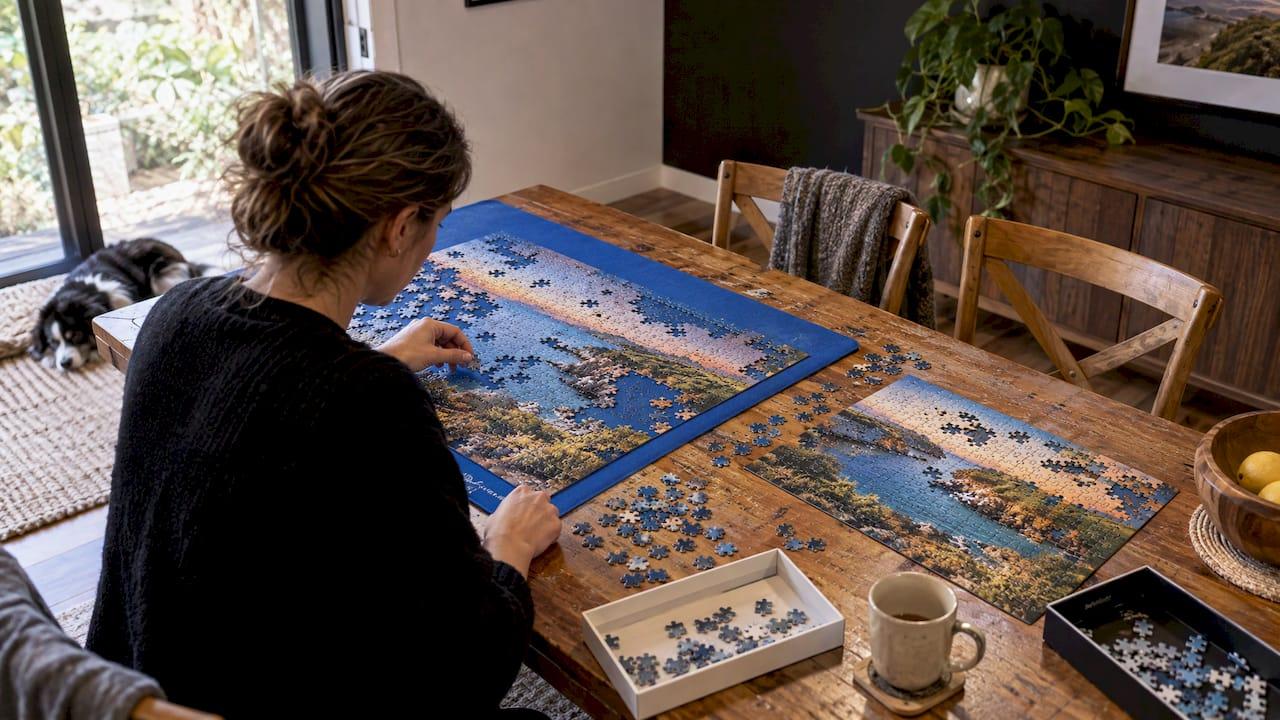
Choose 1,000 pieces if you want a satisfying puzzle you can finish over a weekend or a few evenings on an ordinary dining table. Choose 2,000 pieces if you enjoy long projects, have a dedicated surface and want a bigger, more immersive image. Doubling the piece count does not double the effort: most puzzlers find it closer to four times the challenge, and the finished picture is roughly 25 to 30 percent wider than a 1,000-piece one.
TL;DR
- Time: logged solves put the median at about 3 hours 14 minutes for 1,000 pieces and about 10 hours 48 minutes for 2,000, so roughly three to four times as long.
- Difficulty: the number of possible piece pairings grows with the square of the piece count, which is why 2,000 pieces feels much harder than twice 1,000.
- Space: a typical 1,000-piece puzzle finishes at about 68 × 50 cm; a 2,000-piece puzzle at about 86 × 61 cm. Plan a surface larger than the finished size.
- Image matters as much as count: a detailed landscape with varied colors is far kinder than a sky, a sea or a single-color field.
- Best pick: 1,000 for most households and gifts; 2,000 for experienced solvers with a permanent table.
Table of Contents
- How much harder is 2,000 pieces than 1,000?
- How long does each size take?
- Table space: the constraint nobody plans for
- Do 1,000-piece puzzles have exactly 1,000 pieces?
- The image changes the answer
- How to choose: a short decision guide
- A note on price
- Our perspective
- Give the gift of a landscape you can hold
- FAQ
- Sources
How much harder is 2,000 pieces than 1,000?
It is about four times harder, not two. The reason is simple arithmetic. Each piece can be tested against many others, so as the pile grows, the number of possible comparisons grows much faster than the pile itself. One mathematical model of jigsaw search estimates around 499,759 steps for 1,000 pieces and 1,998,500 for 2,000, a ratio of about four. A separate worked calculation of connections and comparisons reaches the same ratio of roughly 4×, counting 1,935 connections in a 1,000-piece puzzle against 3,910 in a 2,000-piece one.

These are models, and real solving is helped by edges, colors and patterns, which cut the search down. But they match what puzzlers describe: the second thousand pieces are not the same job as the first. Early in a 1,000-piece puzzle you find matches quickly. In a 2,000-piece puzzle, sorting takes longer, the middle section stretches out and the final few hundred pieces demand patience.
There is a happy side to this. The larger puzzle gives you more of everything you like about puzzling: more quiet evenings, more small wins and more of the image to explore as it appears.
How long does each size take?

Real solving times are the most useful guide, because they come from people at a table rather than from formulas. MySpeedPuzzling's recorded solves show a median active time of 3 hours 14 minutes for 1,000 pieces, with the middle half of solvers finishing between 2 hours 25 minutes and 4 hours 28 minutes. For 2,000 pieces, the median is 10 hours 48 minutes, with the middle half between 8 hours 5 minutes and 14 hours 34 minutes. Keep in mind that people who log their times tend to be keen, practiced puzzlers, so a relaxed home solver may take longer.
A guide to 2,000-piece puzzle timing gives wider ranges: 10 to 18 hours for an experienced solver, 15 to 25 hours for an average one, and 25 hours or more for a tough image such as sky or sea, usually spread across several sessions.
| 1,000 pieces | 2,000 pieces | |
|---|---|---|
| Median logged time | 3 h 14 min | 10 h 48 min |
| Middle 50% of solvers | 2 h 25 min to 4 h 28 min | 8 h 5 min to 14 h 34 min |
| Typical finished size | about 68 × 50 cm (27″ × 20″) | about 86 × 61 cm (34″ × 24″) |
| Best for | a weekend, a gift, a shared table | a long project, a permanent puzzle surface |
In practice, a 1,000-piece puzzle fits into two or three evenings. A 2,000-piece puzzle is a project of a few weeks for most people who puzzle after work, and a holiday-week activity for those who like to dive in.
Table space: the constraint nobody plans for
Size is where many people are caught out. Typical finished dimensions, according to a puzzle sizing guide, are 27″ × 20″ (68 cm × 50 cm) for 1,000 pieces and 34″ × 24″ (86 cm × 61 cm) for 2,000 pieces. Brands vary by a few centimeters either way, so check the box.
The finished size is only part of the story. You also need room for the box lid, sorted trays and pieces you have not placed yet. A good rule is to allow roughly 20 to 30 percent more surface than the finished puzzle.
- 1,000 pieces: most dining tables work. A 90 × 60 cm surface is comfortable.
- 2,000 pieces: you want something near 120 × 80 cm, or a portable board you can slide under a bed or onto a shelf between sessions.
- Households with pets, children or a table you eat at: a board with a lid or a spare table makes the 2,000 size far more practical.
If you have the space only on some days, 1,000 pieces is the happier choice, because you can finish before you need the table back.
Do 1,000-piece puzzles have exactly 1,000 pieces?
Not always. Manufacturers cut the puzzle to keep the picture's proportions, so the number on the box is a nominal figure. The same sizing guide notes that a puzzle sold as 1,000 pieces might actually contain 1,026 to keep the correct aspect ratio. The same applies at 2,000. A few pieces more or less makes no real difference to the experience, but it is a good reason not to panic if your count comes out slightly different.
The image changes the answer
Piece count is only one of the things that make a puzzle hard. A 1,000-piece image of a clear blue sky can be tougher than a 2,000-piece image of a busy market. When you choose a size, look at the picture first:
- High-detail scenes with many colors and objects are the friendliest at 2,000 pieces, because you can sort by color and subject.
- Large areas of one tone, such as sky, water, snow or sand, slow everyone down. Pair these with the smaller size until you know your pace.
- Landscape photographs vary a great deal. A coastline with a calm sea behaves very differently from a forest or a rocky ridge. We break this down in four factors that reveal landscape puzzle difficulty.
If you are choosing a puzzle made from a photograph, the quality of the original file matters too. Our checklist on choosing a photo puzzle covers zoom checks, cropping and resolution so a bigger puzzle still looks sharp.
How to choose: a short decision guide
Ask yourself these questions in order.
- Where will it sit? If you cannot leave a puzzle out for at least two weeks, pick 1,000.
- How much time do you have per session? One to two hours a night suits 1,000 pieces. Longer sessions and weekends suit 2,000.
- How experienced are you? If you have finished several 1,000-piece puzzles and want more, 2,000 is a natural step. If you are new, start at 500 or 1,000.
- Are you puzzling alone or with others? Two or three people sharing a 2,000-piece puzzle make it feel like a 1,000-piece one. Solo, it is a long haul.
- Is it a gift? A 1,000-piece puzzle is the safer choice unless you know the recipient already enjoys big ones.
- Will you frame it? A larger puzzle makes a bolder wall piece, but check that your wall and frame suit the dimensions. Our wall art size guide helps you judge scale.
Tips for stepping up to 2,000 pieces
- Sort the edge pieces first, then sort the rest by color or pattern into shallow trays.
- Work in zones rather than scanning the whole pile.
- Use good, even light, and keep the box image in view.
- Stop at a natural breakpoint, such as a finished section, so you start the next session with momentum.
A note on price
Prices vary by brand, material and image, and a larger puzzle usually costs more because it uses more board and printing. We do not publish a price for our jigsaw puzzles in this guide, so check the current range on our site when you are ready to buy.
Our perspective
We make our puzzles from landscape photographs that Mark has taken on panoramic medium format film and digital cameras, so the source image is rich in detail from edge to edge. That matters at any piece count, and it matters most at 2,000 pieces, where every part of the picture has to give the solver something to read.
Our advice is to match the size to the way you like to spend time. A 1,000-piece puzzle is a generous, complete experience: an image with enough variety to reward a few evenings of focus. A 2,000-piece puzzle is an event, and it suits a scene with plenty of texture, such as a rugged coast, a forest or a mountain at dawn.
Whichever you choose, pick an image you will enjoy looking at for hours. The best puzzle is the one you want to see finished.
Mark
Give the gift of a landscape you can hold
Our gift range includes jigsaw puzzles made from Mark Gray's award-winning landscape photography, alongside acrylic blocks and gift certificates. If you are buying for a puzzler and unsure of the size, a gift certificate from AUD 50 lets them choose the image and format they like. Acrylic blocks are priced at $295 each, plus $24.95 postage and handling within Australia or $74.95 internationally, on our acrylic blocks page.

If you enjoy a landscape for longer than an evening, explore our limited edition prints, or start at Mark Gray Gallery to see the full collection.
FAQ
Is a 2,000-piece puzzle twice as hard as a 1,000-piece puzzle?
No, it is usually closer to four times as hard. Models of piece-matching put the ratio at about four, and logged solve times show a median of roughly 3 hours 14 minutes for 1,000 pieces against 10 hours 48 minutes for 2,000. The image and your experience can move this either way.
How big a table do I need for a 2,000-piece puzzle?
The finished puzzle is typically about 86 × 61 cm (34″ × 24″), so you need a surface of around 120 × 80 cm to hold the puzzle plus sorted pieces. A portable board is a good alternative if you need to clear the table between sessions.
Do 1,000-piece puzzles have exactly 1,000 pieces?
Often they do not. Makers adjust the count slightly to preserve the image's proportions, so a box marked 1,000 can hold a few more, for example 1,026. The difference does not change how the puzzle feels to solve.
Should a beginner start with 2,000 pieces?
It is better to build up. Start with 500 or 1,000 pieces, pick an image with plenty of detail, and move to 2,000 once you are comfortable sorting and working in sections. Puzzling with a partner or family is a good way to try the bigger size sooner.
Sources
- Mathematics of Jigsaw Puzzles, Jigsaw Puzzle Hobby
- How Much Harder Is a 2000 Piece Jigsaw Than a 1000 Piece Jigsaw, Bournemouth Maths Tutor
- How Long Does a 1000 Piece Puzzle Take, MySpeedPuzzling
- How Long Does a 2000-Piece Puzzle Take, Daily Jigsaw
- Jigsaw Puzzle Sizes: A Complete Guide, My Puzzle Day