
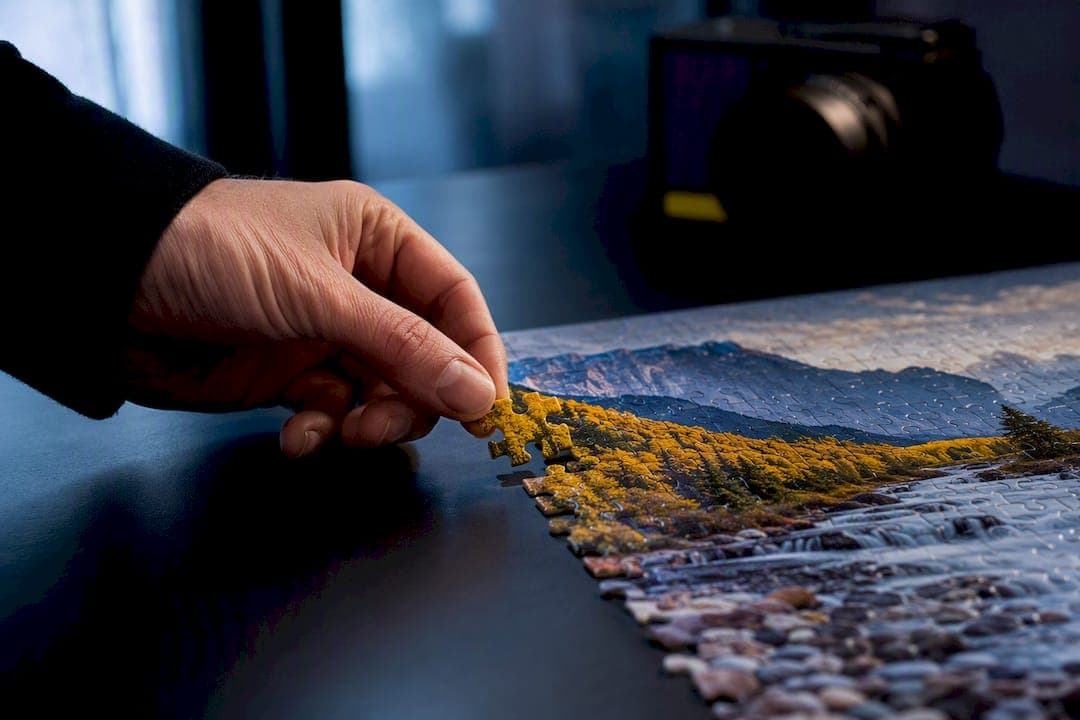
Pick a high-resolution, well-lit photo with a clear focal point and varied tones. That combination is what separates a puzzle that prints beautifully from one that turns out flat or blurry. Before uploading anything, run the zoom test and match your piece count to how busy the image actually is. Everything below walks through both.
TL;DR:
- Use the zoom test to ensure your photo shows no blur, noise, or compression at 100%, as flaws will magnify when printed at puzzle size.
- Choose images with contrast and texture spread across the frame, avoiding large uniform color blocks that can frustrate solvers.
- Match puzzle piece count to image complexity and the builder’s skill level, with 300 for beginners and 1,000 for highly detailed or experienced users.
- Export your photo as a JPEG in sRGB profile at high resolution, cropping to the puzzle's aspect ratio and keeping key details inside the safety margin.
- Verify that the final pixel dimensions meet the puzzle service’s minimum requirements, and check the preview before placing your order.
Table of Contents
- Choosing a Photo Puzzle: Image Quality and the Zoom Test
- Picking a Composition That Solvers Will Enjoy
- Matching Piece Count to Photo Complexity and Who's Building It
- Preparing Your File: Aspect Ratio, Format, and Bleed Margins
- Final Checks Before You Hit Order
- A Photographer's Take on Photos That Print Beautifully
- Material and Puzzle Type: Cardboard, Wood, and Plastic
- Why Brand Reputation and Quality Assurance Matter
- Size Dimensions and How They Change the Build and Display
- Personalization Options Worth Considering
- What Photo Puzzles Typically Cost
- Why the Right Photo Turns a Puzzle Into a Keepsake
- How Com Can Help You Get It Right
- Sources
Choosing a Photo Puzzle: Image Quality and the Zoom Test
Before you fall in love with a photo, check whether it can survive being printed at puzzle size. The most reliable method is the zoom test: open the original file on your computer and view it at 100%. If you spot blur, noise, or blocky compression at that zoom level, those flaws will be magnified once the image is stretched across a 500 or 1,000 piece grid.
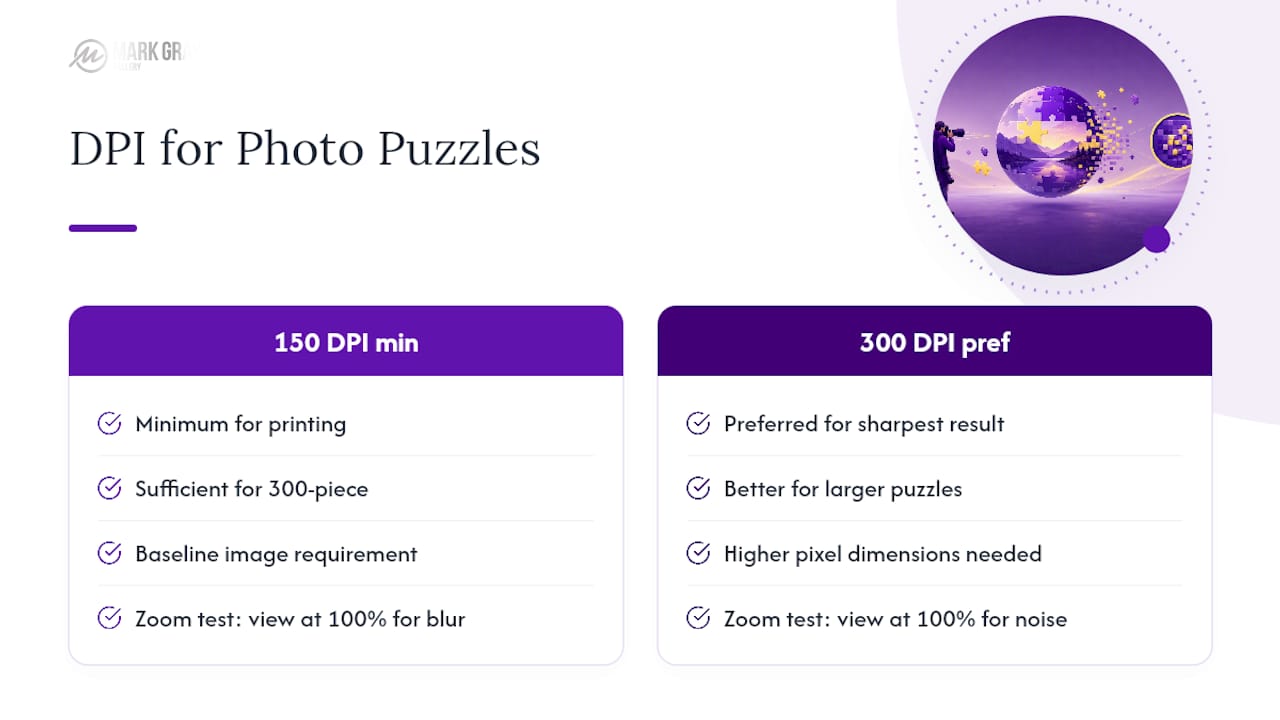
DPI is the other half of the equation. Aim for 150 DPI at minimum, with 300 DPI preferred for the sharpest possible result. In practical terms, a 300-piece puzzle needs image dimensions that align with a minimum of 150 DPI at the finished size, and a 1,000 piece puzzle requires correspondingly higher pixel dimensions for sharpness.
Pro Tip: Skip anything downloaded from Instagram, Facebook, or a text message thread. Those files are compressed on the way out, and the detail loss is often invisible on a phone screen but obvious once printed. Go back to your camera roll or cloud backup for the original.
Most phones from the last several years shoot at 12 megapixels or higher, which is usually plenty of resolution for standard puzzle sizes. The bigger risk is capture sharpness and compression, not raw pixel count. Export the full-size JPEG directly from your camera app or photo library, never a screenshot of it.
Picking a Composition That Solvers Will Enjoy
A puzzle image needs to work twice: once as a photo and once as a 500 or 1,000-piece problem someone has to solve at a kitchen table. Photos with a strong focal point and detail spread across the frame give solvers visual landmarks to sort pieces by, which is exactly what makes a puzzle satisfying rather than frustrating.
Large uniform patches, wide-open sky, a plain wall, a blown-out beach, cause the opposite effect. Dozens of pieces look nearly identical, and solvers end up flipping the same handful of edges over and over with no reference point.
When picking or cropping your photo, keep these guidelines in mind:
- Favor images with texture and contrast distributed across the whole frame, not concentrated in one corner.
- Avoid large blocks of a single color, like flat sky, snow, or water, covering more than a third of the shot.
- Crop to trim dead space at the edges while keeping faces, horizons, and key details away from the very border.
- Family portraits, textured landscapes, and busy cityscapes tend to outperform minimalist or single-subject shots.
Matching Piece Count to Photo Complexity and Who's Building It
Piece count and image complexity have to move together. A photo packed with detail, a market street, a forest canopy, a group photo of fifteen people, can support a 1,000 piece cut because there's enough visual information to fill every piece. A simpler image, a single mountain against a clean sky, gets muddy and repetitive at that same piece count.
Recipient matters just as much as the image itself:
- 300 pieces: best for children, beginners, or simpler images with a few large shapes.
- 500 pieces: a solid middle ground for casual adult builders and moderately detailed photos.
- 1,000 pieces: suited to enthusiasts and highly detailed images, group shots, landscapes, cityscapes with texture throughout.
A plain sunset over open water stretched into a 1,000 piece puzzle is a common mismatch. There aren't enough distinct shapes to guide the build, and the experience turns tedious fast. If you're ordering for a mixed group of skill levels rather than one person, size up one tier from what you'd normally pick. A little extra challenge age gracefully; a puzzle that's too easy gets abandoned in twenty minutes.
Preparing Your File: Aspect Ratio, Format, and Bleed Margins
Puzzle sizes come in fixed aspect ratios, and your photo rarely matches one exactly. You'll generally choose between cropping to fit or adding a border, and cropping almost always looks cleaner because a hard border can feel like an afterthought on a finished puzzle.
Stick with JPEG for photographic images and export in the sRGB color profile, which is what most print services expect on upload. Avoid PNG or TIFF unless a service specifically asks for it, since JPEG balances quality and file size well for this kind of printing.
Every print run also needs a bleed and safety margin, typically around 0.25 inches or 5 to 10% of the image edge. Keep faces, text, and anything essential inside that zone so nothing gets trimmed off during manufacturing.
A simple pre-upload workflow:
- Locate the original, full-resolution file, not a shared or downloaded copy.
- Convert to JPEG if it's in another format, and export at maximum quality.
- Crop to the puzzle's aspect ratio, keeping key details clear of the outer 5 to 10%.
- Rename the file clearly so you upload the right version.
Pro Tip: Photographers who shoot with print in mind leave breathing room around the subject in-camera rather than cropping in tight later. It preserves both resolution and framing options when the aspect ratio doesn't match perfectly.
Final Checks Before You Hit Order
Then preview the crop at your chosen puzzle size to confirm faces and important details land inside the frame.
Before confirming your order, double check the following:
- Pixel dimensions meet or exceed the service's minimum for your chosen piece count.
- You're uploading the original file, not a resaved or shared copy.
- The service's preview tool shows the crop and colors the way you expect.
- For anything borderline, contact support and ask before printing.
If an image looks marginal even after checking, two fixes usually solve it: adjust the crop to cut out the softest or most compressed section, or drop to a smaller piece count so the same resolution stretches less per piece.
A Photographer's Take on Photos That Print Beautifully
Lighting decides more than most people expect. Even, natural light holds onto color nuance and texture that flat, harsh lighting simply erases before the file ever reaches a printer. A photo shot at midday with blown highlights loses shadow detail that no amount of cropping recovers.
For a large-format puzzle meant to be framed afterward, a professionally shot image is worth the investment over a smartphone snapshot, since professional composition and exposure control hold up at scale in ways casual shots rarely do. In the field, that means composing with the edges in mind from the start, not cropping in after the fact, and exposing for shadow detail rather than a bright screen preview.
Material and Puzzle Type: Cardboard, Wood, and Plastic
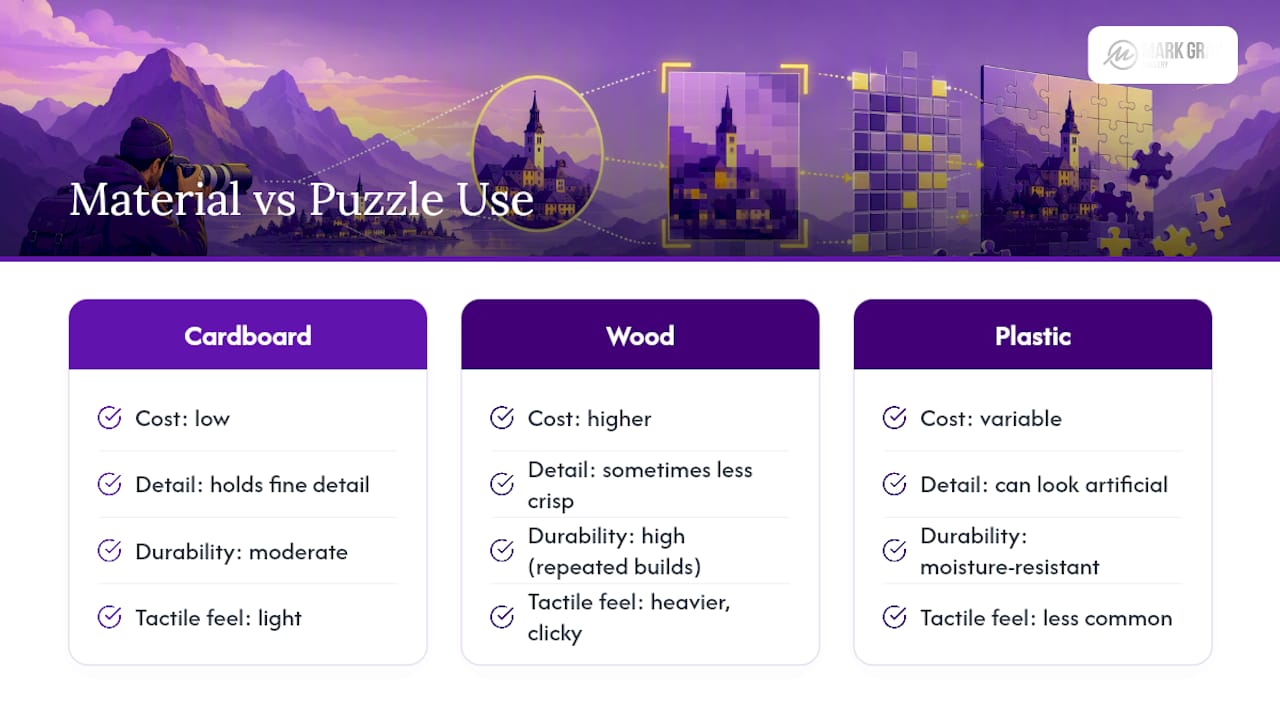
Once the photo itself is sorted, the physical build matters almost as much. Cardboard is the standard choice across the puzzle industry, and for good reason: it holds fine detail well, keeps costs reasonable, and suits most photo puzzles destined for casual family builds or one-time keepsakes.
Wood puzzles feel different in the hand, heavier, with a satisfying click when pieces lock together, and they tend to survive repeated builds better than cardboard. The tradeoff is usually price and, occasionally, a slightly less crisp image reproduction depending on the manufacturing process. Wood suits gift-giving occasions where the puzzle itself, not just the photo, is meant to feel like an heirloom.
Plastic puzzles are less common in the photo-puzzle space but show up in specialty or outdoor-use products, where moisture resistance matters more than tactile feel. They're worth considering if the puzzle will travel or see rougher handling, though the image finish can look slightly more artificial under close inspection.
For most gift-giving purposes, cardboard remains the safe, versatile default, particularly when the goal is preserving a sentimental photo rather than creating a display object meant to last decades. Whichever material you land on, confirm the piece thickness and finish (matte versus glossy) before ordering, since a glossy finish can introduce glare that makes fine detail harder to see under indoor lighting.
Why Brand Reputation and Quality Assurance Matter
Not every puzzle provider checks your file before printing it, and that gap shows up in the finished product. A service that flags low-resolution uploads, offers a crop preview, or has a support team willing to look at a borderline image before it goes to print saves you from an expensive surprise.
Reputation in this category comes down to a few checkable things: how the company handles image review, whether the printed colors match what you saw on screen, and how they respond if something goes wrong. Look for services that show sample photos of their actual print quality rather than stock illustrations, and read recent reviews specifically mentioning image sharpness rather than just shipping speed.
A gallery or photography-led business bringing puzzle products to market has an advantage worth noting here: the same standards used for fine art print quality tend to carry over into how a photo is checked and prepared before it becomes a puzzle. That's a different quality bar than a purely mass-market print shop, where the puzzle is one of hundreds of product categories rather than an extension of a print-quality reputation already built elsewhere.
Size Dimensions and How They Change the Build and Display
Physical size affects both how a puzzle plays and how it looks once it's framed or displayed. A 300 piece puzzle typically finishes around 18 by 24 inches, quick to build in an afternoon and easy to frame on a standard wall. A 1,000 piece puzzle often finishes closer to 20 by 27 inches or larger, demanding more table space and multiple sessions to complete.
Larger finished sizes also mean each piece carries less of the image, which is where the earlier resolution guidance stops being optional. A photo that looks sharp at 300 pieces can look soft at 1,000 simply because the same pixel information is spread across a bigger surface with more, smaller pieces.
Display intentions should factor into your size choice too. A puzzle meant to be built once, then glued and framed as wall art, benefits from a larger size with more visual detail to reward a close look. A puzzle meant for repeat family game nights is often better off smaller and quicker to finish, since the goal is the shared activity rather than the finished piece as decor.
Personalization Options Worth Considering
Most photo puzzle providers now offer some level of customization beyond the image itself. Custom box printing, using the same photo or a different one on the packaging, turns the puzzle into a presentable gift straight out of the shipping box, without extra wrapping needed.
Some services also let you add text, a name, a date, a short message, either on the box or as a printed border around the puzzle image. That's worth considering for occasions like anniversaries, retirements, or memorial gifts where the sentiment matters as much as the picture.
Packaging quality is easy to overlook until the puzzle arrives in a flimsy plain box that undercuts an otherwise great photo. If you're buying as a gift, prioritize providers who treat the box and presentation as part of the product, not an afterthought bolted onto a bulk-printed puzzle.
What Photo Puzzles Typically Cost
Pricing scales mostly with piece count and material, not brand alone. Basic cardboard puzzles in smaller piece counts sit at the lower end of the market, while larger piece counts, wood construction, or premium packaging push the price upward.
Value comparisons should weigh more than the sticker price. A cheaper puzzle that arrives with a soft, poorly cropped image is a worse deal than a slightly pricier one that went through proper file review before printing. Ask whether a provider checks your upload for resolution issues before charging you, since that single step often determines whether the finished puzzle matches what you expected on screen.
Why the Right Photo Turns a Puzzle Into a Keepsake
The photos people regret choosing are almost always the ones picked for sentiment alone, with no thought to how they'd hold up printed. I'd rather see someone pick a slightly less perfect memory that happens to be sharp, well-lit, and full of visual variety than a beloved but blurry phone snap that turns muddy once it's stretched across a puzzle board.
Get the technical checks right first. The sentiment takes care of itself once the print quality is there. If you want a second opinion on a photo before you commit, our gifting guide walks through more of that balance, and we're always happy to help directly.
— Mark
How Com Can Help You Get It Right
The gift range grew out of the same standards used across the gallery's landscape photography prints, and that includes the jigsaw puzzles in the collection. Every custom photo puzzle benefits from careful attention to catch resolution problems, color shifts, and framing issues before they ever reach a printer.
Choosing the right photo is only half the job. Getting it checked properly before it's printed is what actually protects the final result, especially for a puzzle meant to be framed or kept as a lasting keepsake rather than pulled apart after one build. The gift range pairs that pre-print attention with packaging built for gifting, not just shipping.
If you're weighing whether a photo is puzzle-ready, or you want a gift that holds up to a high quality standard, visit the Mark Gray gallery to browse the puzzle and gift range and get a straightforward answer on your image before you order.
Sources
- How to Choose the Best Photo for a Custom Jigsaw Puzzle – Pix on Puzzles
- Photo to Jigsaw Puzzle: Prep and Print Your Image — Pixotter
- What is the recommended image resolution? — PuzzleYou
- Creative tips and insights — Smart-Press