
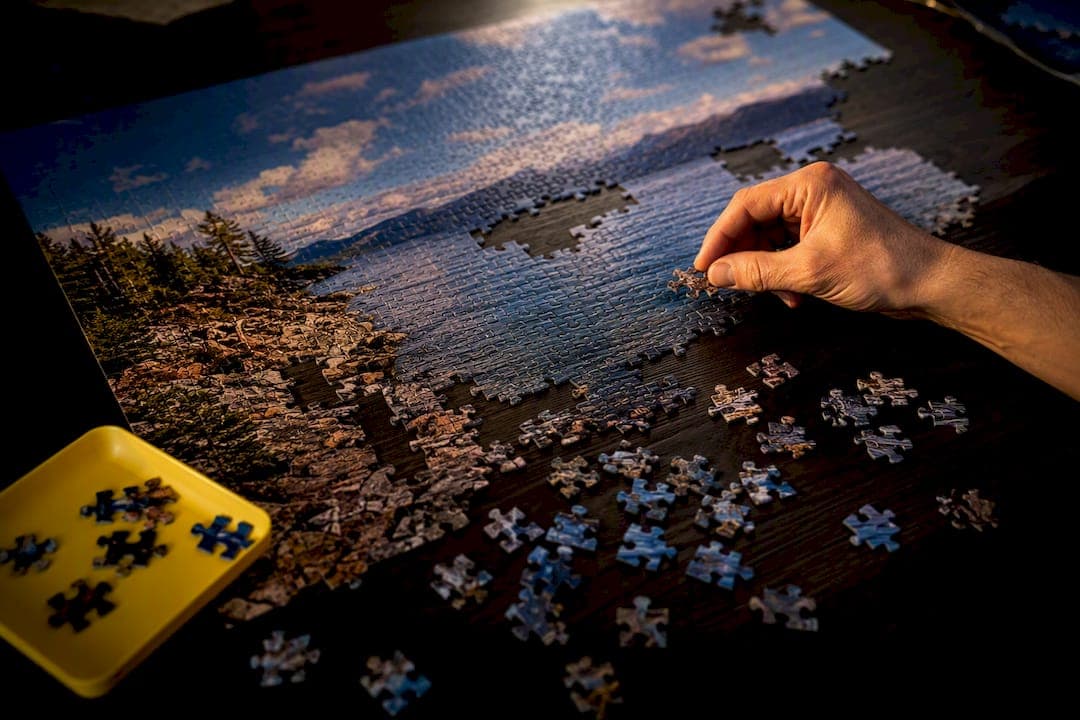
Landscape jigsaw puzzle difficulty comes down to four things working together: the image's visual anchors, piece count and size, cut style, and print quality. Piece count alone is a weak predictor. A 500-piece puzzle of a foggy mountain lake can outlast a 1,000-piece harbor scene stacked with boats and rooftops. The sections ahead break down each factor and show how to size up a box before you buy it.
TL;DR:
- Uniform areas like open sky, calm water, and dense foliage significantly increase puzzle difficulty by removing visual anchors.
- High contrast in images with defined objects accelerates solving, while low contrast and repetitive textures slow progress regardless of piece count.
- Random or whimsy cut puzzles heighten tactile and shape challenges, often making large-gradient areas more complicated compared to standard ribbon cuts.
- Better print quality with sharp colors and tight piece tolerances reduces false fits and helps distinguish subtle color shifts, easing the solving process.
- Matching puzzle difficulty to experience involves choosing images with clear zones and strong anchors, avoiding overly monotonous or low-contrast scenes.
Table of Contents
- What Makes Landscape Jigsaw Puzzle Difficulty So Unpredictable
- Piece Count, Piece Size, and Finished Dimensions
- Image Complexity, Color, and Repetition in Landscape Scenes
- Cut Style and Piece Shape: Ribbon, Random, and Whimsy Cuts
- Material and Print Quality: The Overlooked Difficulty Factor
- Solver Strategy: Lighting, Sorting, and Pacing
- A Photographer's View on What Changes Puzzle Difficulty
- Choosing the Right Difficulty for Your Age Group and Experience
- Why Some Solvers Chase Difficulty and Others Avoid It
- Landscape Photo Puzzles Built Around Compositional Anchors
- Sources
- FAQ
What Makes Landscape Jigsaw Puzzle Difficulty So Unpredictable
Difficulty is never one number. It is the product of several factors multiplying against each other, which is why piece count is a useful first-pass signal but not an absolute predictor. A high piece count combined with repetitive texture, such as a wheat field or a pebble beach, compounds into a genuinely hard build. That same piece count paired with a busy market scene full of distinct objects solves much faster.
Landscapes carry their own predictable choke points:
- Open sky, especially at dawn or dusk when color shifts are subtle
- Still water, where reflections blur the line between sky and surface
- Dense foliage, where thousands of leaves read as one repeating texture
Before buying, scan the box art for these zones. If you can already tell where you will get stuck, you know roughly what you are signing up for.
Piece Count, Piece Size, and Finished Dimensions
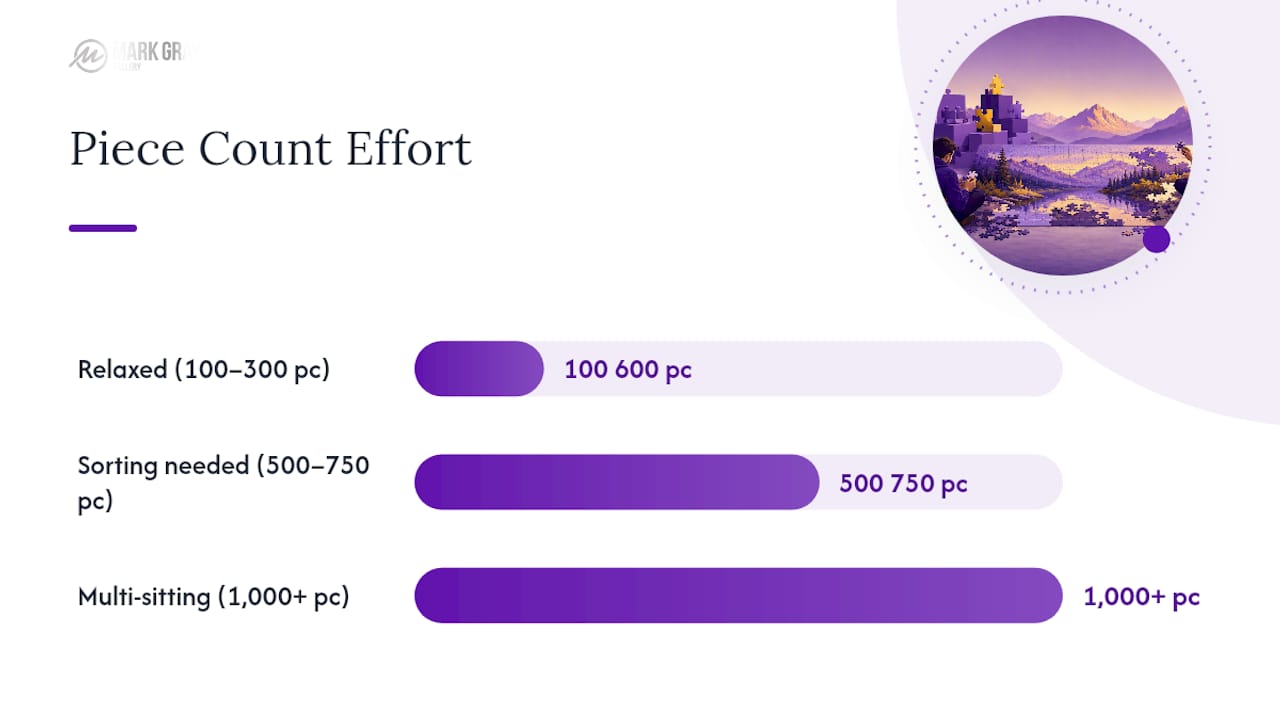
Piece count sets rough expectations, but it is only the starting point. A 100 to 300-piece puzzle is built for a relaxed evening or a first attempt at the hobby. A 500 to 750-piece puzzle asks for real sorting strategy. Cross 1,000 pieces and you are committing several sittings, particularly if the image leans heavily on sky or water.
Piece size matters just as much as the count. Smaller pieces pack more visual information into a tighter space, which sounds like it should make sorting easier. In practice, it compresses detail, so subtle color shifts get squeezed into a piece barely bigger than a fingernail. That is why a 1,000-piece landscape puzzle from a brand like Ravensburger, where finished dimensions run large and pieces stay a reasonable size, can solve faster than a compact 500-piece puzzle crammed into a small finished footprint.
A few scenarios where the "bigger number equals harder puzzle" rule breaks down:
- A 500-piece sunset over calm water, where gradient dominates the frame
- A tightly cropped forest scene with 750 pieces of near-identical green
- A 1,000-piece cityscape with sharp edges and varied color, which often solves faster than either
Image Complexity, Color, and Repetition in Landscape Scenes
This is where landscape puzzles earn their reputation. Large uniform areas and subtle gradients in sky, water, and foliage remove the visual anchors your eye needs to sort pieces, forcing you to rely on shape alone. Shape-only sorting is slow, and it is why a technically simple photograph of an empty beach can humble an experienced solver.
Contrast is the antidote. High-contrast images with clearly defined objects solve faster, while repetitive textures and low contrast increase difficulty even when the piece count stays modest. A distinct lighthouse against a stormy sky gives you a landmark to build outward from. A hazy tree line against a hazy sky gives you nothing to hold onto.
Before buying, run this four-point check on the box image:
- Find three sort zones. Look for a foreground with texture, a midground with distinct shapes, and a background gradient. If you can't identify three separate zones, expect slow, frustrating progress early on.
- Check for a color anchor. A red barn, an orange sunset streak, or a single boat gives you a starting cluster.
- Scan for repetition. Wheat, gravel, ripples, and leaf canopies all read as one texture at puzzle scale.
- Judge the horizon line. A sharp horizon splits the puzzle into two manageable halves; a hazy one blends sky and land into a single frustrating mass.
Pro Tip: Zoom into the product photo on your phone before buying. If the sky or water fills more than a third of the frame and shows almost no color variation, budget extra solving time, or extra patience, for that section.
Cut Style and Piece Shape: Ribbon, Random, and Whimsy Cuts
Most commercial landscape puzzles use a ribbon or grid cut, where pieces follow predictable rows and columns. This predictability helps enormously once you are deep into a wide sky or open water section, because piece shapes repeat in a rhythm you can learn.
Random cuts and whimsy cuts change the equation. Wooden and whimsy-cut puzzles introduce shape and tactile challenges that alter your tactics and increase perceived difficulty compared with standard cardboard ribbon cuts. Unique silhouette pieces, a bird, a leaf, a crescent moon, act as landmarks you can spot instantly. But that same uniqueness can create false-fit temptation, where two irregular pieces look like they should connect and do not.
A few practical notes on choosing a cut style:
- Ribbon cuts suit landscape choke points because the repetition helps you predict the next piece shape.
- Random and whimsy cuts add novelty and charm but slow down large gradient areas.
- If you want a harder build without changing the image, look for a random-cut edition of the same puzzle rather than jumping piece counts.
Material and Print Quality: The Overlooked Difficulty Factor
Print sharpness changes how easily you can tell two shades of blue apart. A muddy or low-contrast print flattens the fine gradient work in skies and water, making an already tricky section harder still.
Fit tolerance matters too. Loose-cutting puzzles invite false fits, where a piece slots in but does not truly belong, and you will not discover the error until three pieces later. Tightly cut puzzles resist that trap.
- Sharp, color-accurate printing preserves the subtle shifts that give gradients any sortable structure at all.
- Loose piece tolerance increases false-fit risk, particularly in skies and water.
- Wood puzzles feel and cut differently from cardboard, adding a tactile learning curve on top of the visual one.
Puzzle difficulty depends on piece count, image design, color variation, and cut style working together, and print quality is the thread running through all of them. A gorgeous photograph printed poorly loses its anchors before you even open the box.
Solver Strategy: Lighting, Sorting, and Pacing
Your environment changes the puzzle's effective difficulty as much as the box itself does. A landscape puzzle solved under warm yellow lamp light will feel harder than the same puzzle solved in daylight, because warm light flattens the exact blue and green shifts you need to see.
- Fix your lighting first. Good, neutral lighting separates subtle shade differences in a gradient and can cut the effective difficulty of a puzzle's hardest section roughly in half. Daylight bulbs or a spot near a window work best.
- Sort by zone, not by color alone. Separate edge pieces, then split the rest into your three sort zones before touching the gradient areas.
- Save the hardest section for last. Build every anchor point and distinct object first. By the time you reach the sky or water, you will have far fewer open slots to test pieces against.
- Pace yourself deliberately. Difficulty that far exceeds your skill breeds anxiety rather than enjoyment; if a session leaves you frustrated instead of absorbed, step back and return to it later.
Pro Tip: Keep a shallow tray for "maybe" pieces from the hardest zone. Revisiting that small pile after finishing an easier section often reveals matches your eye missed the first time.
A Photographer's View on What Changes Puzzle Difficulty
As a landscape photographer, I can tell you that the decisions made behind the camera shape a puzzle's difficulty long before it reaches the die-cutting machine. A wide-angle frame that flattens a mountain range into one continuous ridge removes the depth cues a solver relies on. A tighter composition with layered foreground rock, midground water, and a defined tree line keeps those anchors intact.
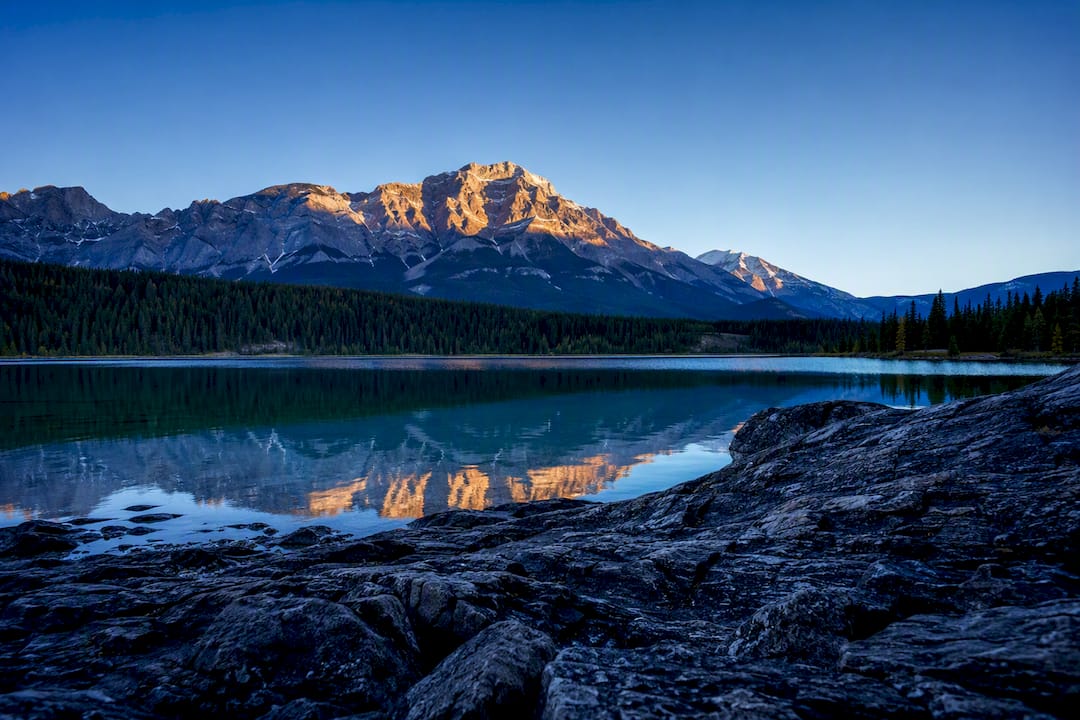
Exposure choices matter too. An image shot to preserve detail in the shadows retains texture in areas that would otherwise print as flat black. Before you buy or commission a landscape image for puzzle use, zoom in on a few sections at full resolution. If any area turns to visual mush under magnification, expect that same mush at puzzle scale. My own Photographer's Checklist for photo puzzles walks through this zoom test in more detail.
Choosing the Right Difficulty for Your Age Group and Experience
A puzzle that feels satisfying to one solver feels punishing to another, which is why matching difficulty to experience matters more than chasing the highest piece count available.
Young children (ages 3 to 6) do best with 12 to 60-piece puzzles built from bold, simple landscape shapes: a bright sun, a single mountain, a handful of trees. Fine detail and gradients confuse them before piece counts even become relevant.
Older kids and casual family solvers (ages 7 to 12) handle 100 to 300-piece puzzles well, especially landscapes with a clear focal object like a lighthouse, barn, or animal breaking up the scenery.
Adult beginners should start in the 300 to 500-piece range with high-contrast images: autumn forests, rocky coastlines, or scenes with architecture mixed into the view. These give enough anchors to build confidence without stalling out.
Intermediate solvers are ready for 500 to 1,000 pieces, including landscapes with moderate sky or water content, as long as the image includes at least a few distinct sort zones.
Experienced enthusiasts looking for a genuine test should seek 1,000-plus piece puzzles with large gradient areas, minimal focal objects, and repetitive natural texture, misty valleys, calm lakes, endless dune fields. These are the builds that separate a relaxing afternoon from a multi-week project.
Why Some Solvers Chase Difficulty and Others Avoid It
Some solvers want a landscape puzzle that fights back. Others want one that lets their mind wander without a battle at every gradient. Neither approach is wrong, but knowing which one you are before you buy saves you from an afternoon of frustration or, just as often, boredom.
I think the mistake most solvers make is picking piece count as a proxy for challenge, when the image itself is the real variable. A 500-piece puzzle with a wide, featureless sky can test you more than a 1,000-piece puzzle full of boats and rooftops. Choose based on how much ambiguity you actually want to sit with, not the number printed on the box.
If you want a puzzle that rewards patience without punishing it, look for images with layered depth and at least one strong anchor point, the kind found across a curated landscape puzzle range.
— Mark
Landscape Photo Puzzles Built Around Compositional Anchors
Not every landscape photograph belongs on a puzzle box, and that is exactly why the puzzles in the gift range are chosen for compositional strength as much as visual beauty. Each image carries the kind of foreground detail, midground structure, and horizon definition covered throughout this guide, the anchors that let a puzzle feel challenging without becoming an exercise in guesswork.

If you want a build that rewards patience rather than punishing it, the gift range of landscape photo puzzles is worth a look before you commit to a box. Pair that browsing with the Photographer's Checklist for photo puzzles to zoom-test any image, whether it is one of Mark's prints or a puzzle already on your shelf, and get a clearer sense of where the hard sections will fall. Browse the current puzzle selection and pick the composition that matches the challenge you are actually looking for.
Sources
These sources back the specific claims made throughout this guide:
- Puzzle Difficulty Levels Explained
- What Makes a Jigsaw Puzzle Hard? Piece Count, Image & Colour Guide
- Choosing a Jigsaw Puzzle for Every Skill Level | Bits and Pieces
- What Makes a Jigsaw Puzzle Difficult? 5 Key Factors
Check vendor-specific listings for exact piece counts and finished dimensions before buying.
FAQ
What is the most difficult jigsaw puzzle to solve?
The hardest landscape puzzles combine high piece counts with large, low-contrast areas like open sky, still water, or dense foliage, since these remove the visual anchors solvers rely on to sort pieces.
How long does it take the average person to do a 1,000-piece puzzle?
It varies widely by image complexity, but a high-contrast 1,000-piece landscape with clear focal points typically solves faster than a low-contrast one dominated by sky or water, sometimes by several hours.
What does it mean if you're good at jigsaw puzzles?
Strong solvers tend to be skilled at spotting subtle color shifts and shape patterns quickly, and they often develop zone-based sorting strategies rather than searching piece by piece.
What are the hardest types of landscape jigsaw puzzles?
The toughest builds are typically large piece counts paired with expansive gradients, think foggy mountain scenes, calm lakes, or dense forest canopies, where color repetition and minimal contrast strip away sorting anchors.
Is piece count the best way to judge landscape puzzle difficulty?
No. Piece count is a useful starting signal, but image complexity, color contrast, cut style, and print quality all shape how hard a landscape puzzle actually feels to solve.