
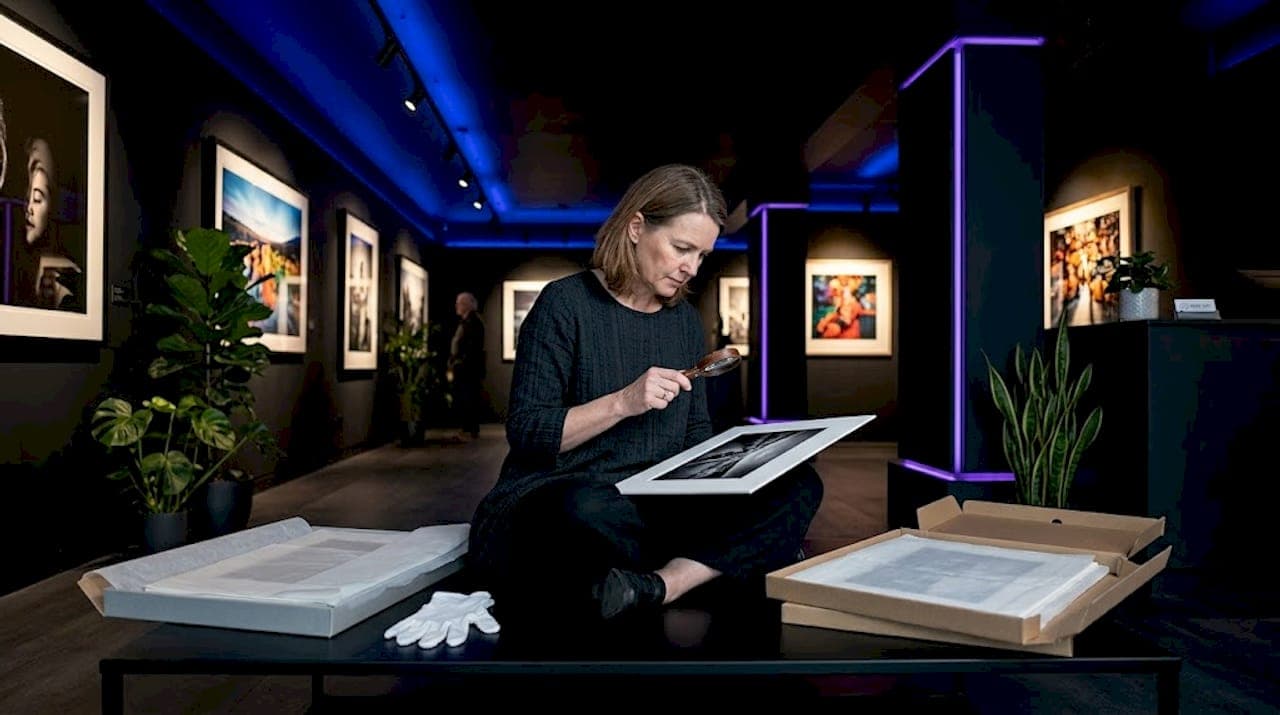
Photography prints occupy a genuinely unique position among art assets. You can own a work by a world-class artist at a fraction of what a painting would cost, yet the photographic print market rewards only those who understand what drives value. Getting the photography print investment basics right from the start separates collectors who build appreciating collections from those who overpay for decorative wall art. This guide covers what actually determines print value, the full cost picture most beginners miss, how to select prints with real long-term potential, and the risks worth taking seriously before you spend a dollar.
Table of Contents
- Key Takeaways
- Photography print investment basics: what drives value
- The real cost of buying photography prints
- How to evaluate and select prints for long-term potential
- Risks, liquidity, and building a balanced portfolio
- My perspective on building a photography print collection
- Explore Mark Gray's award-winning landscape photography
- FAQ
Key Takeaways
| Point | Details |
|---|---|
| Edition size drives scarcity | Small limited editions of 5 to 10 prints create the rarity that supports long-term price appreciation. |
| Budget beyond the sticker price | Auction fees, shipping, insurance, and framing add 10 to 30% above the base price of any print. |
| Patience is non-negotiable | A realistic holding period of 3 to 5 years is standard before meaningful value appreciation appears. |
| Provenance protects your investment | Documented ownership history and gallery authentication reduce risk and support stronger resale prices. |
| Institutional validation matters most | Museum acquisitions and exhibition history are more reliable indicators of future value than commercial buzz. |
Photography print investment basics: what drives value
Most people who start buying photography prints for investment focus almost entirely on the artist's name. That instinct is understandable but incomplete. Value in the photographic print market is determined by several interlocking factors, and missing any one of them can lead to a costly misjudgment.
Edition size is the single most influential variable. Because photographs are reproducible by nature, edition size is critical to establishing scarcity. A print from an edition of five commands a fundamentally different market position than one from an edition of 250. The general threshold that serious collectors use is 10 prints or fewer. Editions above that number reduce exclusivity and suppress long-term price potential considerably.
Provenance and documentation matter at every price point. Understanding provenance establishes ownership history and authenticity, reducing risk and supporting resale value. A certificate of authenticity linked to a reputable gallery, combined with exhibition records, means any future buyer can verify what they are purchasing. Without that paper trail, resale becomes significantly harder.
Condition has a more dramatic effect than most new investors anticipate. Minor damage, fading, or poor storage can sharply reduce resale prices, even for prints by well-regarded photographers. Photographic materials are sensitive to light, humidity, and temperature. A print stored incorrectly for a decade may lose a substantial portion of its market value.
Artist reputation operates on a spectrum. Blue-chip photographers provide stable, long-term pricing with lower volatility, while emerging artists offer higher upside alongside meaningfully higher risk. For investors who prioritize capital preservation, established artists with auction track records are the safer entry point. For those willing to accept volatility in exchange for potential outperformance, carefully researched emerging photographers can deliver strong returns.
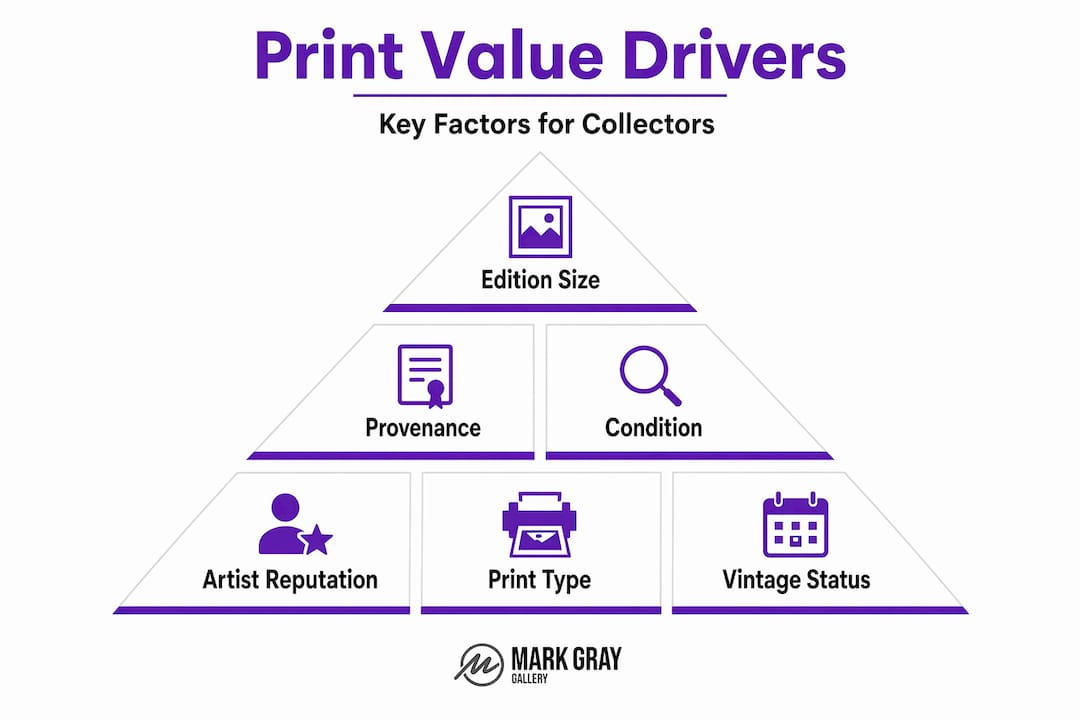
Print type and vintage status round out the picture. Vintage prints, meaning those made close to the time of original capture by the artist or under their direct supervision, typically command a premium over later reprints. The printmaking technique also matters: platinum palladium and gelatin silver prints have distinct collector bases with different price dynamics than pigment ink or chromogenic prints.
Pro Tip: When reviewing any photography print for investment, request the full edition details in writing, including how many prints have already been sold and whether the edition is still open. This single step prevents a significant number of costly buying mistakes.
The real cost of buying photography prints
One of the most common surprises for investors entering the photographic print market is discovering how much the total cost of ownership exceeds the sticker price. Pricing landscape photography prints requires accounting for a range of additional transaction costs that compound quickly.
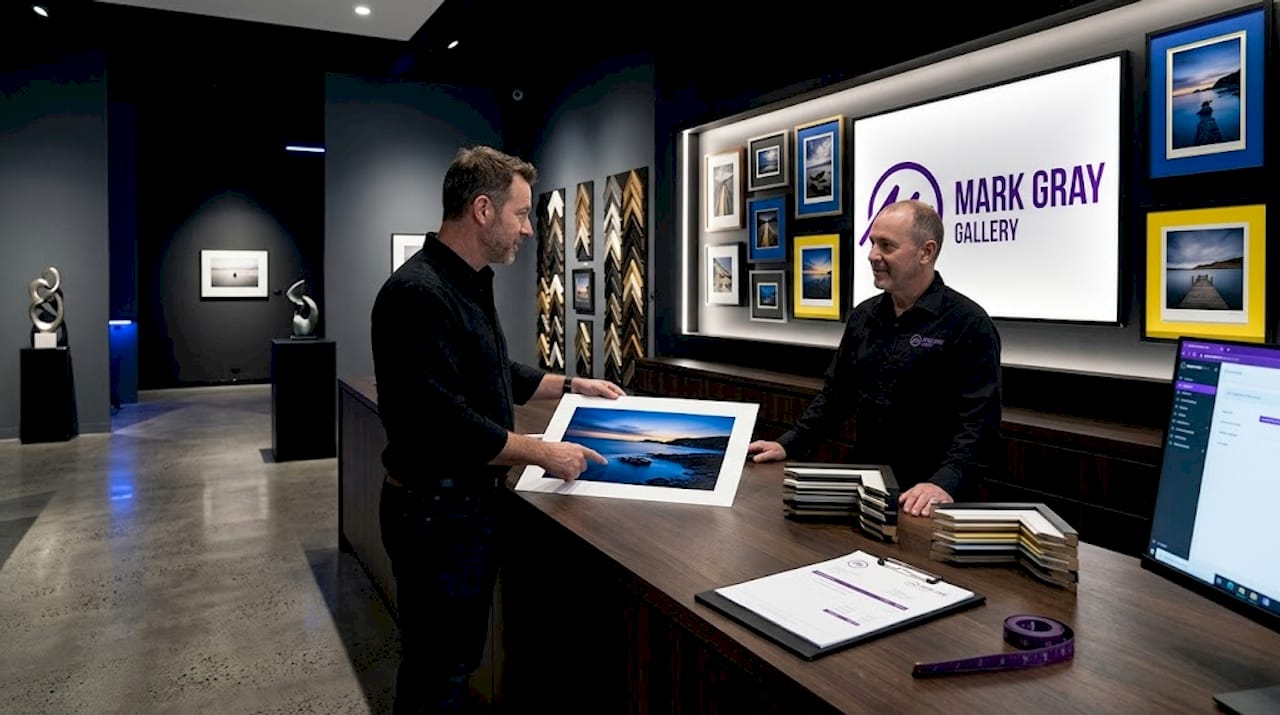
Here is a clear breakdown of the costs you need to budget for before committing to any purchase:
| Cost Category | Typical Range | Notes |
|---|---|---|
| Auction buyer's premium | 10% to 30% above hammer price | Varies by auction house and sale category |
| Shipping and handling | $150 to $800+ | Depends on print size, origin, and fragility |
| Professional framing | $200 to $2,000+ | Museum-quality UV-protective framing required |
| Insurance (annual) | 1% to 2% of artwork value | Specialized fine art insurance policies |
| Conservation and storage | 0.5% to 1.5% of value per year | Climate-controlled storage and periodic conservation checks |
Industry standards across the 2025 to 2026 period confirm that investors should budget 10 to 30% additional beyond a print's base price to cover hidden costs. That figure applies even when buying directly from a gallery rather than through an auction house. Shipping alone for a large format fine art print can run several hundred dollars once crating, insurance in transit, and international freight are included.
Ongoing costs like insurance and conservation can reach 1 to 2% of artwork value annually. On a $10,000 print, that is $100 to $200 per year before you have sold a single thing. Over a five-year holding period, those costs meaningfully affect your net return and need to appear in your initial calculations, not as an afterthought.
Pro Tip: Before purchasing any print, calculate your full breakeven price including acquisition costs, five years of insurance and storage, and your estimated selling commission. If that number isn't realistic against comparable auction results, the purchase math doesn't work.
How to evaluate and select prints for long-term potential
Selecting photography prints with genuine investment potential requires research that goes well beyond reading an artist's biography. The following process applies regardless of whether you are starting with a modest budget or allocating significant capital to the photographic print market.
-
Research the artist's institutional history. Museum acquisitions, major exhibition history, and academic recognition are the most reliable predictors of sustained value. Institutional validation is a better predictor of future appreciation than commercial popularity alone. An artist represented in major public collections carries a fundamentally different risk profile than one who has sold well through commercial galleries alone.
-
Review auction records across multiple platforms. Consistent sale results above estimate over several years signal genuine collector demand. One strong result can be anomalous. A pattern of results tells you something real about where the market currently values an artist's work.
-
Understand primary versus secondary market dynamics. Buying directly from a gallery (the primary market) typically means lower initial cost and direct access to documentation. The secondary market through auctions and dealers offers price discovery and transparency, but at higher transaction costs. For a side-by-side comparison of fine art photography investment structures, understanding how galleries price versus how auctions price the same work is worth studying closely.
-
Prioritize small editions and avoid oversupply. A focused investment strategy aligned with a single artist at a time creates more predictable long-term value than spreading capital across many speculative names. Avoid prints from large editions regardless of how appealing the image is.
-
Apply the 3 to 5 year rule. Photography print investments typically require a 3 to 5 year holding period before meaningful appreciation appears. Any expectation of quick liquidity is misplaced in this market. Buying with a short horizon almost always results in a forced sale at unfavorable terms.
-
Use expert advice strategically. An independent art consultant or specialist appraiser can validate your pricing assumptions using hedonic pricing models that incorporate print type, edition size, artist reputation, and condition. Given the market complexity involved, that fee is almost always worthwhile on higher-value acquisitions.
Risks, liquidity, and building a balanced portfolio
Photography prints are not stocks. That distinction carries more practical weight than most new investors initially appreciate. Understanding the risk profile before you commit capital is not pessimism. It is due diligence.
The primary challenge is illiquidity. The photography investment market requires patience and long-term buy-and-hold strategies. Selling a print in a hurry typically means accepting a price well below market value, because the pool of qualified buyers at any given moment is small and transaction timelines are long.
Key risks to account for before entering the photographic print market:
- High transaction costs on exit. Auction house commissions, dealer markups, and selling fees eat into returns significantly. A print that appreciated 25% over five years may deliver a much smaller net gain once selling costs are deducted.
- Condition deterioration. Improper display, inadequate framing, and humidity fluctuations cause irreversible damage. A single incident of water damage or prolonged UV exposure can eliminate a print's investment value entirely.
- Edition ambiguity. Prints with unclear or disputed edition documentation are extremely difficult to resell at fair prices. This risk is most common with older prints and with artists whose estates have not maintained consistent records.
- Emerging artist volatility. An artist who commands strong prices at 35 may be largely forgotten at 55. Commercial momentum and critical reception can shift substantially over a collection's typical holding period.
- Oversupply from large editions. Prints from editions above 10 face downward price pressure as more copies reach the secondary market simultaneously.
The counterbalance to these risks is real. Photography investment offers portfolio diversification due to its low correlation with equity and bond markets. During periods of stock market volatility, well-chosen art assets have historically maintained or increased value. That non-correlation makes photography prints genuinely useful as a component of a broader investment portfolio, provided you enter with eyes open about the liquidity trade-off.
My perspective on building a photography print collection
I've watched collectors make impressive gains from photography prints, and I've watched others significantly overpay for work that never appreciated. The difference almost always comes down to one thing: whether they bought with conviction grounded in research, or with enthusiasm grounded in aesthetics alone.
In my experience, the investors who do best in this market approach it the way a careful geologist reads rock strata. They look beneath the surface. They ask who owns comparable works, where the artist has been exhibited, how the edition was managed, and what the provenance chain looks like. They don't skip those questions because they love the image.
What I've found actually works is buying one artist at a time, deeply. Understanding a single artist's market, their auction history, their institutional relationships, and where their career trajectory is pointing gives you a real advantage over a collector who spreads across many names superficially. The temptation to diversify too early often leads to a collection full of mediocre prints rather than a focused set of genuinely strong works.
The aesthetic dimension matters too, and I don't think it should be dismissed. A print you genuinely find beautiful is one you'll protect carefully, store properly, and hold through market fluctuations without panic selling. The financial and the personal are not in conflict here. The best collections I've seen were built by people who cared deeply about both.
— Mark
Explore Mark Gray's award-winning landscape photography
For those who have worked through the photography print investment basics in this guide and are ready to explore actual investment-grade prints, Mark Gray's collection offers a compelling starting point.
Mark Gray is an internationally recognized Australian photographer whose landscape work spans Australia, Iceland, Norway, French Polynesia, New Zealand, Spain, and the United Kingdom. His prints are produced in strictly controlled limited editions, with complete provenance documentation, and have earned prestigious recognition across the fine art photography world. Every detail that matters to a serious print investor, from edition control to archival quality materials to exhibition history, is present in his body of work. You can explore his award-winning landscape prints directly through the gallery, where edition details and pricing are transparently presented for collectors at every level.
FAQ
What are the most important factors in photography print value?
Edition size, provenance, condition, and artist reputation are the four primary value drivers. Prints from small limited editions of 5 to 10 with documented ownership history and museum-validated artists consistently outperform larger editions with weaker institutional support.
How long should I hold a photography print investment?
A holding period of 3 to 5 years is standard in the photographic print market before meaningful appreciation typically appears. Attempting to sell sooner usually results in accepting a price below what the work is worth.
What hidden costs do photography print investors often miss?
Beyond the purchase price, investors need to budget for auction buyer premiums of 10 to 30%, professional framing, shipping, specialized insurance, and annual conservation costs that can reach 1 to 2% of the print's value each year.
Are photography prints a liquid investment?
Photography prints are not liquid assets. Sales can take months, and high transaction costs on both the buy and sell side reduce net returns. They are best treated as a long-term, buy-and-hold component of a diversified portfolio rather than a tradable asset.
How do I verify a photography print's authenticity?
Request a certificate of authenticity linked to a reputable gallery or the artist's estate, along with the full edition documentation showing how many prints exist and how many have sold. Complete provenance records including exhibition history provide the strongest authentication foundation.