
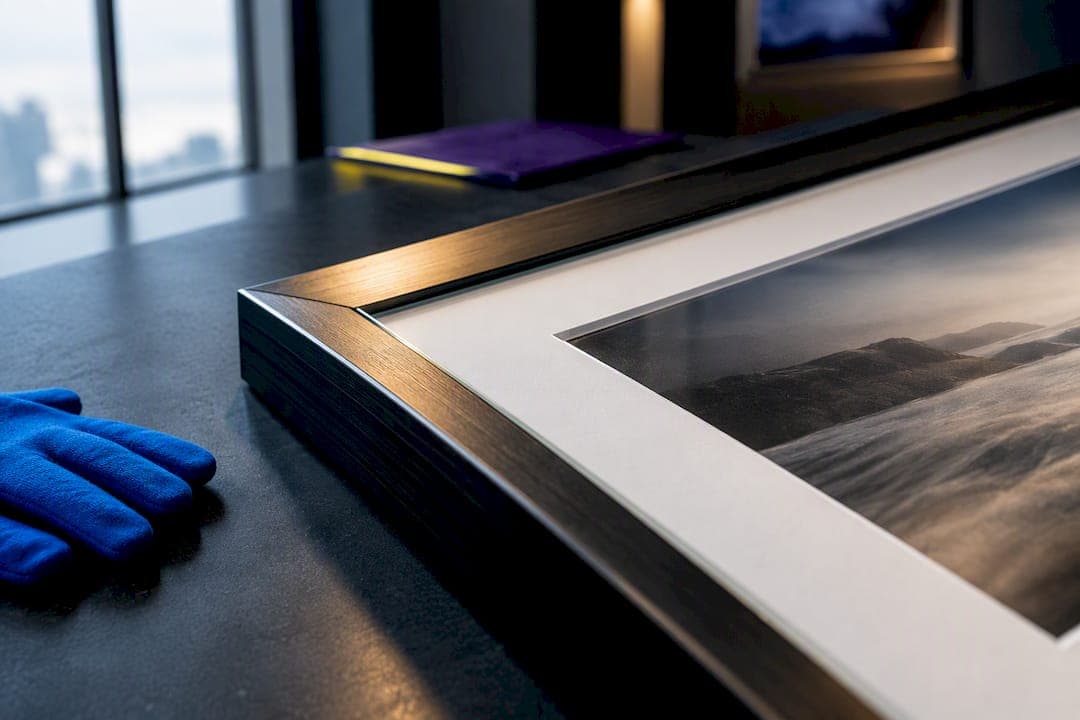
Gallery grade framing means exhibition-standard, conservation-safe, reversible presentation that protects a limited-edition print while leaving it intact for future conservators. It combines glazing that never touches the print, a window mat or spacer to create that separation, archival mount and backing materials, and reversible attachment methods. Every component serves the same goal: the print looks its best today and remains unaltered decades from now.
TL;DR:
- Gallery-grade framing uses reversible hinges with Japanese mulberry paper and wheat-starch paste to ensure safe removal and prevent permanent damage.
- UV-filtering acrylic or conservation glass shields prints from UV rays, but glazing should never touch the print to avoid sticking and tear risks.
- Archival materials like 100% rag mats and acid-free backing are essential, as standard wood or acidic boards can deteriorate the print over time.
- Proper display locations exclude direct sunlight, high humidity areas, and places with temperature swings to maintain optimal conservation conditions.
- For stuck prints, always consult a conservator rather than attempting to remove or repair them yourself to prevent irreversible damage.
Table of Contents
- What gallery-grade framing protects and why collectors choose it
- Core components of a gallery-grade frame
- Conservation-safe mounting methods collectors should insist on
- Glazing choices and controlling light exposure
- Display environment and routine care for gallery-finished prints
- When to keep the artist's finish versus commissioning a conservator
- How Mark Gray supports gallery-standard presentation
- Sources
- FAQ
What gallery-grade framing protects and why collectors choose it
A print's surface and tonal range are fragile in ways that are easy to overlook once the piece is behind glass. Dust, airborne pollutants and light exposure all work slowly against a photograph, and gallery-grade framing exists to slow that process without compromising the object itself.
The guiding principle, echoed across institutional conservation guidance, is reversibility. Nothing should be permanently attached or chemically altered in a way that a future conservator, or a future owner, cannot undo. Museums and archives hold their collections to demanding storage targets, typically around 30 to 40% relative humidity and cooler temperatures, according to preservation guidance from the National Film and Sound Archive. A home cannot replicate a climate-controlled vault, but the same direction (stable, cool, dry, out of direct light) still applies.
What gallery-grade framing achieves:
- Reduces dust, pollutants and light reaching the print's surface.
- Preserves the option to remove, rehinge or reframe without damage.
- Approximates institutional stability targets within a normal home.
Core components of a gallery-grade frame
Five elements work together, and each has a job the others cannot do.
- Glazing: the glass or acrylic layer that shields the print from dust and UV light, positioned so it never makes contact with the print's surface.
- Mat or spacer: a window mat or physical spacer that holds glazing away from the image, typically made from 100% rag or alpha-rag board.
- Mount and backing: an acid-free, archival board behind the print. Wooden backing boards and standard acidic mat board are unsuitable because they off-gas and migrate acid into the print over time.
- Mounting attachments: reversible hinges or archival corners that hold the print in place without adhesives that cannot later be undone.
- Frame and hardware: a structurally sound frame with hanging hardware rated for the print's weight, ideally corrosion-resistant if the display environment is humid or coastal.
The Western Australian Museum's framing guidance lists glazing, mat, backing and mounting as the necessary components of any conservation frame, and specifies 100% rag or alpha-rag mats for photographic material.
Pro Tip: Ask your framer to name the exact mat and backing board by product line, not just "acid-free," since the term alone doesn't guarantee true archival quality.
Conservation-safe mounting methods collectors should insist on
How a print attaches to its backing matters as much as what it's framed in. The preferred method uses Japanese mulberry paper hinges adhered with wheat-starch paste, a combination that is strong enough to hold the print flat but weak enough to release cleanly if removal is ever needed. Conservators recommend wet-tearing the mulberry paper to leave a feathered edge and using the lightest hinge weight possible, so that if a framed piece is ever dropped, the hinge fails before the print does, per Western Australian Museum guidance.

Archival photo corners are a reasonable alternative, particularly for prints a collector expects to reframe occasionally.
Methods to avoid entirely:
- Dry mounting, which fuses the print permanently to its backing.
- Heat or pressure-sensitive adhesives of any kind.
- Spray adhesives and double-sided tape, both of which are effectively irreversible.
If a print has already become stuck to glazing or a backing board, stop and call a conservator. The Australian War Memorial's conservation guidance warns that improvised removal attempts often cause image loss that cannot be repaired.
Glazing choices and controlling light exposure
Glazing is where most collectors make their first real trade-off. Conservation glass offers strong UV filtering, with some products claiming up to around 97% UV reduction, while UV-filtering acrylic is lighter and shatter-resistant but more prone to scratching and static buildup, a distinction detailed in museum framing advice.
It only slows the damage, it does not stop it.
Whichever glazing you choose, it should never touch the print's surface. A window mat or a set of discreet spacers holds the glazing off the image, preventing the two surfaces from bonding under heat or humidity.
Practical choices for different prints:
- Color prints benefit most from high UV-filtering glass or acrylic, since color dyes fade faster under light than most black-and-white silver or pigment processes.
- Black-and-white prints still need UV protection, just with slightly more tolerance for display duration.
- For a piece exposed to strong, uncontrollable light (a north-facing wall, for instance), displaying a copy print and keeping the original stored is a common conservator recommendation.
Display environment and routine care for gallery-finished prints
Where a framed print hangs matters nearly as much as how it was framed. Avoid direct sunlight, kitchens, bathrooms, exterior walls, and spots above heaters or near doors, all locations where light, heat, humidity or temperature swing hardest.
Institutional storage targets sit around 30 to 40% relative humidity and cool temperatures, according to the National Film and Sound Archive. A home cannot hit those numbers exactly, but choosing an interior wall away from bathrooms and kitchens gets you close.
A simple maintenance routine catches problems early:
- Check seals periodically for gaps that let dust or insects in.
- Look for condensation or image transfer onto the glazing.
- Tighten hanging fixings, especially after moving a piece.
- In coastal or marine climates, have hardware checked professionally every so often for corrosion.
Our own guidance on caring for fine art photography prints covers these routines in more depth for collectors building out a home display.
When to keep the artist's finish versus commissioning a conservator
An artist-applied finish is often integral to the work, chosen with the image in mind, and worth preserving as it left the studio. Before changing anything, weigh the documentation that came with the piece and its current condition.
Commissioning a conservator or a conservation-aware framer makes sense for transport, corporate installation, or climate problems the original framing wasn't built for. When you brief a framer, specify reversible methods, name the exact materials, and ask for written documentation of what was used. Our collector's guide to framing limited-edition prints walks through exactly what to ask for.
— Mark
How Mark Gray supports gallery-standard presentation
Limited-edition prints made with panoramic medium format film are collected internationally, a scale that comes with a responsibility to help collectors display them properly. Alongside the Limited Edition Prints collection, we publish detailed framing and care guides so buyers can brief any framer with confidence, or preserve the finish a print already arrived in.
Before framing or reframing a piece, check what documentation came with it, request conservation-level mounting from your framer, and confirm materials in writing.
| Component | Recommended specification |
|---|---|
| Glazing | UV-filtering acrylic or conservation glass, never touching the print |
| Mat/spacer | 100% rag or alpha-rag board |
| Backing | Acid-free, archival quality, never wood-based |
| Mounting | Japanese hinges with wheat-starch paste, or archival corners |
If you're ready to add a piece to your collection, browse the Limited Edition Prints gallery to find a print worth framing this way.
Sources
- Caring for photographs — NFSA
- Framing — Western Australian Museum
- Conservation advice: photographs — Australian War Memorial
FAQ
What makes framing "gallery grade" rather than standard?
Gallery grade framing uses archival, acid-free materials and reversible mounting methods, so the print can be removed or reframed without damage. Standard framing often relies on adhesives or backing boards that degrade the print over time, according to Western Australian Museum guidance.
Can acrylic glazing be used instead of glass for archival framing?
Yes, UV-filtering acrylic is a valid choice and is lighter and more shatter-resistant than glass, though it scratches more easily and can attract static. Conservation glass offers stronger UV filtering, with some products claiming up to around 97% UV reduction, per museum framing advice.
Why shouldn't a print touch its glazing?
Contact between a print and its glazing can cause the two surfaces to stick together under heat or humidity, and separating them afterward risks tearing the print's surface. A window mat or spacer keeps them apart, which is why conservators treat this separation as essential rather than optional.
What should I ask a framer to confirm before they mount my print?
Ask for museum-quality or conservation-style mounting by name, request the exact mat, backing and hinge materials in writing, and confirm the mounting method is reversible. This documentation matters for resale and for any future conservator who works on the piece.
What's the safest way to fix a print that has stuck to its glass?
Do not attempt to peel or pry it free yourself, since improper removal can cause permanent image loss. Contact a trained conservator, as recommended by the Australian War Memorial, who has the tools to separate the surfaces safely.