

Print pricing for photographers is a strategic blend of cost calculation, profit margin setting, and market positioning that determines whether your work generates sustainable income or quietly loses money. How photographers price their prints follows two core methods: cost-plus pricing, which sets a reliable floor, and value-based pricing, which captures what the market will actually pay. Most professional photographers apply markups of 3 to 4 times their total unit cost for loose prints, then adjust upward based on edition size, presentation quality, and client experience. Getting this right is the difference between a thriving print business and one that funds itself out of your own pocket.
How photographers price their prints: calculating true production costs
The most common pricing mistake photographers make is calculating only the print itself and ignoring everything else that touches the sale. Your cost of goods sold (COGS) for a print includes the physical print, any framing or mounting, packaging materials, and the labor involved in preparing and shipping the order. Each of these must be quantified before you set a single price.
Breaking down production and landed costs
Production costs cover what it takes to create the print: lab fees, paper or canvas substrate, ink, and any color management calibration work. Landed costs go further and include packaging (boxes, tissue, foam inserts), shipping subsidies, payment processing fees (typically 2.9% plus a flat fee for platforms like Stripe or PayPal), and your own fulfillment labor. Separating production from landed costs prevents margin erosion that looks invisible until you run a quarterly profit review and wonder where the money went.
Overhead allocation is the step most photographers skip entirely. If you spend $500 per month on studio rent, software subscriptions (Adobe Creative Cloud, Lightroom, color profiling tools), and website hosting, and you sell 50 prints per month, each print carries $10 in overhead. Add a reprint reserve of 3% to 5% of your print cost to cover spoilage, damaged shipments, and client reprints. These buffers are not optional. They are the difference between a price that looks profitable and one that actually is.
A practical cost breakdown for a medium-format fine art print might look like this:
| Cost Component | Example Amount |
|---|---|
| Lab printing fee (16×20 inch) | $18.00 |
| Packaging (box, tissue, foam) | $4.50 |
| Fulfillment labor (15 min at $30/hr) | $7.50 |
| Overhead allocation per unit | $10.00 |
| Payment processing fee (3%) | $1.20 |
| Reprint reserve (4%) | $1.65 |
| Total unit cost | $42.85 |
Using the retail price formula, Total Unit Cost divided by (1 minus Target Margin), a 65% margin target on this print produces a retail price of approximately $122. That is your cost floor before any value-based adjustment.
Pro Tip: Build a volatility cushion of 10% to 20% into your unit cost to absorb fluctuations in lab pricing, shipping rates, and packaging costs. International sellers should use a 15% to 25% buffer given currency and freight variability.
What pricing strategies do photographers use for prints?
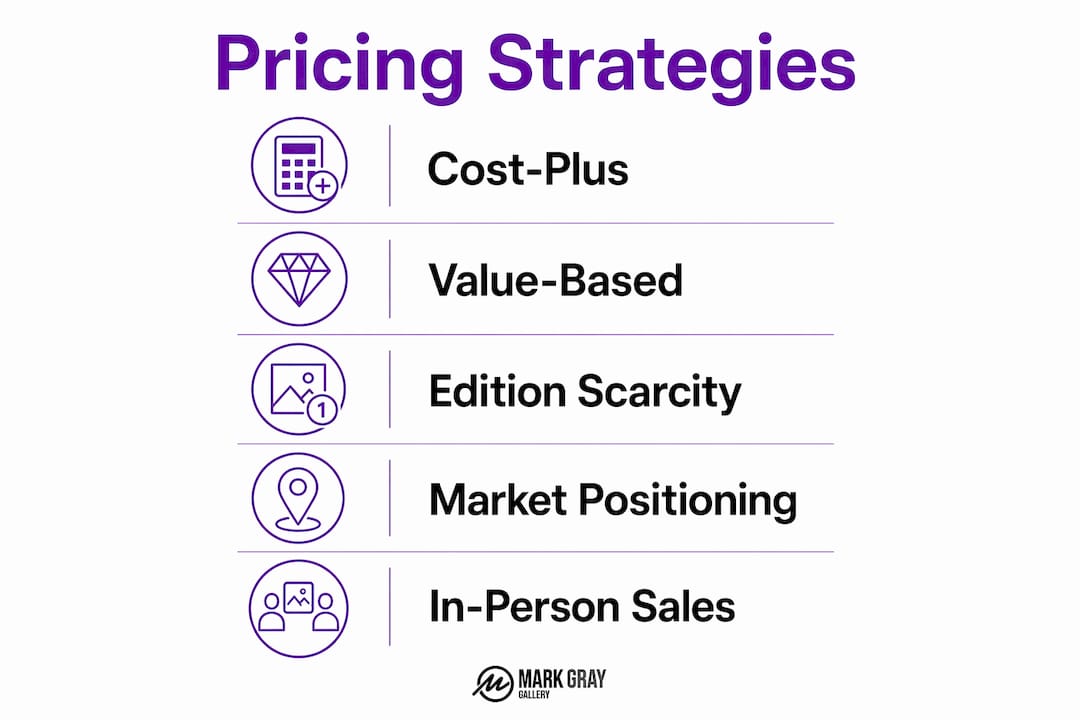
The three dominant photographer pricing strategies are cost-plus, value-based, and edition scarcity pricing. Each serves a different function, and the most experienced photographers combine all three rather than relying on any single approach.
Cost-plus pricing as your floor
Cost-plus pricing is the starting point. You calculate your total unit cost as described above, then apply a multiplier. The 3 to 4 times COGS multiplier is the industry standard for loose prints, meaning a print that costs $42.85 to produce and land would be priced between $128 and $171. This method is reliable and auditable. Its weakness is that it ignores what buyers are willing to pay, which is often considerably more than the cost floor suggests.
Value-based pricing and what it captures
Value-based pricing reflects the emotional longevity of the image, the prestige of the photographer, the quality of the framing, and the overall buying experience rather than just the cost of materials. The same 16×20 inch print of an Icelandic aurora landscape, presented in a signed archival box with a certificate of authenticity, commands a fundamentally different price than the same image rolled in a tube. Buyers are paying for the story, the rarity, and the experience as much as the object.
Edition scarcity as a pricing multiplier
Limited editions are one of the most powerful levers in print pricing. Limited editions can justify 2 to 5 times the price of open editions, depending on edition size and the photographer's market standing. An edition of 10 prints commands a higher price than an edition of 250, which commands more than an open edition. The workflow is to set your cost floor first, validate your value ceiling through competitor research and past sales data, then use edition size to position the final price within that range.
Here is how the three strategies compare in practice:
| Strategy | Strength | Weakness | Best used when |
|---|---|---|---|
| Cost-plus | Protects margins | Ignores market demand | Setting minimum prices |
| Value-based | Captures full buyer willingness | Harder to calculate | Established photographers |
| Edition scarcity | Drives urgency and premium | Requires consistent branding | Limited series releases |
Pro Tip: Validate your value ceiling by researching comparable prints on platforms like Saatchi Art or through gallery price lists. If your cost floor is $122 and comparable limited edition prints sell for $450, your pricing has room to grow without alienating buyers.
- Combine cost-plus as your floor with value-based pricing as your ceiling
- Use edition sizes to position within that range, not to set it arbitrarily
- Revisit pricing every six months as lab costs and market conditions shift
- Review your limited edition print strategy to understand how edition structures affect collector demand
How does market positioning affect what you can charge?
Pricing artwork for sale is inseparable from how you present it. Premium presentation justifies premium prices, and the gap between a $150 print and a $450 print is often less about the physical object and more about the buying experience surrounding it.
In-person sales (IPS) sessions are the most direct way to increase both price and conversion. IPS sessions deliver a curated buying experience that treats the appointment as guided discovery rather than negotiation. When clients see their images displayed at scale on a wall, in a darkened room with proper lighting, they make decisions based on emotional response rather than price comparison. Many photographers report that IPS clients consistently select larger sizes and premium finishes compared to clients who order through an online gallery alone.
Tiered pricing menus are equally powerful. Tiered product menus allow buyers to self-select upward through size, finish, and framing options without feeling pressured. A menu that offers a 12×16 inch unframed print, a 20×24 inch framed print, and a 30×40 inch gallery-wrapped canvas gives buyers three reference points. Most buyers gravitate toward the middle option, which you can design to be your highest-margin product.
Your sales channel also affects pricing power significantly:
- Your own website gives you full pricing control and no commission fees
- Gallery representation typically involves a 40% to 50% commission, requiring higher retail prices
- Marketplaces like Etsy or Redbubble attract price-sensitive buyers and compress margins
- Direct studio or exhibition sales support the highest prices because the environment reinforces value
Pro Tip: Transparency in pricing builds trust. Display your prices clearly on your website rather than requiring buyers to inquire. Photography print investment buyers are more likely to purchase when they can evaluate options independently before committing.
Practical tips to optimize your print pricing and sales
Refining your pricing is an ongoing process, not a one-time decision. These steps help you build a price structure that holds up under scrutiny and grows with your business.
-
Build a consistent price ladder across sizes. If your 8×10 inch print is $95, your 16×20 inch should not be $110. Buyers notice illogical jumps. A clean ladder might be $95, $175, $295, $450, and $650 for five ascending sizes, with each step reflecting both increased production cost and increased perceived value.
-
Choose a shipping cost strategy and commit to it. The three options are embedded pricing (shipping cost folded into the print price), flat-rate shipping (one fee regardless of order size), and pass-through shipping (actual cost charged at checkout). Embedded pricing simplifies the buyer experience and reduces cart abandonment. Pass-through shipping is transparent but can surprise buyers at checkout.
-
Use bundles to increase average order value without discounting. A "two-print bundle" at 15% off the combined retail price increases revenue per transaction while protecting your per-unit margin. Bundles work especially well during exhibition openings or seasonal promotions. Pairing prints with products from photo album printing services can also expand your product range without adding production complexity.
-
Monitor conversion rates and adjust. If you receive consistent traffic to a print page but few purchases, your price may be above the value ceiling for that image or audience. If prints sell immediately after listing, your price is likely below the value ceiling and you have room to increase it.
-
Never underprice labor. Photographers frequently ignore time and overhead when setting prices, which erodes margins and makes the business unsustainable. Every hour spent editing, packaging, communicating with clients, and managing orders has a dollar value. Include it.
-
Leverage limited editions to increase urgency. Announcing that only 15 prints of a specific image remain in an edition creates genuine scarcity. Buyers who have been considering a purchase often act when they understand the edition is closing. This is not a sales tactic. It is an accurate description of a real constraint that adds value to the collector.
Key takeaways
Profitable print pricing requires a cost floor built from total unit costs, a value ceiling validated by market research, and edition scarcity used deliberately to position within that range.
| Point | Details |
|---|---|
| Calculate true unit cost | Include production, packaging, labor, overhead, and a reprint reserve before setting any price. |
| Apply a 3 to 4 times multiplier | Use cost-plus as your pricing floor, not your final price. |
| Use edition scarcity strategically | Limited editions can justify 2 to 5 times the price of open editions. |
| Invest in presentation and IPS | In-person sales sessions and premium packaging directly increase conversion and average order value. |
| Revisit pricing regularly | Build a 10% to 20% volatility cushion and review prices every six months as costs shift. |
Why I think most photographers price their work too timidly
After years of selling landscape photography prints from locations across Australia, Iceland, Norway, and French Polynesia, the pattern I see most often is not greed or confusion. It is timidity. Photographers set prices based on what they fear buyers will reject rather than what the work is genuinely worth.
The uncomfortable truth is that underpricing signals low value to buyers. A collector standing in front of a 40×60 inch archival print of a Milford Sound sunrise, matted and signed, does not feel reassured by a $200 price tag. They feel suspicious. Premium buyers expect premium prices because price is part of how they assess quality and authenticity.
What I have found actually works is combining disciplined cost accounting with honest market research, then pricing with confidence. Educate your clients on what goes into a print: the location scouting, the pre-dawn starts, the color management, the archival materials, the limited edition structure. When buyers understand the depth behind the work, they do not negotiate down. They invest up.
The pricing landscape photography prints process is not a one-time exercise. Revisit your numbers every six months. As your reputation grows, your value ceiling rises. Your prices should rise with it.
— Mark
Explore award-winning landscape prints with strategic pricing applied
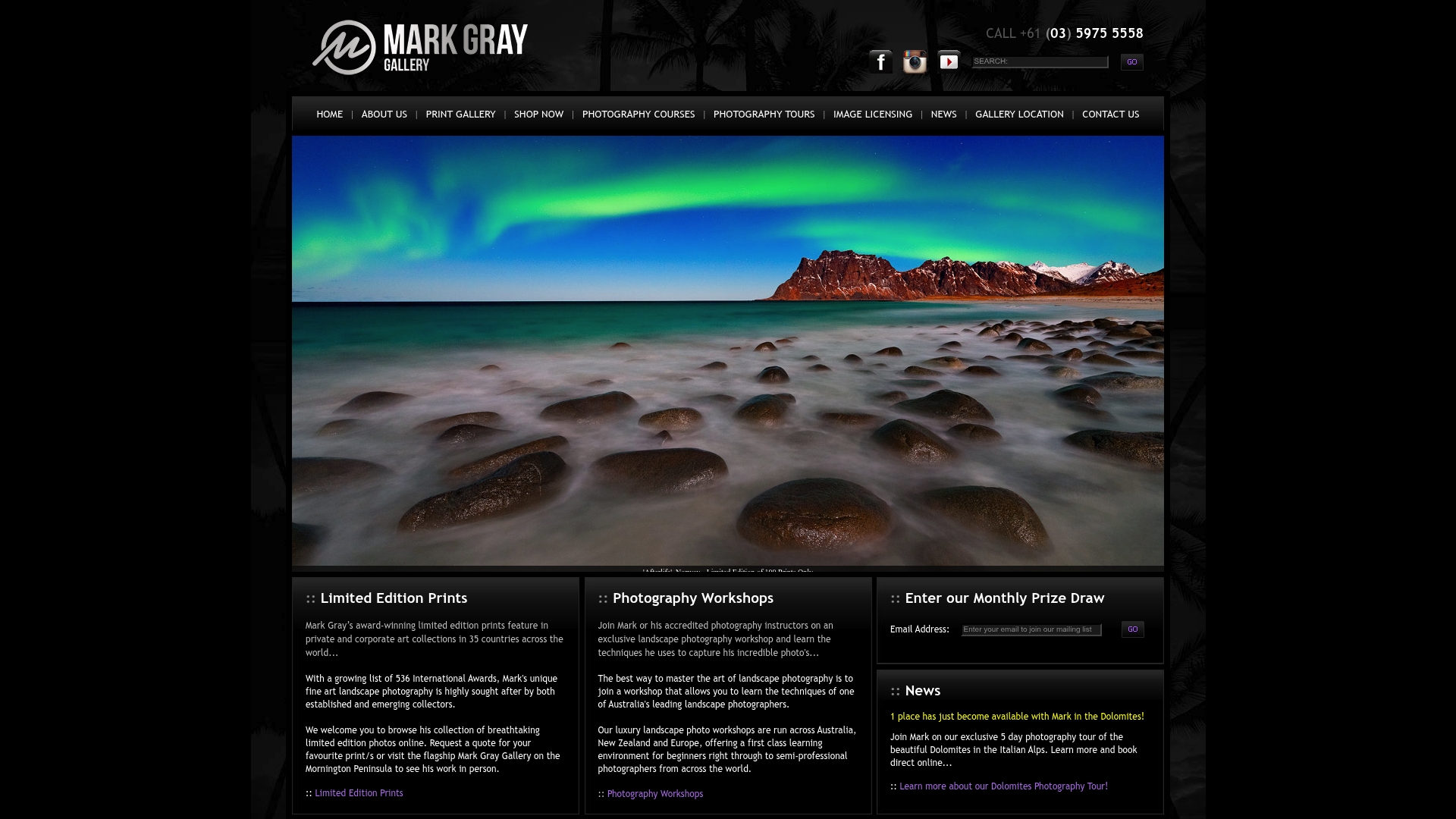
Mark Gray Gallery offers a collection of premium limited edition landscape photography prints from Australia, New Zealand, Norway, Iceland, French Polynesia, Spain, and the United Kingdom. Every print in the collection reflects the pricing principles covered in this guide: genuine production quality, archival materials, clearly defined edition sizes, and presentation that supports the price. Edition sizes are published transparently, certificates of authenticity are included, and packaging is designed to arrive in gallery condition. If you want to see how professional print pricing looks when applied with discipline and pride, explore Mark Gray's prints and experience the difference that considered pricing and exceptional quality make together.
FAQ
What is the standard markup for photography prints?
Most photographers apply a 3 to 4 times multiplier over total unit cost for loose prints, with higher multipliers for framed or limited edition work. This markup covers overhead, labor, and profit margin.
How do limited editions affect print pricing?
Limited editions justify 2 to 5 times the price of open editions, depending on edition size and the photographer's market standing. Smaller editions command higher prices because scarcity increases perceived and actual collector value.
Should shipping costs be included in the print price?
Embedding shipping into the print price reduces cart abandonment and simplifies the buyer experience. Pass-through shipping is transparent but frequently surprises buyers at checkout, which increases the likelihood they abandon the purchase.
How does in-person sales affect print pricing?
IPS sessions increase both price and conversion by presenting images at scale in a curated environment. Clients who view prints in person consistently select larger sizes and premium finishes compared to online-only buyers.
How often should photographers review their print prices?
Prices should be reviewed every six months to account for lab cost changes, shipping rate fluctuations, and shifts in your market positioning. Building a 10% to 20% volatility cushion into your unit cost provides a buffer between reviews.