
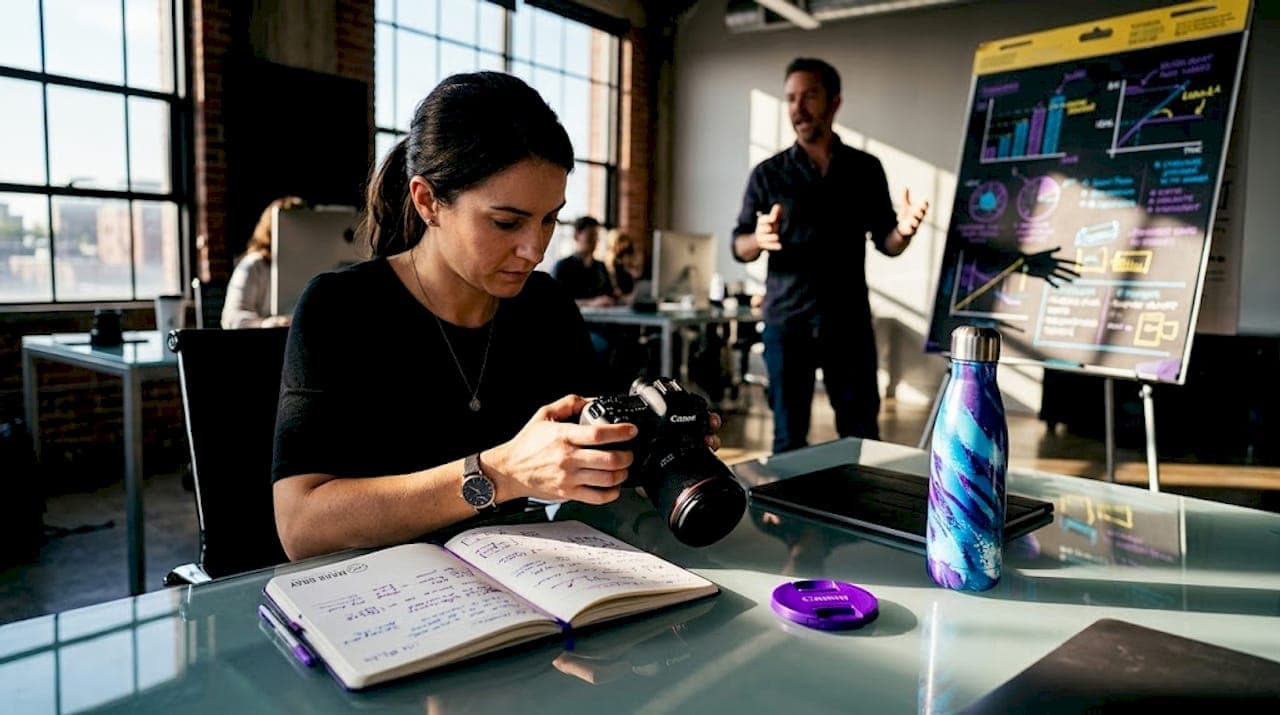
Most photographers believe that shooting more photos automatically leads to better photos. That assumption is only partly true. Understanding how photography courses improve skills changes that picture entirely. Structured learning accelerates your growth in ways that solo shooting rarely does, because courses target the specific gaps in your technique and creative vision with precision. From mastering the exposure triangle to receiving expert critique, a well-designed photography course gives you a shortcut that years of unguided practice simply cannot replicate.
Table of Contents
- Key takeaways
- How photography courses improve skills from day one
- Intentional practice and creative challenges in courses
- The power of instructor feedback and critique
- Beyond the camera: broader skills courses build
- Choosing the right photography course for your goals
- My honest take on why courses matter
- Take your photography further with Mark Gray
- FAQ
Key takeaways
| Point | Details |
|---|---|
| Structure beats repetition | Courses teach technical foundations systematically, accelerating your progress far beyond casual shooting. |
| Feedback is irreplaceable | Expert critiques reveal blind spots that you cannot identify on your own, sharpening both technique and creative decisions. |
| Practice must be intentional | Combining focused technical drills with creative challenges produces faster, more lasting skill gains than random shooting. |
| Courses build "seeing" skills | Learning to read light and compose instinctively transforms your photography from mechanical to genuinely expressive. |
| Choosing the right course matters | Matching the course format and instructor expertise to your goals determines how much you actually take away. |
How photography courses improve skills from day one
The single biggest reason courses accelerate learning is structure. Most self-taught photographers work on whatever interests them that day. Courses are intentionally sequenced, building each skill on the one before it. Courses systematically teach the exposure triangle, composition, light, and editing in a progression that mirrors how professional photographers actually think.
The exposure triangle: your creative control center
Aperture, shutter speed, and ISO are not just technical settings. They are the three creative levers that determine how a scene looks and feels. Aperture controls depth of field, letting you isolate a subject against a blurred background or keep everything sharp from foreground to horizon. Shutter speed freezes motion or blurs it deliberately, turning a waterfall into silk or a cyclist into a streak of energy. ISO determines your sensor's sensitivity to light, which matters enormously in low-light situations.
Courses do not just explain these settings. They build deliberate exercises around each one so that the relationships between them become instinctive. A course drill might ask you to photograph the same scene at five different aperture settings, then compare the results and write down what changed. That kind of structured reflection is what moves knowledge from your head into your hands.
Composition and lighting as taught skills
Composition is often treated as a natural talent. It is not. Rules like the rule of thirds, leading lines, and framing are teachable frameworks that transform how you see a scene before you even raise the camera. Structured photography courses covering composition, lighting, and editing produce dramatic improvements in photo quality, often within weeks of starting.

Lighting education goes even deeper. Courses teach you to recognize the quality, direction, and color of light as separate properties you can work with. Learning the difference between harsh midday light and the warm, raking light of late afternoon changes what time of day you choose to shoot, and how you position yourself relative to your subject.
Pro Tip: Keep a small notebook during any photography course and sketch the light direction in scenes you find compelling. Reviewing these sketches later builds a visual memory bank that you will draw on for years.
Intentional practice and creative challenges in courses
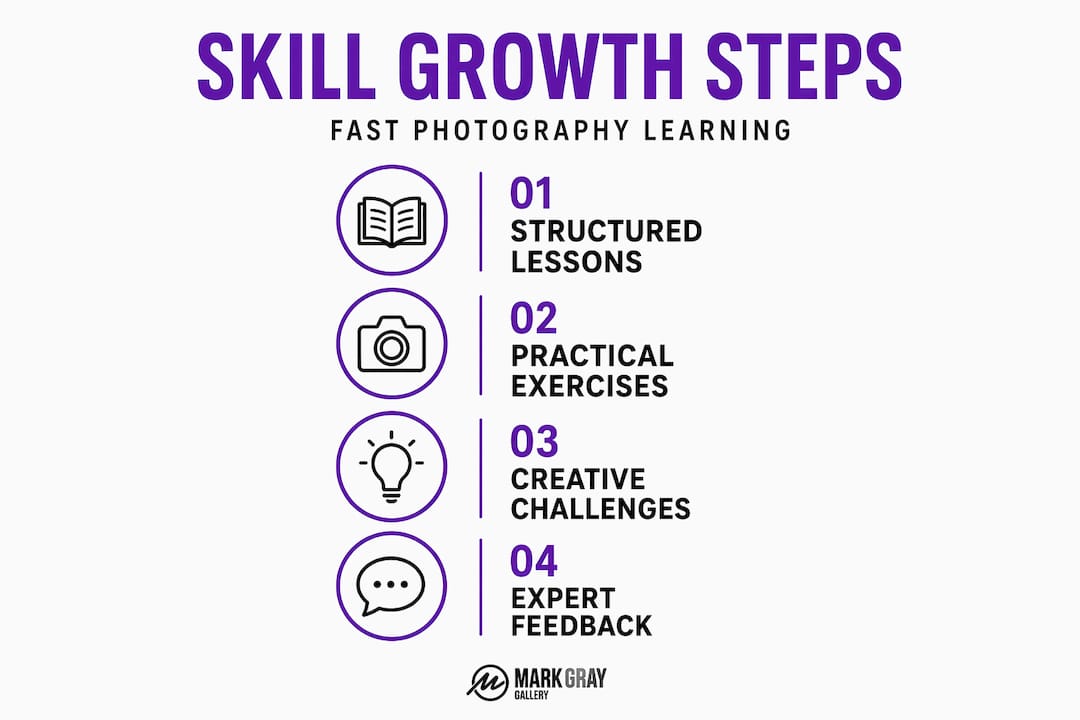
Random practice produces random results. The most effective photography training programs build sessions around deliberate repetition paired with creative constraints. Research recommends 20 to 40 minutes of technical drills followed by an equal period of creative shooting challenges, creating a rhythm that builds muscle memory and creative confidence simultaneously.
A well-designed practice session in a photography course might look like this:
- Aperture control drill. Photograph the same subject at f/2.8, f/5.6, f/11, and f/16. Study how depth of field changes and which version best serves the story you want to tell.
- Exposure bracketing exercise. Shoot a high-contrast scene at three different exposures. Analyze which setting preserved the most detail in shadows and highlights.
- Focus technique practice. Use both single-point autofocus and manual focus on a moving subject. Notice where your camera's autofocus system struggles and learn to compensate.
- Thematic creative challenge. Shoot ten images on the theme of "isolation" using only natural light. The constraint forces you to look harder at ordinary scenes.
- Review and reflection. Study your frames from the session, noting which decisions worked and which ones missed the mark. Write down one thing you will do differently next time.
Combining technical drills with creative challenges and intentional review accelerates skill development far beyond simply shooting more frames. The reflection step is what most self-taught photographers skip entirely, and it is exactly where the deepest learning happens.
Courses assign constrained shooting missions that push you to notice subtle details in composition and light, overcoming the safe and predictable habits that keep so many photographers stuck at the same level for years. When you cannot fall back on your default approach, you discover new ways of seeing.
Pro Tip: After every practice session, select your three best frames and write one sentence explaining exactly why each one works. This habit trains your critical eye faster than any single exercise.
The power of instructor feedback and critique
Solo practice can entrench bad habits. You repeat what feels comfortable, and you evaluate your own work with all the blind spots that familiarity creates. Expert feedback changes that dynamic completely.
Instructor critiques reveal hidden mistakes and sharpen creative decisions in ways that self-assessment simply cannot achieve. A skilled instructor can look at your image and immediately identify that the horizon is slightly tilted, that the light source is creating unflattering shadows, or that your composition has two competing focal points pulling the viewer's eye in opposite directions. You might have stared at that same image for ten minutes and missed all three issues.
The benefits of structured feedback in photography courses include:
- Pattern recognition. Regular critiques build what instructors call a "pattern library," a mental catalog of what effective composition and lighting look like across dozens of different scenarios. You start to recognize strong images faster and understand instinctively why they work.
- Technical diagnosis. An instructor can connect a blurry image to the wrong shutter speed, or a dull flat photo to the wrong time of day, rather than leaving you to guess at the cause.
- Artistic encouragement. Experienced instructors know how to push your creative boundaries without undermining your confidence, helping you develop a personal style rather than just copying what you see online.
- Peer learning. Seeing critiques of your classmates' work is as valuable as receiving feedback on your own. You learn to identify the same issues in other people's images, which sharpens your eye for your own work.
Community interaction and peer collaboration in photography courses expand your perspective and fuel motivation in ways that solitary practice rarely does.
"The most valuable thing a course gave me wasn't a technique. It was learning to see my own work the way an experienced photographer sees it — honestly and with genuine curiosity about how to make it better."
Beyond the camera: broader skills courses build
Learning photography skills through a structured course does more than improve your technical output. It changes the way you experience the world visually. That shift is one of the most celebrated and least expected benefits of photography classes.
Seeing and manipulating light is the defining human skill that separates compelling photography from technically adequate photography. It has nothing to do with your camera or your lens. It is a trained perceptual ability, and courses teach it deliberately.
The broader skills that photography training programs cultivate include:
- Patience and observation. Students learn to wait for perfect light, the right expression, or a decisive moment of motion, developing a quality of attention that transfers directly to other areas of creative and professional life.
- Visual storytelling. Courses teach you to think about what a photograph communicates, not just what it records. This skill applies to design, marketing, presentation, and any other field where visual communication matters.
- Personal expression. Photography becomes a language when you understand its grammar. Courses help you find your own voice within that language, moving you from recording scenes to interpreting them.
- Creative confidence. Completing challenging assignments, receiving honest critique, and watching your work improve builds a resilience and self-assurance that extends well beyond photography.
Most photographers plateau because they repeat the same habits rather than studying their images with genuine critical intent. A photography course breaks that cycle by creating structured moments of honest self-assessment and guided growth.
Choosing the right photography course for your goals
Not all courses deliver the same results. The format, instructor, and curriculum all shape how much you take away. Here is a clear comparison of the main course types available to photographers today:
| Course type | Best for | Key advantage | Watch out for |
|---|---|---|---|
| One-day workshop | Beginners and hobbyists | Fast, focused skill boost in a real location | Limited follow-up and feedback |
| Multi-day tour workshop | Intermediate to advanced | Immersive practice with expert guidance daily | Higher investment of time and cost |
| Online photography courses | Self-paced learners | Flexible schedule, often broad curriculum | Less personalized feedback |
| Certificate programs | Career-focused learners | Recognized credential and structured progression | Can be expensive and time-intensive |
When evaluating any course, prioritize three things. First, look at the instructor's professional work. If you admire their photography, you will likely connect with their teaching perspective. Second, check whether the course includes actual shooting time, not just lectures. Learning photography is a hands-on craft, and theory without practice is only half the lesson. Third, find out how feedback is delivered. Access to critique, whether from the instructor or peers, is what separates a transformative course from an informative one.
Pro Tip: Before enrolling in any photography course, write down three specific skills you want to improve. Use those goals as your evaluation criteria when reviewing the curriculum and asking instructors questions.
Photography workshops set in inspiring locations add another layer of benefit. Shooting in genuinely beautiful environments, under the guidance of someone who knows how to read those specific landscapes and light conditions, produces a quality of learning that studio-based instruction cannot replicate.
My honest take on why courses matter
I have worked with thousands of photographers at every level, and the pattern I see most often is this: talented people with good cameras and genuine passion who are stuck. They are shooting regularly, they love the craft, and their images have barely improved in two years.
The reason is almost always the same. They are practicing, but not learning. They are repeating approaches that feel safe rather than pushing into territory that feels uncomfortable and revealing.
What I have found is that structured learning breaks that cycle in a way that self-directed practice rarely does. A good course forces you to confront your weaknesses directly, to receive feedback you did not ask for about images you thought were your best work, and to shoot assignments that take you out of your comfort zone. That discomfort is exactly where the growth lives.
The photographers I have watched grow fastest are not the ones with the best gear. They are the ones who treat photography as both a technical craft and an expressive art, and who seek out instruction and critique with genuine humility and curiosity. A course gives you both the structure and the community to do that properly.
— Mark
Take your photography further with Mark Gray

Mark Gray is one of Australia's most celebrated landscape photographers, with award-winning work spanning Australia, Iceland, Norway, French Polynesia, and beyond. His photography courses and multi-day workshop tours are built around exactly the principles explored in this article: structured skill-building, intentional practice in extraordinary locations, and the kind of personalized instructor feedback that genuinely accelerates your growth.
Whether you are picking up a camera for the first time or looking to break through a creative plateau, exploring Mark Gray's courses and workshops is an inspiring next step. His one-day courses across Australia and multi-day landscape photography tours worldwide offer a rare combination of professional instruction, breathtaking environments, and a community of passionate photographers growing together. Visit the gallery and see where the journey takes you.
FAQ
What do photography courses typically cover?
Most photography courses cover the exposure triangle, composition principles, lighting techniques, and editing workflows. Structured courses teach these systematically, producing dramatic improvements in photo quality.
How long does it take to see improvement from photography courses?
Many students notice meaningful improvement within the first few weeks, particularly after receiving expert critique on their work. Combining technical drills and creative challenges accelerates this timeline significantly compared to unguided practice.
Are online photography courses as effective as in-person workshops?
Online photography courses offer flexibility and broad curriculum access, but in-person workshops provide immediate instructor feedback, real-location shooting, and peer interaction that deepen learning faster for most students.
Why is instructor feedback so valuable in photography courses?
Expert critiques identify technical and artistic gaps that self-review misses entirely. Regular feedback builds a "pattern library" that helps you recognize strong composition and light instinctively across any shooting situation.
Can a photography course help if I've been shooting for years?
Yes. Most experienced photographers plateau by repeating familiar habits. A course introduces intentional study and outside critique that breaks those patterns and reopens meaningful growth.