
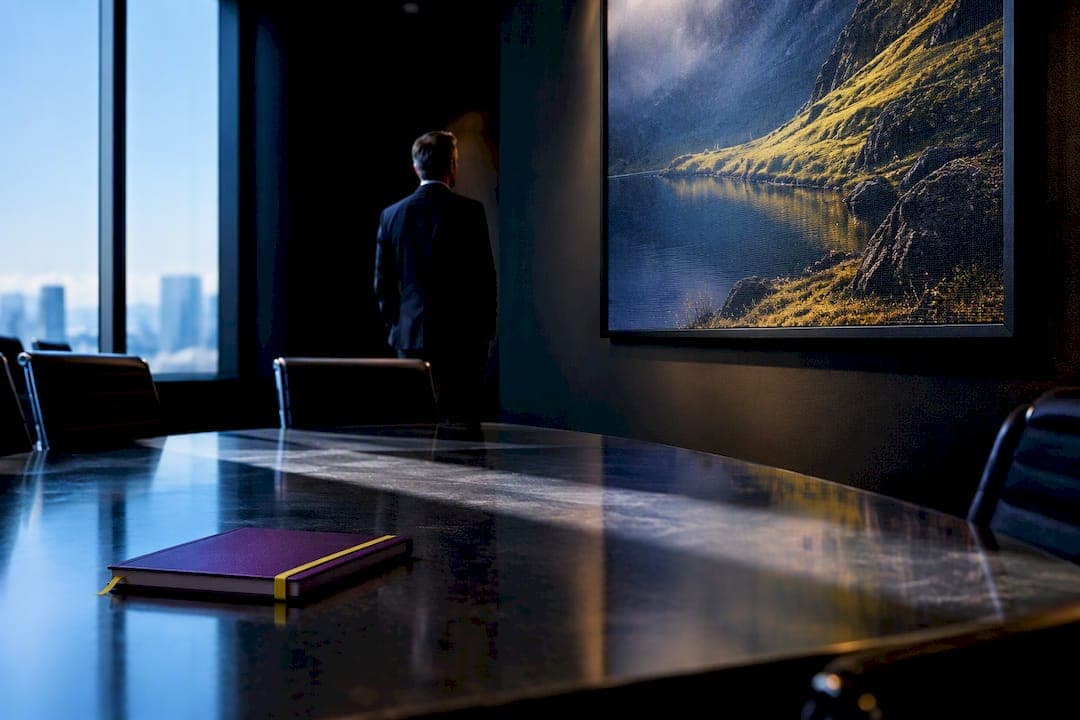
Yes, thoughtfully chosen office art improves psychological comfort, stimulates creativity, and raises perceived productivity and workplace connection. The catch is that these benefits depend heavily on how the art is chosen and installed. Research consistently shows employee agency matters as much as the artwork itself, and the evidence base, while promising, is still smaller than most workplace design guides admit.
TL;DR:
- Employees should actively participate in selecting office art to maximize well-being and productivity benefits, as overruling choices diminishes the positive effects.
- Calmer, nature-themed images are most effective in focus zones, while more complex, conversation-provoking pieces suit collaboration areas.
- A systematic approach, including rotation, proper framing, lighting, and clear governance, is essential to ensure office art implementation delivers its psychological and social advantages.
- Natural materials, diverse representations, and visual coherence with space functions contribute to lower stress and a stronger connection to workplace identity.
- Measuring success through baseline surveys and follow-up assessments over three to six months helps determine whether the office art program improves employee comfort and engagement.
Table of Contents
- Office Art Benefits Backed by Research
- What the Research Actually Shows (and Where It Falls Short)
- How to Choose the Right Art for Each Office Zone
- Implementing an Office Art Program That Actually Delivers
- Beyond Decoration: Wayfinding, Brand, and Conversation
- A Simple Way to Measure Whether Office Art Is Working
- How a Landscape Photography Practice Supports Corporate Art Programs
- Three Design Priorities Worth Repeating
- Bring Real Landscape Photography Into Your Office Pilot
- Sources
- FAQ
Office Art Benefits Backed by Research
The case for hanging real, considered artwork in a workplace rests on five practical benefits, each documented in a different corner of the research.
- Psychological comfort and stress reduction, most consistent when the imagery is realistic nature scenery. A review of visual art in healthcare settings found that realistic nature imagery reduced stress and anxiety in waiting rooms and clinical corridors. That evidence is strongest in medical settings, so treat its transfer to a general office as a reasonable inference rather than a proven fact.
- Creativity and problem-solving stimulation. Visually engaging works, especially ones that invite a second look, seem to nudge people out of routine thinking during collaborative moments.
- Perceived productivity, engagement, and job satisfaction. A systematic mixed-studies review found workplace visual art associated with higher job satisfaction, engagement, and self-reported productivity, alongside psychological comfort.
- Social interaction and mission connection. A Project Zero study of an Australian institutional collection found that art promoted social interaction, emotional response, and personal connection, especially when collections rotated and tied back to the organization's purpose.
- Brand and visitor impression. A reception wall or corridor gallery is often the first physical signal a client or candidate reads about a company's identity, long before anyone says a word.
None of these benefits arrive automatically from any picture on a wall. They show up when the selection process, the placement, and the maintenance are handled with the same care as any other workplace investment.
What the Research Actually Shows (and Where It Falls Short)
Office art has stronger evidence behind it than most interior design trends, but the research is still young, and the caveats matter as much as the headline findings.
The 2026 systematic mixed-studies review found consistent associations between workplace art and psychological comfort, engagement, and reduced distress, plus stronger colleague interaction in some settings. The reviewers were explicit, though: the evidence base remains small, and few studies were conducted in functioning workplaces rather than labs.
The agency effect: Two randomized office experiments found that when workers could choose or arrange their own art and plants, well-being and productivity improved. When managers later overrode those choices, much of the benefit disappeared. The experiment on lean, enriched, and empowered offices is one of the few controlled studies in this field, and it points to a single, testable rule: art works better when people choose it.
A separate controlled study of 413 workers found that diverse representations in artwork, alongside natural materials and windows, were linked with lower stress. That finding also carries a methodological lesson: art rarely operates alone. It works alongside light, material, and layout, not as a standalone lever.
A separate systematic review of art viewing found that fewer than a quarter of the studies it examined used control conditions, and results across studies were mixed. Eudaimonic well-being (a sense of meaning) showed the most convergent evidence, while other outcomes were shakier. Treat office art as a genuine contributor to workplace experience, not a guaranteed productivity fix.

How to Choose the Right Art for Each Office Zone
Different spaces need different pictures, and matching content to function is where most office art programs succeed or fail.
- Focus zones and recovery corners: calmer, nature-based, or low-complexity imagery works best, echoing the stress-reduction pattern seen in healthcare art photography.
- Collaboration and social spaces: choose more visually complex, conversation-provoking pieces that give people something to discuss while they wait for a meeting to start.
- Scale and distance: a piece meant to be seen from across an open floor needs different proportions than one hung beside a desk; a wall art size guide helps avoid the common mistake of hanging oversized art in tight corridors.
- Lighting and glare: glossy prints under harsh overhead light wash out detail and create glare that undercuts the whole point of hanging the piece; the 30 degree rule for wall art lighting is a practical fix.
- Accessibility: keep sightlines clear for wheelchair users and avoid placing art where reflections obscure it from common seated positions.
- Representation: curate deliberately rather than adding a single "diverse" piece as a token gesture; a controlled study linked diverse representations with lower reported stress, but only when the representation felt genuine rather than performative.
Pro Tip: Apply the 70/30 rule loosely: fill roughly 70% of a wall's visual weight with art and leave 30% as breathing room. A wall crowded edge to edge reads as clutter, not curation, no matter how good the individual pieces are.
Implementing an Office Art Program That Actually Delivers
The gap between an office with art and an office where art works comes down to process, not budget. If you skip employee input, or worse, collect it and ignore it, you erase most of the benefit before the first frame goes on the wall.
- Build a decision protocol with real teeth. Decide upfront who chooses, who can veto, and how binding those choices are, then publish the rule before you solicit input. A commissioning guide for corporate offices walks through how to structure that input without turning it into a committee free-for-all.
- Set a rotation cadence. Pilot with one zone for four to eight weeks, then plan refreshes every three to six months. Static collections lose their psychological pull fast; rotation and interpretive labels kept engagement higher in the Project Zero collection study.
- Handle the logistics properly. Budget for professional framing, secure fixing hardware, and basic conservation. A print that fades or a frame that tilts undercuts the very impression you are trying to create.
- Assign clear governance. Name one person accountable for the pilot timeline and for handling any request to override a chosen piece, and require that overrides get logged and explained rather than made quietly.
Pro Tip: If a manager insists on overruling an employee-selected piece, treat that as a data point worth tracking. The research on empowered offices found overrides erase much of the well-being gain, so an override rate above zero is worth investigating, not ignoring.
Beyond Decoration: Wayfinding, Brand, and Conversation
Art earns its wall space twice when it does a job beyond looking good.
- Wayfinding: a landmark piece at a corridor junction or floor entrance gives people a mental marker, cutting down on the "which way to the elevator" moment new visitors always have.
- Brand and values: locally relevant or mission-linked work communicates identity faster than a lobby sign, an approach explored in visual storytelling for brand impact.
- Conversation and learning: a short placard with the story behind a piece, or an occasional informal walk-through, turns a hallway into a talking point rather than wallpaper.
- Avoiding tokenism: pair any representation-focused piece with employee-led interpretation so the choice reads as genuine, not decorative box-checking.
A Simple Way to Measure Whether Office Art Is Working
You do not need a research grant to find out whether your art program is doing anything. You need a baseline and a bit of patience.
- Before installation: survey psychological comfort, sense of belonging, and perceived productivity on a simple 1 to 5 scale.
- Four to six weeks after installation: repeat the same short survey and track informal space usage, such as whether people linger near the new pieces.
- Three to six months out: check longer indicators like retention and absenteeism, while noting any other workplace changes made in that window so you can separate art's effect from, say, a new coffee machine or a schedule change.
| Timeframe | What to measure | Method |
|---|---|---|
| Baseline | Psychological comfort, belonging, perceived productivity | Short 1 to 5 scale survey |
| Short term (4 to several weeks) | Space usage, informal feedback | Observation, quick pulse survey |
| Longer term (3 to several months) | Retention, absenteeism, satisfaction trend | HR data, follow up survey |
A pilot group of even 20 to 30 employees is enough to spot a meaningful shift, as long as you keep the survey questions identical across rounds.
How a Landscape Photography Practice Supports Corporate Art Programs
A workplace art pilot needs a supply source that can move at the pace of a business decision, not a gallery opening schedule. Mark Gray's practice covers several of the pieces that matter here: image licensing for splashbacks, signage, and branded spaces; limited edition prints for boardrooms and executive areas; and open edition prints for broader rollout across multiple floors or offices. Panoramic medium format film captures the level of detail that holds up at the larger scales most office walls demand.
For a pilot, that means a design team can request custom sizing, get clarity on licensing terms before committing budget, and receive certificates of authenticity for pieces as needed. Any team documenting a pilot outcome for future budget approval should keep those records alongside the measurement plan above.

Three Design Priorities Worth Repeating
Give people real say over what goes on their walls, match the artwork to what the space is actually for, and measure before you scale. Favor rotation and interpretation over a single permanent purchase. Get the procurement details right: safe fixing, correct lighting, and someone accountable for upkeep.
— Mark
Bring Real Landscape Photography Into Your Office Pilot
Most workplace art programs stall at the sourcing stage: nobody knows where to find pieces with real depth of detail at the scale a boardroom or open floor demands, and licensing terms for signage or splashbacks often come with confusing conditions attached. The practice offers landscape photography alongside straightforward image licensing for commercial use.
A pilot package works best when it starts small: pick one zone, choose between a limited edition print for a boardroom or an acrylic block for a reception desk, and pair it with the baseline survey outlined above. If you are recognizing a team milestone rather than launching a full pilot, a gift certificate lets a department head pick their own piece, which happens to be the exact kind of employee agency the research says matters most. Browse the current print collections and get a licensing quote at Markgray to see what would fit your first pilot wall.
Sources
- The psychological impact of visual art in the workplace on employees: A systematic mixed-studies review.
- The Relative Merits of Lean, Enriched, and Empowered Offices: An Experimental Examination of the Impact of Workspace Management Strategies on Well-Being and Productivity
- Art works at work: The impact of workplace art | Project Zero
- Physical workplaces and human well-being (Douglas et al., 2022)
FAQ
What Makes Good Office Art?
Good office art matches its content and complexity to the space it hangs in: calming, nature-based imagery for focus areas and recovery corners, and more visually complex or conversation-sparking work for collaboration zones. It also involves employees in the selection, since randomized office experiments found that choice drives much of the well-being benefit.
What Is the 70/30 Rule in Art?
The 70/30 rule is a display guideline suggesting roughly 70% of a wall's visual weight comes from the art itself, with 30% left as open space or negative space around it. It keeps a wall from reading as cluttered, no matter how strong the individual pieces are.
Is Buying Art a Tax Write-Off?
Tax treatment for art purchases depends on your business structure, the purchase price, and local tax rules, so this varies by jurisdiction and is not something a general guide can answer definitively. Check with an accountant or your local tax authority before treating an office art purchase as a deduction.
Why Is Creativity in the Workplace Important?
Creativity drives problem-solving, and visually engaging environments appear to support that process by breaking up routine thinking during collaborative moments. A 2026 systematic review found workplace art associated with higher engagement and psychological comfort, both conditions that tend to precede creative output rather than follow it.
Does Office Art Really Increase Productivity?
Office art is associated with higher perceived productivity in multiple studies, but the effect is stronger when employees help choose the art and weaker when it is imposed without input. Treat it as one contributor to a well-designed workplace, not a standalone fix, since researchers note art tends to work best alongside natural light and materials.