
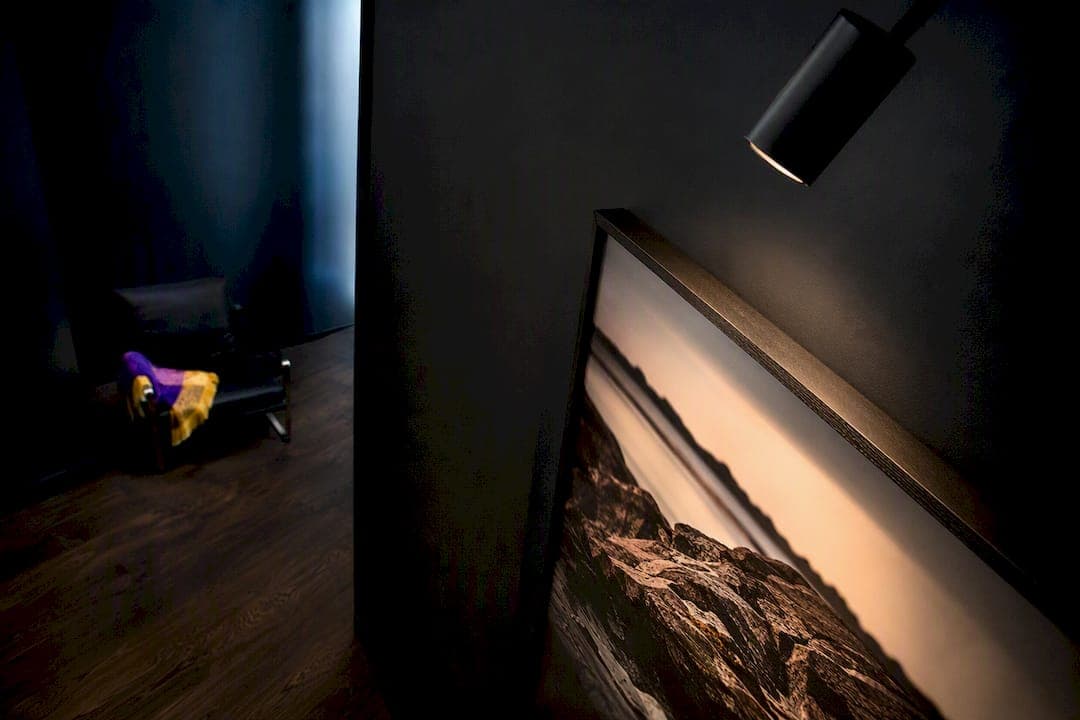
Picture lights suit single framed pieces; track lighting suits gallery walls with several works; recessed spots suit minimal ceilings. Whichever you choose, aim the fixture at roughly a 30-degree angle from vertical, position it about 2 to 3 feet from the wall on an 8-foot ceiling, and default to LED bulbs rated CRI 90+. That combination delivers accurate color and protects the work over time.
TL;DR:
- Choosing between picture lights, track lighting, recessed spots, or LED strip backlighting depends on the number of artworks and permanence of the installation.
- High-CRI LED fixtures rated CRI 90+ and a color temperature of 2700K to 3000K are essential for accurate color rendering and artwork preservation.
- Position lights at roughly a 30-degree angle from vertical and about 2 to 3 feet from the wall on an 8-foot ceiling for optimal illumination.
- Limit light exposure to around 50 lux for paper works to prevent fading over time, with LEDs being the safest option to minimize heat and UV damage.
- For photographic prints, aim for CRI 90+ fixtures at 3000K with diffused lenses, and adjust lighting angles to reduce glare on glossy surfaces.
Table of Contents
- Which fixture type is best for lighting wall art?
- What specs actually matter when buying art lighting?
- How do you position lights on wall art?
- How much light is too much for wall art?
- A photographer's notes on lighting photographic prints
- Why lighting changes how a print is actually seen
- Where to find display-ready prints and framing guidance
- Sources
Which fixture type is best for lighting wall art?
The right category depends on how many pieces you're lighting and how permanent the install needs to be. A single statement photograph over a mantel calls for something different than a stairwell hung with twelve prints.
Picture lights wash light down across one framed piece from a fixture mounted above or beside it. They come in plug-in, hardwired, and rechargeable versions, which makes them the accessible upgrade for a single high-impact work when running new wiring isn't realistic.
Ceiling track lighting uses a mounted rail with multiple aimable heads, letting you light an entire gallery wall and re-aim every head as the collection changes. Interior lighting specialists consider track systems the gallery standard precisely because they combine multiple heads, high CRI options, and full re-aimability, though a cheap track head with weak CRI defeats the purpose.
Recessed or adjustable ceiling spots sit flush with the ceiling for a cleaner look, trading some flexibility for a tidier sightline. They suit minimalist rooms where visible hardware feels wrong, but once installed, moving them means cutting into drywall.
LED strip backlighting hides behind a frame or inside a floating frame to create a soft halo effect. Treat it as mood lighting, not a substitute for a directed spot.
Rechargeable picture lights deserve a separate mention. In rental homes or rooms with awkward wiring, a battery-powered picture light gives you the gallery look with no electrician involved.
| Category | Best for | Installation | Color temp / CRI | Price / commitment |
|---|---|---|---|---|
| Picture lights | Single framed pieces | Plug-in, hardwired, or rechargeable | 2700K to 3000K, CRI 90+ available | Low to moderate, quick install |
| Track lighting | Gallery walls, rotating collections | Hardwired rail, multiple heads | 3000K default, CRI 90+ recommended | Moderate to high, electrician often needed |
| Recessed/adjustable spots | Minimalist or built-in rooms | Hardwired, cut into ceiling | 2700K to 3000K, CRI 90+ | Higher, permanent install |
| LED strip backlighting | Mood lighting, floating frames | Hardwired or plug-in strip | Varies, ambient use only | Low to moderate |
All four categories, along with high-CRI LED bulbs, are widely stocked by Australian lighting retailers and electrical suppliers, so sourcing hardware locally is rarely the bottleneck. The bigger decision is matching the fixture to your wall, not finding one that exists.
What specs actually matter when buying art lighting?
Color rendering index, or CRI, measures how accurately a light source reveals true color compared to natural daylight. For wall art, choose LED fixtures rated CRI 90+ every time. A CRI 80 bulb will still light the room, but it flattens reds and mutes greens, which matters enormously on a photograph or oil painting where color is the entire point.
Color temperature is the second lever. Start at 2700K to 3000K for most home artwork. That warmer range flatters skin tones and earthy landscape palettes. Push toward 3000K when a room already runs cooler or when you're lighting a large gallery wall and want visual consistency across every head, since designers commonly recommend a single practical default rather than mixing temperatures.
Beam angle should scale to the piece. A narrow beam on a large canvas creates a hot spot in the middle and dark corners; a wider beam on a small print wastes light on the wall around it.
Installation tiers, roughly in order of commitment:
- Swap the bulb only (cheapest, works with any existing fixture)
- Plug-in picture light (no electrician required)
- Rechargeable picture light (zero wiring, ideal for rentals)
- Hardwired track or recessed lighting (permanent, highest upfront cost)
Pro Tip: Buy dimmable LED fixtures even if you don't plan to dim them today. Light levels that look right at midday often feel harsh after sunset, and a dimmer lets you correct that without swapping bulbs.
How do you position lights on wall art?
The 30-degree rule is the backbone of good art lighting. Aim the fixture so the beam hits the wall at roughly 30 degrees from vertical, which angles light down across the surface without throwing a hard shadow line beneath the frame or bouncing glare straight back at the viewer.
Two exceptions matter. Behind glass, narrow the angle to 15 to 20 degrees to push the reflection point below eye level. On heavily textured work like impasto oil paintings, steepen it to 40 to 45 degrees to enhance the shadow relief instead of flattening it.
Distance from the wall scales with ceiling height:
- 8-foot ceiling: position fixtures 2 to 3 feet from the wall.
- 10-foot ceiling: move out to 3 to 4 feet, scaling up proportionally beyond that.
- Track too close to the wall creates hotspots at the top of the frame and shadow at the bottom. The 2 to 3 foot band on 8-foot ceilings keeps beam spread predictable for most standard heads.
If you're using a picture light instead of ceiling fixtures, size the fixture to about two-thirds to three-quarters of the artwork's width and mount it 4 to 6 inches above the top of the frame. For a full gallery wall, space track heads so beams overlap slightly at the edges rather than leaving dark seams between pieces. Our wall art size guide walks through matching fixture width to frame dimensions in more detail.
Once everything's mounted, run this checklist:
- Stand at your normal viewing distance and check for glare off glass.
- Walk the room at different times of day to catch competing daylight.
- Adjust angle in small increments. Half a degree of tilt changes the shadow line more than you'd expect.
How much light is too much for wall art?
Light damages art cumulatively, and conservators use lux, a measure of light intensity, to set safe ceilings by medium. Works on paper, including many photographic prints, should stay at roughly 50 lux or below to limit fading over years of display. Oil paintings and more light-stable prints can tolerate 150 to 200 lux. The exposure that matters isn't a single bright afternoon. It's years of daily accumulation.
This is where fixture choice becomes a preservation decision, not just an aesthetic one. LEDs emit minimal heat and virtually no UV radiation compared to halogen, which makes them the safer default for both color fidelity and long-term condition. Avoid halogen entirely for valuable pieces, and never hang art in continuous direct sunlight.
- Add UV-protective window film or glazing when a piece sits near a window with unavoidable daylight.
- Dust fixtures and lenses periodically. A dusty lens dims output unevenly and can look like a fading print.
- Check for hotspots every few months. Fixtures shift slightly over time.
- Replace bulbs with the same CRI and color temperature rating, not just "a warm white LED."
A photographer's notes on lighting photographic prints
Photographic prints behave differently under light than paintings, mainly because of surface finish. Mount most prints at standard gallery eye level, around 57 to 60 inches to the center of the piece, and be deliberate about glare on glossy or glass-faced prints. A slightly steeper angle than the standard 30 degrees often clears the reflection zone on a glossy surface.
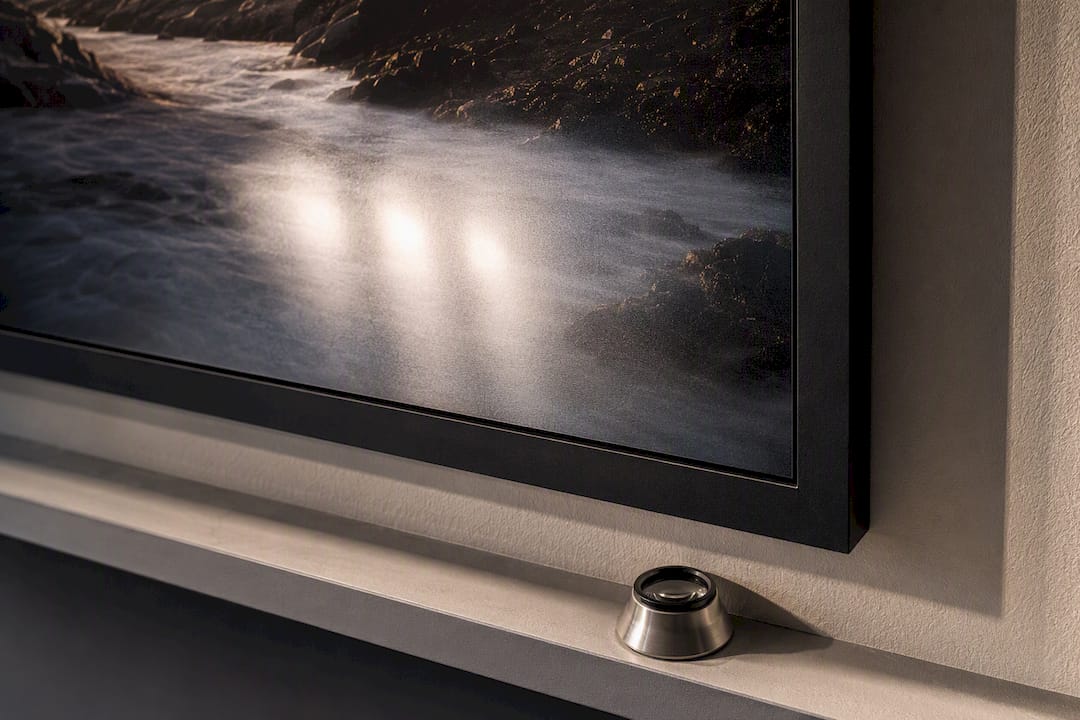
For color accuracy on landscape and travel photography specifically, I favor CRI 90+ fixtures at 3000K with a diffused lens rather than a bare, pinpoint LED. Rechargeable picture lights work well for rotating exhibition walls or workshop displays where pieces change often; hardwired track earns its keep in a permanent collector's room. For sizing and framing decisions before you even reach the lighting stage, our guide to curating a landscape photography wall gallery covers the groundwork.
Why lighting changes how a print is actually seen
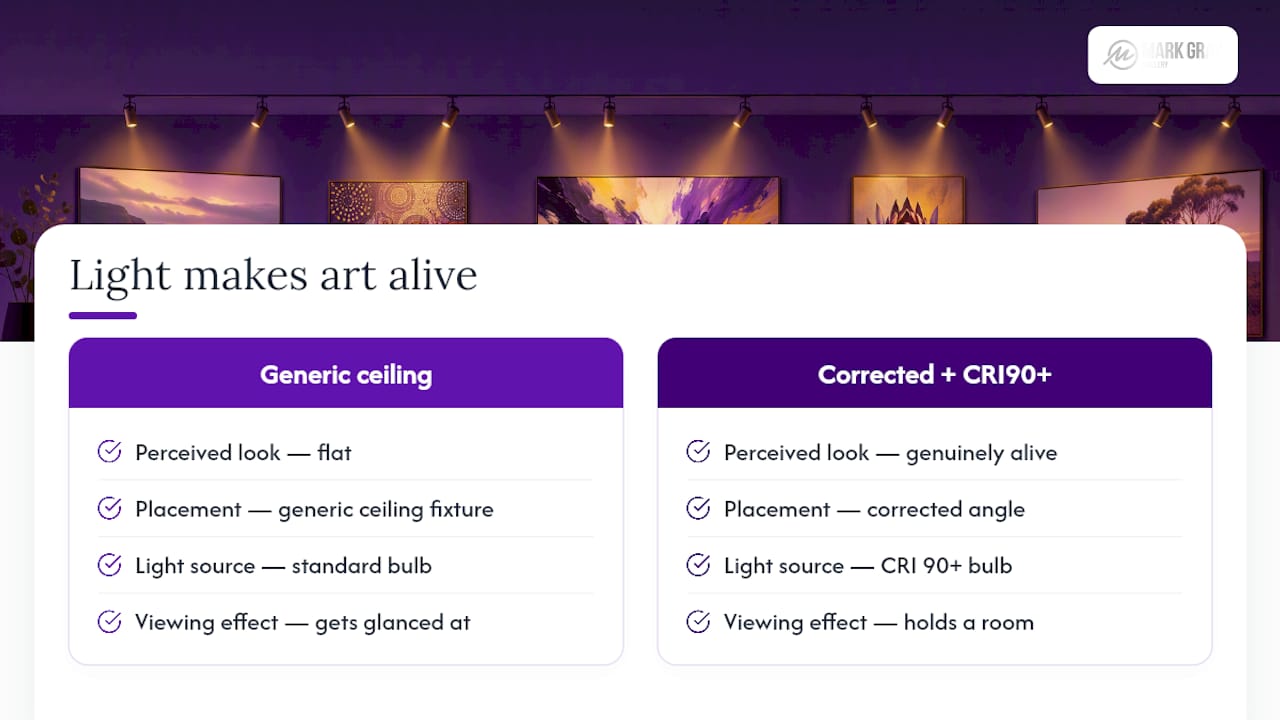
I've watched the same limited edition print read as flat under a generic ceiling fixture and then feel genuinely alive once someone corrected the angle and swapped in a proper CRI 90+ bulb. The image didn't change. The light around it did.
That's the part collectors underestimate: lighting isn't decoration you add after the art is hung. It's the difference between a piece that gets glanced at and one that holds a room. The trick is balancing that impact against preservation. Bright enough to do the work justice, controlled enough to protect it for decades.
— Mark
Where to find display-ready prints and framing guidance
Getting the lighting right is only half the equation. What you're lighting matters just as much, and that's where a fine art photography gallery comes in. Limited edition and open edition landscape photography prints in framing-ready sizes, along with a gift range and stock image licensing for commercial use, are commonly available from specialized galleries. We don't sell lighting hardware. What we do offer is display-ready work built to look right under exactly the setup this guide describes.
If you're building a gallery wall around a signature piece, browse the full print collection to find a work suited to your space, or reach out to discuss commissioning a piece sized for a specific wall. For guidance on choosing sizes before you buy, see our wall art size guide and our notes on caring for fine art photography prints once your piece is hung.
Sources
- Picture Lights, Art Lights & Lighting for Paintings | Lumens
- Picture Lights: Your Complete Guide to Illuminating Artwork