
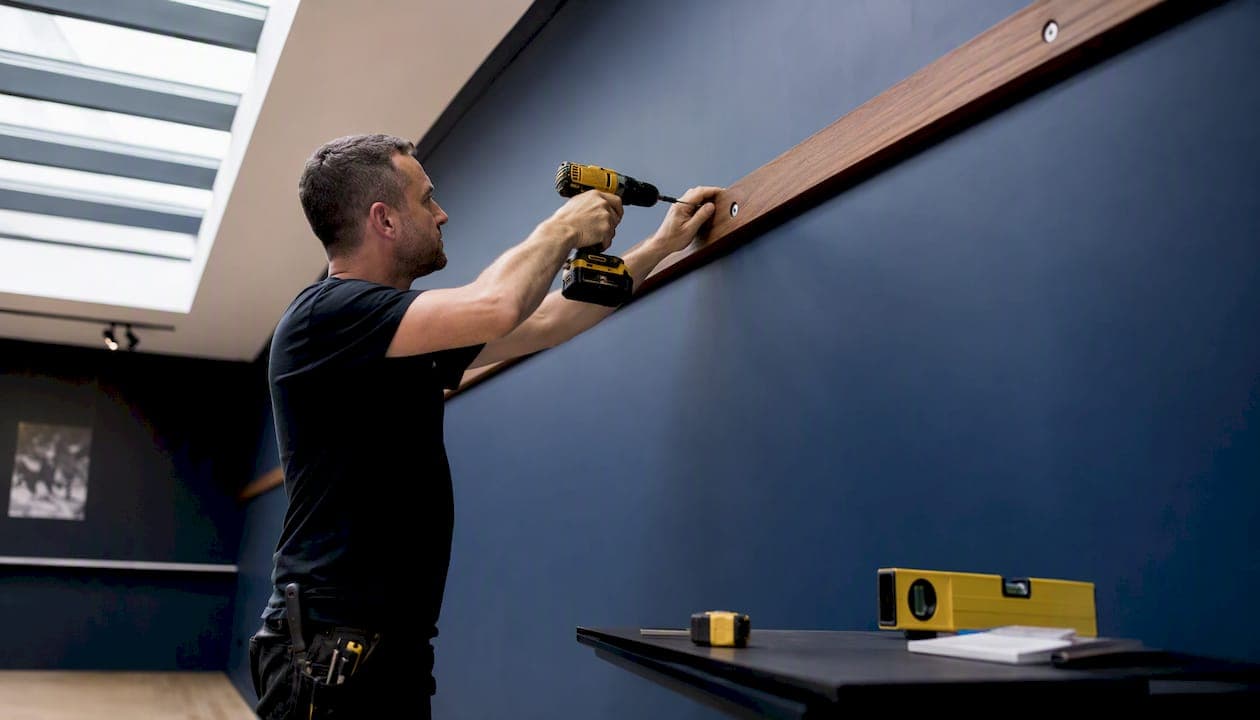
For most homes, galleries, and offices in Australia, a wall-mounted rail/track system is the right choice. It lets you reposition artwork without drilling new holes every time, supports prints from light posters up to around 15 kg, and suits everything from a single landscape print to a rotating gallery wall. For permanent, heavy pieces over 22 kg, a French cleat is the professional standard. Everything else falls between those two anchors.
Quick picks by use case:
- Under 5 kg (posters, small prints): magnetic or wood rail, or a standard two-D-ring and wire setup
- 5–15 kg (medium framed prints, acrylics): wall-mounted rail/track system with rated cords, or heavy-duty anchors into studs
- Over 22 kg (large limited editions, heavy frames): French cleat or a ceiling-fixed track anchored to structural joists
Key Takeaways
For most Australian buyers, a wall-mounted rail/track system is the right print hanging system for flexible, damage-free display, with French cleats reserved for pieces over 22 kg.
| Point | Details |
|---|---|
| Match system to weight | Under 5 kg: magnetic or wood rail. 5–15 kg: rated wall track. Over 22 kg: French cleat into studs. |
| Rail systems for rotating walls | Track systems allow unlimited repositioning without new wall holes, making them the best long-term choice for changing displays. |
| Hardware rated to 2x hung weight | Always choose hooks and anchors rated to at least twice the actual weight of the piece being hung. |
| Two-point hang for all framed prints | Use two D-rings and braided wire rather than a single central hook to distribute load and keep frames level. |
| Mark Gray Gallery | Offers advice and installer referrals for collectors displaying landscape photography prints across Australia. |
Table of Contents
- Which print hanging systems are available in Australia?
- How do you choose the right hanging system?
- What are the main types of print and picture hanging systems?
- Where can you buy these systems in Australia?
- Gallery-grade installation tips from an Australian print expert
- What the gallery experience teaches about choosing a system
- Mark Gray Gallery can help you hang your prints right
- Sources
Which print hanging systems are available in Australia?
The table below covers the systems you'll actually find in the Australian market, matched to the dimensions that matter most for buyers.
| System | Best for | Weight capacity | Mount type | Adjustability | Wall damage | DIY vs. pro | Australian availability |
|---|---|---|---|---|---|---|---|
| The Gallery System (Slimline) | Home, small galleries, retail | Up to ~15 kg per cord | Wall track | High | Damage-free (track only) | DIY-friendly | Direct online, AU stock |
| Gallery360 | AU buyers wanting local support | Varies by product | Wall/ceiling track, standoffs | High | Damage-free (track) | DIY or pro | Perth showroom + online |
| AS Hanging Display Systems | Offices, galleries, retail | Commercial-grade, varies | Wall/ceiling track | High | Damage-free | DIY or pro | AU reseller, replacement parts |
| Shadowline Ceiling Fixed | High-ceiling galleries, commercial | Heavy loads (anchored to joists) | Ceiling track | High | Ceiling fixings only | Pro recommended | Via AU fit-out suppliers |
| Top Rail | Public buildings, rotating exhibits | Varies by rail spec | Top-mounted wall rail | High | Drilled fixings | Pro recommended | Gallery/commercial suppliers |
| The Hangmaster | Home and small commercial | Light to medium | Wall track | Moderate | Damage-free | DIY | AU online |
| STAS | Homes, galleries, offices | Up to 30 kg per cord (model-dependent) | Wall/ceiling track with cords | Very high | Damage-free | DIY-friendly | AU resellers |
| Artiteq Click Rail | Home, light commercial | Up to 20 kg per cord | Wall track (click-fit) | High | Damage-free | DIY | AU resellers |
| Artiteq Click Rail Pro | Galleries, offices, heavier prints | Up to 30 kg per cord | Wall track (click-fit) | High | Damage-free | DIY or pro | AU resellers |
| Magnetic/wood rails | Posters, light prints | Under 5 kg | Magnetic/wood rail | Very high | Minimal | DIY | Specialty retailers AU |
| Standoffs | Acrylic prints, floating look | Light to medium | Direct wall (drilled) | Low | Drilled fixings | DIY or pro | Widely available AU |
| French cleat | Heavy framed work, >22 kg | 50 kg+ (stud-anchored) | Direct stud/wall | Low | Drilled fixings | Pro recommended | Hardware stores AU |
Notes on local support: Gallery360 operates a physical showroom in Perth, making it the strongest option for buyers who want to see product before purchasing or need an in-person installation consultation. AS Hanging supplies replacement cords, hooks, and cord grips through its Australian network, which matters for long-term maintenance. STAS is available through local resellers rather than a dedicated AU storefront; confirm stock before ordering. Artiteq products reach Australia via resellers and typically ship within standard lead times.
How do you choose the right hanging system?
Work through these decisions in order, and you'll narrow the field quickly.
- Weigh the piece. Bathroom scales work for most frames. Under 5 kg, almost any system qualifies. Between 5–15 kg, you need rated cords and either stud anchors or a quality track. Over 22 kg, plan for a French cleat or a ceiling-fixed rail anchored to structural joists. Over 50 kg is for professionals only.
- Identify your wall type. Drywall (plasterboard) is the most common in Australian homes and limits anchor load significantly. Plaster over brick or solid masonry holds far more. Brick requires masonry anchors. Know what you're drilling into before you buy hardware.
- Decide how often you'll rearrange. If the answer is "regularly," a rail/track system pays for itself in saved wall repairs alone. If the piece is permanent, a French cleat or direct-stud mount is more secure and costs less upfront.
- Set your aesthetic priority. Slimline rails and magnetic wood rails disappear behind the art. Standoffs make the mounting part of the display. Ceiling tracks are nearly invisible from below. French cleats are hidden behind the frame.
- Check your budget. Track-and-cord kits typically start around AU$50–$120 for a single rail length, with cords and hooks extra. Standoff kits for a single acrylic panel run AU$30–$80. French cleat sets are inexpensive in materials but may need professional labor. Full professional installation for a gallery wall adds AU$150–$400+ depending on scope.
- Confirm warranty and local service. For commercial installs, ask the supplier about track lifetime warranty, cord replacement policy, and whether they stock spare parts locally.
Questions to ask your supplier or installer before committing:
- What mount type does this rail require, and does it need stud alignment?
- What is the maximum load per cord, and what is the total rail capacity?
- Are replacement cords and hooks available locally in Australia?
- What is the lead time for made-to-order lengths?
- Does installation include on-site leveling and a final load test?
Statistic callout: Professional gallery guides recommend choosing hardware rated to at least twice the actual hung weight. A 10 kg print needs hooks and anchors rated to 20 kg minimum.
Pro Tip: Before purchasing any hanging kit, verify that your frame has the right fittings on its back: two D-rings (not a single central ring) and braided steel wire rather than twisted wire. The frame side fails just as often as the wall side, and upgrading to braided wire costs almost nothing compared to a dropped print.
For large-format display decisions, the large format photography display guide covers mounting options specific to oversized landscape prints.
What are the main types of print and picture hanging systems?
Rail and track systems
Rail systems mount a horizontal track to the wall or ceiling, then suspend adjustable cords with hooks that grip the frame wire. The defining advantage is flexibility: artwork repositions without new wall holes, which makes these systems the preferred choice for rotating displays in commercial spaces, galleries, and any home wall that changes seasonally. Wall-mounted rails sit near the ceiling line; ceiling-flush tracks like Shadowline integrate into the ceiling itself and are nearly invisible from the floor.
STAS, Artiteq Click Rail, Artiteq Click Rail Pro, AS Hanging, The Gallery System (Slimline), and Gallery360 all operate on this principle. The Artiteq Click Rail Pro and STAS models support up to 30 kg per cord on appropriate anchors, making them viable for medium-heavy framed prints. The Gallery System's Slimline profile is particularly suited to interior design-focused installs where the rail itself should disappear.
Slimline, magnetic, and wood rail systems
Slimline rails prioritize a low-profile finish over maximum load capacity. Magnetic and wood rail systems, like the Edo-style magnetic print rails, clamp the top and bottom edges of a poster or unframed print between two rails held together by strong magnets. Install is fast, swap time is seconds, and the aesthetic is clean and contemporary. Check the magnet rating and maximum poster width before buying: some models specify limits by the centimeter. These suit prints under 5 kg and work best for paper or canvas rather than heavy framed work.
Standoffs for acrylic prints
Standoffs mount directly to the wall through drilled holes and hold an acrylic panel at a fixed distance, typically around 19 mm from the surface, creating a floating effect that suits contemporary photography prints. The mounting approach is fundamentally different from rail systems: each standoff position is fixed, so repositioning means new holes. The visual payoff is striking for the right print, particularly large acrylic landscape panels.
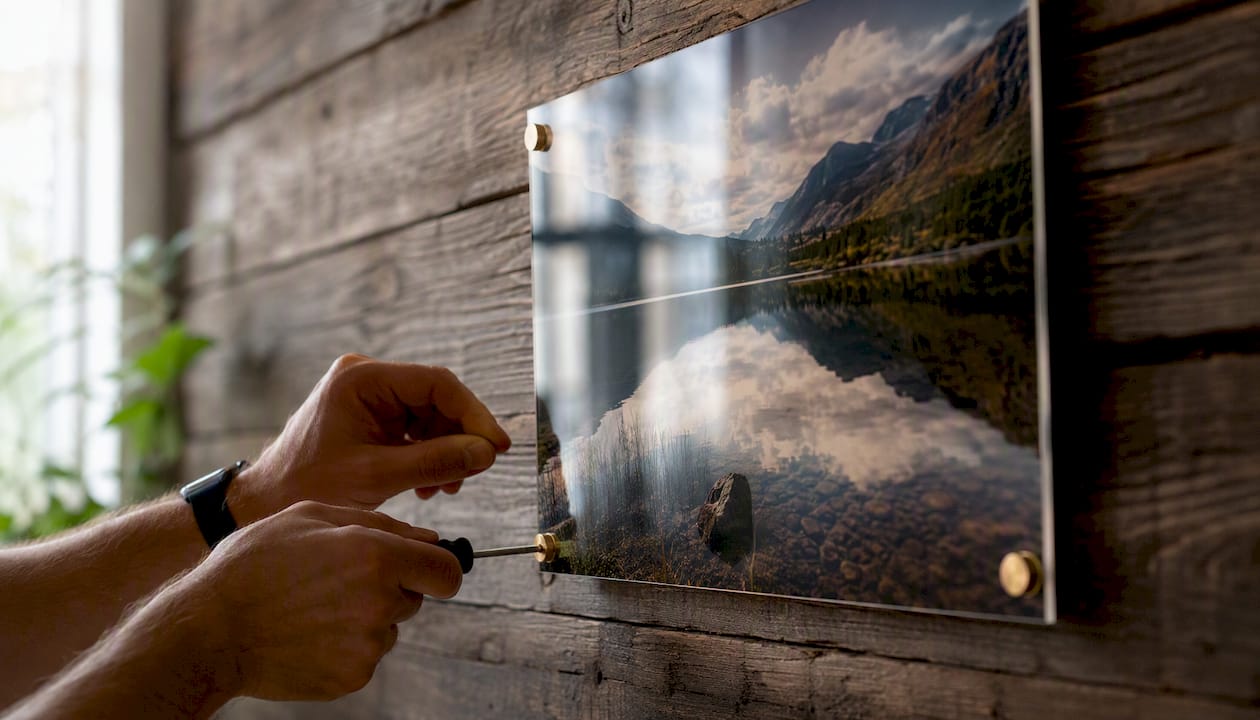
Pro Tip: When installing standoffs for acrylic prints, tighten each cap to finger-tight plus a quarter turn only. Going further causes radial stress cracks around the mounting holes, which are irreversible on an acrylic panel.
French cleats and two-point systems
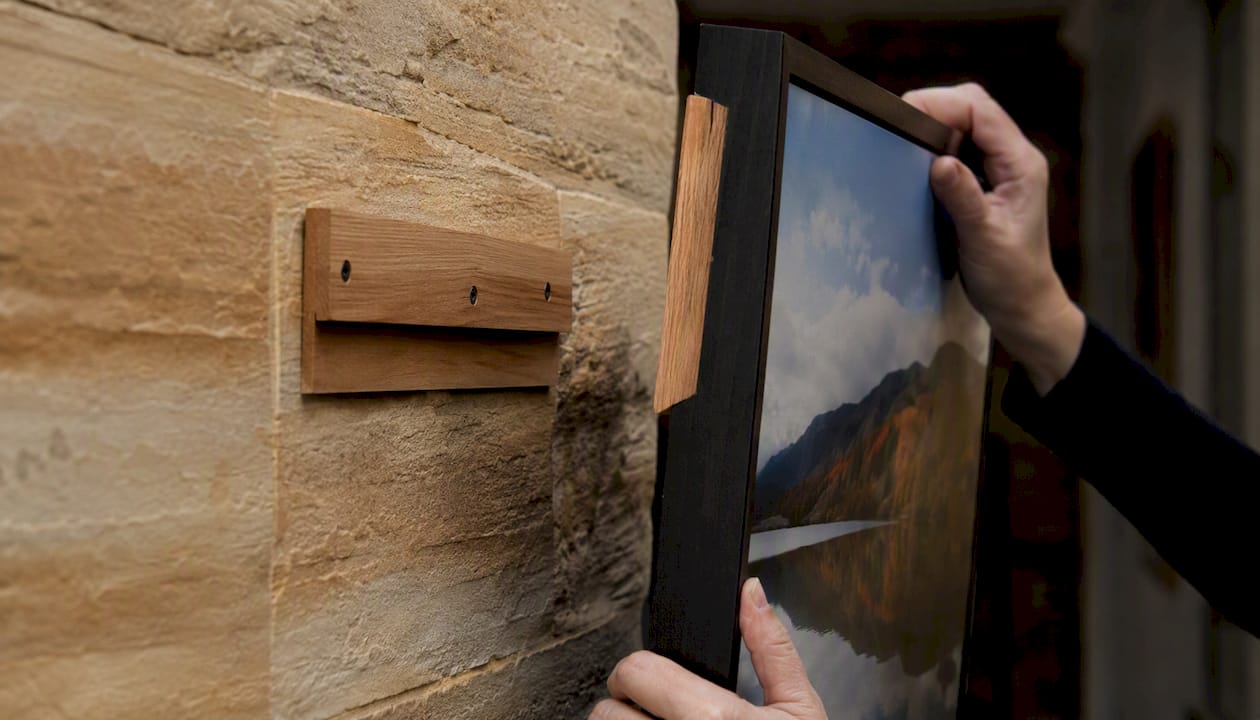
A French cleat is two interlocking beveled strips: one fixed to the wall into studs, one attached to the frame. The frame simply hooks over the wall strip and can slide horizontally for fine adjustment. For anything over 22 kg, French cleats are the professional standard because they distribute load across the full width of the cleat rather than concentrating it at two hook points. Galleries routinely use cleats for heavy limited-edition prints and large framed works. Pairing a cleat with a safe heavy-object fixing approach into structural studs or masonry is non-negotiable at this weight class.
Direct stud mounting and anchors
For medium prints on drywall without a rail system, the anchor choice determines the weight limit. Standard plastic anchors handle 5–10 kg at best. Toggle anchors (butterfly bolts) distribute load across the back of the drywall panel and can support 15–25 kg depending on panel thickness. Stud mounting bypasses the anchor entirely and is the most secure option for direct-wall hangs. A stud finder is a AU$20–$50 investment that prevents the most common mid-weight hanging failure.
Typical weight capacity by system type:
| System type | Typical capacity per point | Notes |
|---|---|---|
| Magnetic/wood rail | suitable for light-weight prints | Width limits apply; check model spec |
| Standard wall track (single cord) | typically supports moderate weights | Depends on rail anchor and cord rating |
| Pro rail (STAS, Artiteq Click Rail Pro) | suitable for medium-weight uses per cord | Requires correct wall anchor or stud |
| Standoffs (4-point) | suitable for light to medium weights | Acrylic panel thickness matters |
| French cleat (stud-anchored) | recommended for heavy framed pieces | Load distributes across full cleat width |
| Ceiling-fixed track (Shadowline) | designed for heavy loads | Must anchor to structural joists |
Where can you buy these systems in Australia?
Retailers and resellers:
- The Gallery System (Slimline): Available direct online at thegallerysystem.com.au with Australian stock and shipping. Good documentation and product range for home and small gallery buyers.
- Gallery360: Perth-based showroom plus online sales; the strongest option for Western Australian buyers wanting to inspect product in person or arrange local installation.
- AS Hanging Display Systems: Australian reseller network with replacement parts availability; suited to commercial buyers who need ongoing cord and hook supply.
- STAS: Available through Australian resellers; confirm current stock and lead times before ordering, as availability varies by model.
- Artiteq Click Rail and Click Rail Pro: Stocked by Australian art supply and framing retailers; check local framing shops and online art supply stores.
- The Hangmaster: Available online for Australian buyers; suits home installs and light commercial use.
- Magnetic/wood rails and standoffs: Widely available through Australian hardware chains, specialty art supply retailers, and online marketplaces.
- French cleat materials: Standard hardware stores (Bunnings, Mitre 10) stock the timber and aluminum extrusions needed; pre-made cleat sets are available online.
When to hire a professional installer:
Hire a pro for any piece over 22 kg, for ceiling-fixed track systems (Shadowline and similar), for commercial fit-outs with multiple rails, or when your wall type is uncertain. Gallery installers and specialized art hanging services operate in most Australian capital cities. A professional brings a laser level, stud finder, and load-testing experience that prevents the most expensive mistakes.
Warranty signals to check:
Look for a lifetime warranty on the rail itself (track extrusion), a cord replacement policy (cords stretch and degrade over years), and confirmation that spare hooks and cord grips are available locally. AS Hanging's Australian network is specifically noted for replacement parts availability. For any commercial install, ask whether the installer offers a workmanship guarantee on the hanging itself, separate from the product warranty.
Lead times: Most standard rail lengths ship from Australian stock within a few business days. Made-to-order lengths (custom cuts for Shadowline ceiling tracks and commercial fit-outs) typically require 2–4 weeks. Confirm before committing to an installation date.
Gallery-grade installation tips from an Australian print expert
Getting the hardware right is half the job. The other half is the installation itself, and this is where most amateur hangs go wrong.
Top installation mistakes and how to avoid them:
- Single hook failure. The wall hook or anchor is the most common failure point in amateur installs, not the wire or frame. Upgrade to professional-rated hooks and verify the anchor type matches your wall. A hook rated to twice the hung weight is the minimum standard.
- Wire stretch on a single D-ring. A single central D-ring concentrates all load at one point and allows the frame to tilt. Use two D-rings positioned one-quarter of the frame width in from each side, connected by braided steel wire.
- Skipping the stud finder. Drywall anchors fail at loads that stud-mounted hooks handle easily. Spend two minutes with a stud finder before drilling.
- Overtightening standoff caps. Covered above, but worth repeating: finger-tight plus a quarter turn only on acrylic panels.
Step-by-step gallery-quality hang:
- Weigh the piece on bathroom scales. Note the weight and choose hardware rated to at least 2x that figure.
- Check the frame back: two D-rings, braided wire, no single-point hangers.
- Use the tape trick: press painter's tape across the frame's back hardware, mark the hook centers on the tape, then transfer the tape to the wall at the correct height. Drill exactly where the marks land.
- Use a laser level to confirm horizontal alignment before fastening.
- Hang the piece, then apply felt bumpers to the bottom two corners of the frame. Bumpers keep the frame plumb, protect the wall surface, and prevent the print from shifting.
Preservation after hanging:
Avoid direct sunlight on any framed print; UV exposure fades pigment inks over months, not years. For acrylic-mounted prints, keep them away from heat sources: thermal expansion behind the panel causes stress at the standoff points over time. Archival backing on framed prints slows moisture and acid migration from the frame materials. More on long-term care is covered in the fine art print care guide.
What the gallery experience teaches about choosing a system
The single most consistent lesson from hanging prints in gallery and collector settings is that the system you choose should match the wall's purpose, not just the print's weight. A wall that changes four times a year needs a rail. A wall that holds one permanent statement piece needs a cleat or a stud-mounted hook rated well above the load.
At Mark Gray Gallery, the preference for collector-grade limited editions is always a two-point hang with braided wire and rated hooks, or a French cleat for the heaviest pieces. Rail systems are the recommendation for clients who want to rotate between prints from the collection without calling a tradesperson every time. The aesthetic finish matters too: a slimline rail in a brushed aluminum finish disappears behind a landscape print in a way that a visible standoff bracket never will.
The honest advice is this: buy the hardware once at the right rating, and you will not think about it again for a decade. Buy cheap hooks to save AU$15, and you will be repairing a wall and a frame within a year.
Mark Gray Gallery can help you hang your prints right
Choosing the right system is straightforward once you know the weight, wall type, and how often you plan to rearrange. Where it gets complicated is the installation itself, particularly for large-format limited edition landscape prints that deserve a gallery-quality result.
Mark Gray Gallery works with collectors across Australia to advise on the best hanging approach for each specific print, wall, and space. Whether you need a recommendation on which rail system suits your home, a referral to a trusted local installer, or guidance on how to display a large acrylic or framed landscape print correctly, the gallery is available to help. There is no pressure and no minimum spend on advice.
Browse the landscape photography print collection and reach out directly for a no-obligation conversation about display and installation options for your space.