
For collectors, the answer is clear: limited-edition photographic prints are curated, scarce artworks with documented provenance; print-on-demand (POD) is a production and fulfillment model built for accessibility and volume. These are not competing quality levels — they are fundamentally different products serving different purposes.
- Limited editions carry a fixed run size, artist signature, certificate of authenticity (COA), and archival production specs. Scarcity and provenance drive their collector value.
- POD prints are produced after each order is placed, with no edition cap, no COA, and quality that varies by vendor.
- For investment-grade landscape photography, choose limited editions with documented provenance. For decor, gifts, or testing a new image, POD is a practical and affordable fit.
- Mark Gray Gallery offers gallery-quality limited edition landscape prints with full COA documentation and archival production standards.
Table of Contents
- What does print-on-demand mean for photography buyers?
- What makes a photographic print a true limited edition?
- How do POD and limited editions compare on the factors collectors care about?
- What production specs actually matter for collector-grade prints?
- Why do limited editions hold or gain value while POD generally does not?
- How do you verify authenticity before buying a limited edition?
- What should you ask before buying? A practical checklist
- How should you care for and frame prints to protect their value?
- When should you choose a limited edition, and when is POD the right call?
- Key Takeaways
- Why edition size and intent matter more than most buyers realize
- Mark Gray Gallery: gallery-quality limited editions for serious collectors
- Further reading and sources
What does print-on-demand mean for photography buyers?
Print-on-demand is a make-after-order production model: a customer places an order, a vendor prints and ships the item, and the seller never holds inventory. For photographers, that means uploading an image file, connecting it to a POD platform, and letting the vendor handle the rest.
- No upfront investment in stock or warehouse space — the seller pays only when a sale occurs.
- Open edition by default — there is no cap on how many copies can be sold, which means no scarcity and no collector premium.
- Vendor-dependent quality — POD output varies widely; some services deliver washed-out colors on lightweight paper, while higher-tier vendors approach better results.
- Typical product mix: open-edition decor prints, mugs, puzzles, phone cases, and gift items.
- Higher per-unit cost than bulk small-batch printing, though zero inventory risk offsets that for low-volume sellers.
Pro Tip: Use POD for design testing and gift-range items. Never assume a POD print meets archival or collector-grade standards without verifying the vendor's paper weight, ink type, and color calibration process.
What makes a photographic print a true limited edition?
A limited-edition print is an authorized, capped run produced to specified archival standards, with full provenance documentation. According to Sotheby's, an editioned photograph produced under the artist's authorization is treated as an original artwork — collectors evaluate editions by size, print dimensions, print date, and production process.
- Edition size: the total number of prints authorized in the run. Smaller editions command stronger scarcity premiums.
- Numbering: each print is marked (e.g., 7/25), confirming its place within the run and the total authorized quantity.
- Artist signature: hand-signed by the photographer, confirming personal authorization.
- Certificate of authenticity (COA): a primary trust document stating edition number, size, image title, paper and ink specs, and the artist's signature.
- Release statement: a formal declaration of the edition size and the commitment not to reprint beyond that number.
- Production control: small-batch printing with proofing, color matching, and inspected finishing — consistency across every print in the run.
A valid COA, documented edition size, and a gallery invoice or provenance record are the three primary trust signals every collector should request before purchase.
Explore the full range of edition types for collectors to understand how different release formats affect long-term value.
How do POD and limited editions compare on the factors collectors care about?
Scarcity and production control are the decisive differences. POD prioritizes availability; limited editions prioritize rarity and consistency. Limited editions frequently include special finishes, premium archival materials, and signed certificates that are not standard in on-demand reproduction models.
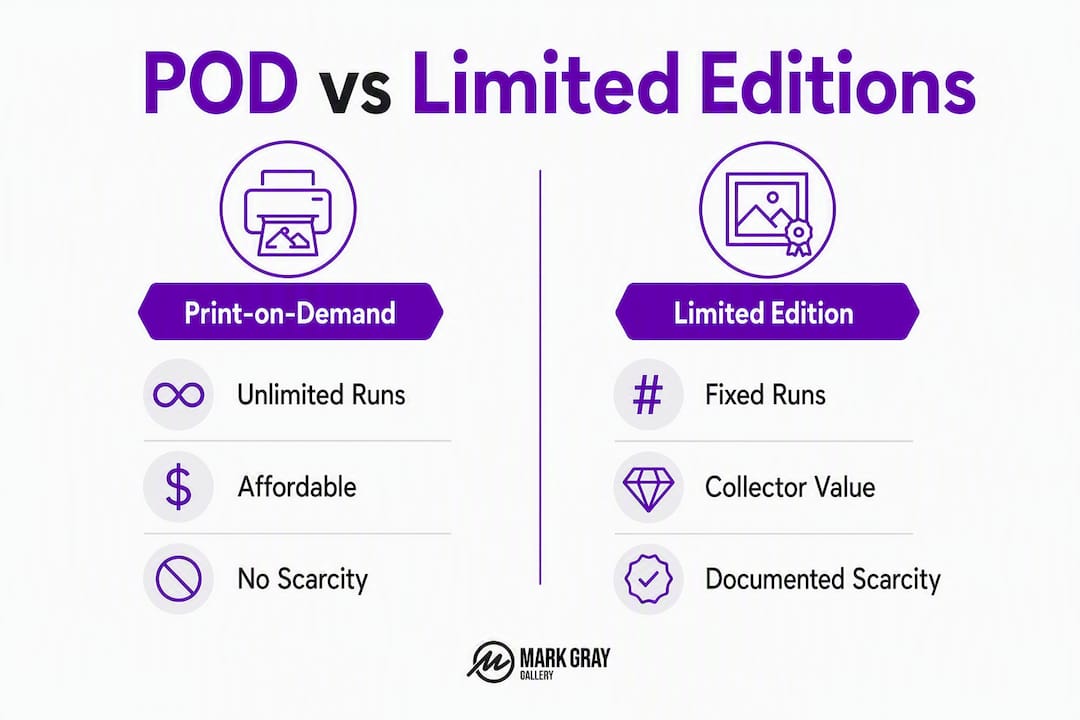
| Factor | Print-on-Demand | Limited Edition |
|---|---|---|
| Edition size | Unlimited / open | Fixed, documented cap |
| Scarcity | None | High — drives collector premium |
| Archival materials | Vendor-dependent | Specified: cotton rag, pigment inks |
| Artist control | Minimal post-upload | Full: proofing, signing, COA |
| Pricing | Lower entry point | Premium, reflects scarcity and production cost |
| Lead time | Days (automated) | Weeks (proofing, signing, inspection) |
| Resale potential | Very limited | Supported by provenance and scarcity |
| Typical use | Decor, gifts, merch | Collector investment, gallery display |
A numbered, signed 25-piece landscape run behaves very differently in the market than an open-edition POD poster of the same image. The former has a verifiable supply ceiling; the latter does not.
What production specs actually matter for collector-grade prints?
Archival paper and pigment inks, combined with controlled printing processes, are non-negotiable for collector-grade work. Small-batch printing allows proofing and quality inspection that supports a premium collector offering — POD workflows delegate these controls to automated vendor processes.
- Paper: cotton rag or alpha-cellulose fine art papers, typically 300gsm or heavier, acid-free and pH-neutral.
- Inks: pigment-based inks resist fading far longer than dye-based alternatives; ask for the specific ink set used.
- Printing method: giclée (archival inkjet) is the standard for fine art photography; chromogenic (C-print) is used for certain photographic papers.
- Color management: ICC profiles, calibrated monitors, and lab proofing ensure the printed image matches the artist's intent.
- Finishing: surface choice (matte, lustre, gloss), trimming, and mounting all affect the final presentation and longevity.
Learn more about how fine art printing works and what to look for when reviewing a printer's specifications.
Pro Tip: Before committing to a high-value purchase, ask the gallery for a production proof and the specific archival specifications — paper weight, paper mill, ink set, and the ICC profile used for color management.
Why do limited editions hold or gain value while POD generally does not?
Limited editions are priced for scarcity and perceived collectibility; POD is priced for accessibility and volume. The economic logic is straightforward: when supply is capped and documented, demand can exceed supply over time, supporting secondary-market interest. Collectors treat editioned photographs as original works when produced under artist authorization with documentary evidence.
- Pricing premium: edition numbering, artist signature, archival materials, and COA issuance all add to production cost and justify a higher retail price.
- Resale liquidity: a COA, gallery invoice, and documented edition size give secondary buyers the confidence to transact. Without them, resale is speculative at best.
- POD economics: per-unit POD pricing trades a higher unit cost for zero inventory risk — a sensible trade for merch, not for collector-grade art.
Understand the full picture of why limited editions appreciate and what provenance factors matter most to secondary buyers.
How do you verify authenticity before buying a limited edition?
Authentication requires documented provenance, a COA, edition documentation, and direct artist or gallery confirmation. A reputable gallery will have all of this ready before you ask.
- Request the COA — confirm it states the edition number, total edition size, image title, paper and ink specs, and the artist's signature.
- Verify the edition number — the number on the print (e.g., 7/25) must match the COA exactly.
- Confirm the artist signature — hand-signed on the print itself, not a printed facsimile.
- Ask for a production proof — a gallery-quality seller can provide a reference proof showing color accuracy and finishing standards.
- Request a gallery invoice or provenance record — this documents the chain of ownership and supports future resale.
- Check the release statement — a formal commitment that no additional prints beyond the stated edition size will be produced.
Pro Tip: If documentation is missing, inconsistent, or the seller cannot produce a production proof, treat the work as a decorative reproduction rather than a collectible.
What should you ask before buying? A practical checklist
Use this checklist to confirm edition status, materials, provenance, and policies before any purchase. How a seller answers these questions tells you almost everything you need to know.
- Edition size and availability: "How many prints are in this edition, and how many remain?"
- COA and signature: "Does each print come with a signed COA, and is the print hand-signed?"
- Material specs: "What paper and ink are used? Can you provide the paper mill and ink set details?"
- Proofing and color accuracy: "Can I see a production proof or color reference?"
- Framing and shipping: "What framing options do you recommend, and how is the print packaged for shipping?"
- Return policy: "What is your return policy for fine art prints versus gift items?"
A POD seller will typically answer material questions with generic platform specs and cannot offer a production proof or COA. A gallery selling limited editions will answer every question with specific documentation. That gap is the clearest signal of which product you are actually buying. For deeper guidance, review what makes a fine art print collectible.
How should you care for and frame prints to protect their value?
Proper archival framing and environmental control are the two most important steps in preserving both image quality and resale value. A print that fades or yellows within a decade loses both its visual impact and its market credibility.
- Light: avoid direct sunlight and use UV-filtering glazing (museum glass or acrylic) to reduce fading.
- Humidity and temperature: maintain stable conditions; avoid bathrooms, kitchens, and exterior walls prone to condensation.
- Matting and backing: acid-free, archival-grade mat board and backing prevent chemical degradation over time.
- Framing materials: conservation-grade frames with reversible mounting methods allow future conservation without damaging the print.
- Documentation: keep the COA, gallery invoice, and framing records together — a conservator-grade framing invoice can strengthen provenance at resale.
Pro Tip: Document your framing choices on the provenance record. Buyers in the secondary market value knowing the print has been stored and displayed correctly since purchase.
Explore professional framing guidance for limited edition prints to match your framing choices to the archival specs of your print.
When should you choose a limited edition, and when is POD the right call?
If you want investment-grade, scarcity-backed work, choose limited editions. If you want affordable decor or gifts, POD is usually the right fit. Many photographers adopt a hybrid model: limited editions for gallery drops and collector releases, POD for merchandise and open-edition items.
| Buyer Intent | Recommended Format | Key Reason |
|---|---|---|
| Building a collector investment wall | Limited edition | Scarcity, provenance, archival longevity |
| Seasonal decor or room refresh | POD or open edition | Affordable, accessible, no COA needed |
| Gifting photography enthusiasts | POD gift range | Low cost, wide product variety |
| Anchor piece for a curated gallery wall | Limited edition | Documented value, display quality |
| Testing a new image or design | POD | Zero inventory risk, fast turnaround |
Pro Tip: Mix both strategies. Buy limited editions for anchor pieces that define your collection, and use POD for complementary decor or gifts. This protects your investment while keeping your space flexible.
Key Takeaways
Limited editions deliver collector value through scarcity, archival production, and documented provenance; POD delivers accessibility and affordability without those guarantees.
| Point | Details |
|---|---|
| Scarcity is the core difference | Limited editions have a fixed, documented run; POD is open supply with no collector premium. |
| Always request full documentation | COA, edition number, artist signature, and gallery invoice are non-negotiable for collector purchases. |
| Materials determine longevity | Archival pigment inks and acid-free cotton rag paper are the standard for investment-grade prints. |
| POD suits decor and gifts | Use POD for affordable, accessible products; it is not suited to investment-grade collecting. |
| Mark Gray Gallery | Offers curated limited-edition landscape prints with full COA, archival specs, and provenance documentation. |
Why edition size and intent matter more than most buyers realize
The most common mistake collectors make is treating all photographic prints as equivalent products differentiated only by price. They are not. A POD poster and a signed, numbered limited-edition print of the same image are economically and materially different objects — one is merchandise, the other is a documented artwork.
What I find most underappreciated is the role of intent in edition value. When an artist commits to a fixed edition size and signs every print, they are making a binding promise to every buyer in that run. That promise is what the secondary market prices. Without it, you are buying a reproduction, regardless of how beautiful the image is.
The hybrid strategy — limited editions for collector releases, POD for the gift range — is not a compromise. It is the most honest way to serve both audiences without diluting either offering. Collectors get scarcity and provenance; gift buyers get accessibility and variety. Both get exactly what they came for.
At Mark Gray Gallery, every limited-edition landscape print is produced with this separation in mind. The edition size is set before printing begins, every print is signed and numbered, and the COA travels with the work. That discipline is what separates a collectible from a commodity.
Mark Gray Gallery: gallery-quality limited editions for serious collectors
For collectors who want the full package — archival production, signed and numbered prints, COA documentation, and provenance records — Mark Gray Gallery offers a curated collection of premium limited-edition landscape photography from Australia, New Zealand, Norway, Iceland, French Polynesia, Spain, and the United Kingdom.
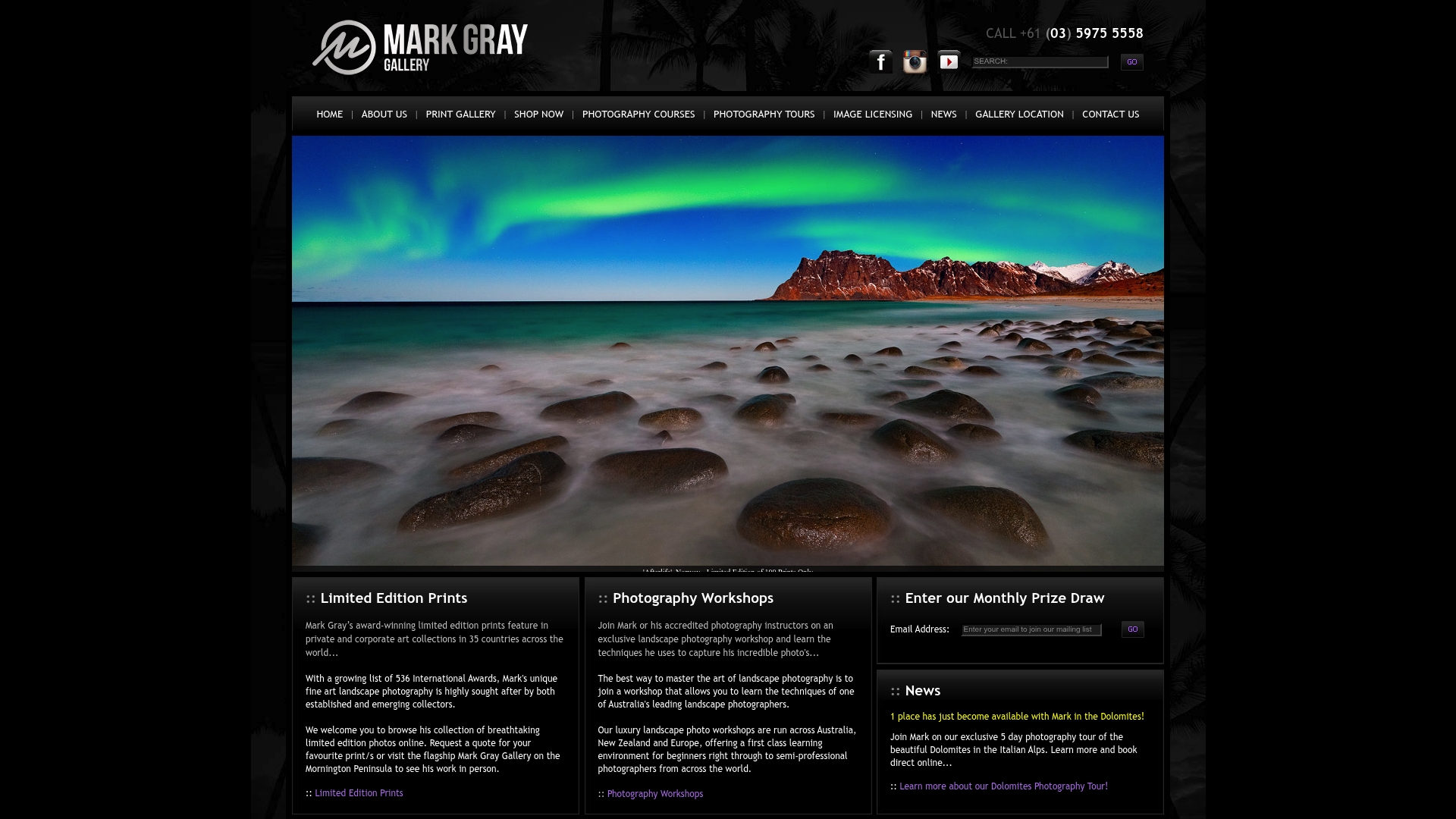
Every edition is produced to strict archival standards: pigment inks, acid-free fine art papers, and color-managed printing. COA documentation and gallery provenance records are included with each purchase. The gallery also provides framing referrals and production proof references for buyers who want complete confidence before committing. View the current limited-edition collection and contact the gallery directly at markgray.com.au to discuss availability, edition sizes, or a custom commission.
Further reading and sources
- Print on Demand — Wikipedia: technical background on the POD production model and its mechanics.
- Print-On-Demand vs. Small-Batch Runs — reprint.top: core economic comparison of POD and small-batch production, including scarcity, materials, and pricing tradeoffs.
- Prints, Photographs, Sculptures, and Multiples — Sotheby's: authoritative guide to edition types, collector evaluation criteria, and how editioned photographs function as original artworks.
- How Artists Make Money Selling Prints and Editions — Mallory Shotwell: practical guidance on hybrid strategies, edition mechanics, and how professional photographers separate collector tiers from merch.
- What is Print on Demand — Printful: overview of POD platforms, vendor variability, and quality considerations for photographers using on-demand fulfillment.
- Best Print on Demand Companies for US Sellers — Savings Grove: a vetted roundup of POD platforms available in the United States, useful for photographers evaluating fulfillment options.