
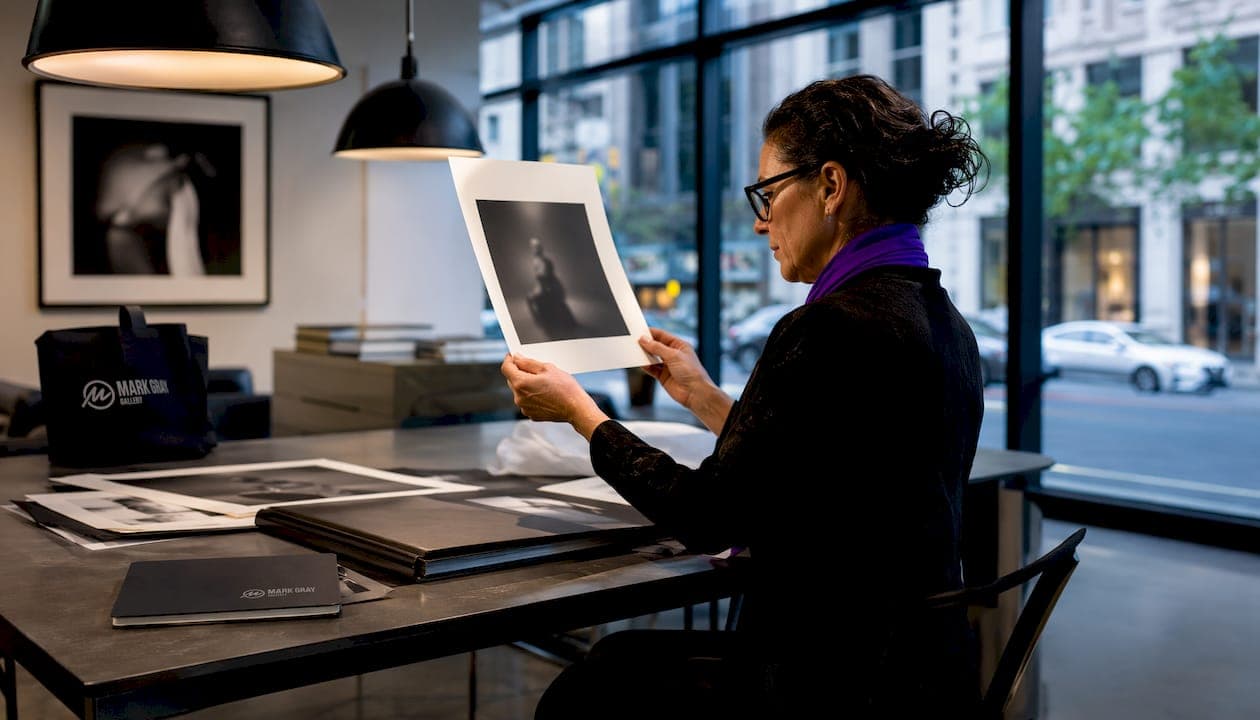
A museum-quality fine art photographic print follows a defined chain: high-quality digital capture, print-specific file preparation with calibrated color management, pigment-based giclée printing on an archival substrate, proofing and signed artist approval, and controlled editioning with a Certificate of Authenticity. Every link in that chain matters to you as a collector.
Quick collector checklist — insist on all of these before any edition is finalized:
- ICC profile name and the paper/printer combination it was built for
- Soft proof or hard proof on the actual substrate, viewed under standardized lighting
- Written edition size, numbering policy, and signed approval before the full run
- Certificate of Authenticity with paper, ink, edition number, and proof reference
- Recommended outgassing period and framing specifications
Table of Contents
- How the fine art printing process works, stage by stage
- File preparation and color management: what collectors should verify
- What makes a true fine art print: printers, inks, and substrates
- How studio proofing and artist approval protect edition consistency
- How limited editions are documented and authenticated
- Finishing, framing, and long-term conservation
- What a limited-edition print typically costs and how long it takes
- How to choose a fine art printing studio with confidence
- What Mark Gray's studio practice looks like in action
- Key Takeaways
- Why the printing process is the collector's real guarantee
- Mark Gray Gallery: limited-edition landscape prints, studio quality
- Useful sources
How the fine art printing process works, stage by stage
Understanding the full arc from original file to framed limited edition helps you ask the right questions at each stage and recognize when a studio is cutting corners.
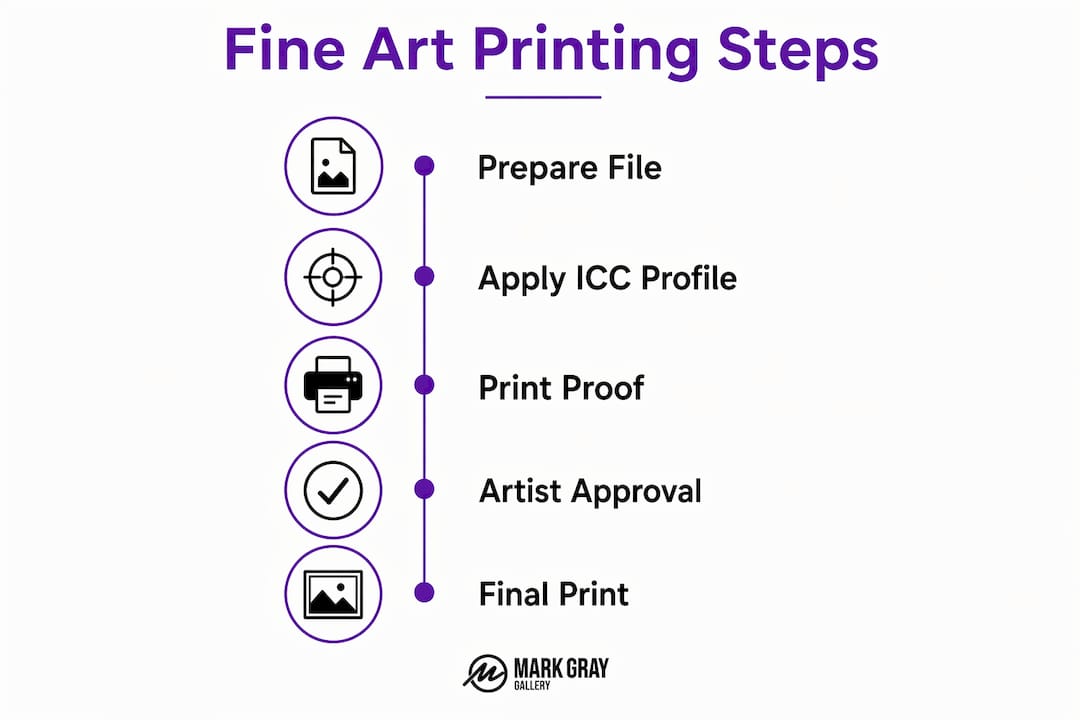
- Capture or digitization. The source file is either a high-resolution digital capture or a scan of a physical original. Digitization method must match the original: flatbed scanning for flat, non-textured works; large-format photography with cross-polarized lighting for textured canvases to eliminate glare artifacts.
- File preparation and color management. The file is edited in a large color space (Adobe RGB or ProPhoto RGB), at 300 PPI or higher at final print size, and prepared specifically for print rendering, not screen display.
- Soft proofing. Using the studio's ICC profile on a calibrated display, the editor previews how colors and tones will map to the chosen paper and ink set before a single sheet is printed.
- Hard proofing and artist approval. A physical proof is printed on the actual substrate, reviewed under standardized lighting, and signed off by the artist or studio before the full edition run begins.
- Giclée printing. Archival pigment inks are laid down through a large-format inkjet system onto the approved substrate, guided by the ICC profile throughout.
- Finishing and editioning. Prints are trimmed, mounted, and framed using archival materials; each print is numbered, signed, and issued with a Certificate of Authenticity.
- Packing and shipping. Finished prints are packed in acid-free materials with handling instructions and insured for transit.
File preparation and color management: what collectors should verify
Print-ready files are prepared in Adobe RGB or ProPhoto RGB, at 300 PPI or higher at final size, and saved as uncompressed TIFF where possible. Artists scanning originals at appropriate high resolution for smaller pieces export at a bit depth intended to preserve the full tonal range needed for large reproductions.
ICC profiles are mathematical color maps that translate a file's color space into accurate output for a specific printer, ink, and paper combination. Without a matching ICC profile, consistent color reproduction is largely guesswork. RIP software uses these profiles during final output translation, making them non-negotiable for any studio claiming archival quality.
Soft proofing on a calibrated display lets the editor see how the file will render on the chosen substrate before printing. Print-specific editing differs meaningfully from screen editing: midtones and shadow detail need careful preservation, whites must stay neutral, and sharpening should be restrained to avoid artifacts on textured papers.
Collector checklist for this stage:
- Request the ICC profile name and the paper/printer it was built for
- Ask for a soft-proof screenshot or proof PDF before approving the run
- Confirm file format (TIFF preferred), color space, and resolution at final print size
- Require a signed approval step before the edition proceeds
Pro Tip: Insist on a studio proof printed on the actual paper stock and evaluated under D50 or D65 standardized lighting. Screen-based approvals alone are not sufficient for edition sign-off.
What makes a true fine art print: printers, inks, and substrates
A true giclée print uses archival pigment-based inks, professional-grade substrates, and calibrated color management throughout. Large-format inkjet systems typically run multiple ink channels, which expands the color gamut well beyond what standard desktop printers can achieve and produces the smooth tonal gradations collectors associate with gallery-quality work.
Substrate choice shapes the final character of the print as much as the printer itself. The four main categories:
- Cotton rag papers. Acid-free, lignin-free, and capable of extraordinary fine detail. The preferred choice for photographic fine art prints intended for long-term collection.
- Baryta papers. A fiber-based coating that mimics the look and feel of traditional darkroom silver gelatin prints. Excellent for deep blacks and photographic shadow detail.
- Textured fine-art stocks. Handmade or mould-made papers with visible surface texture. They add tactile character but can soften fine detail compared to smooth cotton rag.
- Archival inkjet canvas. Allows stretched or gallery-wrap presentation. The woven texture adds visual depth but trades some fine-detail resolution against smooth paper options.
For each substrate, ask the studio for the manufacturer's paper name and the specific ICC profile built for that paper/printer combination. Permanence data from the paper manufacturer is worth requesting too. Explore the types of limited edition photography prints available to understand how substrate choice affects both appearance and collectible value.
How studio proofing and artist approval protect edition consistency
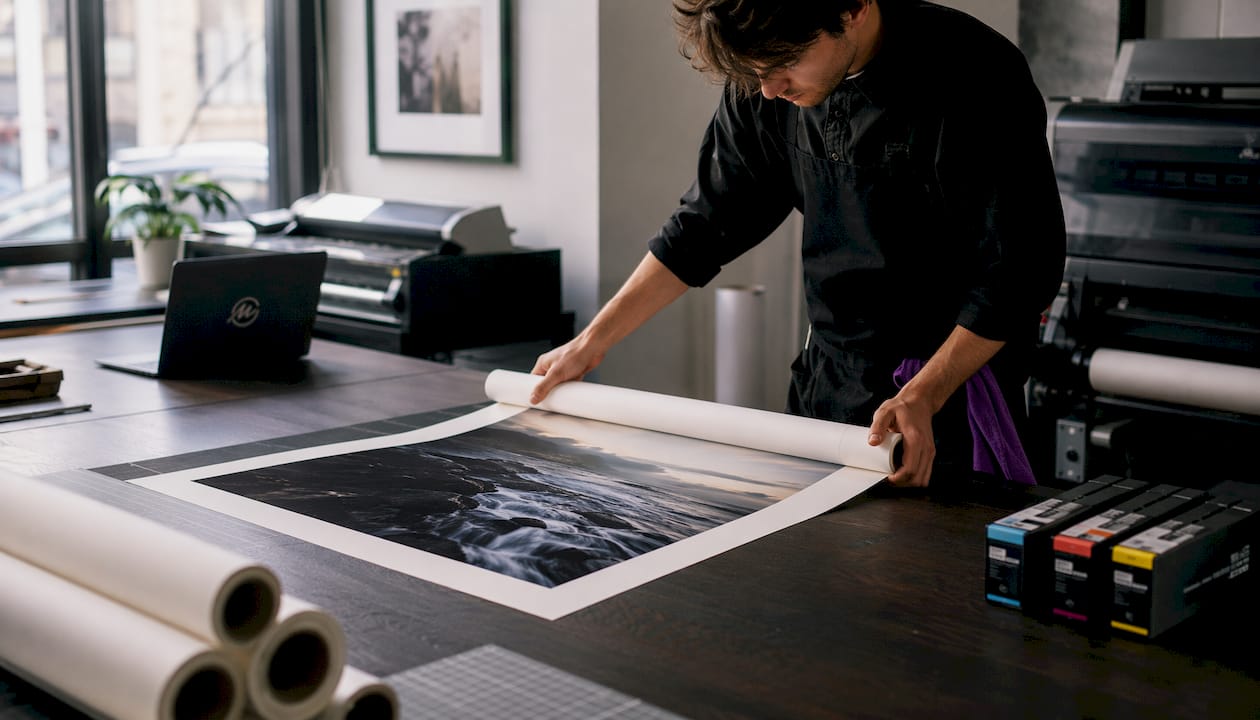
Proofing is where color and tonal accuracy are verified. It is the single most important step for guaranteeing that every print in an edition matches the approved standard. Studios recommend proofing to check color neutrality, shadow and highlight detail, paper feel, and cropping before scaling to a full run.
A typical approval workflow:
- Initial soft proof on a calibrated display using the studio's ICC profile
- Hard proof printed on the actual substrate at full or reduced size
- Artist or collector review under D50/D65 standardized lighting
- Revisions to file or settings if needed, followed by a second proof
- Signed approval document retained in the edition record before the full run begins
Common issues to watch for during review: color casts in neutrals, crushed shadow detail, clipped highlights, surface glare from incorrect paper/ink pairing, and scale-related artifacts that only appear at full print size.
Pro Tip: Require that the agreed final proof be retained physically and referenced in the Certificate of Authenticity. That retained proof is your benchmark if any print in the edition is later disputed. Learn more about what a proof means in a professional photography context.
How limited editions are documented and authenticated
To be genuinely collectible, a limited-edition print must have documented edition controls and a verifiable Certificate of Authenticity. Studios and collectors treat editioning as an archival investment: numbered prints, signed COAs, and controlled print runs convert a reproduction into an authorized collectible asset.
Edition formats typically follow the "1/50" convention, indicating the first print in an edition of fifty. Artist proofs (A/P) sit outside the main edition and are usually reserved for the artist or special sales. A complete COA should include:
- Artist name and title of the work
- Edition number and total edition size
- Paper name, ink type, and print dimensions
- Reference to the retained proof
- Studio contact details, artist signature, and date of production
Request the edition policy in writing before ordering, and make the COA a contractual part of the sale. The value of limited edition prints is directly tied to the strength of this documentation.
Finishing, framing, and long-term conservation
Finishing includes careful trimming, optional mounting using hinging or float-mount techniques, archival matting and glazing, and UV-protective varnish for canvas prints. Each choice affects both the immediate appearance and the long-term stability of the work.
Pigment inks require an outgassing period after printing before heavy handling or framing. Solvents need time to evaporate and the pigment needs to bond fully to the paper coating. Skipping this step risks abrasion, smudging, or long-term instability.
- Use acid-free mats and UV-filter glazing to protect against light degradation
- Include spacers between the print surface and the glass
- Display in climate-stable conditions, away from direct sunlight and humidity fluctuations
- Retain original packaging and COA with the print
Pro Tip: Ask the studio for their recommended curing period and framing specifications in writing before you arrange framing. A reputable studio will have this documented. For detailed guidance, see framing limited edition prints professionally.
What a limited-edition print typically costs and how long it takes
Production from final proof approval to a finished, framed limited-edition print typically takes several weeks, depending on studio workload, edition size, finishing complexity, and shipping distance. Custom framing and museum-grade glazing add materially to both time and cost.
Ranges are illustrative estimates only; actual costs vary by studio, print size, substrate, and finishing specification.
Key cost drivers to understand before approving a run:
- Proofing rounds (each additional round adds time and material cost)
- Paper and ink costs (cotton rag and baryta command a premium over standard stocks)
- Finishing complexity (float mounts, museum glazing, and custom frames add significantly)
- Insured shipping for large or framed works
Get a written cost breakdown and production timeline before approving any full edition run. See how photographers price their prints for further context on what drives those numbers.
How to choose a fine art printing studio with confidence
Choose a studio that demonstrates repeatable proofing practices, transparent ICC profile use, archival materials, and clear edition documentation. A studio that cannot answer basic questions about its process is a studio that cannot guarantee consistent edition output.
Questions to ask every studio:
- What ICC profiles and paper brands do you use, and can I have the profile for soft proofing?
- Can I see a hard proof on the actual substrate before the edition run?
- How do you log edition runs and issue COAs?
- What permanence data do you provide for your inks and papers?
- What is your outgassing or curing policy after printing?
Trust signals worth looking for:
- Published proofing workflow with documented approval steps
- Retention of proof records tied to edition logs
- Written edition policy provided before the sale
- Lab-tested permanence data for paper and ink combinations
- Gallery or museum references for previous limited-edition work
Red flags: refusal to provide an ICC profile or proof, vague material descriptions, unwillingness to sign an edition agreement, or no record of previous limited-edition production.
What Mark Gray's studio practice looks like in action
Experienced photographers and trusted studios formalize proof approval, maintain edition logs, and provide COAs and handling guidance as standard practice. At Mark Gray's studio, collectors can expect sample paper swatches, documented proof sign-off, controlled lighting for comparisons, and detailed COA contents that reference the retained proof.
Specific practices collectors should expect from any high-quality provider:
- Paper swatch samples provided before substrate selection is finalized
- Proof sign-off documented and retained as part of the edition record
- Standardized lighting used for all proof comparisons
- COA that includes paper name, ink type, edition number, proof reference, and artist signature
- Written handling and framing recommendations included with each print
Pro Tip: When a studio offers an on-site proofing session or a documented online proof gallery tied to the edition record, that is a strong signal of repeatable quality control. It means the studio can reproduce the same result for every print in the run.
Key Takeaways
A museum-quality limited-edition fine art print requires ICC-profiled color management, archival pigment inks on acid-free substrates, signed proof approval, and a verifiable Certificate of Authenticity before any edition is considered complete.
| Point | Details |
|---|---|
| ICC profiles are non-negotiable | Request the profile name and paper/printer pairing; without it, consistent color reproduction is unreliable. |
| Signed proof approval protects the edition | Retain the agreed hard proof in the edition record and reference it in the COA. |
| Archival materials define longevity | Cotton rag or baryta paper with pigment inks, acid-free mats, and UV glazing protect long-term value. |
| Outgassing before framing | Allow the studio's recommended curing period after printing before framing to prevent smudging or instability. |
| Mark Gray Gallery | Produces limited-edition landscape prints with documented proofing, archival materials, and COAs as standard. |
Why the printing process is the collector's real guarantee
The print process is not a technical footnote. It is the guarantee of authenticity, consistency, and longevity for a collectible photographic edition. Disciplined proofing and transparent material disclosure protect edition value and prevent disputes long after the sale is complete. A print without a retained proof and a verifiable COA is simply a reproduction, regardless of how beautiful it looks on the wall.
The collectors who have the most confidence in their acquisitions are the ones who asked the right questions before approving the edition. Insist on documented proof and a complete COA before completing payment. That discipline protects your investment and honors the work itself.
Mark Gray Gallery: limited-edition landscape prints, studio quality
Mark Gray Gallery produces exclusive, limited-edition landscape photography prints to studio proof and museum standards, with documented COAs and archival materials on every edition. Each print goes through the full proofing collaboration described in this guide: substrate selection, ICC-profiled color management, signed approval, and controlled editioning.
The gallery offers proofing collaboration, archival paper and ink options, and recommended framing specifications for collectors who want the complete picture before they commit. Editions span sensational landscapes from Australia, New Zealand, Norway, Iceland, French Polynesia, Spain, and the United Kingdom, each produced with the same disciplined process outlined above.
To view the portfolio, request proof previews, or discuss edition policies and pricing, visit Mark Gray Gallery and take the next step toward owning a print built to last.
Useful sources
The following references informed the technical claims and workflow recommendations in this guide. Collectors are encouraged to request specific citations from any studio they engage, including paper manufacturer names and ink permanence data.
- Giclée Printing: Process, Materials & History Explained — World of Printmaking: ICC profiles, pigment inks, outgassing, and archival substrate requirements
- Behind the Print: The Complete Fine Art Reproduction Process Explained — The Color House Miami: print-specific editing, color accuracy, and studio-artist collaboration
- How to Prepare Files and Artwork for Fine Art Printing — Art Services Network: digitization methods, editioning, and COA practices
- Art Reproduction Printing Guide — SmartPhoto: proofing workflows and studio testing standards
- How to Make Fine Art Prints of Your Art — Alice Mathew Collection: scanning resolution, bit depth, and file export best practices
- Materials and Techniques — The Metropolitan Museum of Art: authoritative context on printmaking processes and material choices