
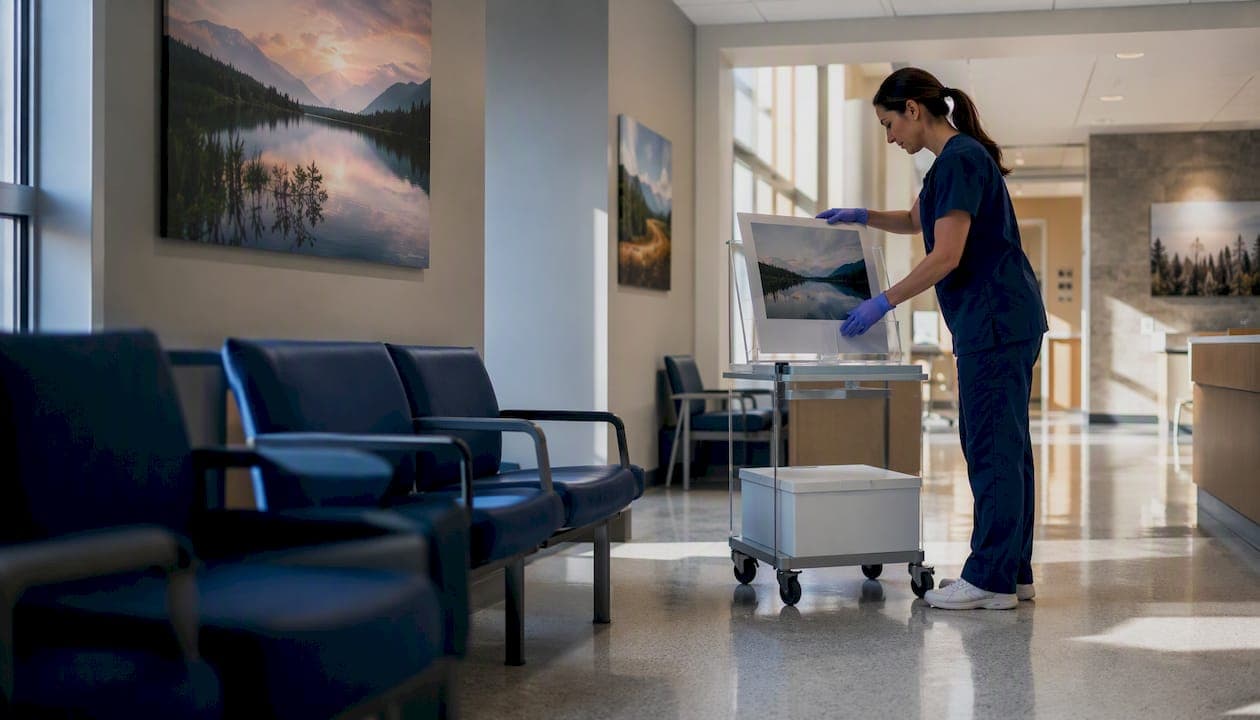
The right approach to healthcare art photography starts with nature-based, site-specific images rather than generic decor. Photography chosen for clinical spaces reduces measurable patient stress and reshapes how families perceive the quality of care they're receiving.
Start with an honest audit of your spaces: lobbies, corridors, patient rooms, behavioral health units. Then decide whether to buy prints, license images, or commission original work for the walls that matter most.
- Prioritize calming, nature-based imagery over abstract or clinical photography.
- Audit high-traffic and high-stress zones before spending a dollar.
- Match acquisition method (buy, license, commission) to timeline and budget.
Pro Tip: Photograph or list every wall you're considering before contacting a supplier. Dimensions, lighting conditions, and foot traffic patterns determine material choice as much as the image itself.
Key Takeaways
Nature-based, site-specific photography reduces patient stress and improves perceived quality of care when specified with cleanable, infection-control-appropriate materials.
| Point | Details |
|---|---|
| Audit before buying | Map every target wall's dimensions, lighting, and traffic before contacting suppliers. |
| Choose calming subjects | Landscapes, nature close-ups, and gentle abstracts outperform clinical or high-contrast imagery. |
| Match acquisition to need | Buy for speed, license for scale, commission for exclusivity, or use a gallery partner for full projects. |
| Specify cleanable materials | Use acrylic-faced or aluminum composite panels with sealed, powder-coated frames in clinical zones. |
| Consider Mark Gray Gallery | Offers prints, licensing, and site-specific commissions suited to healthcare procurement timelines. |
Table of Contents
- Why Photographic Art Matters in Hospital Design
- What Photography Styles Work Best in Clinical Spaces?
- How Should a Hospital Acquire Art: Buy, License, or Commission?
- What Materials and Framing Keep Art Clean and Safe?
- How Do You Write a Brief for a Healthcare Art Supplier?
- How Do You Measure the Impact of Healthcare Art?
- What Does Mark Gray Gallery Offer Healthcare Projects?
- A Practitioner's Note on Working Inside Clinical Protocols
- Ready to Bring Healthcare Art Photography to Your Facility?
- Frequently Asked Questions
- Sources
Why Photographic Art Matters in Hospital Design
Curated art measurably reduces stress and changes how patients judge the safety and quality of care around them. NYC Health + Hospitals built its position on a WHO 2019 evidence synthesis confirming this link, and now stewards an 8,000-work collection matched deliberately to the emotional needs of specific spaces, from lobbies to pediatric units to behavioral health milieus.
The practical payoffs extend well past patient comfort. Staff working surrounded by considered imagery report better morale. Donors and board members read a well-curated collection as evidence of institutional care. Recruitment teams use it too. A hospital that feels human is easier to hire into.
Nature photography carries particular weight here. The Foundation for Photo/Art in Hospitals reports that nature images give patients, caregivers, and families color, comfort, and hope, which is why the foundation donates full portfolios to minimize cost barriers for hospitals.
- Lobbies and waiting areas: highest visibility, highest first-impression value.
- ICU and behavioral health sightlines: highest emotional stakes, lowest tolerance for the wrong image.
- Pediatric units: need distinct visual language from adult inpatient floors.
Pro Tip: If budget is limited, spend it first on ICU sightlines and behavioral health corridors. Those are the spaces where the wrong image, or no image, does the most damage.
What Photography Styles Work Best in Clinical Spaces?
Calming landscapes, close-up nature studies, and gentle abstracts outperform almost everything else in clinical environments. These subjects give the eye a slow, low-demand path to follow, the visual equivalent of an unhurried breath, which is part of why they show up again and again in evidence-backed hospital art programs.
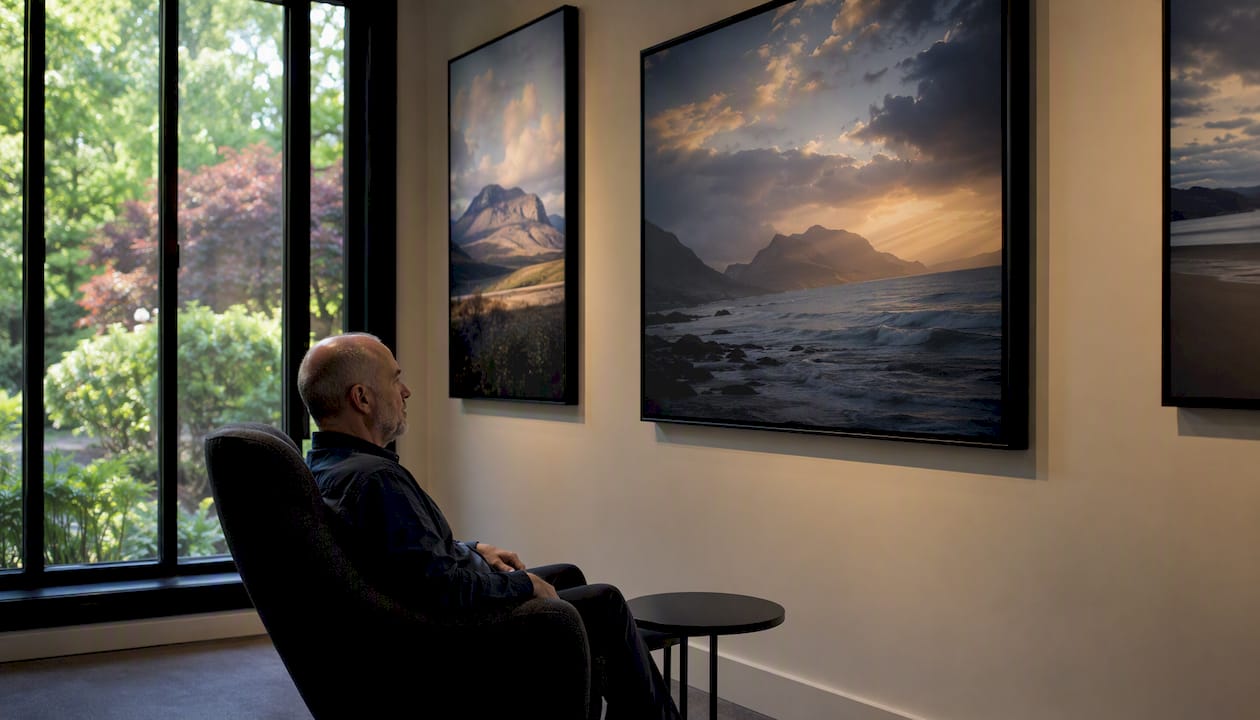
Avoid anything with high-contrast patterns, aggressive color clashes, or subject matter that could read as clinical, violent, or unsettling to someone already anxious. Portraiture featuring visible medical procedures has no place outside of consent-driven editorial contexts. Culturally specific or religious imagery needs care too. What reads as comforting to one community can alienate another in the same waiting room.
Accessibility matters as much as subject matter. Sufficient contrast helps patients with low vision. Avoid busy compositions that strain eyes already dealing with medication side effects or fatigue.
- Water, forests, coastlines, and open sky consistently test well across patient populations.
- Macro nature studies (bark, leaves, stone) work in tighter corridor spaces where a full landscape can't breathe.
- Gentle abstracts drawn from natural forms suit behavioral health units needing lower visual intensity.
- Avoid: clinical procedure imagery, high-contrast graphic patterns, culturally narrow symbolism.
Pro Tip: Test candidate images on a printed board in the actual hallway before committing to a full order. Fluorescent lighting and traffic flow change how a photograph reads compared to a screen preview.
How Should a Hospital Acquire Art: Buy, License, or Commission?
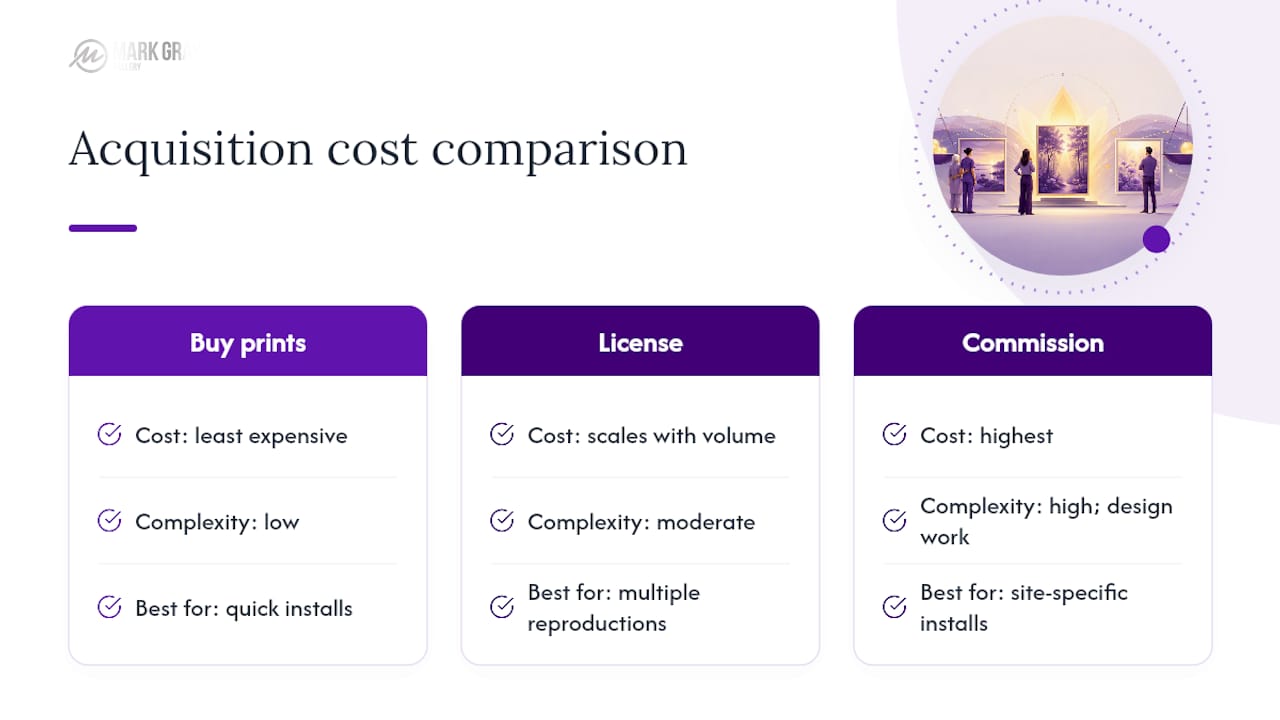
Four routes cover almost every institutional need: buying existing limited-edition prints, licensing images for reproduction, commissioning site-specific work, or partnering with a gallery that manages the whole project. Pick based on how much exclusivity and customization your space actually needs.
Buying prints is fastest and cheapest, ideal for lobbies and standard patient rooms where proven, tested imagery does the job. Licensing suits larger reproduction runs, such as repeating a theme across dozens of identical rooms in a new wing. Commissioning delivers imagery tailored to a specific architectural context, as demonstrated by studio MAHA's Quiet Topographies series developed with Sharp HealthCare's project team around sightlines and scale. Gallery partnerships combine sourcing, licensing, and project management under one point of contact, which matters most for multi-building rollouts.
- Buy: fastest turnaround, lowest cost, least customization.
- License: best for repeated use across many identical spaces.
- Commission: highest cost and lead time, best fit and exclusivity.
- Gallery partnership: single point of contact for larger, multi-space projects.
Some programs lower cost further through donation. The Foundation for Photo/Art in Hospitals subsidizes printing, framing, and shipping so hospitals receive finished, donated works at little to no cost.
Pro Tip: Get budget approval for the full project scope before soliciting quotes. Piecemeal approvals slow commissioned work far more than the photography itself does.
What Materials and Framing Keep Art Clean and Safe?
Cleanable, impact-resistant, moisture-resistant surfaces belong in every clinical zone, full stop. That generally means laminated prints sealed behind acrylic, or images printed directly onto aluminum composite panels with a hard, non-porous face. Traditional glass framing, porous mat board, and fabric-wrapped canvas all present infection-control problems that outweigh their aesthetic advantages.
Suggested substrates and mounting approach:
- Acrylic-faced prints: scratch-resistant, wipeable, good clarity for large-format landscape work.
- Aluminum composite (dibond) panels: rigid, lightweight, ideal for larger corridor pieces and mount flush to reduce dust-trapping edges.
- Sealed, powder-coated frames: avoid raw wood or fabric matting; powder coating wipes clean without degrading.
- Anti-glare coating: essential near windows or overhead lighting, especially in patient rooms where viewing angle is fixed from a bed.
Maintenance needs a schedule, not a one-time decision. Build cleaning protocols that match your facility's existing infection-control cadence, generally a wipeable surface cleaned on the same rotation as other high-touch fixtures. Request a warranty covering surface degradation from repeated disinfectant use, and plan a replacement cycle for any pieces installed in high-humidity zones like near patient bathrooms.
Safety and compliance note: Never install porous framing materials, fabric mats, or untreated wood in clinical zones. Facilities teams should reject any submission that can't be wiped down with standard hospital disinfectant.
- Confirm substrate is non-porous before approving any vendor sample.
- Match anti-glare coating to the room's actual lighting, not a showroom.
- Set a cleaning cadence aligned with existing infection-control protocols.
Pro Tip: Ask suppliers for a disinfectant-compatibility statement in writing. A print that looks fine on delivery can degrade after a hundred wipe-downs with hospital-grade cleaner.
How Do You Write a Brief for a Healthcare Art Supplier?
Every brief needs five things before you send it anywhere: the spaces being addressed, hygiene and material requirements, the rights you need, the budget range, and the timeline. Skipping any one of these produces quotes you can't actually compare against each other.
- Define target spaces with dimensions, lighting conditions, and traffic level.
- Specify hygiene requirements (wipeable surface, non-porous framing).
- State the rights needed: one-time purchase, licensed reproduction, or exclusivity.
- Set a budget range, not a single number, so vendors can propose options.
- Give a realistic timeline, including installation and any required approvals.
When comparing suppliers, ask about insurance coverage, whether their materials have been tested for hospital cleaning protocols, who handles installation, typical lead times, and whether they can provide references from prior healthcare projects. Medical photography briefs that involve people, procedures, or identifiable patients require explicit written consent and clear terms on how long images may be used and where. If a photographer will be shooting on-site rather than supplying existing work, consent-first workflows and hygiene coordination with your infection-control team should be non-negotiable parts of the contract.
- Confirm exclusivity terms in writing before signing.
- Require documented consent for any image featuring identifiable people.
- Ask for a warranty and a defined reproduction window.
Pro Tip: Request two reference sites from any vendor claiming healthcare experience, and actually call them. Installation quality varies enormously between vendors who mostly sell to hotels and those who understand clinical constraints.
How Do You Measure the Impact of Healthcare Art?
Three measurement streams give you a defensible before-and-after story: patient experience surveys, staff well-being metrics, and operational proxies like reduced complaint volume or improved satisfaction scores in renovated units.
- Add one or two art-specific questions to existing patient satisfaction surveys ("Did the visual environment feel calming?").
- Track staff feedback separately, since morale effects often show up faster than patient-reported outcomes.
- Compare complaint logs or satisfaction scores for a renovated wing against a control unit that hasn't changed yet.
Run a small pilot in one wing before committing budget system-wide. Expect early signal within two to three months, with clearer trends by six. Present results to stakeholders as a simple before-and-after comparison tied to the specific spaces you upgraded, not a system-wide average that dilutes the effect.
- Survey question: "Did the artwork in this space feel calming or distracting?"
- Pair patient data with staff feedback for a fuller picture.
- Pilot one unit first; expand only after seeing a clear trend.
What Does Mark Gray Gallery Offer Healthcare Projects?
Mark Gray Gallery supplies limited- and open-edition landscape prints, commercial image licensing, and site-specific commission work, backed by project support suited to healthcare installations. That combination matters because most healthcare buyers need at least two of those services in the same project, not just a single print sale—much like how experienced commercial photography services align project management and production logistics in healthcare installations.
Available services include:
- Limited- and open-edition landscape prints ready for large-format hospital display.
- Image licensing for reproduction across multiple rooms or a full wing.
- Site-specific commission conversations for architecturally distinct spaces.
- Guidance on display and mounting options suited to institutional walls.
A portfolio spanning iconic landscape locations worldwide gives procurement teams a wide base of tested, calming imagery to review before committing to a custom shoot. Next steps typically start with a space audit, followed by a review of existing prints or a discussion of commissioned work, with proposal turnaround scaled to project size.
Pro Tip: Ask about sample loan options before a full purchase order. Seeing a large-format print in your actual lighting beats any digital proof.
A Practitioner's Note on Working Inside Clinical Protocols
Photographers who work in healthcare settings operate inside the same consent and hygiene rules as clinical staff, not around them. A pre-shoot walk-through with facilities and infection-control leads should happen before a single frame gets exposed, covering sightlines, patient privacy, and what surfaces can and can't be touched.
That coordination step isn't a formality. It's what keeps a photography project from becoming a disruption on a floor where disruption has real consequences.
Ready to Bring Healthcare Art Photography to Your Facility?
If you've read this far, you already know the gap between generic stock art and photography chosen for a specific hallway, waiting room, or ICU sightline. Mark Gray Gallery closes that gap with a working portfolio of tested landscape imagery, commercial licensing for multi-room rollouts, and commission conversations for spaces that need something built to fit.
A first meeting typically covers your space audit, a review of existing gallery-quality prints that might already fit your walls, and a rough sense of budget and lead time before any commission conversation begins. Explore the full print and licensing catalog and request a sample loan for the space you're prioritizing first.
Frequently Asked Questions
What is healthcare art photography? It's photography, typically nature or landscape imagery, deliberately selected and specified for clinical spaces to reduce patient stress and support a calmer care environment.
How much does hospital art photography typically cost? Costs vary widely by acquisition route. Buying existing prints is the least expensive option, licensing scales with reproduction volume, and commissioned site-specific work carries the highest cost due to design collaboration and custom production.
What materials are safest for hospital art installations? Non-porous, wipeable surfaces such as acrylic-faced prints or aluminum composite panels with sealed, powder-coated frames meet most infection-control standards. Avoid fabric matting, raw wood, and traditional glass framing in clinical zones.
Do hospitals need consent to photograph patients for art programs? Yes. Any image featuring an identifiable patient requires documented consent covering how the image will be used, where it will be displayed, and for how long.
How do you measure whether art photography is improving patient experience? Add art-specific questions to existing patient satisfaction surveys, track staff feedback separately, and compare complaint or satisfaction data for a renovated unit against a control unit before expanding system-wide.
Sources
- Healing Hospital Art – The Foundation for Photo/Art in Hospitals
- Sharp – Quiet Topographies - studio MAHA
Use these sources to build a citation-backed internal brief when requesting capital budget for an art program.