
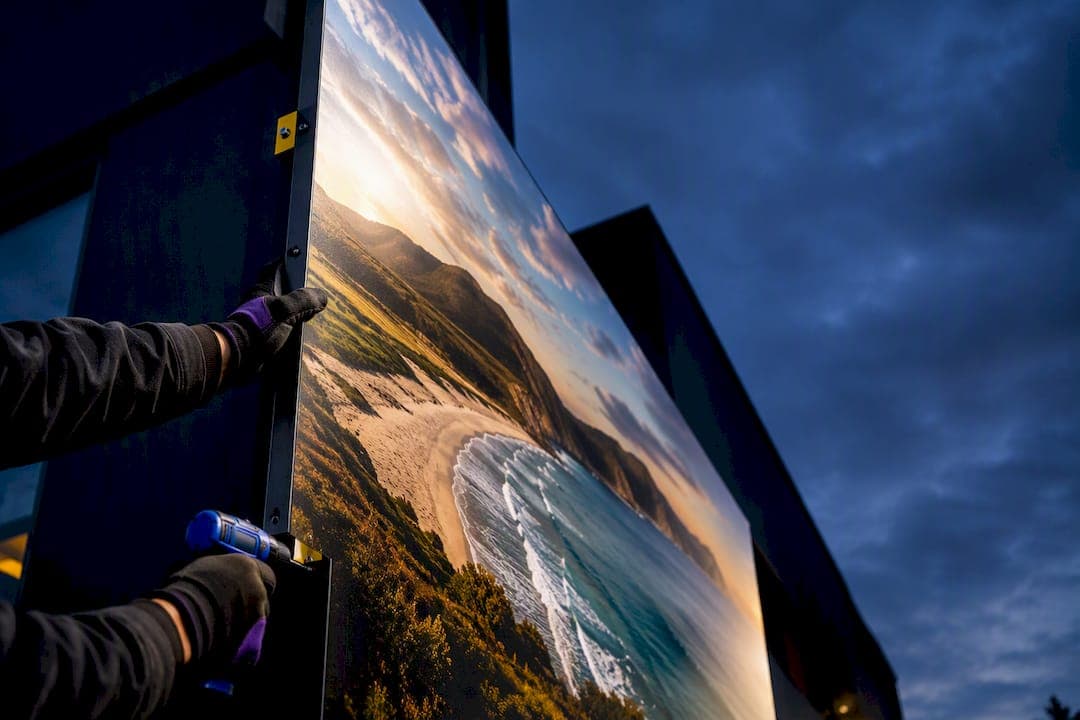
Signage is a commercial use, full stop, and that means you need an explicit license or a commissioned assignment before that image goes on a wall, a truck, or a shopfront. The two fastest compliant routes are commissioning a photographer directly, or purchasing a commercial or extended stock license that names signage and fabrication as permitted uses. Either way, get the license terms in writing before you send anything to a fabricator.
TL;DR:
- Signage images require explicit commercial licenses that cover outdoor use and large-format reproduction, with license terms confirmed in writing before production.
- Rights-managed licenses are best for exclusive, high-visibility signage, while royalty-free licenses often have caps that may be exceeded quickly in busy retail environments.
- Licensing from photographers directly provides the clearest control, but stock libraries and rights management organizations offer faster, cost-effective options with varying control levels.
- Signage licenses must specify scope, duration, territory, audience limits, and sublicensing rights, and all license documents should be stored and verified before fabrication.
- Additional permissions are needed for identifiable people, trademarks, or private landmarks visible in signage images, and local signage laws may restrict display regardless of license.
Table of Contents
- How Does Signage Image Licensing Actually Work?
- What License Types Cover Outdoor and Large-Format Signage?
- Where Can You Source Images for Signage Legally?
- What Contract Terms Actually Matter for Signage Projects?
- Do Trademarks and People in Photos Need Separate Permission?
- How Much Should You Budget for Signage Image Licensing?
- How Do You Verify an Image License Before Production?
- What's the Step-by-Step Workflow for Licensing Signage Images?
- Commissioning a Photographer for Signage: What to Expect
- What Legal Restrictions Apply to Signage in Public Spaces?
- Do You Need to Credit the Photographer on a Sign?
- What Resolution Do Signage Images Need?
- Digital Signage vs Physical Signage: Do Licensing Rules Differ?
- How Do You Choose the Right License Process for Each Signage Format?
- A Publisher's Take on Licensing Mistakes That Cost Real Money
- License Your Signage Images Directly and Skip the Guesswork
- Sources
- FAQ
How Does Signage Image Licensing Actually Work?
Copyright sits with the creator the moment the shutter clicks, unless it has been formally assigned to someone else. A license does not transfer that ownership. It grants you a defined set of permissions, and those permissions have edges: scope, duration, territory, and the media you're allowed to use the image on. Signage counts as both reproduction and communication to the public, which puts it squarely in commercial territory rather than the more relaxed world of editorial or personal use.
Only the copyright holder can grant these rights, and one artwork can carry more than one rightsholder. A composite image might involve a photographer and a designer who layered graphics on top, and each may hold separate rights that need clearing.
- Copyright remains with the creator unless there's an explicit-written assignment.
- A license is permission with limits, not a transfer of ownership.
- Signage reproduction and public display typically require commercial rights, not personal or editorial ones.
- Composite artwork can involve multiple rightsholders who each need to sign off.
What License Types Cover Outdoor and Large-Format Signage?
Not every license was built with a three-meter shopfront banner in mind, and the type you choose changes what you can legally do with it.
- Rights-managed: Negotiated scope tailored to your project, useful when you need exclusivity or high-visibility placement like a billboard or building wrap.
- Royalty-free: Convenient and often cheaper, but frequently capped by print run or audience size. Check whether the standard license covers outdoor use or whether you need an enhanced or extended license for banners and billboards.
- Creative Commons: Only some CC license variants permit commercial use at all, and nearly all of them require correct attribution, which gets tricky on a physical sign with no obvious place to print credit.
- Public domain: Free to use in most respects, but still worth checking for trademark issues or personality rights if a person is identifiable in the frame.
Read the fine print before you commit. A royalty-free image that looks perfect for a shopfront sign might carry a reproduction cap that a busy retail location blows past in a matter of weeks.
Where Can You Source Images for Signage Legally?
Four routes cover almost every signage project, and each comes with a different balance of control and speed.
- Commission a photographer for full control over composition, resolution, and licensing language written specifically for signage use.
- Stock libraries are fast and affordable, but always check whether the license is standard or extended for outdoor and large-format use.
- Rights Management Organisations, such as Copyright Agency, license images on behalf of creators through statutory or negotiated schemes, which simplifies compliance when you need multiple images from different photographers.
- Public-domain and Creative Commons resources, including Creative Commons search and Wikimedia Commons, offer no-cost options, but every item still needs an individual check for commercial permissions and attribution rules.
Commissioning gives you the cleanest paper trail. Stock and RMO routes trade some of that control for speed and lower upfront cost, which works fine for most standard retail or office signage.
What Contract Terms Actually Matter for Signage Projects?
A license that reads fine for a website banner can fall apart the moment it meets a fabricator and a set of aluminum composite panels. Before you sign off on anything, confirm these terms in writing.
- Scope of use — does the license cover indoor and outdoor placement, illuminated or backlit signs, and the specific reproduction method your fabricator will use?
- Duration and territory — is the license perpetual or time-limited, and does it cover local, national, or worldwide display?
- Print-run and audience limits — many stock licenses cap the number of reproductions or the size of audience the image can reach before an upgrade is required.
- Sublicensing and assignment — can your fabricator legally reproduce the file, or do they need to be named as an authorized reproducer under the license?
- Attribution, moral rights, and indemnities — check what credit is required, whether the creator retains moral rights over how the work is displayed, and what happens if you need to extend the license later.
Pro Tip: Ask your fabricator, in writing, whether they need to be listed as an authorized reproducer under the license. Some licensing agreements require the fabricator to be named separately from the commissioning business, and missing this step can stall production by weeks.
Do Trademarks and People in Photos Need Separate Permission?
A valid image license doesn't automatically clear everything visible in the frame. Copyright protects the photograph itself; trademark law protects brand identifiers like logos, and the two rights don't automatically transfer together. If a competitor's logo, a recognizable brand mark, or someone else's product appears in your signage image, you may need separate trademark permission even with a fully licensed photo.
- Identifiable people in the image usually require a model release, especially for commercial signage that implies endorsement.
- Private buildings or distinctive architecture may need a property release.
- If a logo or a well-known face appears anywhere in the shot, assume it needs extra clearance until you've confirmed otherwise.
How Much Should You Budget for Signage Image Licensing?
Cost climbs with size, reach, duration, and exclusivity. A small indoor directory sign costs far less to license than a highway billboard running for three years, and resale or merchandising rights push the price higher still.
- Larger physical dimensions and outdoor placement often trigger extended or enhanced license tiers.
- Longer campaign durations and wider geographic reach both increase licensing fees.
- Exclusivity, where competitors can't use the same image, commands a premium over non-exclusive use.
Vendor thresholds are concrete, not vague. Adobe Stock's additional terms set numeric caps, commonly around 500,000 reproductions or viewers under a standard license, before an enhanced license becomes mandatory. Commissioning a photographer sidesteps these caps entirely but usually costs more upfront, and full copyright assignment is typically negotiated separately from a standard usage license, at a higher fee.
How Do You Verify an Image License Before Production?
Never take a supplier's word for it. Ask for the paperwork, and keep it somewhere your fabricator and your future self can find it.
- Request the signed license agreement, the invoice, and a written usage statement covering signage specifically.
- Check the original file's metadata against what the supplier has told you, since mismatched metadata is a common red flag.
- Store the license documents centrally and hand a copy to your fabricator or installer before production starts.
- If a supplier can't produce proof of license, stop the project until they can. Production delays cost far less than a legal dispute.
What's the Step-by-Step Workflow for Licensing Signage Images?
- Define the use precisely: sign size, indoor or outdoor location, materials, expected duration, and audience reach.
- Choose your sourcing route: commission, stock library, RMO, or public domain, based on budget and control needed.
- Secure the written license and any model or trademark releases before you place a fabrication order.
- Share the license with your fabricator and archive every document for future audits, reprints, or license renewals.
Pro Tip: A signage mockup or sample drawing is a design tool, not a legal clearance document. Confirming rights separately, even after a mockup looks approved, saves you from discovering a licensing gap after the sign is already fabricated.
Commissioning a Photographer for Signage: What to Expect
Bespoke photography earns its higher cost when stock simply can't match your brand's specific location, color palette, or composition needs. A commissioning agreement should spell out signage use explicitly, not leave it implied.
- Specify signage use by name in the license, including outdoor, illuminated, or large-format reproduction.
- Confirm deliverable file formats and resolution suited to the print size you need.
- Expect photographers to invoice licensing separately from the shoot fee, with pricing tied to scope and exclusivity.
What Legal Restrictions Apply to Signage in Public Spaces?
Image licensing solves the copyright side of the equation, but it doesn't touch local advertising and planning law, which governs whether you can display that image at all. Most Australian councils regulate signage under local planning schemes that control size, illumination, placement near roads, and content in public view. A perfectly licensed image can still breach a local sign code if it's oversized, positioned too close to an intersection, or lit in a way that creates a driving hazard.
Councils typically require a development or signage permit for anything beyond small, temporary, or shopfront-scale displays, and the rules vary meaningfully between local government areas. A billboard-sized installation faces far more scrutiny than a window decal, and heritage overlays or commercial precinct guidelines can restrict imagery further, particularly around content deemed inappropriate for public display near schools or residential zones.
Advertising standards add another layer on top of planning law. Content that makes claims about a product, depicts a person in a way that implies endorsement, or uses imagery that could mislead viewers falls under advertising conduct rules separate from copyright entirely. This matters most for retail and hospitality signage, where a licensed food photo used without context could arguably misrepresent what's actually served.
The practical takeaway: check your local council's signage or outdoor advertising policy before fabrication begins, not after. A licensed image and a permitted image are two different approvals, and you need both before installation, not just one.
Do You Need to Credit the Photographer on a Sign?
Attribution requirements depend entirely on the license type, and getting this wrong is one of the more common signage mistakes. Creative Commons licenses almost universally require attribution as a condition of use, typically naming the photographer and linking back to the license terms. On a physical sign, that's awkward. There's no comment section or credit line at the bottom of a shopfront banner, so CC-licensed images often need a small printed credit near the sign or, for digital signage, a rotating credit frame.
Commercial and rights-managed licenses usually waive attribution requirements entirely, since you're paying specifically for unrestricted commercial use without a credit obligation. Always check the specific license wording rather than assuming, since some royalty-free platforms still require attribution unless you've paid for an extended or enhanced tier that removes it.
Moral rights add a separate consideration under Australian copyright law. Even when a license doesn't require attribution, a photographer may retain the right to be identified as the creator or to object to their work being altered or presented in a way that damages their reputation. This rarely causes friction with straightforward commercial signage, but it becomes relevant if an image gets cropped, filtered, or combined with content the photographer might find objectionable.
When in doubt, include a small, unobtrusive credit. It costs almost nothing on a large sign and removes any ambiguity about whether you've met the license's terms.
What Resolution Do Signage Images Need?
Signage punishes low-resolution images in a way that websites and brochures never will, because viewers stand far closer to the pixels than the final image was ever designed to handle at that scale. A photo that looks crisp on a screen can turn blurry and pixelated once it's stretched across a three-meter banner.
The rule of thumb professional print shops use is roughly 100 to 150 DPI (dots per inch) at final print size for large-format signage viewed from a distance, compared to 300 DPI for close-up print materials like brochures. Viewing distance matters more than raw pixel count. A billboard viewed from fifty meters away tolerates a much lower effective resolution than a lobby sign viewers will stand a meter from.
Original file format matters just as much as resolution. RAW or high-resolution TIFF files give fabricators the flexibility to scale, crop, and color-correct without introducing artifacts, while a compressed JPEG pulled from a website will show visible degradation once blown up to signage size. Always request the largest original file the license permits, not a web-optimized export.
Color profile is the detail most businesses miss entirely. Images shot or edited in RGB, standard for digital display, need conversion to CMYK for physical print production, and that conversion can shift colors unexpectedly if it's not handled by someone familiar with your fabricator's printing process. Brief your image supplier on the intended print method (large-format inkjet, dye-sublimation, UV print) before final delivery, so the file arrives ready for that specific process rather than needing rework after the fact.

Digital Signage vs Physical Signage: Do Licensing Rules Differ?
Digital signage and physical signage draw from the same copyright and trademark principles, but the practical licensing details diverge in ways that catch businesses off guard. Physical signage is typically a one-time reproduction: the image goes to print, gets fabricated, and stays fixed until the sign is replaced. Digital signage, by contrast, often means the image is displayed repeatedly, potentially across a network of screens, and sometimes streamed or served from a central content management system.
That repetition and distribution model matters because some stock licenses define usage limits around impressions, viewers, or reproductions rather than physical copies. A digital sign in a busy shopping center that cycles through content thousands of times a day can rack up viewer counts fast enough to breach a standard license's audience cap, even though nothing was physically printed. Always check whether your license's limits are defined by print run or by viewer/impression count, since digital display formats usually fall into the latter category.
Territory and duration terms also behave differently. A physical sign installed in one location is easy to map against a license's territorial scope. A digital signage network that pushes content to screens across multiple states, or that gets updated remotely without a fresh licensing check, can drift outside the original license's territory or duration without anyone noticing until an audit or a rights holder's complaint surfaces the issue.
The safest approach for digital signage is to license for the broadest reasonable distribution and impression count upfront, rather than assuming a license bought for one screen automatically covers a network. If your signage strategy might expand from one location to several, say so when you negotiate the license rather than after the fact.

How Do You Choose the Right License Process for Each Signage Format?
Different signage formats call for different licensing workflows, and matching the process to the format saves both time and money. A single indoor directory sign or a small retail window decal rarely needs more than a standard stock license, checked once for outdoor or reproduction restrictions before ordering print.
Large-format outdoor signage, billboards, building wraps, and vehicle graphics almost always require an extended or enhanced license, and it's worth requesting written confirmation from the vendor that the specific format is covered before you commit to fabrication. Some vendors list billboard and vehicle use as excluded categories entirely under their standard terms, which only becomes obvious if you read the fine print rather than assuming coverage.
Multi-location or franchise signage, where the same image appears across several sites, needs a license that explicitly names multiple locations or an unlimited-location clause. Buying a single-location license and rolling it out across ten franchise sites without checking the terms is one of the more expensive mistakes a marketing team can make, since retroactive licensing fees for unauthorized use tend to run higher than upfront licensing would have.
Digital signage networks, as covered above, need licenses scoped around impressions or viewer counts rather than print runs. For any format involving exclusivity, competitive protection, or long-term campaigns, rights-managed licensing negotiated directly with the photographer or their agent gives you the clearest, most defensible paper trail. Whichever format you're working with, request the license terms in writing before fabrication starts, not after the sign is already on order.
A Publisher's Take on Licensing Mistakes That Cost Real Money
The mistake I see most often isn't malicious. It's a mockup that gets approved internally, everyone assumes that approval equals legal clearance, and the sign goes to fabrication before anyone checks the actual license. A sample drawing is a communication tool, not a legal document, and treating it as one causes expensive delays once a rights issue surfaces after production has already started.
My rule of thumb: never let a fabricator start work without a written license that names signage explicitly. "Commercial use" on a stock site isn't the same as "outdoor signage, illuminated, three-year duration." Get the specific wording, every time.
— Mark
License Your Signage Images Directly and Skip the Guesswork
If you'd rather not chase down license terms across five different stock vendors, licensing directly from a working photographer solves that problem in one step. Com offers image licensing for commercial uses including signage and splashbacks, with usage terms written for exactly the kind of large-format, outdoor, or long-duration display that standard stock licenses often exclude.
Award-winning landscape photography, shot on panoramic medium format film and collected in 32 countries, gives your signage a level of detail that holds up at scale, from a shopfront window to a building wrap. When you reach out, come with your project scope ready: sign dimensions, indoor or outdoor placement, expected duration, and whether the display is physical or digital. That's enough for a proper licensing quote tailored to your format rather than a generic one-size-fits-all agreement. Start by browsing the image licensing page and sending through your project brief.
Sources
- Copyright licensing and rights management organisations in Australia | IP Australia First Response
- What is the difference between a copyright and trademark? — LegalVision
- License comparison | DepositPhotos
- Adobe Stock Additional Terms
- Creative Commons search
FAQ
How Does Image Licensing Work?
A license grants defined permission to use an image under specific limits like scope, duration, and territory, without transferring copyright ownership. For signage, that means confirming the license explicitly covers commercial display, outdoor use, and the reproduction method your fabricator will use.
What Are the Copyright Laws for Images in Australia?
Copyright automatically belongs to the creator the moment an image is made, and it stays with them unless formally assigned. Businesses using images commercially, including on signage, need either a license from the rights holder or a commissioned assignment that transfers ownership outright.
Can I Use Licensable Images for Free?
Public-domain and some Creative Commons images can be used at no cost, but each one still needs checking for commercial-use permissions and attribution requirements before it goes on signage. Fair dealing exceptions exist under Australian law, but they're narrow and rarely cover commercial signage display.
How Do I Know if an Image Is Licensed?
Ask the supplier for the signed license agreement, the invoice, and a written usage statement that names signage specifically. If they can't produce that paperwork, treat the image as unlicensed and hold production until it's resolved.
What Does It Cost to License a Photo for Signage?
Costs vary with size, duration, exclusivity, and audience reach, and there's no flat industry rate. Com's image licensing service prices are provided on request based on your specific project scope.