
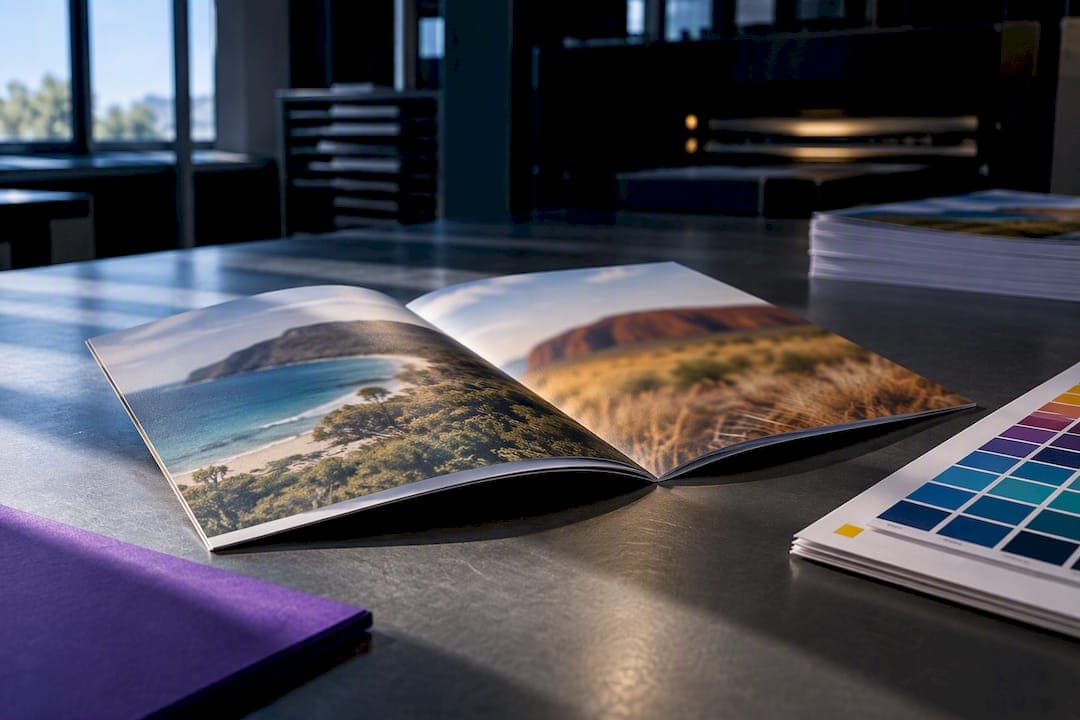
Yes, you can license images for brochure use, but you need a written licence specifying territory, duration, print run, and permitted alterations before a single file goes to print. That licence sets out exactly what you can do with the image, for how long, and where. The usual path is straightforward: request a quote, agree the terms, pay the fee, and receive both the licence document and a high resolution file ready for your printer.
TL;DR:
- Licensing images for brochures requires a written agreement specifying territory, print run, duration, and permitted modifications to ensure legal use.
- A license grants specific rights to use the image without transferring copyright, with costs influenced mainly by print run size, placement, and exclusivity.
- Clear communication of technical details and mock-ups upfront accelerates licensing and prevents costly revisions or legal issues.
- Australian copyright law emphasizes that licenses only permit use; fair dealing exceptions do not cover commercial brochure printing without explicit permission.
- Renewing licenses before expiry and properly archiving all documentation are crucial to avoid unintentional infringement on reprints or extended use.
Table of Contents
- Brochure Image Licensing: How the Licence Actually Works
- The Brief a Licensor Actually Needs From You
- Rights, Moral Rights, and Gallery Procedures in Australia
- Licensing an Image for a Brochure, Step by Step
- What Brochure Image Licensing Actually Costs
- Why Mark Gray's Licensing Process Works for Brochure Projects
- Renewing or Extending Your Brochure Licence
- Licensing an Existing Image vs. Commissioning New Photography
- Ready to License an Image for Your Next Brochure
- Sources
- FAQ
Brochure Image Licensing: How the Licence Actually Works
A photo licence is permission, not a sale. The photographer or gallery keeps copyright; you are buying a defined set of rights to use one image in one way, for one purpose. That distinction matters when you are picking images for brochures, because a licence written for a website banner will not automatically cover a printed catalog with a large print run.
Every proper licence spells out the same core variables:
- Media: print, digital, or both, named explicitly rather than assumed
- Territory: a single country, a region, or worldwide distribution
- Duration: a fixed term, a single print run, or perpetual use
- Print run: the maximum number of copies the licence covers
- Exclusivity: whether the licensor can sell the same image to a competitor
Marketing brochures count as commercial use, not editorial use, even when the brochure describes a nonprofit program or a community event. That classification matters because editorial licences (used for news reporting or commentary) are usually cheaper and come with tighter restrictions that specifically exclude promotional material. Formats split into two broad categories: royalty-free licences that let you reuse an image after one payment, and rights-managed licences priced around your specific print run, territory, and exclusivity needs. Rights-managed licensing tends to cost more per use but gives you control over who else can run the same photo, which matters if you are printing a flagship annual brochure and do not want your hero image showing up in a rival's catalog next quarter.
The Brief a Licensor Actually Needs From You
Vague requests produce vague quotes, and vague quotes produce revision cycles that blow your print deadline. Give the licensor these details in your first email:
- Print run — the exact number of copies, not a rough estimate
- Finished size — dimensions of the brochure and the image's size within it
- Placement — cover, full-page interior, thumbnail, or background element
- Print method — offset, digital, or large-format, since resolution needs differ
- Color profile — CMYK for print, with any Pantone matching requirements
- Territory and duration — where the brochure will circulate and for how long
- Whether online use is included — many brochures get scanned and posted online too
Ask directly about permitted alterations (cropping, color grading, text overlays), whether attribution is required, and whether you can sublicense the image to a printing partner. A mock-up showing exactly how the image sits on the page removes almost all guesswork for the licensor and speeds up their quote.
Pro Tip: Send your mock-up and exact print dates in the very first message, not after the quote comes back. Licensors price based on prominence, and a cover placement can cost several times more than the same image buried on page 14.
Rights, Moral Rights, and Gallery Procedures in Australia
Copyright in a photograph generally stays with the photographer unless it has been explicitly assigned in writing, according to Arts Law Centre of Australia guidance. A licence never transfers that ownership. It only grants permission for the specific use you negotiated.
Moral rights add another layer many brochure buyers overlook. Under Australian law, photographers retain the right to be attributed and to object to changes that distort or damage their work, so aggressive cropping or heavy filtering can breach terms even when the usage fee is paid in full.
Public collections add their own procedural layer:
- The National Gallery of Australia requires a written request and typically charges an image supply fee separate from the usage fee, plus conditions on alteration and mock-up submission.
- The Art Gallery of New South Wales asks for application forms and evidence of permission before releasing reproduction rights, with fees that vary by order.
- Works involving First Nations artists may carry additional cultural protocols and consent requirements that go beyond standard copyright clearance.
Fair dealing exceptions in Australia are narrow and mostly cover research, criticism, and parody. Government copyright basics make clear that commercial brochure production does not fall under those exceptions, so assuming a "found online" image is safe to print is one of the fastest ways to end up with a legal letter instead of a finished brochure.
Licensing an Image for a Brochure, Step by Step
The process rewards patience in the early stages and speed once terms are agreed.
- Identify the rightsholder. Check image metadata, watermark links, or gallery credit lines to find the photographer, agency, or institution that controls the rights.
- Send a concise request. Include your mock-up, technical specs, and the exact rights you need, then ask for a written licence and a quote.
- Review the terms carefully. Check exclusivity, sublicensing rights, duration, and what edits are allowed before you sign anything.
- Negotiate if the fit is close but not exact. Most licensors will adjust territory or duration for a fair price change rather than lose the sale entirely.
- Complete payment and collect your assets. You should receive a signed licence and a print-ready high resolution file, not just a low-res preview.
- Archive the record. File the licence, receipt, mock-up, and expiry date together so renewals and audits do not turn into a scavenger hunt.
Pro Tip: Keep one folder per campaign with the licence PDF, the payment receipt, the approved mock-up, and the expiry date. When your brochure gets reprinted eighteen months later, that folder saves you from re-clearing rights from scratch.
What Brochure Image Licensing Actually Costs
Pricing shifts based on a handful of predictable factors, so a quote that seems high in isolation often makes sense once you see what is driving it.
- Print run size — 500 copies costs less to license than 50,000
- Prominence — cover placement commands a premium over an interior thumbnail
- Exclusivity — locking out competitors costs more than a shared, non-exclusive licence
- Territory — a single-country licence is cheaper than worldwide distribution rights
- Bundled digital rights — adding web or social use to a print licence usually costs extra, but less than licensing them separately
Public galleries offer a useful benchmark. The National Gallery of Australia's fee structure typically separates an image supply fee, covering file preparation, from a usage fee tied to your print run and market, and payment is generally required before the high-resolution file is released. Royalty-free libraries can undercut those rates for small, one-off brochure runs, but they often restrict merchandise use and limit how many people on your team can access the file, so read the seat limits before assuming royalty-free is automatically cheaper for your situation. Budget for the base licence fee plus a buffer for alterations or an unplanned reprint that pushes you past your original print run.
Why Mark Gray's Licensing Process Works for Brochure Projects
Licensing directly from a working photographer cuts out a layer of ambiguity that stock marketplaces cannot always resolve. Landscape photography is licensed for commercial use across signage, splashbacks, websites, and brochures, with terms set by the person who actually holds the copyright.
- Direct answers on usage terms — no waiting on a marketplace support ticket to clarify what "commercial licence" actually covers for your print run
- Print-ready files delivered once terms are agreed, sized correctly for offset or digital print
- Documented licence paperwork for every transaction, so your project folder has a clean audit trail from day one
If you want more detail on how licensing fees and royalties are typically structured, the guide to how photo licensing royalties work breaks down the mechanics further.
Renewing or Extending Your Brochure Licence
Most brochure licences carry an expiry date tied to either a time period or a fixed print run, and both are easy to blow past without noticing. A licence written for "one print run of 5,000" does not automatically cover a second printing next year, even if the design has not changed. Reprinting under an expired licence is a fresh infringement, not a technicality.
Renewal is usually simpler than the original negotiation. Most licensors will extend an existing agreement at a set rate, especially if you approach them before the term lapses rather than after. Reach out with your original licence number, the new print run or date range you need, and whether anything about placement or territory has changed. If your brochure image is getting reused across new channels, a mid-campaign redesign, a trade show handout, an emailed PDF version, treat that as a trigger to renegotiate scope rather than assuming your original terms stretch to cover it.
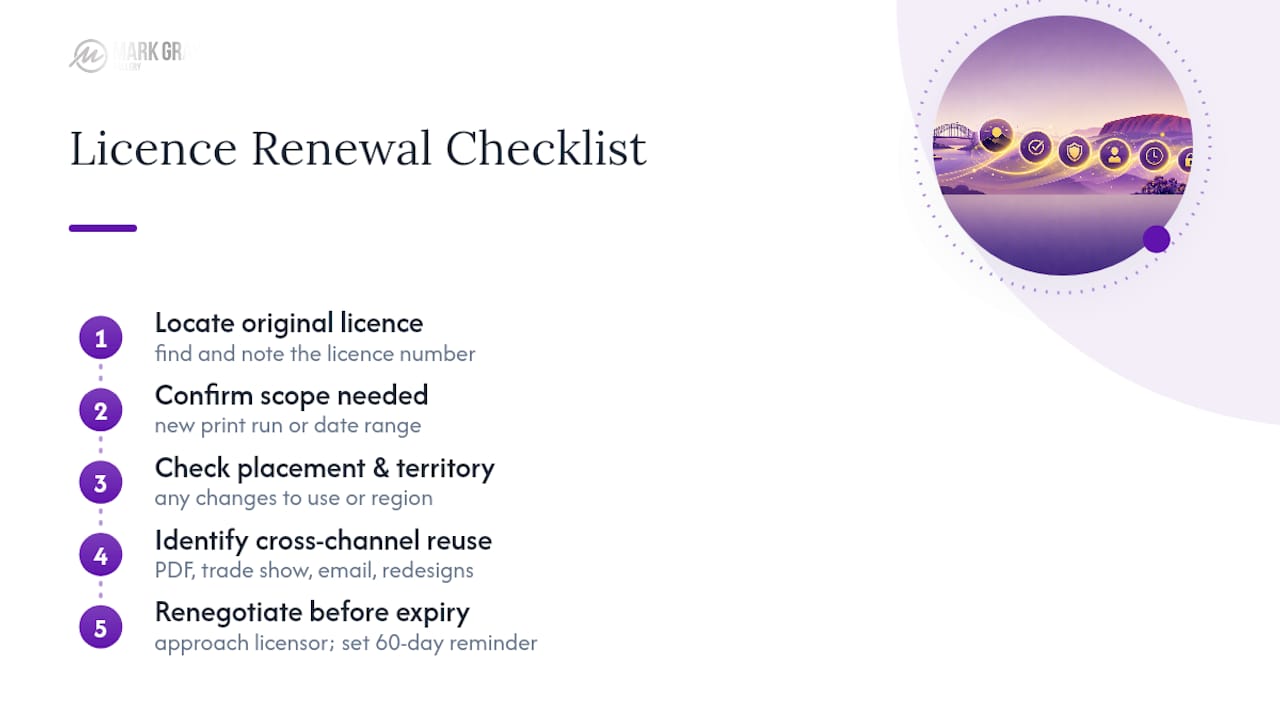
Build in a calendar reminder 60 days before any licence expires. That window gives you time to renew on favorable terms or swap the image entirely if the licensor raises the rate beyond your budget. Letting a licence lapse mid-reprint is one of the more avoidable ways a brochure project runs into legal trouble, and it is entirely preventable with a basic tracking system.
Licensing an Existing Image vs. Commissioning New Photography
Licensing wins on speed and cost for a single brochure run with a modest budget. Commissioning wins when you need exclusivity, precise brand alignment, or expect to reuse the imagery across multiple campaigns for years. If your brochure is a one-off with a defined print run, license. If you are building a visual identity you will lean on repeatedly, commissioning original photography is usually worth the extra investment. Ask yourself one question before you decide: will this image need to work for you again next year?
— Mark
Ready to License an Image for Your Next Brochure
Chasing down usage rights on generic stock sites often means guessing at fine print, hunting for support, and hoping the licence you bought actually covers your print run. Working directly with Mark Gray removes that guesswork: every licence is documented in writing, with terms set by the photographer who holds the copyright, not a marketplace algorithm.
Mark Gray's image licensing service covers image selection support, clear licensing terms matched to your print run and territory, and delivery of print-ready files alongside signed licence paperwork you can file straight into your project records. If your brochure calls for a striking landscape shot, browsing the limited edition print gallery is a good starting point to see the style and quality on offer. For a strong composition, pairing sound licensing with visual storytelling principles helps the image actually earn its placement on the page. To get a quote, contact the team through the image licensing page with your print run, size, and placement details ready to go.
Sources
- Arts Law Centre of Australia — Copyright guidance
- Art Gallery of New South Wales — Using images of the collection
- Australian Government — Copyright basics
FAQ
What Are the Copyright Laws for Images in Australia?
Copyright automatically belongs to the photographer the moment an image is created, and it generally stays with them unless assigned in writing, per Arts Law Centre of Australia. Fair dealing exceptions are narrow and do not cover commercial brochure printing, according to government copyright basics.
How Does Image Licensing Work?
A licence grants permission to use an image for a specific media, territory, duration, and print run, without transferring ownership. The photographer or rightsholder sets the terms, you agree to them in writing, and payment typically unlocks the high resolution file.
How Do I Know if an Image Is Free for Commercial Use?
Check the licence terms attached to the specific image rather than assuming a "free" label covers brochures. Many free-to-use images exclude commercial or promotional material entirely, so a written commercial licence is the only reliable way to confirm brochure use is covered.
Can My Image Be Used Without My Permission?
No. Using someone else's photograph in a brochure without a licence is copyright infringement regardless of how the image was found or how it is credited. Public galleries such as the Art Gallery of New South Wales require documented evidence of permission before releasing images for reproduction, and the same standard applies to independent photographers.