
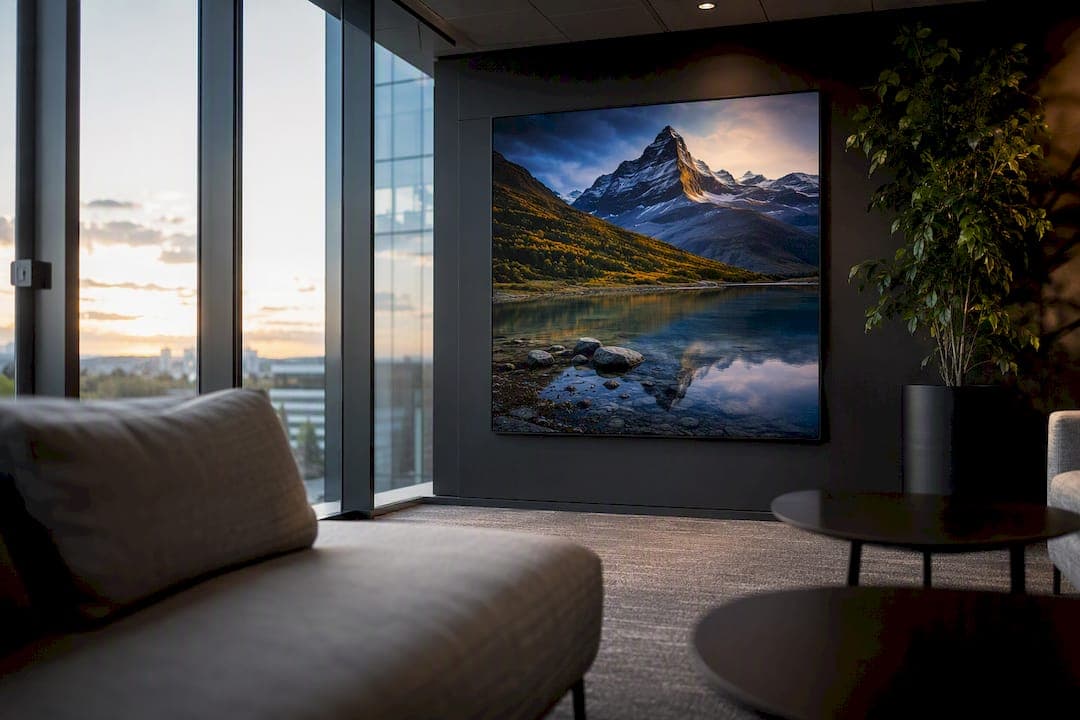
For corporate offices, the fastest low-risk route is to buy a finished limited-edition print or license a high-resolution image and order production to the project's exact specs. Buying a print gives you provenance and a turnkey installation. Licensing gives you scale, repeatable reproduction, and control over the final size and substrate.
The immediate next step is simple: request a soft proof and a physical sample or print swatch sized to your actual viewing distance before committing to a full order. Working with an established source like Mark Gray Gallery means that step is already built into the process, with archival giclée production and a track record of corporate installs.
- Choose a finished print for a lobby statement piece with instant provenance.
- Choose an image license when you need the same photograph across multiple sites or sizes.
- Ask for a swatch or proof before signing off on any large-format order.
Pro Tip: Ask for a FotoQuote-referenced price breakdown when comparing license quotes. It gives procurement teams a neutral benchmark instead of guessing whether a fee is fair.
Key Takeaways
Procurement risk drops sharply when you request a physical sample, a written license or sale agreement, and installer specs before committing to full production.
| Point | Details |
|---|---|
| Choose your route | Buy a finished print for statement walls; license a file for multi-site or repeat use. |
| Separate license rights | Keep physical display and digital/marketing rights as distinct contract terms. |
| Size to viewing distance | Match print scale to how far people actually stand from the wall. |
| Budget by zone | Direct roughly 40% of spend to the highest-visibility 10% of walls. |
| Work with Mark Gray Gallery | One vendor handles licensing, archival giclée production, and installation support. |
Table of Contents
- Buying a Print vs. Licensing an Image for the Office
- What Should Procurement Ask For Before Signing?
- How Do You Size and Choose Materials for Office Walls?
- What Drives Cost and How Long Does It Take?
- How Do You Maintain and Manage Office Art Over Time?
- Why Mark Gray Gallery Fits Corporate Procurement
- Sources
Buying a Print vs. Licensing an Image for the Office
A finished print is a physical object: a limited or open-edition piece, produced to spec, arriving with a provenance certificate and often ready to hang. A license is different. It hands you a high-resolution file and permission to reproduce it a set number of times, but you handle (or commission separately) the actual production, framing, and installation.
The right choice depends on where the artwork lives and how many times you need it.
- Lobby or reception centerpiece: a limited-edition print, because impact and authenticity matter more than repeatability.
- Multi-floor rollout or a mural spanning several offices: a licensed file, because you need identical production specs across locations.
- Rebranding project touching dozens of walls: a hybrid mix, anchored by one bespoke piece with a curated print collection filling secondary walls, a strategy that balances impact with speed for larger rollouts.
| Factor | Finished Print | Licensed Image |
|---|---|---|
| Lead time | Shorter, often stock-ready | Longer, production handled separately |
| Flexibility | Fixed size and finish | Scalable to any wall or mural |
| Cost driver | Print price + framing | License fee + your own production |
| Best for | Statement walls, reception areas | Multi-site or repeat installations |
Pro Tip: Don't force one model across an entire building. A single anchor print in reception paired with licensed images for meeting rooms often costs less and looks more considered than uniform reproductions everywhere.
What Should Procurement Ask For Before Signing?
A rushed order is where corporate art projects go wrong: wrong size, missing license language, or an installer who wasn't briefed on wall type. Build the request properly the first time.
- Define the brief: wall dimensions, viewing distance, lighting conditions, and the mood the piece needs to convey.
- Confirm scope: exact print sizes, quantities per location, and finish (framed, acrylic, aluminum).
- Specify mounting method and who installs it, the gallery's recommended installer or your own facilities team.
- Request a written license or sale agreement before payment, not after delivery.
- Route the agreement through legal or procurement for the terms below before final sign-off.
Every contract or license should spell out permitted uses (physical display in the office versus digital use in marketing or on your website), duration, territory, and reproduction counts. If exclusivity matters, competitor firms not being able to display the same image, say so explicitly, since it usually raises the fee. Ask for indemnity language, a credit line if required, and renewal terms so nobody discovers the license lapsed mid-lease.
Photographers licensing images for murals and large commercial prints typically scope fees by size and visibility, and expect a signed contract before production starts. Keep display rights and marketing rights as separate line items. A written agreement that isolates physical display from digital use prevents a marketing team from repurposing an office print on a website without paying for that separate use, a distinction covered in more depth in this guide to licensed photography for commercial use.
Approval should move in stages: soft proof on screen, physical sample or swatch in hand, then an installation mock-up on the actual wall before final production runs.
Pro Tip: Never let a single license cover both the printed wall piece and a digital marketing reuse. Price and contract them separately, even if they're the same photograph, or you'll end up renegotiating later at a worse rate.
How Do You Size and Choose Materials for Office Walls?
Size follows viewing distance, not wall dimensions alone. A reception wall viewed from 15 feet away can carry a much larger print than a corridor where people pass within arm's reach. A rough rule: divide viewing distance in inches by 2 to 3 to estimate a workable print width, so a typical lobby sightline supports appropriately larger artwork than a narrow corridor, while a narrow corridor calls for something closer to 24 to 36 inches.
Wall type matters just as much as room type:
- Lobbies and reception areas: large-format statement pieces, ideally eye-level positioned around 57 to 60 inches to center.
- Corridors: narrower, elongated formats that don't obstruct foot traffic.
- Meeting rooms: mid-size prints that read well from a seated position, not just standing.
| Substrate | Best For | Notes |
|---|---|---|
| Giclée on archival paper, framed | Reception, executive offices | Archival inks resist fading for decades |
| Acrylic face-mount | High-impact lobby walls | Glossy depth, higher price point |
| Dibond/aluminum | High-traffic corridors | Durable, lightweight, minimal glare |
| Canvas | Meeting rooms, softer aesthetic | Warmer texture, less reflective |
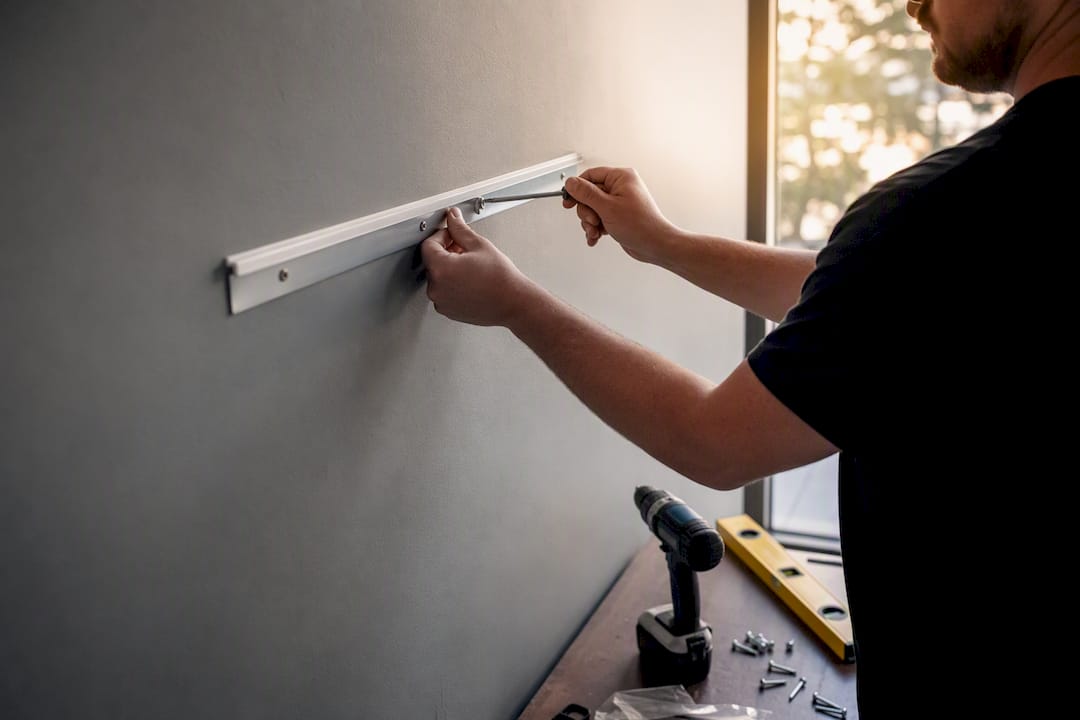
Ready-to-install options save real installation time. Factory-framed prints, float frames, and hidden cleat or rail hanging systems all reduce on-site labor. Specify mounting points, fixings, and an installer warranty in the order itself, not as an afterthought once the crate arrives. A large-format print sizing guide covers resolution requirements for oversized formats in more detail, since a file that looks fine at 16 inches wide can pixelate badly at 6 feet.
What Drives Cost and How Long Does It Take?
Budget swings on a handful of variables, and license fees behave differently than print costs.
- License fee versus outright print purchase, licensing typically costs less upfront but requires you to fund production separately.
- Substrate and finish, acrylic and aluminum run higher than paper or canvas.
- Custom framing, mounting hardware, and installer labor.
- Shipping, crating, and insurance for large or fragile pieces.
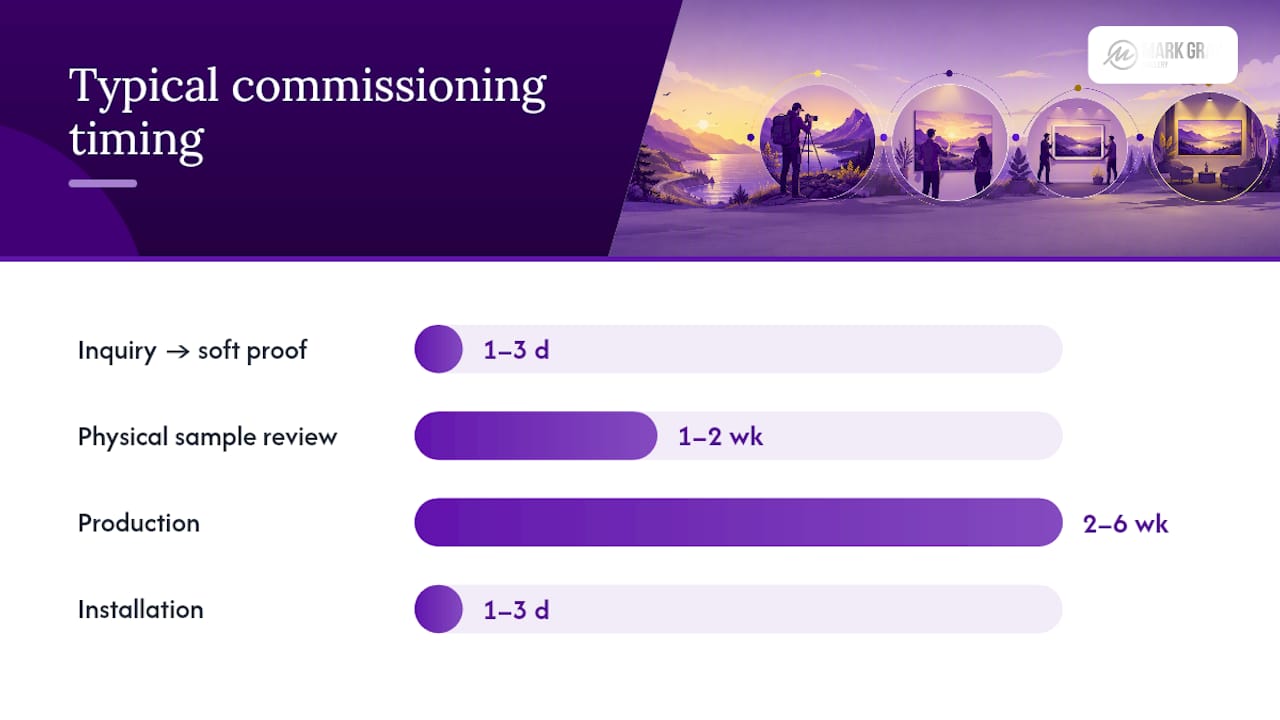
Curated, stock-ready prints can ship in days. Bespoke large-format prints or wall murals routinely take 6 to 12 weeks once you factor in proofing, production, framing, and installer scheduling.
| Stage | Typical Timing |
|---|---|
| Inquiry to soft proof | 1 to 3 days |
| Physical sample review | 1 to 2 weeks |
| Production | 2 to 6 weeks |
| Installation | 1 to 3 days |
Pro Tip: Use zone-based budgeting: put roughly 40% of your total art budget toward the small percentage of walls that get the most foot traffic, main entrances, lift lobbies, reception. That's where visitors form an impression, and it's where the spend actually shows.
How Do You Maintain and Manage Office Art Over Time?
Corporate art isn't a one-time purchase; it's an asset that needs light upkeep and a plan for change.
- Dust framed and acrylic pieces with a soft, dry cloth. Avoid glass cleaners on acrylic face-mounts, they can cloud the surface.
- Inspect high-traffic pieces seasonally for shifting, fading near windows, or frame damage.
- Keep provenance certificates and condition reports on file for every limited-edition piece.
For licensed digital files, centralize storage and set calendar reminders ahead of license expiry dates, so nobody discovers a lapsed reproduction right during a rollout. A rotation cycle for high-visibility zones, refreshing lobby pieces every couple of years, keeps the space feeling current without a full re-buy.
Why Mark Gray Gallery Fits Corporate Procurement
Working with a single vendor for licensing, production, and delivery removes a layer of coordination most procurement teams don't have time for. Mark Gray Gallery offers both limited and open-edition prints and commercial licensing from one source, with published lead times built for office timelines rather than retail ones.
Every order comes with the trust signals procurement teams should be asking for anyway:
- A written license agreement stating permitted uses and print counts.
- Limited-edition certificates and provenance documentation.
- Archival giclée print specifications with material datasheets.
- An installation warranty or a recommended installer for large-format pieces.
That last point matters more than it sounds. A survey of commercial art buyers found that ease of long-term management, rotation, condition tracking, provenance, is as much a procurement factor as the artwork itself. Sourcing from one gallery instead of stitching together a photographer, a printer, and a framer separately cuts that management burden considerably.
A Note From the Gallery on Working With Corporate Clients
We've handled enough corporate installs to know the pattern: teams move faster once they see a physical sample, not just a screen proof. Our commercial terms and sample timelines are built around that reality. Quality control and support don't stop at delivery, we stay involved through final placement.
How to Start a Corporate Order With Mark Gray Gallery
If you've read this far, you already know what you need: a proof, a sample, and a straight answer on pricing and timing. That's exactly where Mark Gray Gallery starts every corporate inquiry, whether it's a single reception piece or a multi-floor licensing rollout with production handled to spec.
Reach out with your wall dimensions, viewing distance, and intended use (display only, or display plus marketing), and you'll get a proof and a sample-based quote rather than a generic price list. Larger rollouts and trade accounts get contract support for multi-site licensing and volume framing. Corporate inquiries typically hear back within a couple of business days, and physical samples are available for review before any full production run begins. International inquiries are welcome; production specs and shipping are confirmed per order. Working with a design partner like WeLzYGFX to align artwork with existing brand identity before you order can also tighten the final result.
Start the conversation at Markgray and get a proof moving before your next design review.
Sources
For deeper licensing detail, review how image licensing differs for commercial versus consumer use and how website licensing terms differ from print display rights. For planning multi-piece installations, this guide on curating a landscape photography wall collection adapts well to corporate gallery walls. For a third-party pricing reference, the Photofocus guide to licensing images for murals remains a solid benchmark for scoping fees by size and visibility.