

Licensed photography gives you cleared legal rights, measurable brand exclusivity, and traceable quality. Free images rarely deliver all three reliably, and for commercial use in the United States, that gap carries real financial and legal consequences.
The short answer for commercial use:
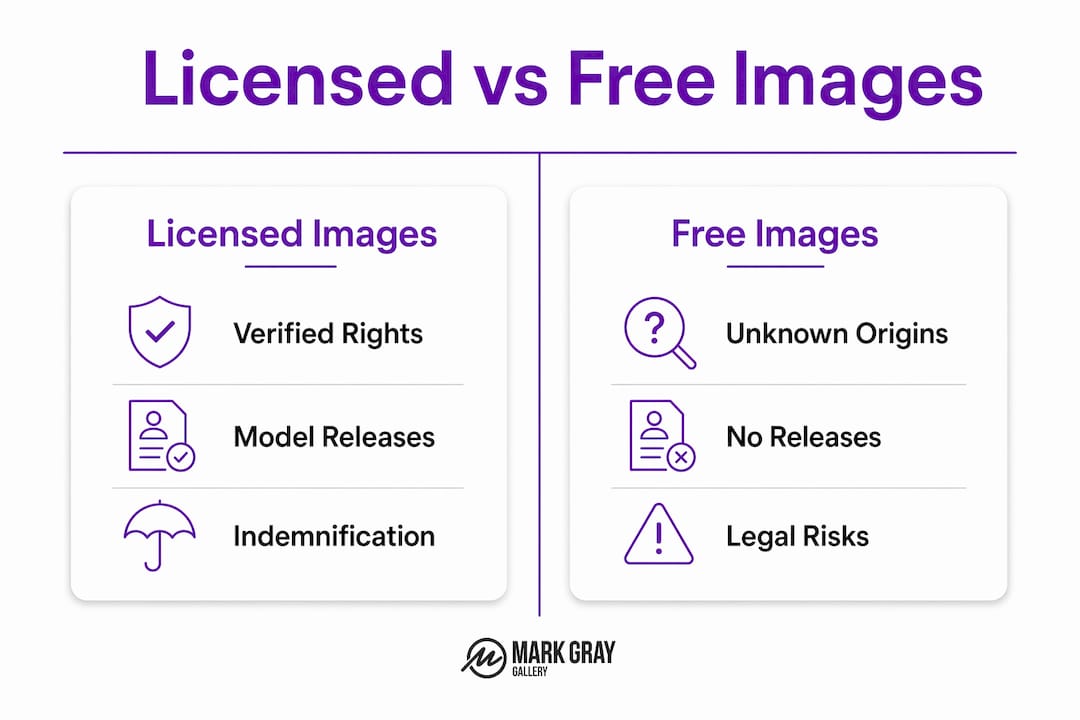
- Legal protection: Licensed images come with documented rights. Free images from platforms like Unsplash or Pixabay often carry no indemnification, meaning you absorb all liability if an image was uploaded without proper releases.
- Brand uniqueness: Free images are used by thousands of organizations simultaneously. Licensed photography, especially exclusive options, protects your visual identity.
- Traceability: A paid license gives you a paper trail. Free images often have no audit path, which creates problems during disputes or brand reviews.
- Quality and consistency: Professional licensed photography is shot and curated to a commercial standard. Free platforms vary widely.
Act now: Use licensed photography for hero images, paid campaigns, signage, and client-facing pages. Reserve free images only for low-stakes internal drafts or supporting visuals, and always verify the license terms before publishing.
Pro Tip: Save a screenshot of every license page at the time of download. That single habit protects you in the event of a future dispute or audit.
Table of Contents
- What does "licensed photography" actually mean?
- Why free images carry serious legal risk for commercial use
- How to verify whether an image is safe to use commercially
- When free images are fine and when you need a license
- License terms you need to check before publishing
- How to license an image: practical routes and cost factors
- Why licensed photography builds long-term brand value
- Key Takeaways
- The case for licensed photography in commercial work
- License professional landscape photography for your brand
- Useful sources and verification tools
What does "licensed photography" actually mean?
A license is not ownership. When you license an image, the photographer retains copyright while granting you specific usage rights under defined conditions. Understanding the difference between license types is what separates a protected commercial campaign from an expensive legal mistake.
The main license types you will encounter:
- Royalty-free (RF): A one-time payment grants use within stated limits. Despite the name, royalty-free does not mean free; it means you pay once rather than per use. Exclusivity and certain media types may still be excluded.
- Rights-managed (RM): Priced by specific usage terms including duration, territory, audience size, and media type. Generally yields higher quality and more precise rights control.
- Exclusive vs. non-exclusive: An exclusive license means only your organization can use that image. Non-exclusive means the photographer can sell the same image to multiple buyers simultaneously, which is how the same photo ends up on competing websites.
- Creative Commons (CC): A family of public licenses that allow use under conditions set by the creator. CC-BY requires attribution; CC-BY-NC prohibits commercial use; CC-BY-SA requires derivative works to carry the same license. Always read the specific variant before using any CC image commercially.
- Public domain: Copyright has expired or was explicitly waived. Wikimedia Commons hosts a large public domain collection, but always verify the specific image's status before commercial use.
Platforms like Shutterstock and similar paid libraries primarily offer royalty-free and rights-managed licenses with documented terms. Unsplash and Pixabay operate under their own custom licenses that permit commercial use without attribution in most cases, but those licenses carry no indemnification. Flickr hosts images under a mix of Creative Commons, All Rights Reserved, and custom licenses, so the license varies by photographer and must be checked per image.
The critical distinction: "Available online" is not a license. Copyright protection is automatic the moment a photographer creates an image. Downloading and using an image without a license, regardless of where you found it, is infringement under U.S. law.
Why free images carry serious legal risk for commercial use
Copyright protection in the United States is automatic. Under the Berne Convention, a photographer owns copyright the moment the shutter fires. Online availability does not equal permission, and using an image without a license exposes your organization to claims you may not see coming.
Under U.S. copyright law, statutory damages for willful infringement can reach up to $150,000 per work. Even non-willful infringement carries statutory damages. For a commercial campaign using multiple unlicensed images, the exposure compounds quickly.
The U.S. Copyright Office is the authoritative source on these thresholds, and the law does not require the copyright holder to prove financial loss to collect statutory damages. That asymmetry is what makes unlicensed commercial use genuinely dangerous.
Missing model and property releases compound the risk. A photograph of a recognizable person used in advertising without a signed model release creates a separate right-of-publicity or privacy claim, entirely independent of copyright. The same applies to private property: using an image of a building or interior for commercial purposes without a property release can trigger additional claims from the property owner. Free platforms generally do not verify whether uploaded images carry these releases.

Many free-image platforms provide no indemnification to users. If an image on Unsplash or Pixabay was uploaded by someone who did not own the rights, or who photographed a person without a release, you bear the full legal exposure. Pixabay's FAQ states images are available for commercial use without attribution, but that platform assurance is not legal clearance and carries no warranty against third-party claims.
Paid licensing from professional sources typically includes documented rights, verified releases, and in some cases indemnification clauses that shift liability back to the licensor if a rights problem emerges. That protection is a concrete, measurable advantage, not a marketing claim.
A practical scenario: a regional retailer uses a free image of a smiling professional in a signage campaign. The subject later claims their likeness was used commercially without consent. Without a model release on file, the retailer has no defense. Settlement costs, legal fees, and the expense of replacing all printed signage can easily exceed what a properly licensed image would have cost by a factor of ten or more.
How to verify whether an image is safe to use commercially
Verification is not optional for commercial use. A five-step process, applied consistently, reduces your exposure and creates the documentation trail you need if a dispute arises.
Step-by-step verification checklist:
- Identify the original source. Where did the image originate? A direct download from a paid library with a transaction record is the strongest starting point. An image found via a Google Images search has no provenance until you trace it.
- Read the license terms in full. Navigate to the platform's license page, not just the image page. Look specifically for: commercial use permission, attribution requirements, exclusivity status, territory and duration limits, and any prohibition on derivative works or sublicensing.
- Check for model and property releases. Paid libraries like Shutterstock flag whether a model release is on file. Free platforms rarely do. If the image shows a recognizable person or private property and you intend to use it commercially, confirm release status before proceeding.
- Run a reverse-image search. Use Google Images reverse search or TinEye to find where else the image appears. This reveals whether it is widely distributed, whether it appears on competitor sites, and sometimes whether it has been flagged in prior disputes.
- Contact the rights holder when in doubt. If the license is ambiguous or you cannot confirm release status, reach out to the photographer or platform directly. A written response confirming your permitted use is worth keeping on file.
Useful tools for this process:
- Google Images reverse search: Paste an image URL or upload a file to find other instances of the image across the web.
- TinEye: A dedicated reverse-image search engine that tracks image usage history and can surface earlier appearances or copyright notices.
- Pixsy: A monitoring service that tracks where your images (or images you are investigating) appear online and can initiate takedown or licensing requests. Useful for organizations managing large image libraries.
- EXIF metadata viewers: Tools like Jeffrey's Exif Viewer can surface embedded metadata including the original photographer's name, camera data, and sometimes copyright notices. Free images often have metadata stripped, which is itself a warning sign.
Pro Tip: Create a simple internal log for every image you publish commercially. Record the source URL, license type, download date, a screenshot of the license page, and whether a model/property release was confirmed. This documentation is your primary defense in any future audit or complaint.
When free images are fine and when you need a license
Not every image decision carries the same risk. The right framework is proportional: the broader the audience, the higher the commercial stakes, and the more visible the placement, the stronger the case for a licensed image.
Low-risk uses where free images are generally acceptable:
- Internal presentations and team documents never published externally
- Early-stage A/B test thumbnails for content that will be replaced before scaling
- Draft mockups shared only with clients for concept approval
- Blog post supporting visuals with minimal commercial intent and low traffic
High-risk uses that require licensed photography:
- Hero images on product pages, landing pages, and homepages
- Paid advertising across any channel (digital, print, outdoor)
- Signage, packaging, and physical marketing materials
- Client proposals and pitch decks representing your brand professionally
- Social media campaigns tied to product launches or promotions
- Any use where the image appears alongside a price or purchase call-to-action
The decision rule is straightforward: audience size × visibility × brand importance. A national billboard campaign and a low-traffic internal wiki sit at opposite ends of that spectrum. Most commercial use cases fall clearly on the licensed side.
A hybrid visual strategy works well for most organizations: free images for supporting and low-stakes visuals, licensed photography for hero assets and revenue-driving placements. This approach balances cost with brand protection without requiring every image to be a paid license.

Paid libraries also offer a practical efficiency advantage. Search depth and catalog quality tend to be stronger in paid sources, which reduces the time your team spends hunting for the right image and lowers the risk of selecting an overused photo that appears on a competitor's site.
License terms you need to check before publishing
Every license controls the same core dimensions. Knowing what each term means in practice lets you confirm rights quickly and spot the clauses that could create problems later.
| Usage dimension | What to check | Common license language to look for |
|---|---|---|
| Duration | How long can you use the image? | "Perpetual" vs. "fixed-term license"; renewal required after expiry |
| Territory | Which countries or regions are covered? | "Worldwide" vs. "United States only"; separate fees for international use |
| Media | Which formats and channels are permitted? | "Digital only," "print," "broadcast," "outdoor/signage" listed separately |
| Exclusivity | Can others license the same image? | "Non-exclusive" (default) vs. "exclusive" (higher cost, sole rights) |
| Attribution | Must you credit the photographer? | Required under CC-BY; typically not required for RF commercial licenses |
| Sublicensing | Can you pass rights to a client or agency? | Often prohibited by default; requires explicit permission or separate clause |
| Indemnity | Who bears liability if rights are disputed? | Paid libraries may offer limited indemnity; free platforms typically disclaim all liability |
A few specific flags worth noting. Creative Commons licenses, including CC-BY and CC-BY-SA, are designed for sharing and adaptation, not for paid advertising. Using a CC-licensed image in a commercial ad campaign without additional clearance, particularly a model release, creates exposure that the CC license itself does not address. The Creative Commons license terms are clear that commercial use under CC-BY-NC is prohibited, but even CC-BY permits commercial use only within the license's stated conditions, which do not include model or property release warranties.
Duration is the term most commonly overlooked. A royalty-free license purchased for a campaign does not automatically renew. If your campaign runs longer than the license period, you are technically in breach. Build license expiry dates into your asset management system.
How to license an image: practical routes and cost factors
Licensing an image is a straightforward process once you know the route that fits your budget and usage needs. The licensing value scales with reach and duration: a local brochure costs less to license than a national digital campaign, and a one-year license costs less than a perpetual one.
Licensing routes, from simplest to most tailored:
- Stock library subscription or credit purchase: The fastest route for most commercial teams. Libraries offer searchable catalogs with pre-cleared licenses. Credits or subscriptions set a predictable cost per image.
- Direct license from a photographer: Appropriate when you need a specific image, exclusive rights, or a custom usage scope. Negotiate directly with the photographer or their representative. This route also gives you the clearest documentation of what is and is not permitted.
- Commission a photographer: For hero assets, product photography, or brand campaigns, commissioning original work gives you full control over the image, the model releases, and the usage terms from the outset. The commercial photography licensing guide from Mark Gray Gallery explains how commercial commissions differ from standard stock licensing.
- Agency buyout: A full buyout transfers broad usage rights, often in perpetuity, across all media. This is the most expensive route but eliminates ongoing license management for high-value assets.
What drives the price of a license:
- Audience reach and geographic territory
- Duration of use
- Media type (digital, print, broadcast, outdoor)
- Exclusivity (non-exclusive is standard; exclusive commands a premium)
- Whether a model or property release is required and on file
Negotiation tips:
- Start with a defined use brief: channel, territory, duration, and audience size. Vague requests get vague pricing.
- Ask for tiered pricing that allows you to expand usage later rather than paying for rights you may not need upfront.
- Always request a written license agreement, not just an email confirmation. Email threads are ambiguous; a signed document is not.
- For top-performing images, negotiate rollover or re-licensing terms tied to campaign performance rather than committing to a full buyout at the outset.
Pro Tip: Re-licensing a strong-performing image at the end of its initial term is often more cost-effective than a full buyout upfront. Track which licensed images drive the best results and use that data to justify renewal or exclusivity negotiations.
For a detailed breakdown of royalty structures and pricing mechanics, the photo licensing royalties guide covers the key models in practical terms.
Why licensed photography builds long-term brand value
Licensed photography is not just a legal safeguard. It is a marketing asset that compounds over time. Curated licensed images improve credibility and build consistent visual identity across campaigns, which drives stronger audience trust than generic free imagery that appears across dozens of competing brands simultaneously.
The overuse problem with free images is real and measurable. Free images undermine brand distinctiveness because the same photographs circulate across thousands of websites and marketing materials. A potential customer who has seen your hero image on three other sites before reaching yours is not going to associate it with your brand. Licensed photography, particularly exclusive options, prevents that erosion.
Paid licensing provides higher professional assurance through cleared rights and verified releases, which matters not just legally but operationally. Teams that build an internal library of properly licensed images spend less time re-verifying rights for repeat campaigns and more time on creative work.
Licensed photography is a fair-value exchange tied to impact. The wider the usage and the greater the business outcome, the more appropriate it is to pay for rights that match that scale. Photographers and brand specialists consistently frame licensing this way, and the logic holds from a pure ROI perspective.
Practical recommendations for teams managing visual assets:
- Build an internal licensed-image library tagged by usage rights, expiry date, and permitted media.
- Track image performance by campaign to identify which assets justify re-licensing or exclusivity upgrades.
- Treat hero images as long-term brand assets, not disposable campaign materials. The photography portfolio curation guide explains how curated selection improves both performance and brand coherence.
- For landscape and place-based imagery, professional photography captures a sense of location and identity that stock free images rarely replicate. Mark Gray Gallery's landscape photography demonstrates how place-specific imagery builds distinctive brand narratives.
Professional photographers working with major brands understand this dynamic firsthand. Lufthansa, SanDisk, and Huel have all licensed professional photography for global campaigns, from brand guidelines to Times Square billboards, precisely because the specificity and quality of licensed work cannot be replicated by free alternatives. For photographers and brands alike, licensing creates a documented, scalable relationship between image value and usage scope.
Key Takeaways
Licensed photography is the lower-risk, higher-impact choice for any commercial, brand-critical, or client-facing use where legal exposure and visual distinctiveness both matter.
| Point | Details |
|---|---|
| Copyright is automatic | Photographers own rights from the moment of capture; online availability is not permission to use. |
| Free platforms carry no indemnity | Unsplash, Pixabay, and similar sites disclaim liability; you absorb all legal risk if rights are disputed. |
| Verify before you publish | Check license terms, run a reverse-image search via TinEye or Google Images, and confirm model/property releases for any commercial use. |
| Use a hybrid strategy | Free images are acceptable for low-stakes internal use; licensed photography is required for hero assets, paid campaigns, and signage. |
| Mark Gray Gallery licensing | Mark Gray Gallery offers documented commercial licenses for landscape photography covering websites, signage, brochures, and more. |
The case for licensed photography in commercial work
The advice in this guide reflects a straightforward reality that becomes obvious once you have worked on the licensing side of professional photography: the cost of a proper license is almost always smaller than the cost of getting it wrong.
What surprises most organizations is not the statutory damage exposure, though that is significant. It is the operational disruption. A takedown demand mid-campaign means pulling materials, replacing assets under deadline pressure, and explaining the situation to clients or stakeholders. That scramble is entirely avoidable with documented licensing from the outset.
There is also a quality argument that gets underplayed. Free images are free partly because they are generic. They are designed to be broadly usable, which means they are broadly used. Licensed photography, particularly work commissioned or exclusively licensed from a professional photographer, carries a specificity and visual authority that generic stock simply cannot replicate. That difference shows up in how audiences respond to brand materials, even when they cannot articulate why.
The hybrid strategy recommended throughout this guide is genuinely practical. Not every image needs to be a licensed asset. But the images that represent your brand at its most visible, your homepage hero, your campaign creative, your printed signage, those deserve the protection and quality that only a documented license provides.
License professional landscape photography for your brand
Mark Gray Gallery offers commercial licensing for award-winning landscape photography covering some of the world's most distinctive locations, from Australia and New Zealand to Iceland, Norway, French Polynesia, Spain, and the United Kingdom.
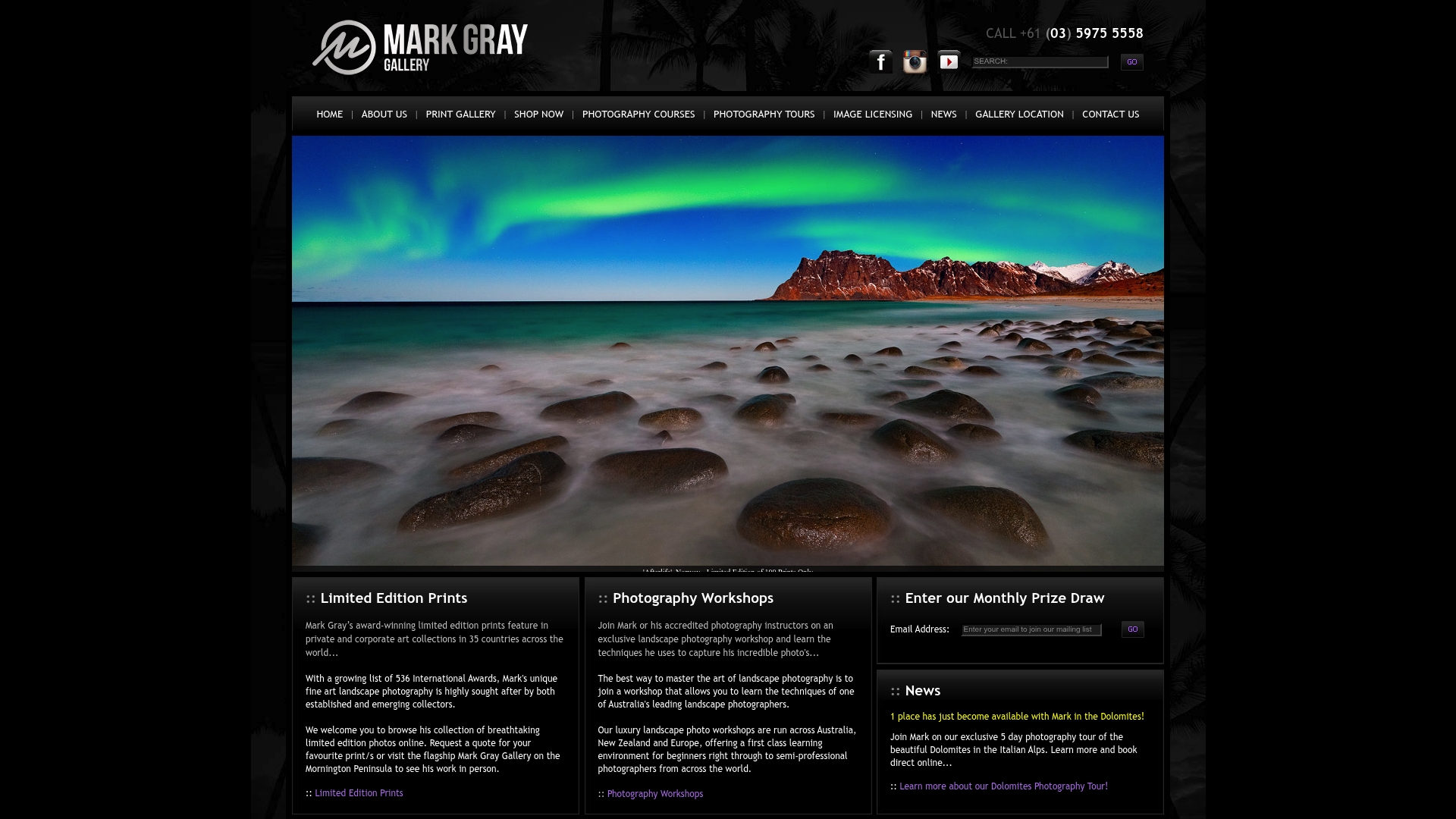
Every licensed image comes with documented usage rights, confirmed releases where applicable, and direct support for your specific commercial application, whether that is a website hero, printed signage, a brochure, or a splashback installation. Exclusive licensing options are available for organizations that need visual assets their competitors cannot replicate.
- Bespoke licensing for websites, signage, brochures, flyers, and splashbacks
- Exclusive image options for brand-critical campaigns
- Documented releases and written license agreements
- Ongoing licensing support for repeat or expanded use
Ready to protect your brand with photography that is as distinctive as your business? License an image directly through Mark Gray Gallery and receive a written license tailored to your exact commercial use.
Useful sources and verification tools
A short list of authoritative resources for verifying image rights, reading license terms, and understanding U.S. copyright law before you publish.
- U.S. Copyright Office — Fair Use FAQ: The primary U.S. government source on copyright, fair use thresholds, and statutory damages. Start here for any legal question about image rights.
- University of Texas Copyright Crash Course — Images and Photos: A clear, practical guide to image copyright for commercial and educational use. Covers public domain, Creative Commons, and licensing basics.
- Creative Commons License Reference — CC-BY-NC 4.0: The official Creative Commons license page. Use this to read the exact terms of any CC license before commercial use.
- Wikimedia Commons: A large repository of public domain and CC-licensed media. Always verify the individual image's license status before use.
- TinEye: Reverse-image search engine for tracing image origin and usage history. Use before publishing any image whose provenance is unclear.
- Google Images reverse search: Upload or paste an image URL to find other instances across the web. Useful for identifying overuse or prior rights disputes.
- Pixsy: Image monitoring and takedown service. Useful for organizations managing licensed image libraries and tracking unauthorized use.
- Mark Gray Gallery — How to License Photography for Websites: Step-by-step guidance on licensing images for web use, including what to check and how to document your rights.
- For Photographers Only — Industry Coverage: Industry-focused resource covering professional photography licensing practices and news relevant to commercial photographers and buyers.