
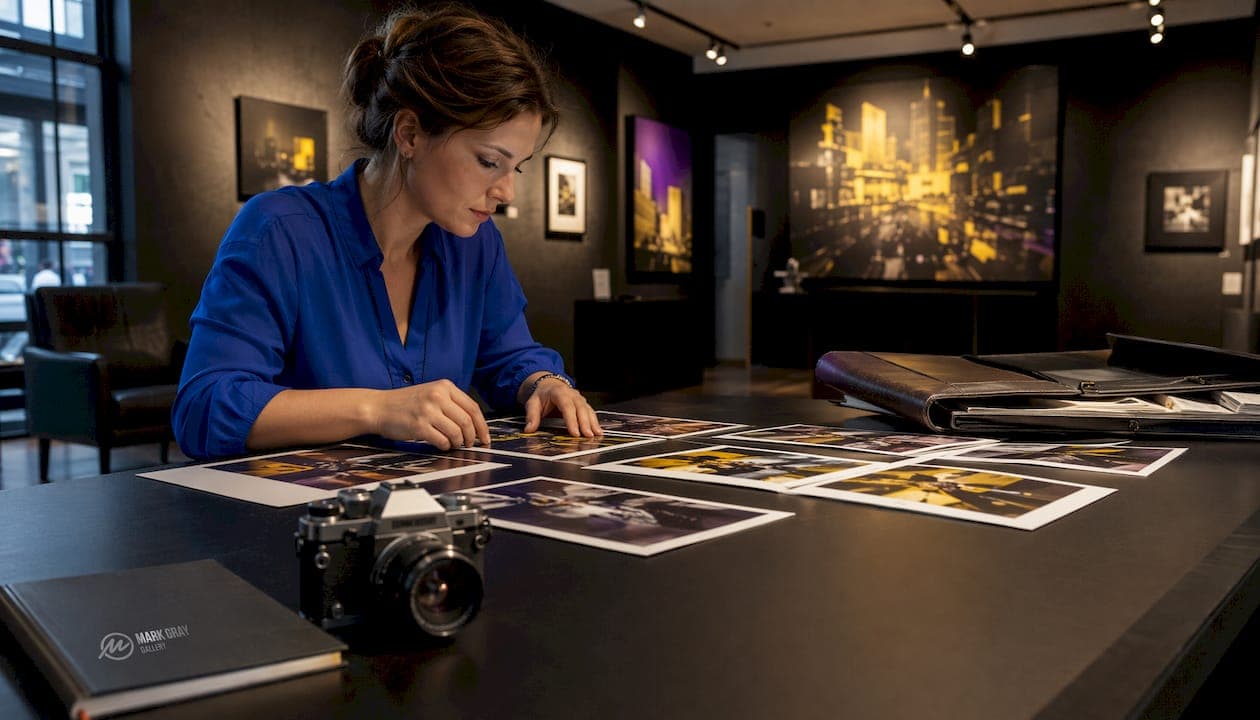
What is photography portfolio curation?
Photography portfolio curation is the selective, strategic process of organizing a limited set of images to define your visual identity, demonstrate professional capabilities, and attract the clients you most want to work with. It is not archiving, and it is not simply picking your favorites. Curation is a deliberate sales act: every image either earns its place or weakens the whole.
Think of your portfolio as an advertisement, not a record. The goal is to show potential clients exactly what working with you looks like, and to make them confident enough to reach out.
Key principles that define effective curation:
- It is selective by design. Experts recommend 15–30 images for a focused single-genre portfolio; multiple genres warrant separate sections of 10–15 images each.
- It is client-centered, not photographer-centered. Every image answers one question: "Does this show the work I want to be hired for?"
- It signals professional focus. A tightly curated portfolio communicates a specialty far more powerfully than a broad archive ever could.
- It is a living tool, not a finished product. The best portfolios are updated regularly as skills and goals evolve.
Why portfolio curation is the foundation of client attraction
A well-curated portfolio does something a great single photograph cannot: it builds confidence before a client reads a single word of your copy. Consistency of style, quality, and subject matter tells a visitor that you are reliable, focused, and worth the investment.
"Clients are not evaluating your artistic growth. They are risk-managing a hiring decision. They want to know three things: Can you deliver consistent quality? Do you understand my specific need? Are you someone I can work with?" — Fstoppers
Poor curation creates the opposite effect. A portfolio that spans weddings, real estate, food, and pet photography in a single scroll tells every visitor that you are a generalist, which in most markets means you are nobody's first choice for anything. Diluted branding costs bookings. A focused portfolio, even a short one, signals mastery and attracts the clients who are already looking for exactly what you offer.
The About and Contact pages matter here too. Clients hire people, not just images. A professional bio that communicates your specialty and approach closes the gap between "looks interesting" and "let's book a call."

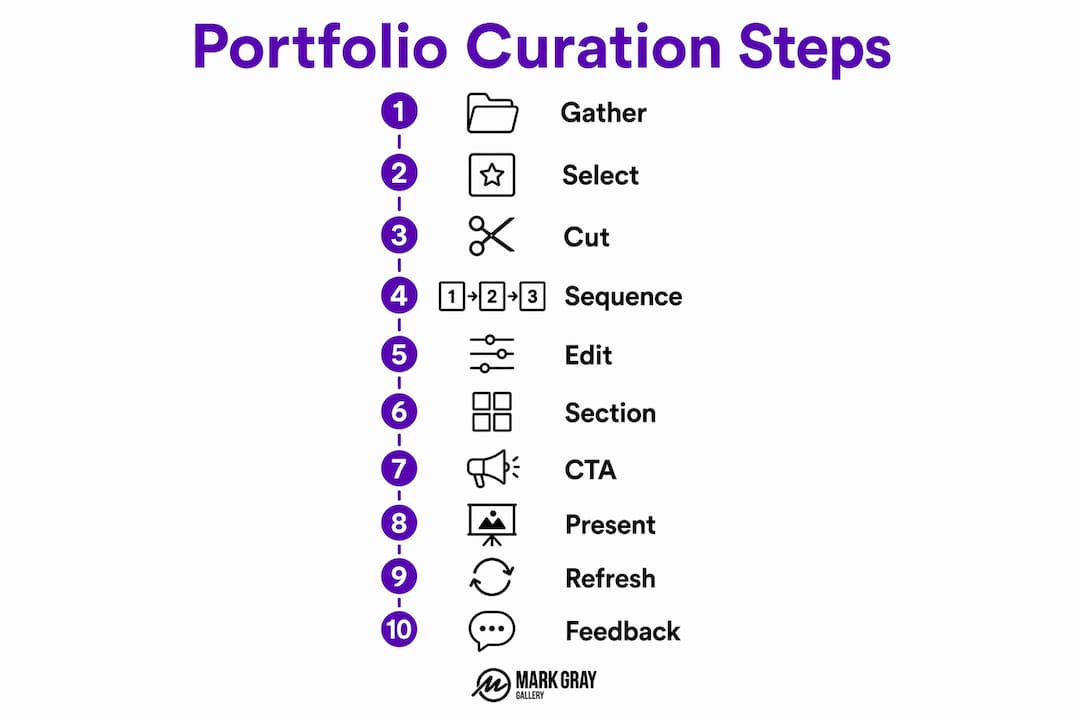
How to curate your photography portfolio step by step
1. Gather everything first
Pull every candidate image into one place before you make a single cut. Personal projects, client work, collaborations: all of it. You cannot curate what you cannot see.
2. Select your strongest images aligned with your goals
Go through the full collection and remove anything that does not make you feel genuinely proud. If you hesitate on an image, it does not belong. Hard editing that prioritizes color treatment, lighting quality, and production value consistently outperforms larger, mixed-quality collections when it comes to client conversion.
3. Cut technically good images that do not serve your goals
This is the hardest step. A photograph can be technically excellent and still have no place in your portfolio if it does not match the work you want to be hired for. A landscape photographer pursuing commercial outdoor brand work should not include street photography, no matter how strong it is. Cutting those images protects your portfolio's authority.
4. Sequence with intention
The order of images shapes the entire viewing experience. Open with your single strongest image. Close with your second strongest, because the recency effect means viewers remember the last thing they saw. In between, alternate wide and tight shots, and balance busy images with calmer ones to prevent viewer fatigue and maintain engagement.
5. Maintain consistent editing throughout
A portfolio that jumps between warm film tones and cool desaturated edits reads as inconsistent, even when every individual image is strong. One coherent color and tone treatment turns a set of good photos into a recognizable body of work.
6. Build separate sections for multiple genres
If you work across genres, give each its own dedicated section rather than mixing them on a single scroll. A client looking for headshots should see nothing but headshots. Forcing visitors to sort through mixed content means most of them will not bother.
7. Add a clear call to action at the end
Your portfolio page should not simply end. After a visitor has spent time with your work, they are in a receptive state. Give them a direct next step: a contact form, a booking link, or a link to your packages.
8. Consider both digital and physical presentation
Digital portfolios offer speed, reach, and easy updating. A physical portfolio book still carries real weight in commercial and editorial contexts. A well-printed portfolio book with 20–30 images on archival paper makes an impression a phone screen cannot replicate, particularly when meeting with agencies or art directors. For photographers whose work involves print output, showing it in print demonstrates you understand the medium. Explore how fine art print presentation can strengthen the physical portfolio experience.
9. Refresh your portfolio every quarter
A portfolio that has not been touched in months quietly signals stagnation. A quarterly audit, swapping out images that no longer represent your current work, keeps the portfolio current, reflects your evolving skills, and supports your site's search standing.
10. Seek peer and mentor feedback
Photographers are often too emotionally attached to their images to curate objectively. Peer or mentor feedback identifies filler images that are hard to see when you are self-selecting. Ask photographers you trust to evaluate technical quality, and ask non-photographers to respond to emotion and storytelling. Both perspectives matter. Photography courses and mentorship programs are among the most direct ways to build this kind of critical eye.
Pro Tip: After gathering outside feedback, note which images people mention unprompted after viewing your portfolio. Those are your anchors. Build the sequence around them.
Best practices and common mistakes in portfolio curation
The photographers who attract the most consistent work share a few habits. Those who struggle often share the same avoidable mistakes.
What the best portfolios do:
- Show only images at the same quality level. A portfolio is judged by its weakest image, not its strongest.
- Maintain one coherent editing style throughout, with no noticeable shifts in color treatment or tone.
- Keep the image count focused. Fifteen exceptional photographs outperform fifty mixed ones every time.
- Separate genres into distinct sections so each client type finds exactly what they need without effort.
- Update at least quarterly so the portfolio reflects current skills and current goals.
- Make navigation obvious. A confused visitor is a lost client.
- Treat the About and Contact pages as trust builders, not afterthoughts.
What weakens portfolios:
- Including technically good images that do not support your professional positioning.
- Mixing unrelated genres in a single gallery, which creates a disjointed viewing experience.
- Letting the portfolio stagnate. An outdated portfolio tells potential clients you are either not working or not growing.
- Overloading with filler images to appear prolific. Volume without focus dilutes the message.
- Neglecting mobile performance. A portfolio that loads slowly or displays poorly on a phone loses visitors before they see a single image.
Expert insights on curation, branding, and client attraction
The photographers who book consistently tend to think about their portfolios differently from those who do not. The shift is from "showing what I have done" to "advertising what I want to do next."
"A portfolio should be viewed as an advertisement for your future, not merely a record of past work. It signals what clients can expect and what work you want to shoot next." — Pic-Time Blog
Travis Hodges, portrait and documentary photographer and Canon Student Development Programme mentor, puts it plainly: people reviewing portfolios remember the one image they did not like, regardless of how many they saw. That single weak image casts doubt on everything around it. The discipline of hard curation is itself something a client can read in the work. It signals judgment, confidence, and professional maturity.
Emotional distance is the other recurring theme among experienced photographers. Outside opinions consistently reveal weak spots that are invisible when you are too close to the work. The photographers who improve fastest are those who actively seek that friction rather than avoid it.
What effective portfolio curation looks like in practice
The gap between a portfolio that displays nice pictures and one that books clients is almost always about the decisions made during curation, not the quality of the raw images.
Consider a wedding photographer who has shot forty weddings but whose portfolio contains 120 images spanning every genre they have ever tried. Visitors see a capable photographer with no clear identity. Now consider the same photographer who selects 25 images, all weddings, all sharing a warm and documentary tone, sequenced to open with an extraordinary ceremony moment and close with a reception detail that feels intimate and alive. The second portfolio communicates a specialty, a style, and a promise. Clients who want that specific look know immediately they have found their photographer.
The same principle applies to landscape photographers building a fine art portfolio. Showing 80 technically strong images from a dozen countries creates visual noise. Selecting 20 images that share a consistent color palette, a preference for dramatic light, and a clear compositional point of view creates a body of work that feels authored. That authorship is what collectors and licensing clients respond to. Understanding the value of professional photography as a distinct discipline, rather than a volume exercise, is the foundation of this approach.
The common thread across every genre: curation is subtraction. The images you cut define the portfolio as much as the ones you keep.
How to tailor your portfolio for different audiences and clients
A single master portfolio on your website serves as your public-facing foundation. But the photographers who win the most targeted work go one step further: they adapt their presentation for each specific audience.
When pitching to a wedding venue, lead with images shot in similar spaces and lighting conditions. When approaching a corporate client for headshots, build a custom selection heavy on professional portraits and business environments. When submitting to an editorial publication, front-load your strongest single image and keep the edit tight, because editors reviewing thousands of submissions make decisions in seconds.
The practical approach most working photographers use is a master gallery online combined with custom PDF portfolios or private online galleries for specific pitches. This keeps the public portfolio clean and focused while allowing targeted presentations that speak directly to each client's needs. Marketing fine art photography online involves exactly this kind of audience-aware thinking: knowing who you are speaking to before you decide what to show them.
For photographers working across multiple disciplines, separate portfolio sections with distinct URLs make it easy for each client type to find relevant work without wading through unrelated images. A restaurant looking for food photography should land on a food photography page and see nothing else. The less work a client has to do to confirm you are the right choice, the more likely they are to reach out.
Key Takeaways
Photography portfolio curation is a deliberate sales process: selecting, sequencing, and presenting your strongest images to communicate a clear specialty and make it easy for the right clients to say yes.
| Point | Details |
|---|---|
| Recommended portfolio size | Aim for 15–30 images for a single-genre portfolio; separate sections of 10–15 images each for multiple genres. |
| Hard editing wins clients | Prioritizing color treatment, lighting quality, and production value outperforms larger mixed-quality collections. |
| Sequence shapes perception | Open with your strongest image, close with your second strongest, and alternate compositions in between to maintain engagement. |
| Refresh every quarter | A quarterly audit keeps the portfolio current, reflects evolving skills, and supports search standing. |
| Tailor for each audience | Adapt your selection for specific clients using custom PDF portfolios or private galleries alongside your public master gallery. |