

Licensing your photography stock images is the process of granting buyers permission to use your photos under specific conditions while you retain full copyright ownership. You never sell the image itself. You sell the right to use it. That distinction is what makes stock licensing one of the most powerful income models in photography. A single landscape image can generate revenue from a website, a brochure, a commercial splashback, and a signage project, all from one license sale each. This guide covers the main license types, legal requirements, and practical steps to maximize what your portfolio earns.
What are the main stock image licensing models and how do they work?
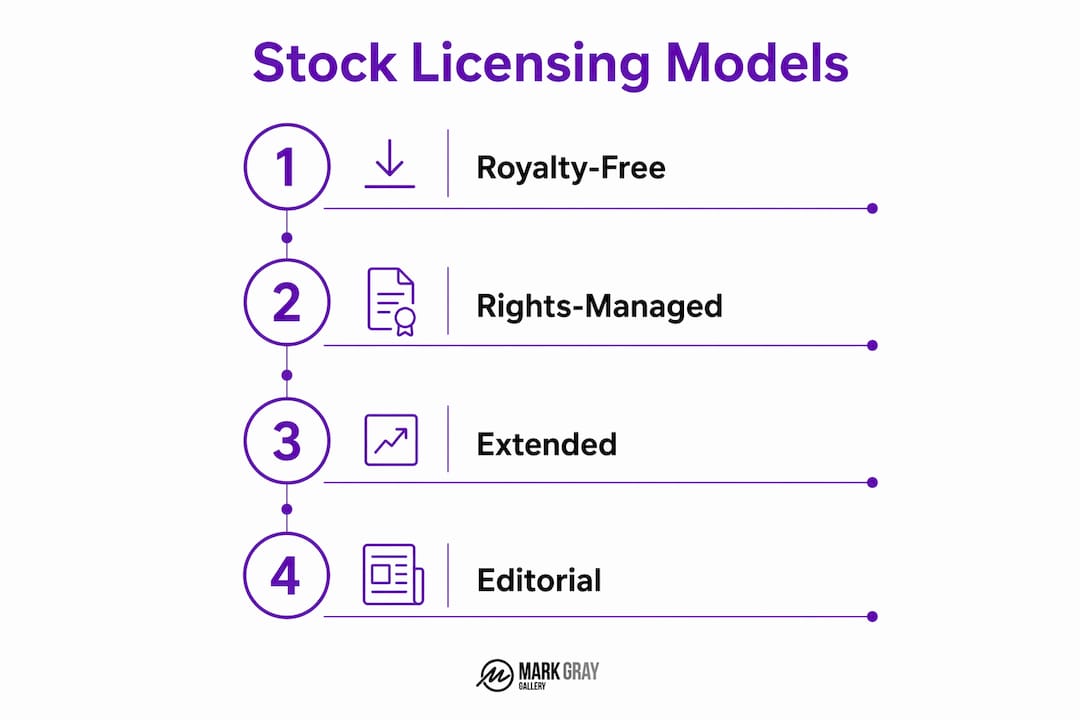
Stock image licensing agreements follow four primary models. Each one defines how a buyer can use your image, for how long, and at what price. Choosing the right model shapes both your income and your control over the work.
Royalty-free (RF) is the most common model in 2026. A buyer pays a one-time fee for flexible usage without paying repeat fees each time they use the image. "Royalty-free" does not mean free. It means the buyer is not charged a royalty per use after the initial purchase. RF licenses are non-exclusive, so you can sell the same image to many buyers simultaneously.

Rights-managed (RM) licenses are usage-specific. Pricing depends on territory, duration, media type, and audience size. A buyer licensing an image for a national print campaign pays more than one licensing it for a local website. RM fees vary by territory and can be significantly higher than RF, but sales volume is lower. This model suits premium or exclusive imagery.
Extended licenses apply when a buyer needs rights beyond standard use. Merchandise resale, templates distributed to third parties, and large-scale print runs all require extended licenses. Extended licenses command higher fees because they grant broader rights. Never assume a standard RF license covers these uses.
Editorial licenses restrict use to news, education, and commentary. They do not permit commercial advertising. The table below summarizes the key differences.
| License type | Payment structure | Exclusivity | Typical use |
|---|---|---|---|
| Royalty-free | One-time fee | Non-exclusive | Websites, brochures, social media |
| Rights-managed | Usage-based pricing | Can be exclusive | Advertising campaigns, editorial spreads |
| Extended | Premium one-time fee | Non-exclusive | Merchandise, templates, large print runs |
| Editorial | Low flat fee | Non-exclusive | News, education, commentary only |
What legal considerations are required to license stock images commercially?
Copyright belongs to the photographer automatically at the moment of capture. You do not need to register it to own it, though registration strengthens your legal position in infringement disputes. Licensing grants usage rights. It does not transfer ownership. That separation is the legal foundation of every stock deal.
Commercial licensing requires signed releases for any recognizable person or private property in the image. Without a model release, an image of a person cannot be used in advertising, product packaging, or promotional material. Without a property release, images of private buildings, artwork, or branded locations face the same restriction. Without these releases, images are confined to editorial use, which limits earnings significantly.
The financial risk of misuse is serious. Using images without proper licenses risks statutory damages up to $150,000 per image. That figure applies to buyers who misuse licensed images, but it also reflects the legal exposure photographers face if they license images they do not have the rights to supply. Supplying an image for commercial use without a valid release is a liability.
Key documentation to maintain:
- Signed model releases for every identifiable person in commercial images
- Signed property releases for private locations, artwork, and branded environments
- A digital archive organized by image file name for fast retrieval
- Records of when and where each release was signed
Pro Tip: Store release documents in a cloud-based folder named to match your image file names. When a buyer requests proof of release, you can retrieve it in seconds rather than searching through paper files.
Landscape images without people or private property are the cleanest category for commercial licensing. They rarely require releases and can move directly into commercial markets. This is one reason why landscape photography, including the work featured at Com, translates so well into commercial stock licensing for signage, splashbacks, and large-format print applications. For a broader look at legal considerations for stock licensing, the legal documentation requirements are worth reviewing before you submit images to any platform.
How do photographers practically license their stock images to maximize revenue?
Building a portfolio that generates consistent income takes time and volume. Photographers building portfolios of 1,000 or more images over two to three years can generate $500 to $2,000 per month in passive income. First-year earnings typically fall between $100 and $500 as the portfolio grows. The income curve is slow at first and accelerates with scale.
A practical approach to growing licensing revenue follows these steps:
- Build volume first. Upload consistently. A portfolio of 50 images earns far less than one of 500, even if the quality is equal.
- Upload non-exclusively to multiple platforms. Uploading to 3–5 platforms simultaneously improves discovery across diverse buyer bases without locking you into one agency's terms.
- Keyword every image thoroughly. Effective keywording and metadata significantly improve discoverability on stock platforms. Include location, mood, subject, color, and intended use in your tags.
- Open a direct sales channel. Photographers who sell direct keep nearly 100% of sales revenue compared to 15–40% royalties from agencies. Direct sales can yield four to six times the income per transaction.
- Consider professional representation. Agents or sales teams can pitch your work to brands directly. Commissions run 15% to 30%, but the deals they secure often exceed what platform sales generate.
Pro Tip: Treat stock agencies as your discovery layer and your personal store as your primary revenue center. Agencies bring buyers to your work. Your own store keeps the margin.
| Channel | Revenue share | Control over pricing | Best for |
|---|---|---|---|
| Stock agency | 15–40% royalty | Low | Discovery and volume |
| Direct store | Up to 100% | High | Margin and repeat buyers |
| Agent or sales team | 70–85% after commission | Medium | Premium and brand deals |
For photographers focused on licensing photography for websites and commercial applications, combining all three channels produces the strongest results. Understanding how commercial photography licensing differs from standard stock agreements also helps when negotiating with business buyers directly.
What are common mistakes when licensing photography stock images?
The most costly mistake photographers make is misclassifying images. Confusing editorial usage with commercial licensing is a major source of infringement disputes. An editorial image of a recognizable person cannot be used in an advertisement, even if the buyer pays a commercial rate. Clear tagging at the point of upload prevents this problem.
Other frequent errors include:
- Skipping extended licenses. A buyer who uses a standard RF image on merchandise for resale is in breach of the license. Photographers who do not offer extended licenses miss the higher fees those uses command.
- Failing to secure releases before upload. Going back to obtain a release after the fact is difficult and sometimes impossible. Get releases signed on the day of the shoot.
- Signing exclusive contracts without reading the terms. Some platforms offer higher royalties in exchange for exclusivity. That arrangement limits your ability to upload the same images elsewhere, which reduces total exposure.
- Relying on a single platform. If one agency changes its royalty structure or closes, a photographer with all images in one place loses all passive income overnight.
Pro Tip: Read the exclusivity clause of every platform agreement before you upload. Non-exclusive arrangements give you the freedom to distribute widely. Exclusivity should only be considered when the financial terms clearly outweigh the lost exposure.
A useful resource for business buyers navigating image selection is this image selection guide for UK business owners, which illustrates how buyers think about licensing decisions. Understanding the buyer's perspective helps photographers price and classify their work more accurately.
Key Takeaways
Licensing your photography stock images generates sustainable passive income when you combine the right license models, solid legal documentation, and a multi-channel distribution strategy.
| Point | Details |
|---|---|
| Copyright stays with you | Licensing grants usage rights only; you retain full ownership of every image. |
| License type determines price | Royalty-free, rights-managed, and extended licenses each carry different fees and restrictions. |
| Releases protect commercial value | Signed model and property releases are required for commercial use; without them, images earn less. |
| Multi-channel distribution wins | Uploading to 3–5 platforms plus a direct store maximizes both discovery and revenue per sale. |
| Direct sales multiply income | Selling direct keeps up to 100% of revenue versus 15–40% from agency royalties. |
Why I treat licensing as the backbone of a photography business
Most photographers think of licensing as an afterthought, something to sort out after the shoot. I think about it before I press the shutter. Knowing that a landscape image of Iceland's Vatnajökull glacier or Australia's Kimberley coast can be licensed for a hotel splashback, a tourism brochure, and a website header changes how I approach composition, resolution, and even the time of day I shoot.
The photographers I see struggle with licensing are almost always the ones who built a large portfolio without a legal framework to support it. They have beautiful images that cannot enter commercial markets because releases were never signed, or because they uploaded exclusively to one platform and now cannot distribute freely. That is a fixable problem, but it costs time and sometimes money to unwind.
My honest advice is to treat your agency presence as advertising and your direct sales channel as your business. Agencies introduce buyers to your work. Your own store is where the real margin lives. I have found that buyers who discover my landscape photography through a stock platform often come directly to the gallery for larger prints or custom licensing arrangements. That second transaction is where the relationship and the revenue both grow.
Legal documentation is not glamorous, but it is the difference between a portfolio that earns and one that sits idle. Every release I have ever signed on location has paid for itself many times over.
— Mark
Award-winning landscape photography available for licensing
Mark Gray is an internationally acclaimed Australian landscape photographer whose work spans Australia, New Zealand, Norway, Iceland, French Polynesia, Spain, and the United Kingdom.
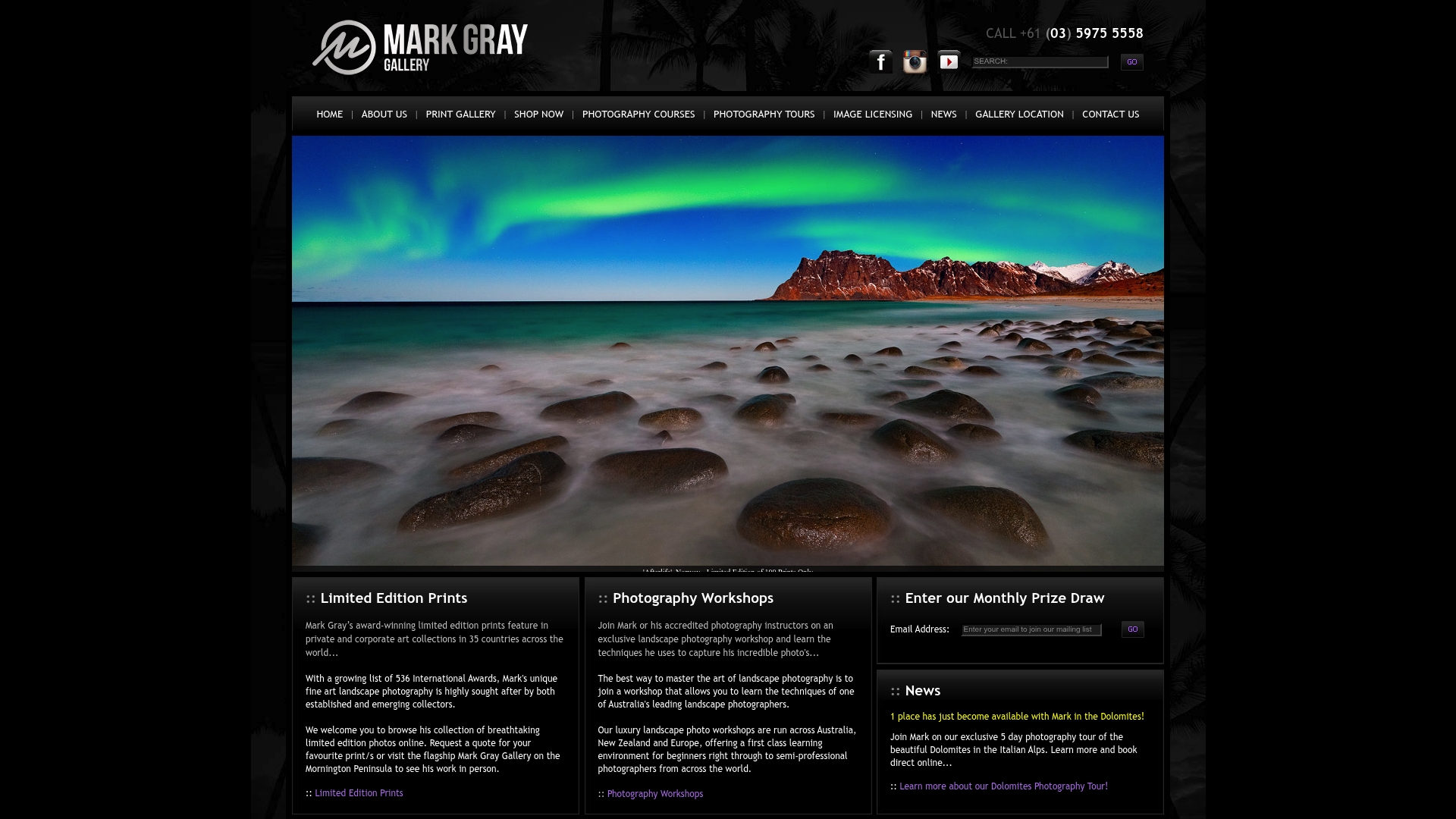
Com offers premium landscape images available for commercial licensing across a wide range of applications, including splashbacks, signage, websites, brochures, and flyers. Each image is captured at the highest resolution to meet the demands of large-format commercial print. Whether you are a business seeking inspiring imagery for a commercial space or a creative professional looking for exclusive fine art photography, the Mark Gray Gallery is the place to start. Explore the full collection and licensing options at markgray.com.au.
FAQ
What is stock image licensing?
Stock image licensing is the process of granting a buyer permission to use a photograph under defined conditions while the photographer retains copyright. The buyer pays for usage rights, not ownership of the image.
What does royalty-free mean in photography licensing?
Royalty-free means the buyer pays a single fee and can use the image multiple times without paying additional royalties. It does not mean the image is free to use.
Do I need model releases to license my photos commercially?
Yes. Any image featuring a recognizable person used in advertising or commercial promotion requires a signed model release. Without one, the image is restricted to editorial use only.
How much can photographers earn from stock licensing?
Photographers building portfolios of 1,000 or more images over two to three years can earn $500 to $2,000 per month in passive income. First-year earnings typically range from $100 to $500.
Can I upload the same image to multiple stock platforms?
Yes, provided you choose non-exclusive agreements. Non-exclusive uploads to 3–5 platforms simultaneously increase discovery and sales without restricting your distribution rights.