
If you post it, boost it, or run it as an ad, you need a license or documented permission that matches exactly how you plan to use it: the channel, the term, and whether money is behind it. Identifiable people need a signed release before any commercial promotion. Document that approval before you hit publish, not after a takedown notice lands in your inbox.
TL;DR:
- A license must specify scope, term, territory, exclusivity, and derivatives to cover all authorized uses and prevent licensing gaps.
- Platform terms of service typically grant broad rights to the host platform but do not replace the need for proper commercial licenses and releases.
- Clearing image rights involves verifying copyright, securing signed releases from identifiable individuals, and confirming platform compliance through a three-question check.
- Stock images often come with clear licenses, but "editorial only" flags and Creative Commons restrictions can limit commercial use; AI and found images carry particular legal risks.
- Structuring licensing negotiations around usage scope, term, territory, and derivatives reduces costs and clarifies allowed campaign applications.
Table of Contents
- What Social Media Image Licensing Actually Means
- The Three Rights Buckets You Must Clear
- Setting the Five Knobs Before You Sign Anything
- Stock, Creative Commons, AI, and Found Images: What's Actually Safe
- A Repeatable Rights-Audit Workflow You Can Run Every Time
- What Image Licenses Actually Cost and How to Negotiate Them
- Building the Contract: What to Ask For Before You Commission
- Why Photography Experience Changes How You Read a License
- License Landscape Photography Through Com
- Sources
What Social Media Image Licensing Actually Means
Copyright belongs to the creator the moment the shutter clicks, whether they are a professional photographer or a friend with an iPhone. Posting an image to Instagram or Facebook does not transfer that ownership to you, and it does not transfer it to the platform either. What you're actually managing here is a separate, narrower question: what permission do you personally have to use that file for your business.
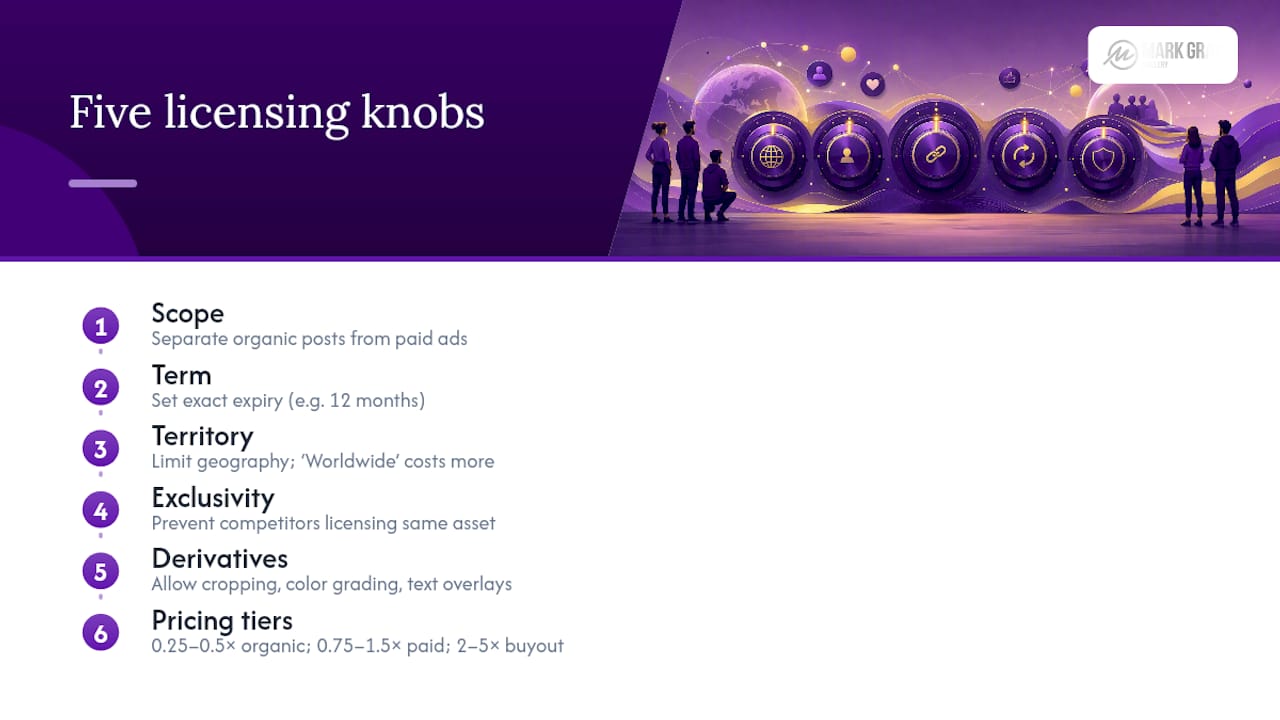
A license is simply a set of permissions layered on top of that ownership. Every usable license has five adjustable settings, and understanding them is the entire game:
- Scope — organic posts only, or paid amplification too
- Term — how long you're allowed to keep using the image
- Territory — which countries or regions the permission covers
- Exclusivity — whether others can license the same image
- Derivatives — whether you can crop, recolor, or repurpose the file
Platform terms of service complicate this further. When you upload a photo to a major network, you typically grant that platform a broad license to host, display, and sometimes sublicense the content, and that license often survives even after you delete the post. That's a completely separate transaction from the commercial rights your business needs to run the image in an ad campaign. Confusing the two is the single most common mistake small teams make.
Assignment, meaning an actual transfer of copyright ownership, is rare and usually unnecessary. Reserve it for situations where you need permanent, unrestricted control, such as building a logo or core brand asset. For nearly everything else, a well-scoped license does the job for far less money.
The Three Rights Buckets You Must Clear
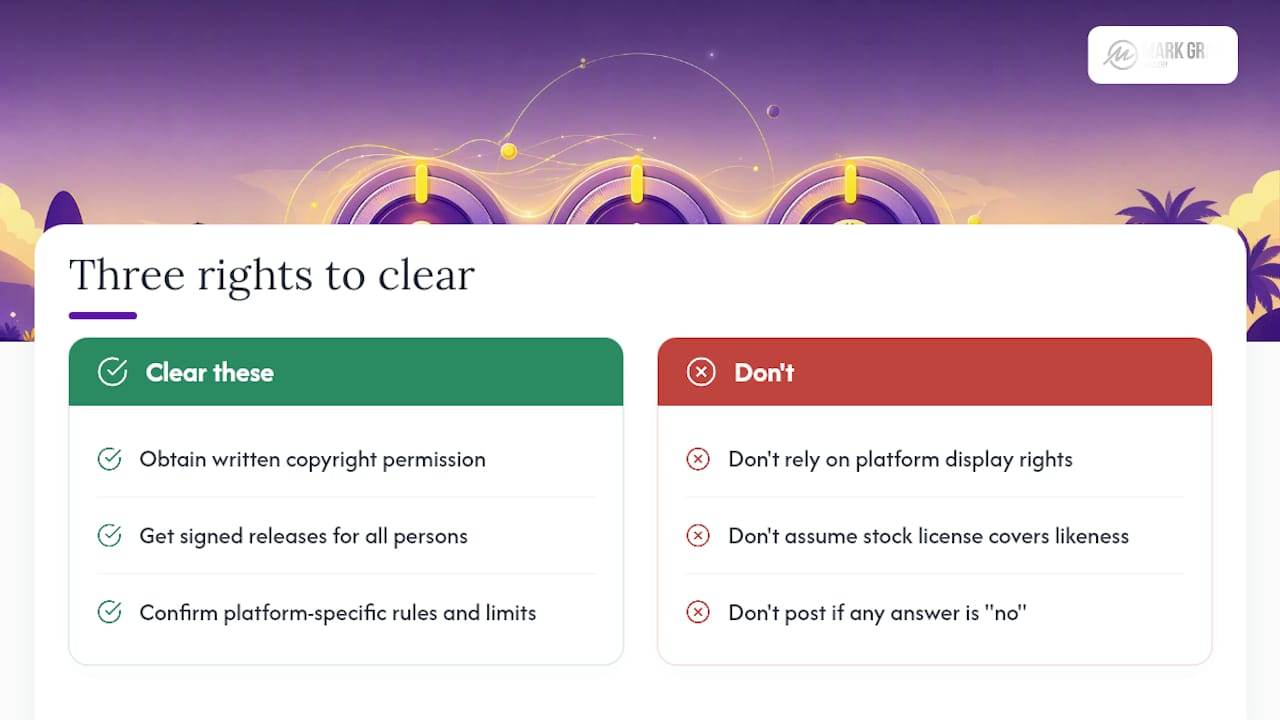
Every image you consider for commercial use falls into three separate legal buckets, and clearing one does nothing for the other two. Treating image rights as three distinct categories, copyright, likeness, and platform terms, is the fastest way to spot a gap before it becomes a legal problem.
Copyright asks who owns the file and whether they've granted you permission. Trace the chain: did a photographer shoot it, did a stock agency license it, did an employee create it on the clock? Get that answer in writing.
Likeness rights, also called the right of publicity, ask a separate question entirely. Even a fully licensed photo can be unusable for commercial promotion if an identifiable person in the frame never signed a release. This trips up more marketers than copyright ever does, because a stock license can feel like a green light when it isn't one for the person pictured.
Platform terms are the third bucket, and they never substitute for the other two. Facebook's right to display your post does nothing to protect you from a lawsuit over an uncleared model or an unlicensed photographer's file.
Pro Tip: Before you approve any campaign asset, ask three separate yes/no questions: Do I have copyright permission? Do I have a signed release for every identifiable person? Am I clear on what the platform itself requires? One "no" stops the post.
Setting the Five Knobs Before You Sign Anything
Vague licensing language is where budgets quietly balloon. Instead of accepting a generic "use on social media" grant, negotiate each of the five knobs by name.
Scope separates organic posting from paid amplification, and this distinction matters more than most marketers realize. A photo cleared for an organic Instagram post is not automatically cleared to run as a boosted ad; courts and platforms both treat paid amplification as advertising, a different legal category entirely, according to University of Law's analysis of social media copyright.
Term sets your expiration date. Ask for exactly what the campaign needs: "Brand may use the Content on Instagram and TikTok organic posts only, for 12 months."
Territory matters if you run global ads. "Worldwide" costs more than "United States and Canada only."
Exclusivity determines whether a competitor could license the identical shot next month.
Derivatives cover cropping, color grading, or adding text overlays, permissions that are frequently overlooked and frequently needed.
Loosening any single knob raises the price, because you're asking the rights holder to give up more control. A tiered multiplier approach is standard in the industry: short-term organic reuse commonly runs 0.25 to 0.5 times the base fee, paid use runs 0.75 to 1.5 times, and a full buyout can reach two to five times the base rate. Ask narrowly, and you pay narrowly. Our own guide to licensing stock images breaks down how these terms typically appear in a professional photographer's contract.
Stock, Creative Commons, AI, and Found Images: What's Actually Safe
Not every image source carries the same risk, and the differences trip people up constantly.
- Stock photography usually comes with a clear commercial license, but check for an "editorial use only" flag, which blocks any promotional or advertising use outright.
- Creative Commons covers a spectrum. CC0 places an image in the public domain with no restrictions. CC BY requires attribution but permits commercial use. CC BY-NC blocks commercial use entirely, no matter how you attribute it.
- AI-generated images often come with commercial-use permissions baked into the tool's terms, but those terms vary by platform, and passing off an AI image as a real customer photo raises separate disclosure and deception concerns.
- Found images, the ones pulled from a Google search or a competitor's Instagram feed, carry no license at all. "I found it online" is not a legal defense, and fair use is a narrow, fact-specific exception you cannot rely on as blanket permission for commercial content.
Our comparison of licensed photography versus free images digs deeper into why a free find so often costs more in the long run.
A Repeatable Rights-Audit Workflow You Can Run Every Time
Clearing rights shouldn't require reinventing the process for every campaign. A five-step workflow keeps it consistent whether you're a solo operator or running a small marketing team.
- Identify the asset chain. Who shot it, who licensed it, and does that license actually reach you?
- Confirm copyright. Get the license or purchase receipt in writing, not a verbal assurance.
- Confirm releases. Check every identifiable face against a signed model release that covers commercial use.
- Confirm audio and music clearance if the asset is video, since a separate license governs the soundtrack.
- Lock the usage scope and document approval before the post goes live, let alone before it gets boosted.
Label each asset in your tracker with a plain status: Pending, Cleared for Organic, Cleared for Paid, or Cleared for All Channels. That single column prevents a well-meaning team member from boosting a photo that was only ever cleared for an organic feed post. This kind of structured tracking before renewal decisions is what separates teams that scramble after a takedown from teams that never get one.
Pro Tip: Store the signed license, the model release, and a screenshot of the exact usage terms together in one folder per asset. When a platform flags your ad three months later, you want that answer in thirty seconds, not three days of email searching.
What Image Licenses Actually Cost and How to Negotiate Them
Pricing image rights doesn't have to be a guessing game. The industry standard starts with a base fee for the creator's work, then applies a usage multiplier depending on how far you're taking it.
- Short-term organic reuse: roughly 0.25 to 0.5 times the base fee
- Paid advertising use: roughly 0.75 to 1.5 times the base fee
- Full buyout with unlimited use: 2 to 5 times the base fee
Whitelisting, meaning running an ad through the creator's own social handle to borrow their engagement, typically carries its own charge, either a flat monthly fee or a percentage uplift on the base rate. Reserve it for campaigns where the creator's specific audience is the point.
The most common negotiation mistake is agreeing to a lump sum without naming the scope, term, and territory it covers. Treat pricing as a predictable calculation rather than an ad-hoc negotiation: start from the base fee, apply the right multiplier, and put the number in writing before the shoot, not after. Our breakdown of how photo licensing royalties work walks through real multiplier math in more detail, and ANT Management's guide to licensing fees covers additional pricing drivers worth knowing before you negotiate.
Building the Contract: What to Ask For Before You Commission
Before you commission a photographer or license a stock image for a campaign, define the brief in plain terms: which channels, whether paid amplification is part of the plan, how long you need the rights, which territories matter, and what edits you'll need to make.
Once the brief is set, the contract itself should cover six items without exception:
- Grant of rights stated explicitly, not implied
- Term and territory, spelled out with actual dates and countries
- Permitted edits, naming exactly what derivative uses are allowed
- Warranties confirming the creator actually owns or can license every element, including any people or trademarked items in frame
- A takedown process, in case a rights issue surfaces after the campaign launches
- Payment tied to deliverables, not to a vague milestone
Escalate to legal review when a contract is silent on any of these six items, when a shoot involves minors, or when the image will run in paid ads across multiple countries. Those are the situations where a missing clause turns into a real liability, not just an awkward email exchange.
Why Photography Experience Changes How You Read a License
Licensing clauses read differently once you've spent years on the other side of the camera. I've built the pricing and audit approach in this guide around real commercial licensing work, teaching landscape photography courses, and negotiating stock usage for splashbacks, signage, and brochures, not around theoretical contract templates.
That practitioner view is why the five knobs and the multiplier pricing method here reflect what creators and brands actually negotiate, not just what a license document says on paper. Awards, client testimonials, and case-specific licensing data will be added here as they become available.
License Landscape Photography Through Com
Licensing an image shouldn't mean gambling on a stock site's fine print or chasing down a stranger for a release form months after your campaign launched. Stock image licensing is often built around the knobs this guide walks through: scope, term, territory, exclusivity, and derivatives, typically set upfront so you know what you're paying for and permitted to do.
This fits you if you run splashbacks, signage, websites, brochures, or flyers and need landscape photography that's cleared for commercial use without a legal scramble later. Some images come from a single, traceable source, which can help avoid uncertain ownership chains before posting. If you're weighing a stock subscription against a one-off commission, licensing directly means you get a straightforward answer on usage rights instead of a maze of tiered subscription clauses. Browse the available landscape images and request a license scoped to your exact campaign at Markgray.
Sources
The University of Law's breakdown of copyright and social media clarifies platform license mechanics. InfluencerDB's guide covers the three rights buckets and pricing multipliers in depth. NISM Online explains likeness rights clearly. Creative Commons details license variations for commercial use.
— Mark
- Copyright in the age of social media | University of Law
- Social media image rights: Avoid legal risk
- Can You Post That? A Social Media Marketer’s Guide to Likeness Rights - NISM Online
- About Creative Commons