
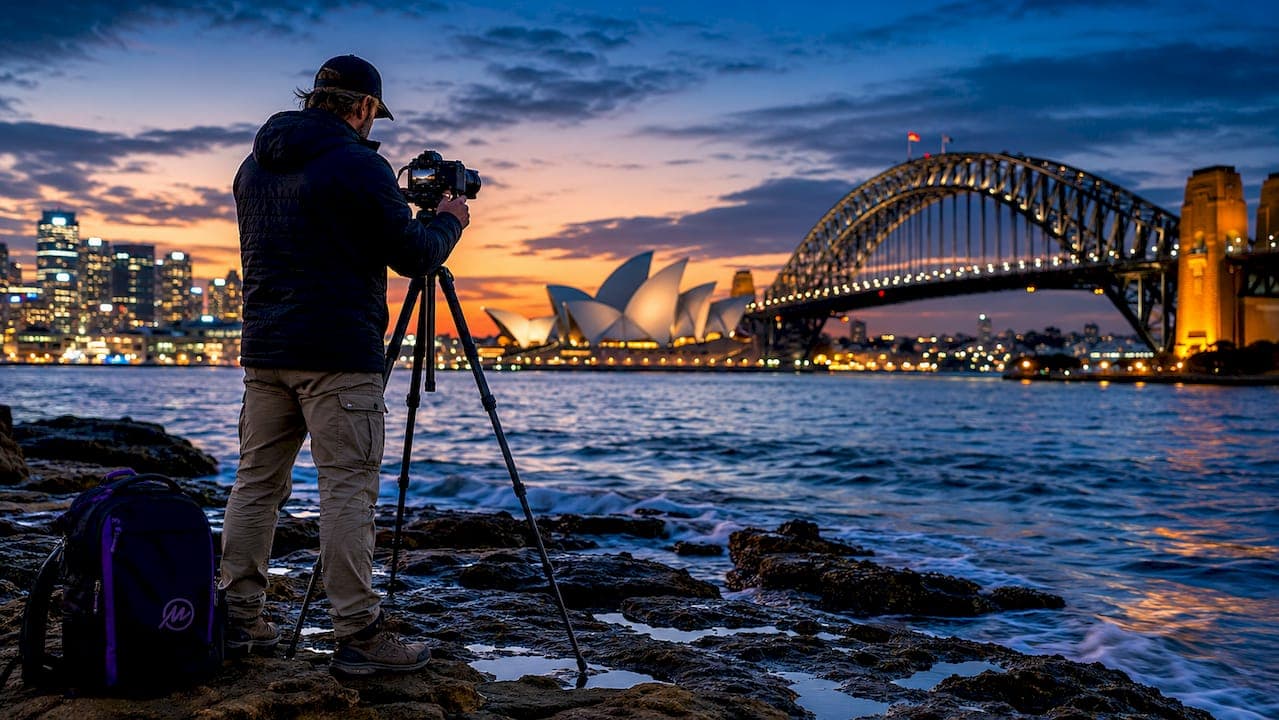
Sydney Harbour is defined by two of the world's most photographed landmarks: the Sydney Opera House and the Harbour Bridge. This photography spots Sydney Harbour guide covers the best vantage points, optimal timing, and practical techniques for capturing both iconic structures and the quieter, less crowded gems that most visitors never find. Whether you shoot with a mirrorless camera or a telephoto zoom, locations like Mrs Macquarie's Point, Cahill Walk, and Kirribilli deliver results that go far beyond the standard postcard shot. Timing your visit around sunrise and golden hour separates memorable images from forgettable ones.
Which sydney harbour spots combine opera house and harbour bridge views?
Mrs Macquarie's Point is the single best location for capturing both the Sydney Opera House and the Harbour Bridge in one frame. Arriving at sunrise between 6–7am in summer or 7–8am in winter gives you soft, directional light and a nearly empty foreground. That combination of light and space is what separates a professional-quality image from a crowded tourist snapshot.
Bradley's Head, on the north shore, offers a different advantage: telephoto compression. A 200–400mm lens from Bradley's Head stacks the Opera House and the Bridge into a tight, dramatic composition that feels impossible from the city side. The longer focal length also blurs the water into smooth texture, which adds depth to the final image.
- Mrs Macquarie's Point: Best at sunrise; wide-angle compositions work well here
- Bradley's Head: Ideal for telephoto compression shots; accessible by ferry from Circular Quay
- Cahill Walk: Elevated position above the Opera House forecourt; best shooting window is 8–10am
Pro Tip: Shoot from a low angle at Mrs Macquarie's Point to include water reflections in the foreground. Even a slight crouch changes the geometry of the entire composition.
One important note for professionals: commercial photography on the Opera House site or using its image for commercial purposes requires prior approval from the Sydney Opera House Trust. Personal and editorial photography generally does not require a permit, but always verify before a paid shoot.
What are the best vantage points for photographing the harbour bridge?
The Harbour Bridge is accessible from multiple free viewpoints, and you do not need to pay for BridgeClimb to get a compelling shot. City-side and north-side foreshore viewpoints each offer distinct compositions depending on the time of day. Choosing the right side at the right hour is the single most important decision you will make for bridge photography.
The pedestrian walkway across the bridge itself is underused by photographers. Walking the span gives you close-up details of the steel arch, rivets, and pylons that no ground-level shot can replicate. The walkway also provides a direct downward view of the harbour traffic below, which works beautifully with a wide-angle lens.
- City side (Circular Quay area): Best at sunrise and late afternoon for warm front lighting
- North side (Milsons Point, Blues Point Reserve): Best at sunset and night; faces west for evening color
- Pedestrian walkway: Best in the morning and late afternoon for side lighting on the arch structure
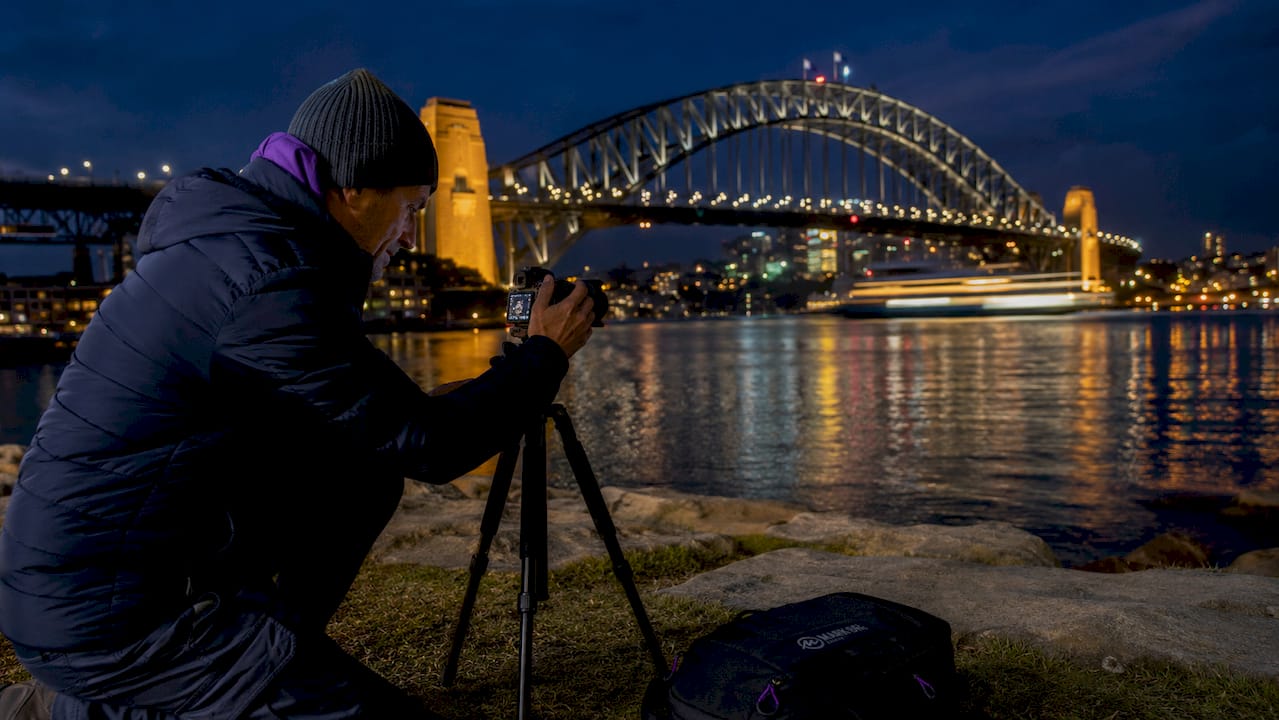
- Milsons Point foreshore: Ideal for long-exposure night shots with ferry light streaks on the water
Pro Tip: At Milsons Point, set up your tripod at least 30 minutes before the ferry peak hour. Ferry streaks require a 10–30 second exposure, and heavy foot traffic on the wharf creates camera shake that ruins the shot.
Night photography at Milsons Point rewards patience. The bridge lights reflect across the harbour surface, and a 20-second exposure at ISO 200 produces a mirror-like water effect that looks nothing like what the eye sees in real time. Arriving before ferry peak minimizes interruptions and gives you a clean setup window.
How can a foreshore walk maximize your sydney harbour shots?
A continuous foreshore walk is the most efficient way to photograph multiple Sydney Harbour locations in a single day. The 11km route from Woolloomooloo to Pyrmont passes through the Royal Botanic Garden, Mrs Macquarie's Chair, Circular Quay, Barangaroo, and Darling Harbour. Each stop offers a different angle, different foreground elements, and different crowd density.
Walking the route rather than driving between spots means you catch the light as it shifts. The difference between 7am and 9am at the Botanic Gardens is dramatic. Early morning delivers mist on the water and empty paths; by mid-morning, tour groups arrive and the light flattens.
Here is a practical sequence for the foreshore walk:
- Woolloomooloo Wharf (6:30am): Start with the wharf's long wooden jetty as a leading line toward the city skyline
- Mrs Macquarie's Chair (7:00am): Classic combined Opera House and Bridge shot at peak golden hour
- Royal Botanic Garden path (7:45am): Foreground of native trees and garden beds with harbour behind
- Circular Quay (8:30am): Ferry activity and Opera House close-up details
- Barangaroo Reserve (9:30am): Modern city skyline from the north-western waterfront
- Darling Harbour (11:00am): Reflections off the glass buildings and bridge structures
| Stop | Best Shot Type | Recommended Time |
|---|---|---|
| Mrs Macquarie's Chair | Wide-angle landmark | 6:30–7:30am |
| Royal Botanic Garden | Environmental portrait | 7:30–9:00am |
| Circular Quay | Street and architecture | 8:00–10:00am |
| Barangaroo Reserve | Skyline and water | 9:00–11:00am |
| Darling Harbour | Reflection and urban | 10:00am–12:00pm |
Combining public transport with the foreshore walk lets you cover the full route without a car. A ferry from Circular Quay to Milsons Point or Kirribilli adds a water-level perspective before you continue on foot.
Which hidden gems around sydney harbour are worth visiting?
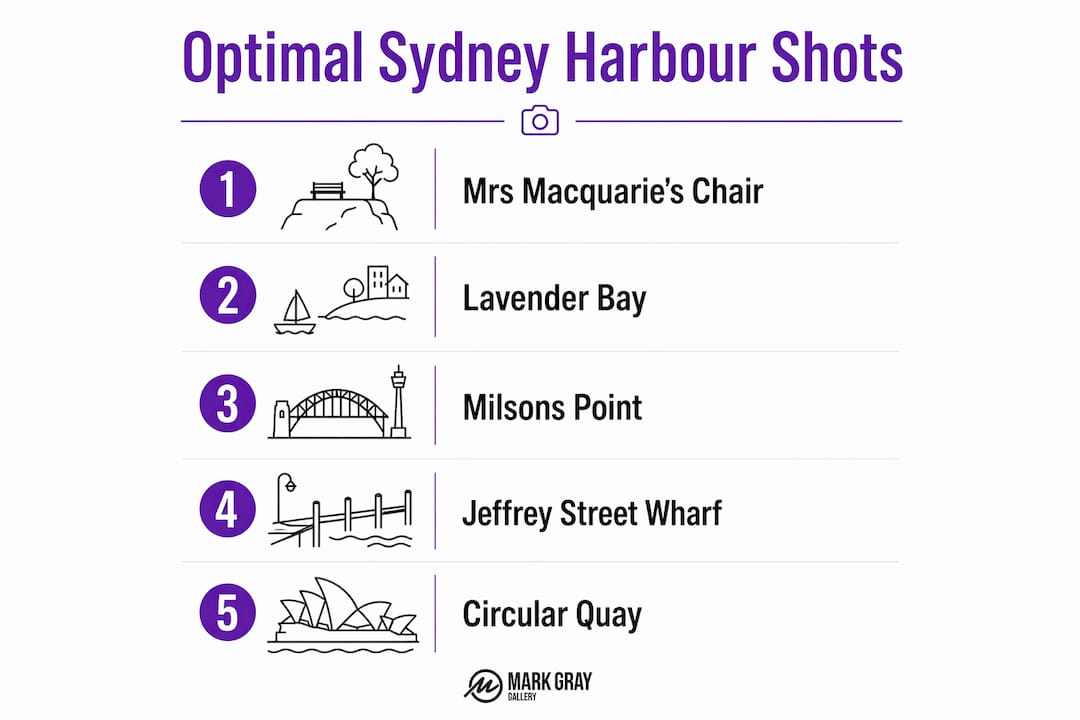
The best Sydney photography hotspots that most visitors miss are elevated, quiet, and face west for evening light. Cahill Walk sits above the Opera House forecourt and delivers an aerial perspective of the sails that no ground-level position can match. The best shooting window at Cahill Walk is 8–10am, when the sun is low enough to cast shadows across the Opera House roof tiles.
Observatory Hill Park is another underused location. The park sits on a ridge above The Rocks and frames the Harbour Bridge with historic sandstone buildings in the foreground. Morning light from the east catches the bridge's eastern face, and the park is almost always quiet before 9am.
- Jeffrey Street Wharf, Kirribilli: Sunset shots with pink and orange sky behind the city skyline; tripod recommended for long exposures
- Lavender Bay: Natural framing through fig trees with the Bridge reflected in still water at dawn
- Wendy's Secret Garden, Lavender Bay: Overgrown garden paths leading to open harbour views; unique organic foreground
- Blues Point Reserve: Faces west across the harbour; outstanding for golden hour and twilight city shots
Pro Tip: Lavender Bay is glassy and still in the hour before sunrise. Arrive before 6am in summer and you will often find perfect reflections with zero wind disturbance. That window closes fast once the morning breeze picks up.
The seasonal light changes across Sydney Harbour are significant. Winter mornings deliver longer golden hours and lower sun angles that create longer shadows across the Bridge and Opera House. Summer sunrises are earlier and more dramatic in color, but the window is shorter.
What unique shots does sydney harbour offer from the water?
Boat-based photography delivers angles that are physically impossible from shore. A lower shooting angle from a boat deck places the horizon higher in the frame, which makes the Opera House and Bridge appear taller and more imposing. Boat decks provide changing angles and foreground interest that no fixed land position can replicate.
The best departure points for water-based photography are Circular Quay and the area near Mrs Macquarie's Point. From the water, you can position yourself directly in front of the Opera House sails with the Bridge behind, a composition that requires open water between you and the shore.
- Rose Bay: Quieter eastern harbour; seaplanes and sailing boats provide natural foreground interest
- Shark Island: Accessible by ferry; isolated position in the middle of the harbour with 360-degree views
- Circular Quay ferry approach: The 10-minute ferry crossing to Milsons Point passes directly under the Bridge
Pro Tip: Use a fast shutter speed of at least 1/500 second on a moving boat to prevent motion blur. A lens image stabilizer helps, but shutter speed is the primary control. Shoot in bursts to maximize sharp frames.
Equipment protection matters on the water. A dry bag for your camera body and a UV filter on every lens guards against salt spray. The harbour water reflects light upward, which can cause unexpected overexposure on bright days. A circular polarizer cuts that reflection and saturates the water color significantly.
Key takeaways
Sydney Harbour's best photography results come from combining the right location with precise timing, not from simply showing up at the most famous spots.
| Point | Details |
|---|---|
| Prioritize timing over location | Sunrise at 6–7am summer and 7–8am winter delivers the best light and fewest crowds. |
| Mrs Macquarie's Point is the top combined shot | It is the only free public spot that frames both the Opera House and Bridge at sunrise. |
| Walk the foreshore for variety | The 11km Woolloomooloo to Pyrmont route covers five distinct shooting environments in one session. |
| Hidden gems beat crowded hotspots | Cahill Walk, Lavender Bay, and Observatory Hill offer superior conditions for tripod and long-exposure work. |
| Water access changes everything | Boat-based shooting from Rose Bay or Shark Island provides compositions unavailable from any land position. |
What i have learned shooting sydney harbour over the years
Most photographers arrive at Mrs Macquarie's Point, take the obvious shot, and leave. That is the wrong approach. Sydney Harbour rewards the photographer who treats it as a geometry problem. Angle, distance, light direction, and reflection all interact differently at every location and every hour.
My honest experience is that the foreshore walk produces better images than any single fixed spot. Moving between Woolloomooloo, the Botanic Gardens, and Circular Quay in a single morning session gives you five or six genuinely different compositions. Staying in one place gives you variations of the same image.
For night work, Milsons Point and Jeffrey Street Wharf are the two locations I return to most. The ferry streaks at Milsons Point require patience and a solid tripod, but the results are unlike anything you can achieve in daylight. I always arrive 45 minutes early to scout the exact tripod position before the light drops.
One thing I tell every photographer who joins a workshop: respect the commercial photography rules at the Opera House site. Personal photography is fine, but if you are shooting for a client or licensing the image, get the approval first. The process is straightforward, and it protects your work legally.
The scenic routes around Australia offer the same lesson: the best images come from preparation, not luck. Sydney Harbour is generous with its light and its drama. Show up early, move often, and the harbour will reward you.
— Mark
Explore sydney harbour photography with mark gray
Mark Gray is an award-winning Australian landscape photographer whose work spans Sydney Harbour, the Australian outback, Iceland, Norway, and French Polynesia. His gallery at markgray.com.au features a collection of limited edition fine art prints that demonstrate exactly what is possible when technical skill meets inspired location knowledge. For photographers who want to develop their own craft, Mark offers one-day photography courses and multi-day workshop tours across Australia and worldwide. These sessions cover everything from foreshore walk planning to long-exposure night techniques at Milsons Point. Browse the full portfolio, explore workshop dates, and find the print that brings Sydney Harbour into your home.
FAQ
What is the best time to photograph sydney harbour?
Sunrise between 6–7am in summer and 7–8am in winter delivers the softest light and the fewest crowds. Golden hour near sunset is the second best window, particularly for west-facing spots like Blues Point Reserve.
Where can i photograph both the opera house and harbour bridge together?
Mrs Macquarie's Point is the most reliable free location for capturing both landmarks in a single wide-angle frame. Bradley's Head on the north shore offers a telephoto compression alternative.
Do i need a permit to photograph the sydney opera house?
Personal and editorial photography does not require a permit. Commercial photography on the Opera House site or using its image for commercial purposes requires prior approval from the Sydney Opera House Trust.
What equipment do i need for night photography at milsons point?
A sturdy tripod and a camera capable of 10–30 second exposures are the minimum requirements. A remote shutter release prevents camera shake, and a wide-aperture lens in the f/2.8–f/4 range keeps ISO low for cleaner images.
Are there good sydney harbour photo spots accessible without a car?
The foreshore walk from Woolloomooloo to Pyrmont is fully walkable and served by multiple ferry and bus connections. Circular Quay is the central transport hub for reaching Milsons Point, Kirribilli, and Bradley's Head by public ferry.