

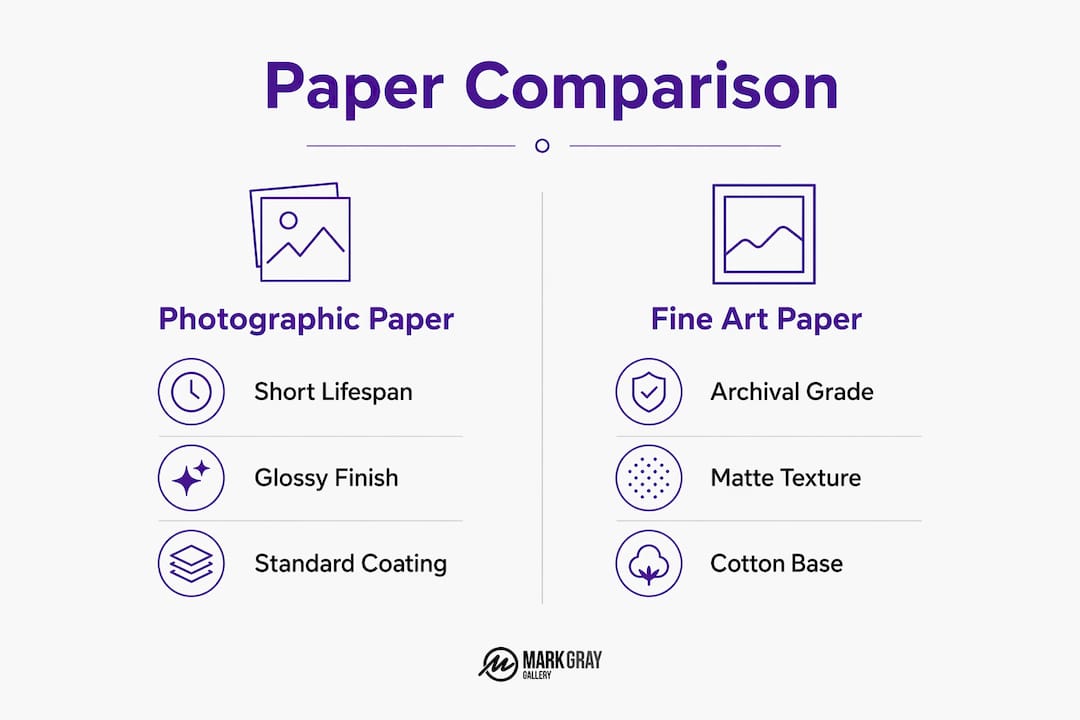
Photographic paper and fine art paper serve fundamentally different purposes, and choosing between them shapes everything from a print's visual impact to how long it will last on a wall. Photographic paper features a resin-coated core, often enhanced with optical brighteners, and delivers glossy, luster, metallic, or satin finishes built for vivid color and sharp contrast. Fine art paper is acid-free, typically cotton-based, and engineered for archival preservation with a matte, tactile surface that invites close, contemplative viewing. Here is the clearest way to understand the difference between photographic and fine art paper at a glance:
- Longevity: Fine art paper lasts for many decades with pigment inks under proper conditions; resin-coated photo paper degrades faster and may yellow over time.
- Surface finish: Fine art paper is traditionally matte and textured; photographic paper offers glossy, luster, or metallic finishes for high contrast and visual punch.
- Visual character: Fine art paper renders subtle tonal gradations and natural color; photographic paper maximizes color vibrancy and sharp detail.
- Intended use: Photographic paper suits portfolio presentations and retail prints for immediate impact; fine art paper aligns with gallery exhibitions, museum displays, and heirloom-quality prints.
- Material composition: Photographic paper uses a plastic resin coating with optical brighteners; fine art paper is acid-free and lignin-free, often made from 100% cotton rag.
Table of Contents
- What photographic paper is and how it performs
- What makes fine art paper archival-grade
- How photographic paper and fine art paper compare across critical dimensions
- Mark Gray's perspective on choosing the right paper for your prints
- Key Takeaways
What photographic paper is and how it performs
Photographic paper is built around a paper core laminated with a plastic resin layer, which gives it that characteristic smooth, slightly rigid feel. Optical brighteners are commonly added to the coating to enhance perceived whiteness and push color vibrancy to its maximum. The result is a print medium that makes colors pop and fine detail sing.
Common finishes include:
- Glossy: Maximum reflectivity and color saturation, ideal for bold, high-contrast images.
- Luster: A semi-sheen that balances vibrancy with reduced glare, popular for portrait and landscape work.
- Metallic: A pearlescent surface that adds dimension and shimmer, particularly striking for seascape and architectural photography.
- Satin: Softer than glossy, with a smooth finish that works well across a range of lighting environments.
Photographic paper excels in portfolio presentations, retail photography, and any context where immediate visual impact is the priority. The resin coating does, however, limit long-term archival stability. Coating breakdown and brightener fading reduce lifespan compared to cotton-based alternatives, making photographic paper best suited to short- to medium-term display.
Pro Tip: When selecting a photographic paper finish, consider the lighting environment where the print will be displayed. Glossy and metallic finishes can produce distracting glare under overhead or directional lighting, while luster and satin surfaces balance vibrancy with greater versatility across different rooms.
What makes fine art paper archival-grade
Fine art paper is a classification based on chemical and fiber content, not just thickness or price. True archival papers are acid- and lignin-free and most often made from 100% cotton rag, which provides long-term chemical stability that wood-pulp papers simply cannot match. This is the foundation of their extraordinary longevity.
Key characteristics that define fine art paper:
- Material: 100% cotton rag or high-quality alpha-cellulose, free from acids and lignin that cause yellowing.
- Weight: Fine art paper typically ranges from 230 to 340 gsm, giving prints a substantial, precious feel that photographic paper cannot replicate.
- Surface: Predominantly matte, with options ranging from silky smooth to richly textured, reducing glare and suiting framed display behind glass.
- Ink compatibility: Designed for pigment-based inks, which bond with the cotton fibers to achieve the archival longevity that dye-based inks cannot sustain.
- Tonal rendering: Excels at subtle color gradations, natural skin tones, and the quiet depth of black-and-white photography.
Under proper display conditions — UV-filtering glazing, controlled humidity, and protection from direct sunlight — fine art cotton rag papers maintain color and detail for over a century. Galleries, museums, and serious collectors recognize this as the standard for collectible prints. The tactile experience matters too: holding a 310 gsm cotton rag print feels categorically different from a resin-coated sheet, and that weight communicates quality before a viewer even studies the image.
A note on optical brightening agents (OBAs): Many fine art papers contain OBAs to achieve a brilliant, cool-white appearance. According to Henry Wilhelm's research, papers with fluorescent brighteners should be avoided for museum-quality prints where long-term permanence is critical, because these dyes can degrade over time, particularly when framed behind UV-filtering glazing that blocks the UV light OBAs need to fluoresce. For archival work, OBA-free papers are the more conservative choice.
How photographic paper and fine art paper compare across critical dimensions
The choice between these two print media comes down to five dimensions. Professional printers consistently emphasize that neither is universally superior — the right paper depends entirely on artistic intent and display context.
| Dimension | Photographic Paper | Fine Art Paper |
|---|---|---|
| Longevity | Shorter lifespan; resin coating and brighteners degrade over time | Lasts for many decades with pigment inks under proper display conditions |
| Surface finish | Glossy, luster, metallic, satin — high reflectivity | Matte, smooth, or textured — minimal glare, suited for framing |
| Visual characteristics | High contrast, vivid color, sharp detail | Subtle tonal gradations, natural color, quiet depth |
| Intended use | Portfolio prints, retail display, immediate visual impact | Gallery exhibitions, museum display, heirloom and collectible prints |
| Material composition | Resin-coated paper core with optical brighteners | Acid-free, lignin-free, cotton rag or alpha-cellulose |
Matte fine art papers avoid glare in museum settings and work particularly well for black-and-white photography, where tonal subtlety matters more than punch. Photographic papers with reflective finishes, by contrast, enhance vibrancy for portfolio or casual display where immediate impression is the goal. Understanding this trade-off is what separates an informed print decision from a guess. For collectors thinking about print investment value, the material composition column in that table carries significant weight — archival paper directly supports long-term value retention.

Mark Gray's perspective on choosing the right paper for your prints
Mark Gray, whose award-winning landscape photography spans Australia, Iceland, Norway, French Polynesia, and beyond, approaches paper selection as an extension of artistic vision rather than a purely technical decision. At Mark Gray Gallery, every limited edition print is produced with archival standards at the forefront, because the goal is not just a beautiful image today — it is a print that remains extraordinary decades from now.
That philosophy shapes the guidance Mark offers collectors. Fine art paper creates a tactile, heirloom-quality object — something a collector handles with care and frames with intention. Photographic paper, particularly in luster or metallic finishes, produces prints that command attention from across a room. Both have their place, and both can be produced to a high standard when the right ink and printing process are applied.
For archival work, Mark aligns with Henry Wilhelm's guidance on OBAs: where long-term preservation is the priority, OBA-free cotton rag papers are the more dependable choice. The care and display of fine art prints — UV-filtering glazing, controlled light exposure, and appropriate humidity — matters just as much as the paper itself in achieving that 100-plus-year lifespan.
The tactile and aesthetic experience of a fine art print is something no screen can replicate. Weight, texture, and the way a matte cotton surface absorbs light rather than reflecting it back — these qualities transform a photograph into an object with genuine presence. That is the standard Mark Gray Gallery holds itself to with every print it produces.
Key Takeaways
Fine art paper outlasts photographic paper by decades because its acid-free, cotton-based composition resists chemical degradation in ways that resin-coated photo paper cannot.
| Point | Details |
|---|---|
| Longevity gap is significant | Fine art paper lasts 60–200+ years with pigment inks; photographic paper degrades faster due to resin and brightener breakdown. |
| Material composition is definitive | Acid-free, lignin-free cotton rag defines true archival paper — weight alone does not qualify a paper as fine art. |
| Surface finish drives visual impact | Glossy and luster photo papers maximize vibrancy; matte fine art papers reduce glare and suit framed, museum-style display. |
| Artistic intent should guide the choice | Neither paper is universally superior; the right choice depends on whether the goal is immediate impact or long-term preservation. |
| Display conditions matter | Archival longevity assumes UV-filtering glazing, controlled humidity, and protection from direct sunlight. |