

A certificate of authenticity is the issuer's formal, written declaration that a specific artwork is what it claims to be, backed by details of authorship, materials, and production. Collectors rely on it for provenance, resale, and insurance valuation, and buyers use it to confirm they're paying for the genuine piece rather than a reproduction. Here's the catch most sellers miss: a CoA is not automatically a binding legal document. Its credibility rests entirely on what it contains, not the fact that it exists. A certificate with a signature and nothing else protects no one. A certificate with a serial number, a registry entry, and a working contact address does real work when a resale, an insurance claim, or a dispute comes along.
Key Takeaways
A trustworthy certificate of authenticity combines complete identifying fields, verifiable security elements, and honest edition language, and increasingly pairs with digital provenance standards like C2PA for long-term proof.
| Point | Details |
|---|---|
| Include every mandatory field | List artist name, title, medium, dimensions, edition number, and signature on every certificate. |
| Add verification features | Use serial numbers, QR codes, or registry IDs so buyers can independently confirm authenticity. |
| Respect edition limits | Never exceed a stated edition size; it protects resale and insurance value for every buyer. |
| Follow cultural protocols | Consult community bodies and use code certificates where Indigenous provenance rules apply. |
| Pair physical and digital proof | Reference C2PA or in-camera credentials on your CoA, as Mark Gray Gallery does with every limited-edition print. |
Table of Contents
- What Fields Belong on a Certificate of Authenticity
- How to Create, Sign, and Deliver a CoA
- Limited Editions and Photography: What Collectors Expect
- Indigenous Art and Community-Verified Provenance
- Digital Provenance: C2PA and In-Camera Signatures
- How to Verify a Certificate and What to Do If You Suspect a Fake
- A Working Example: How One Photographer Documents Every Print
- Sources
What Fields Belong on a Certificate of Authenticity
Collectors and appraisers expect a consistent set of details, and leaving one out is often the first thing a skeptical buyer notices. Build your template around these fields and you'll rarely field an awkward follow-up question.
- Artist's full legal name and current contact information
- Title of the work, medium, and dimensions
- Date the piece was created and the date the certificate was issued
- Edition number and total edition size, if applicable (written as "7/50," never just "limited edition")
- The artist's original signature, ideally matching the signature on the work itself
- A unique serial number tied to that specific piece
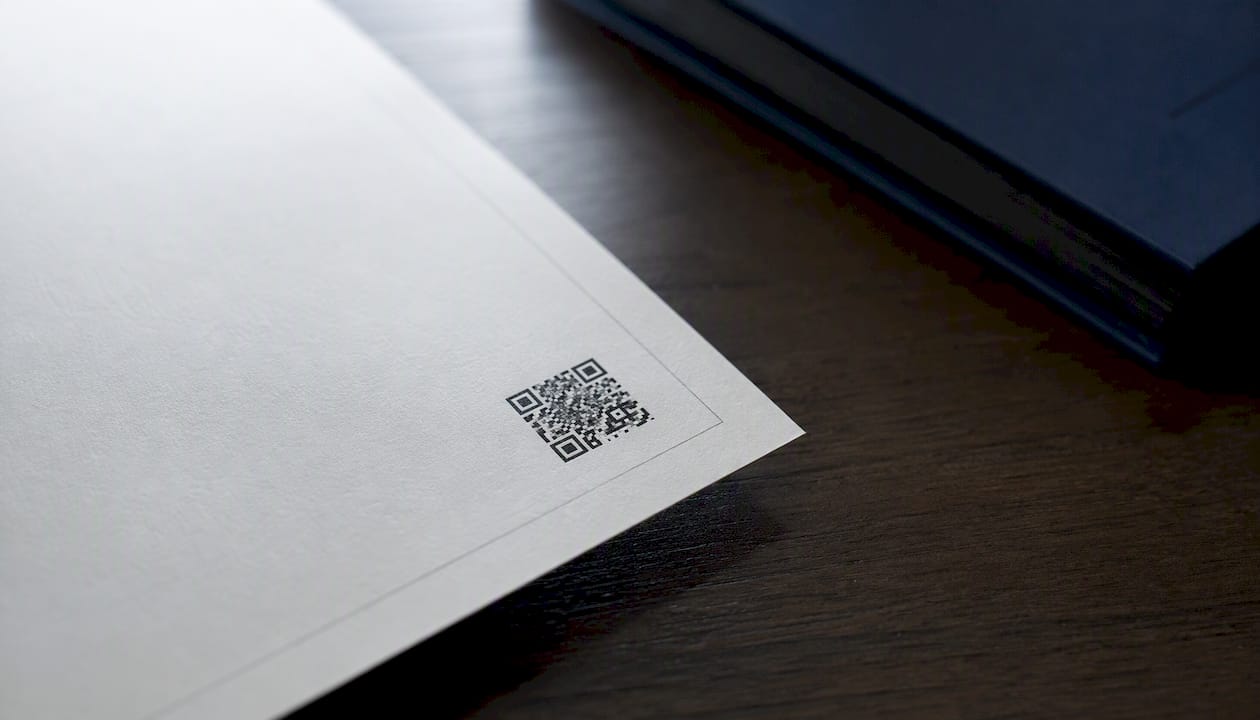
Beyond the basics, security features separate a serious certificate from a printed formality. A QR code linking to a registry entry, an embossed seal or hologram, and a photograph of the actual piece (not a stock image of "a similar print") all make forgery harder and verification faster. Wording matters too: an open edition certificate should say so plainly, because implying scarcity on a piece that will be printed indefinitely is the fastest way to lose a collector's trust for good. Complete photography-specific checklists back up how much these details influence resale confidence.
How to Create, Sign, and Deliver a CoA
Building a reliable certificate is less about design software and more about sequencing. Follow this order and you won't have to backfill missing information after the piece has already shipped.
- Gather your production metadata first. Confirm the final title, dimensions, medium, edition size, and creation date before you open a template. Guessing at edition size after prints exist is how sellers end up issuing contradictory certificates.
- Write the authenticity statement. A single clear sentence works: "This certifies that [title] is an original work by [artist name], produced in [medium], and is number [X] of [Y] in this edition." Precision here protects you later.
- Add verification elements. Assign a serial number, generate a QR code linking to a registry or your own verification page, and consider a blockchain or ledger reference if you sell at higher volumes.
- Photograph the finished piece and attach or embed that image on the certificate itself. A generic product shot doesn't count.
- Sign and date it by hand, even if the rest of the document is printed or digital. A scanned or printed signature is easier to forge than a wet-ink original.
- Store a backup. Keep a private ledger, spreadsheet, or digital vault recording every certificate issued, matched to buyer contact and sale date, so you have a second line of proof if the physical copy is ever lost.
- Deliver the CoA with the work, not as an afterthought email weeks later. Print delivery works for gallery sales; a signed PDF works for online and international shipments.
A workflow like this pairs naturally with how you handle fine art printing, since production records and certificate data should come from the same source file, not two separate systems.
Limited Editions and Photography: What Collectors Expect

Edition numbering is a promise, not decoration. When a certificate reads "12/30," it tells a buyer exactly how scarce that piece is and legally obligates the issuing artist not to print a thirty-first. Exceeding a stated edition size, even by accident, undermines every certificate you've issued for that image and can trigger real financial exposure if a collector later discovers it.
Photography carries its own expectations beyond painting or sculpture:
- Paper type and manufacturer (cotton rag, baryta, etc.)
- Printer model and ICC profile used for the run
- Exact print date, separate from the capture date
- Any archival or protective treatment applied to the surface
Clear edition management protects resale value because appraisers and insurers can trace a print back to its original production run with confidence.
Indigenous Art and Community-Verified Provenance
Certificates for Indigenous and First Nations artwork carry obligations a standard template doesn't cover. Authorship, cultural permissions, and community consent often need to be documented alongside the usual production details, guided by the protocols for using First Nations cultural and intellectual property.
- A standard artist-issued CoA may not be sufficient; a community-verified or "code certificate" is sometimes the appropriate document instead
- The Indigenous Art Code offers sector-specific guidance on ethical transactions and provenance recording
- Sellers should contact the relevant representative body before issuing any certificate and record consent notes directly on the document
- Practical next step: treat community consultation as part of production, not paperwork tacked on after a sale
Digital Provenance: C2PA and In-Camera Signatures
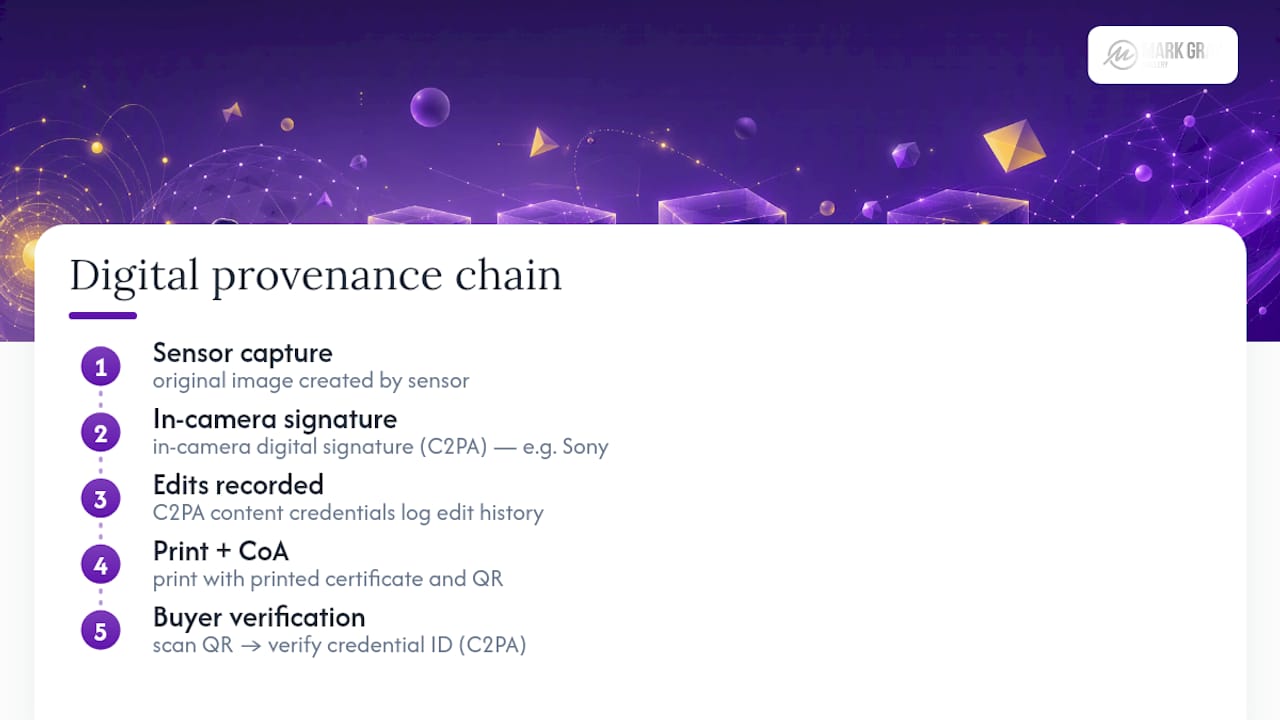
Physical certificates now have a digital counterpart worth understanding. C2PA content credentials record a file's capture and edit history in a cryptographically verifiable format, and pairing that digital trail with a printed CoA gives buyers two independent ways to confirm a work is genuine.
For photographers, this is closer than it sounds. Sony's Camera Authenticity Solution can generate an in-camera digital signature at the moment of capture, in C2PA format, creating a verifiable chain from sensor to final print. Referencing that credential ID on your printed certificate, alongside your QR code, costs nothing extra and adds a layer of proof that's difficult to fake.
How to Verify a Certificate and What to Do If You Suspect a Fake
A buyer checking authenticity should work through a short list before wiring any money.
- Compare the signature on the certificate against the signature on the piece itself.
- Confirm the serial number or QR code resolves to a working registry entry, not a dead link.
- Request the full provenance chain, including prior sale records if the work has changed hands.
- If anything doesn't match, contact the issuer directly, request documentation, and consult an independent appraiser before proceeding. Preserve every email and receipt in case you need legal or consumer-protection guidance later, since misrepresentation carries real financial risk for both sides.
A Working Example: How One Photographer Documents Every Print
Every limited-edition print that leaves the gallery ships with a certificate listing the full title, edition number, exact print date, paper stock, and printer used, alongside a hand signature and a unique serial number cross-referenced to a private sales ledger.
- Edition size and print run are locked in before the first print ships, never adjusted after sales begin
- Every certificate includes a small photograph of the actual piece, not a generic reference image
- Sale records, buyer contacts, and scanned certificates are archived digitally as a backup if a physical copy is ever damaged or lost
Pro Tip: Write your edition statement once as a template ("X of Y, [title], [medium], printed [date]") and reuse the exact phrasing across the whole run. Inconsistent wording across a single edition is one of the fastest ways collectors lose confidence in a certificate's reliability.
The reputational value of getting this right
Issuing a certificate that actually holds up under scrutiny isn't paperwork. It's part of how a collector decides whether to trust you with a second purchase, and a third. Good documentation protects the buyer's investment and the artist's reputation in the same stroke, and that's a trade worth making every time.
— Mark
See authenticated prints and book a workshop
Every limited-edition print in the gallery ships with a full certificate of authenticity, edition number, and production details included, not sold separately or offered as an afterthought. That's the difference between a print you can insure and resell with confidence and one you're simply hoping holds its value.
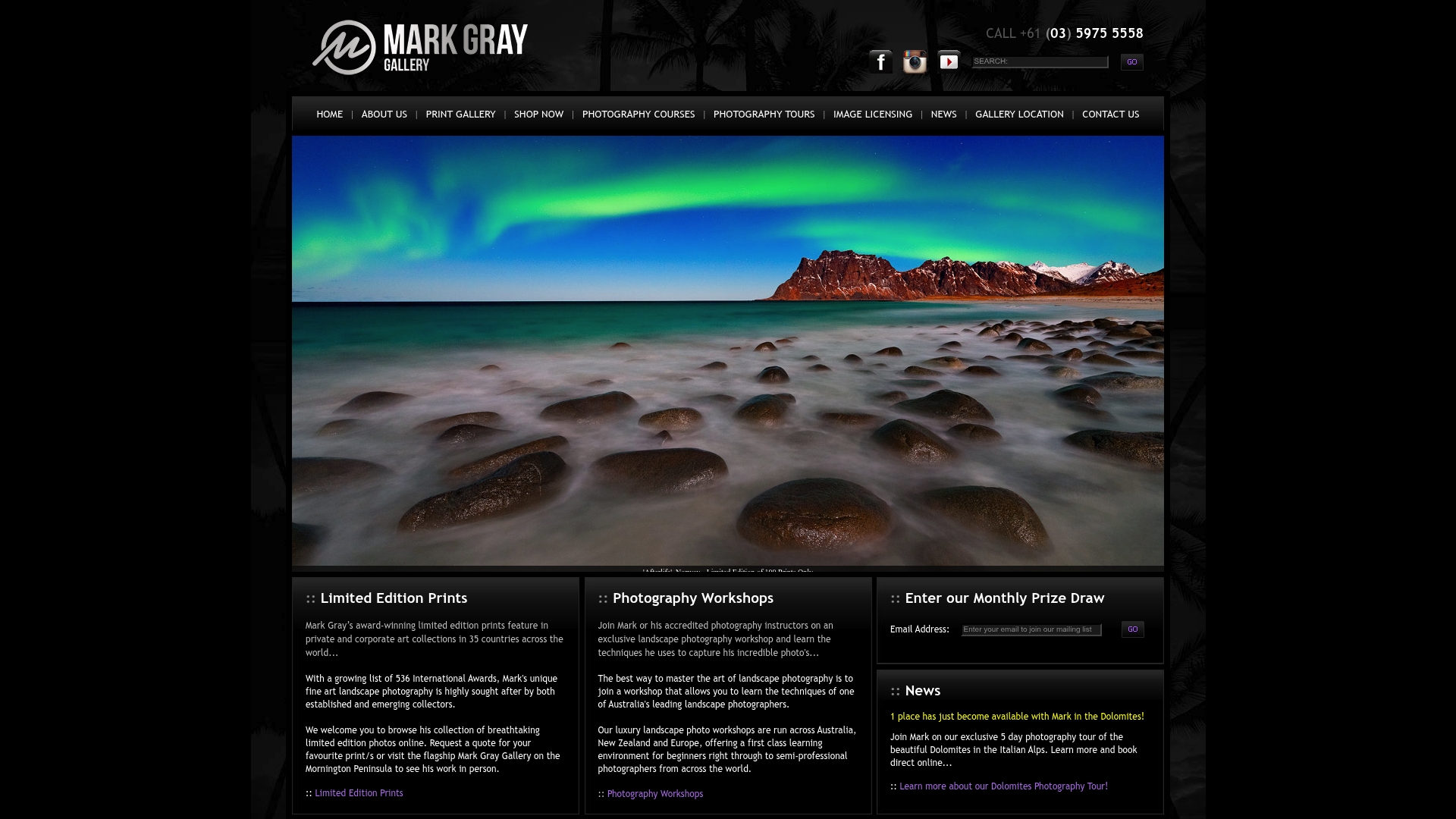
If you want to see how that documentation looks on an actual piece, browse the current limited-edition print collection to check availability and edition sizes before they close out. The same gallery also runs single-day and multi-day photography workshops for artists who want to learn the production side firsthand, from capture through archival printing.
Sources
- Certificate of authenticity — Wikipedia
- Tools to understand how content was created and edited — Google Blog
- Camera Authenticity Solution | Sony
- Creative
- Certificate of Authenticity for Photography: What Collectors Must Know