
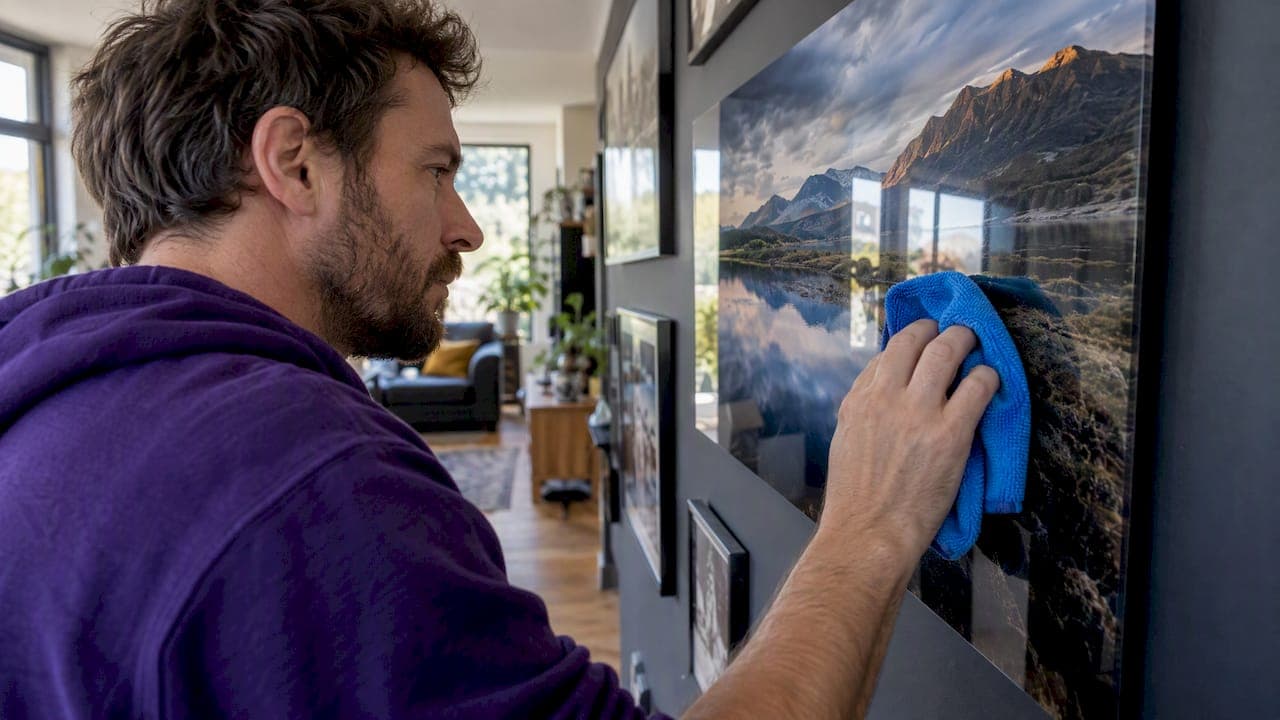
Dust acrylic photo prints with a clean, dry microfiber cloth for routine care, and save water for actual marks. For fingerprints or streaks, dampen a microfiber cloth, never the print itself, with lukewarm water and a single drop of mild dish soap. Never spray cleaner onto the surface, never reach for ammonia or solvents, and keep every drop of liquid well away from the acrylic edge.
TL;DR:
- Before wet cleaning, remove loose grit with a clean microfiber cloth, test an inconspicuous edge, then wipe in straight lines and blot promptly.
- Use roughly 20 by 20 centimeter sections on heavily soiled prints, changing to a fresh cloth as soon as gray streaks appear.
- Ammonia, alcohol, acetone, paper towels, and abrasive pads can permanently cloud or scratch the surface, so never use them on acrylic glazing.
- Stop immediately if tidelines, bubbling edges, soft adhesive, or persistent haze appear; trapped moisture behind face mounted acrylic requires a framer or conservator.
- Dry dust indoor prints monthly in low traffic areas, reserving damp cleaning for visible marks; apply plastic cleaner that reduces static to the cloth only.
Table of Contents
- Gathering the right tools before you start
- Step-by-step method for cleaning acrylic photo prints
- What never belongs near your acrylic print
- Keeping dust down between cleans
- When to stop cleaning and call a professional
- A note on caring for prints the way a studio does
- Where to find professionally finished acrylic pieces
- FAQ
- Sources
Gathering the right tools before you start
A good clean starts with the right supplies on hand, not a scramble halfway through. Rough or improvised materials are the fastest route to permanent scratches on a glossy acrylic surface, so it pays to assemble a proper kit first.
- A clean, lint-free microfiber cloth, kept exclusively for the print and swapped the moment it picks up grit
- A soft, dry brush for crevices around a frame edge where dust collects
- Distilled or lukewarm tap water, plus a single drop of mild dish soap for occasional wet cleaning
- A few cotton swabs for tight corners, used dry whenever possible
- An anti-static plastic cleaner for reducing dust attraction between cleans, available from specialty plastics suppliers
Take off rings, bracelets, and watches before you touch the surface, since metal catches and scratches acrylic surprisingly easily. Work on a padded, flat surface rather than holding the print upright, and switch off fans or air conditioning nearby so airborne dust does not settle back onto a freshly cleaned face.
Step-by-step method for cleaning acrylic photo prints
Treat the clean as a sequence, not a single wipe. Skipping the dry stage or rushing the wet stage is where most avoidable damage happens.
- Prepare the space: lay the print face up on a padded, flat surface, remove jewelry, and stop any airflow in the room.
- Dry dust first: sweep a clean microfiber cloth lightly across the surface in one direction to lift loose dust before any liquid touches the print.
- Test a corner: dampen a separate microfiber cloth with lukewarm water and one drop of mild dish soap, then test an inconspicuous edge area first.
- Clean in straight lines: wipe the dampened cloth across the surface in one direction, never in circles, changing to a fresh section of cloth as soon as it picks up grime.
- Rinse and blot: go over the same area with a cloth dampened in plain water, then blot immediately with a dry microfiber to lift remaining moisture.
- Dry flat and inspect: leave the print lying flat to air dry, then check it under diffuse, angled light for streaks, haze, or tidelines near the edge.
Dry dusting comes first in every pass because it removes the grit that a damp cloth would otherwise drag across the surface, leaving fine scratch trails on an otherwise glossy finish. The one-drop method exists for the same reason manufacturers recommend it: enough soap to lift oils from fingerprints, not enough to leave residue or run toward the frame channel.
For a heavily soiled piece, work in sections of roughly 20 by 20 centimeters rather than attempting the whole surface at once, swapping to a fresh cloth the moment the one in hand shows gray streaks. This keeps you from grinding the same grit back into the acrylic as you move across the print.
Pro Tip: Keep a bowl of your cleaning solution nearby and dip the cloth into it, rather than carrying the bottle to the print; this is the easiest way to avoid an accidental spray onto the glazing.
What never belongs near your acrylic print
Some of the most common cleaning habits are also the most damaging, and the damage they cause rarely has a fix.
- Ammonia-based glass cleaners, which can cloud or craze the acrylic surface on contact
- Alcohol and acetone-based solvents, both capable of causing immediate, permanent clouding
- Paper towels, newspaper, or any rough sponge, all of which leave fine scratches invisible until the light catches them
- Abrasive pads or anything marketed for kitchen or bathroom surfaces
Manufacturer guidance from PLEXIGLAS® explicitly discourages ammonia and solvent-based cleaners on acrylic, since the chemical reaction that causes haze or crazing is typically irreversible. Spraying any liquid directly onto the print, using water that is too hot, or reusing a dirty cloth are the three habits that cause the most repeat damage. The simplest rule covers all three: never spray the glazing, always dampen the cloth away from the print, and retire a cloth the moment it stops looking clean.
Keeping dust down between cleans
The best way to avoid risky wet cleaning is to need it less often. A light dry-dusting pass once a month is usually enough for a print kept indoors away from heavy traffic, with wet cleaning reserved for visible fingerprints or streaks rather than a fixed schedule.
- Dry-dust monthly with a clean microfiber cloth to prevent grit buildup
- Reach for the one-drop wet method only when dusting alone will not lift a mark
- Apply anti-static plastic cleaner to the cloth, never directly to the print, to cut down on the static charge that draws dust to acrylic in the first place
- Hang prints away from direct airflow, vents, and high-traffic doorways to slow dust accumulation
Pro Tip: Acrylic's static charge is what makes it such a dust magnet in the first place; an occasional anti-static treatment on the cloth does more to keep a print clean than any amount of extra wiping.
When to stop cleaning and call a professional
A few warning signs mean cleaning is no longer the answer. Tidelines, a lifted or bubbling edge, adhesive that feels soft to the touch, or a uniform haze that will not lift with a dry or damp cloth all point to moisture or damage behind the acrylic itself, not on top of it.

Face-mounted prints have almost no margin for error here: once moisture works past the edge and gets trapped behind the glazing, it cannot be dried from the front, and further cleaning usually makes the problem worse. If you spot any of these signs, stop cleaning immediately, photograph the affected area for reference, and contact the framer or a conservator rather than attempting a fix yourself.
A note on caring for prints the way a studio does
We treat conservative care as the standard in our own studio: dry-dusting first, wet cleaning only when truly needed, and face-mounted pieces entrusted to framers we trust. A print holds its value longest when it is handled the way a professional handles one, not the way a window gets wiped.
When you choose a framer for a face-mounted acrylic piece, ask directly what cleaning they recommend and what warranty or repair options come with the mount. That single question tells you a lot about how a shop treats the work it sends out.
— Mark
Where to find professionally finished acrylic pieces
If dry-dusting and the one-drop method feel like more upkeep than you want, a professionally mounted acrylic piece from our gallery is worth a look. Our Acrylic Blocks are finished and ready to display, priced at $295 one-off per each, with postage and handling of $24.95 within Australia or $74.95 internationally. We also offer Limited Edition Prints and Open Edition Prints for collectors who want a larger panoramic piece without managing the mounting process themselves.

For more on keeping any fine art print in top condition, our guide to caring for fine art photography prints covers storage and handling beyond acrylic alone, and our piece on acrylic face mounting explains what to ask a framer before committing to a mount. If you are relocating a framed or acrylic-mounted piece, this guide to packing artwork for a move from our moving partner is a useful companion resource.
- Acrylic Blocks: $295 one-off per each, plus postage
- Limited Edition Prints: priced on request
- Open Edition Prints: priced on request
| Product | Price | Where to view |
|---|---|---|
| Acrylic Blocks | a fixed price per each | View acrylic blocks |
| Postage, Australia-wide | a fixed postage fee within Australia | View acrylic blocks |
| Postage, international | $74.95 one-off per each | View acrylic blocks |
| Gift Certificates | starting from a base amount in AUD | View gift certificates |
Browse the full collection of acrylic blocks to see finished pieces ready to ship.
FAQ
How do you clean acrylic paint?
Dried acrylic paint on a hard surface is generally cleaned with warm water and a soft cloth, since the paint itself is water-based until fully cured. This is a different material and situation from cleaning an acrylic-glazed photo print, which calls for the dry-dusting and one-drop dish soap method described above.
How do you clean a canvas picture without ruining it?
A canvas print is typically dusted with a soft, dry brush or lint-free cloth rather than wiped with liquid, since canvas fibers absorb moisture and can warp or stain. Stronger cleaning or stain removal on canvas is best left to a conservator, much like moisture issues behind acrylic glazing.
Can you use Dawn to clean acrylic?
A small amount of a mild dish soap like Dawn, limited to a single drop mixed into lukewarm water on a damp microfiber cloth, is consistent with manufacturer-backed cleaning guidance for acrylic-mounted prints. The soap should go on the cloth, never sprayed onto the print, and should be rinsed and blotted promptly afterward.
What not to use on plexiglass?
Avoid ammonia-based glass cleaners and solvents such as alcohol or acetone on plexiglass, since manufacturer guidance warns these can cause permanent clouding or crazing. Paper towels, newspaper, and abrasive pads should also be avoided because they leave fine scratches on the glossy surface.
Sources
- Kunst-Stoff anti-static plastic cleaner & polisher — Acrylics Online
- How to clean acrylic mounted prints — PCCOLOUR
- How to properly clean, disinfect and maintain PLEXIGLAS® — PLEXIGLAS®