
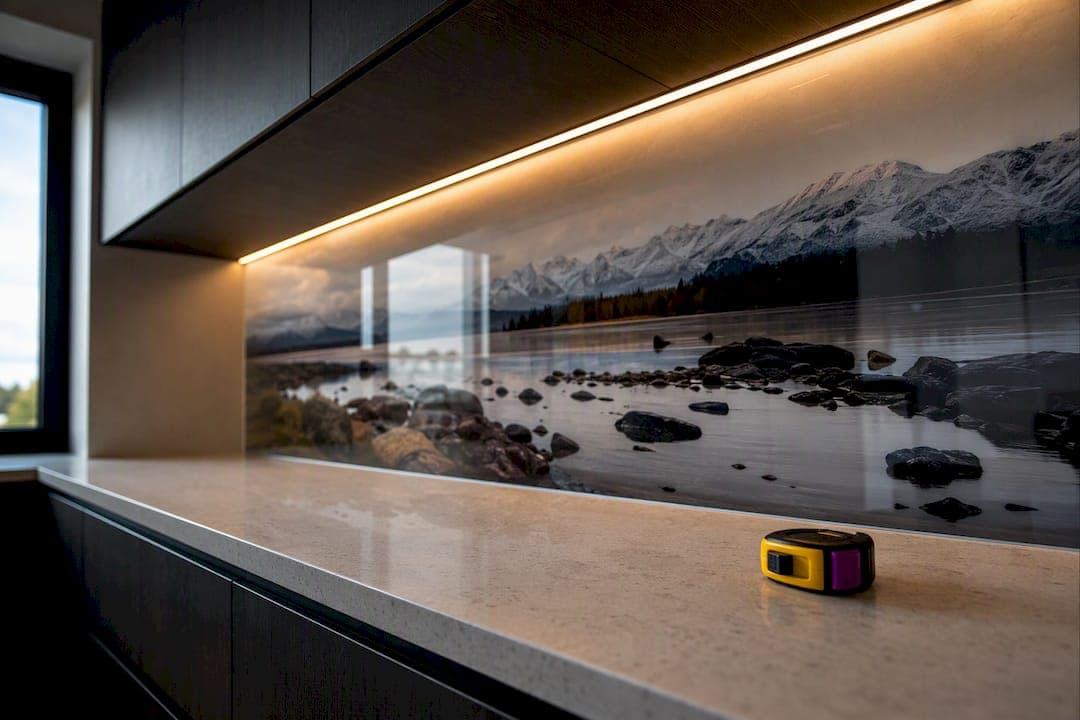
Yes, reproducing most photographs as a printed kitchen splashback requires permission from whoever owns the copyright. Secure a written licence or commission original photography before you send anything to print. The Australian Copyright Council treats a splashback the same as any other reproduction of an artwork: copyright clearance comes first, printing comes second. Skip that step and you are gambling with a legal exposure that lasts as long as the glass stays on your wall.
TL;DR:
- Licensing fees for splashback images can range from low-cost stock licenses for limited use to higher prices for exclusive or resale rights.
- Most images require a written license specifying permitted use, dimensions, and territory, as verbal permission has no legal standing.
- Stock photo libraries often have restrictive fine print, making direct licensing or commissioning bespoke photography safer for large-format prints.
- Proper resolution and color management are critical; images must be high-resolution, stitched if necessary, and proofed before printing.
- Always secure a signed license before printing to avoid legal risks, especially for projects with resale or commercial value.
Table of Contents
- When Do You Legally Need Splashback Image Licensing?
- Where Can You Legally Source a Splashback Image?
- What Should a Splashback Licence Specify?
- What Resolution Do You Need for a Printed Splashback?
- What Does a Splashback Photo Licence Typically Cost?
- Mark Gray's Practical Advice on Commissioning Splashback Images
- What's the Fastest Safe Path to a Licensed Splashback?
- License Your Splashback Image With Mark Gray Gallery
- Sources
- FAQ
When Do You Legally Need Splashback Image Licensing?
Copyright in a photograph belongs to whoever created it, not whoever downloaded it. That principle sits at the heart of the Copyright Act 1968, section 35, which sets out ownership rules for original works and explains the narrow circumstances where commissioning a photograph shifts ownership to the person who paid for it. Outside those specific commissioned scenarios, the photographer keeps control.

Reproduction and communication of a work to the public count among the exclusive rights the Act grants a copyright owner. Printing an image onto glass, tile, or metal for a splashback is a reproduction in a material form, full stop. It does not matter that the final product sits in a private kitchen rather than a public gallery.
Fair dealing exceptions exist for research, criticism, and parody, but they almost never stretch to cover a decorative home renovation. A handful of assumptions trip people up constantly:
- "I found it on Google Images, so it must be free to use."
- "It's just for my own kitchen, not for sale."
- "The photo has no watermark, so no one owns it."
None of those assumptions hold up under copyright law. The Australian Copyright Council's fact sheet on getting permission confirms that permission, in the form of a licence or copyright clearance, is normally required before you reproduce an image for something like custom decor.
Where Can You Legally Source a Splashback Image?
You have three realistic routes to a legally clean image, and each suits a different kind of project.
- Stock photo libraries offer speed and low upfront cost, but read the fine print. A basic licence often covers small digital use only, not large-format printing or physical products for resale.
- Direct licensing from a photographer gives you a tailored scope, a genuine high-resolution file, and someone who can answer questions when your printer asks about color profiles.
- Commissioning bespoke photography costs more but delivers a panoramic image built specifically for your splashback's dimensions, with no ambiguity about who owns what.
Some splashback manufacturers will offer to broker a licence on your behalf. That can work, but never assume it happens automatically. Ask in writing whether image clearance is included in your quote, and get the answer in the contract, not a verbal reassurance from a salesperson.
What Should a Splashback Licence Specify?
A licence that only says "you can use this photo" is not a licence, it is an invitation to a dispute. Before you approve any print job, insist on these terms in writing.
- Permitted substrate and use — confirm the licence explicitly covers glass, tile, or metal reproduction, not just website or brochure use.
- Print size and cropping allowances — specify exact dimensions and whether stitching or cropping multiple frames is permitted.
- Number of reproductions — one splashback only, or multiple units across a build?
- Duration and territory — does the licence expire, and does it cover use only in Australia or worldwide?
- Exclusivity — will the same image appear on someone else's splashback down the street?
- Attribution and moral rights — even licensed images can carry moral rights obligations for the original creator.
- File specs and colour profile — get this in writing so your printer isn't guessing.
- Signed agreement — a verbal yes from a photographer is worth nothing if a dispute arises later.
Pro Tip: Keep the signed licence with your installation paperwork and receipts. If you ever sell the house or a dispute arises, that document is your proof the splashback was created legally.
Industry guidance on photography and copyright consistently stresses that assignments and licences should be in writing, with scope negotiated up front rather than assumed.
What Resolution Do You Need for a Printed Splashback?
A splashback is not a phone screen. It is viewed up close, under kitchen lighting, often on a surface several meters wide. Low-resolution files that look fine on Instagram turn blurry and pixelated the moment they are enlarged to cover a benchtop run.
Long, narrow splashbacks frequently require images stitched from multiple high-resolution frames to maintain sharpness across the full width. A photographer preparing a file for this kind of print typically builds in extra bleed and margin, giving the installer room to crop and align without compromising the image.
Color management matters just as much as resolution. Printer colour profiles, the glass type (low-iron glass renders colour more accurately than standard float glass), and a gloss versus matte finish all shift how the final image reads on your wall. Before committing to a full print run, request at least one proof, whether that is a digital mockup, a full-size paper print, or a physical glass sample.
- Confirm the file is delivered as an uncompressed, print-ready format at the correct dimensions.
- Ask whether the printer applies its own colour correction, and request a proof either way.
- Never approve a full production run without seeing a physical or full-size sample first.
What Does a Splashback Photo Licence Typically Cost?
Licensing fees vary widely depending on scope, and the cheapest option is not always the wisest one. A one-off licence to use a single image on one splashback typically costs less than an extended licence that covers unlimited prints, multiple properties, or commercial resale.
Stock libraries illustrate this tiering well. Austockphoto's listing structure shows a basic single-use licence as the entry point, with paid add-ons layered on top: unlimited print rights and rights to use the image on products intended for resale both carry separate, additional fees. That structure is common across the stock photography industry, not unique to one supplier.
Commissioned or exclusive work sits at the higher end of the price range, reflecting the photographer's time, equipment, and the fact that you are often buying sole use of the image. When comparing quotes, ask each supplier to itemize exactly what the fee covers: number of prints, substrate type, duration, and whether the file has been prepared specifically for large-format output. A vague one-line quote is a red flag in itself.

Mark Gray's Practical Advice on Commissioning Splashback Images
Generic stock photography rarely holds up at splashback scale. A landscape shot compressed for web use, then stretched across two meters of glass, tends to show every flaw a monitor hides. Bespoke or properly licensed high-resolution imagery avoids that problem because the file was built for exactly this kind of reproduction from the start.
When briefing a photographer for a splashback project, cover these points before any shutter clicks:
- Desired aspect ratio and final print dimensions.
- Whether the shot needs to be a stitched panorama for a long run.
- Margin allowance for cropping and installation alignment.
- Colour profile requirements matched to your chosen substrate.
Mark Gray documents licence scope in writing for every commercial image request, specifying permitted use, print dimensions, and file delivery format before any image licensing agreement is finalized. That approach follows the same principles laid out in the broader guide to licensing photography stock images, and it gives homeowners and designers a paper trail from commission to install.
What's the Fastest Safe Path to a Licensed Splashback?
The safest route follows three steps in order: choose your image source, secure a written licence before any printing begins, then proof the file and only print once you have approved a sample.
Watch for warning signs along the way. Verbal-only permission from a photographer, a supplied file with no stated resolution, licence wording that never mentions "splashback" or "large format," and an installer who will not hand over a signed agreement all point to the same risk: an image you do not actually have the right to print. If a project involves a commercial kitchen, a rental property, or any resale value, get formal legal advice before signing anything. The cost of a short consultation is trivial next to the cost of removing and replacing an infringing splashback.
— Mark
License Your Splashback Image With Mark Gray Gallery
Most of the routes above work, but each comes with its own friction: stock libraries bury restrictive fine print, and independent photographers vary wildly in how clearly they document scope. Mark Gray Gallery removes that guesswork by pairing award-winning landscape photography, collected across 32 countries, with a licensing process built specifically for large-format commercial reproduction.
Every splashback licence from Mark Gray Gallery specifies permitted use, print dimensions, and file format in writing before any file changes hands, so you are never left interpreting vague terms after the glass has already been cut. Because the source images are captured on panoramic medium format film, you get the resolution and colour depth a splashback demands without commissioning a custom shoot from scratch, though bespoke commissions remain available for designers who want something entirely unique.
If you have a photograph in mind or need help finding the right panoramic image for your kitchen, visit the image licensing page to request a licence and start the proofing conversation today.
Sources
- Artworks: Getting Permission - Australian Copyright Council (INFO086)
- Copyright Act 1968 - s.35 (AustLII)
- Austockphoto listing and basic licence example
- Photography & Copyright (industry guidance PDF)
FAQ
Do You Need a Licence to Print a Photo on a Splashback?
In almost every case, yes. Copyright law protects the photographer's exclusive right to reproduce their work, and printing it onto glass or tile counts as reproduction, so you need a licence or written permission unless you took the photo yourself.
What Rules Apply to Splashbacks in Australia?
There is no separate "splashback law." The same copyright rules that cover any printed reproduction apply, meaning you need permission from the image's copyright holder under the Copyright Act 1968 before printing. Building and material safety standards for the splashback itself are a separate matter from image rights and sit outside copyright law entirely.
Can You Use a Laminate Splashback Instead of Glass?
Laminate splashbacks are a common budget alternative to glass, but the substrate does not change your licensing obligations. Whether you print on laminate, glass, or metal, you still need permission to reproduce someone else's photograph.
What Are the Current Trends for Printed Kitchen Splashbacks?
Panoramic landscape scenes, muted natural colour palettes, and low-iron glass finishes remain popular choices for homeowners wanting a splashback that reads as a feature rather than a photo print. Whatever the style, the image still needs proper licensing before it goes to print.
How Much Does Splashback Image Licensing Typically Cost?
Costs vary by scope. A basic single-use stock licence sits at the lower end, while extended licences covering unlimited prints or resale rights, illustrated by Austockphoto's add-on pricing, cost more. Mark Gray Gallery's current licensing rates are available directly through the image licensing page.