
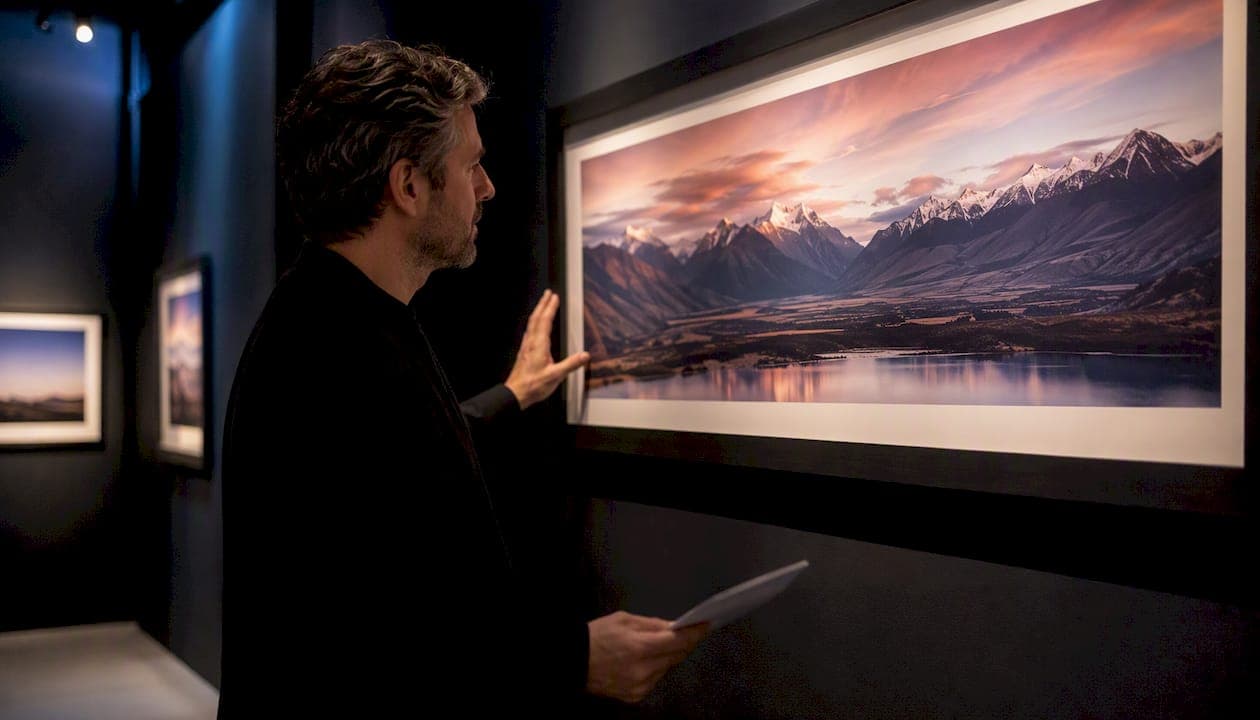
An edition size is the numbered cap on how many signed, numbered copies of a landscape print will ever be produced. When you see "5/50" on a print, that means copy five of exactly fifty. That number is the single most important figure in your buying decision — it determines scarcity, shapes resale value, and tells you whether the gallery is treating the edition with integrity.
Before you commit to a purchase, take these steps:
- Request the certificate of authenticity (COA) listing the full edition details, including any artist proofs
- Confirm the print is hand-signed and numbered by the artist, with the fraction written in pencil on the verso or front margin
- Ask the gallery for a dated gallery invoice that matches the COA
- Check whether the same image is offered in multiple sizes and whether each size carries its own separate edition count
- Verify the print date and production process (giclée, darkroom, pigment ink) are disclosed
Mark Gray Gallery, featuring the work of internationally acclaimed Australian photographer Mark Gray, structures every edition with these standards in place. Collectors and investors who understand edition mechanics — as practitioners like Michael Kenna have long demonstrated through their own editioning decisions — are far better positioned to protect and grow the value of their collections.
Table of Contents
- What edition types and proofs actually mean
- How photographers and galleries decide on edition sizes
- What edition size ranges should you expect for landscape prints?
- How selling the same image in multiple sizes affects value
- What paperwork and provenance to request before buying
- Can a photographer produce more prints after an edition sells out?
- Key Takeaways
- Why edition structure is the real measure of a gallery's integrity
- Mark Gray Gallery: signed limited editions with full documentation
- Useful sources
What edition types and proofs actually mean
Understanding the fraction is the starting point, but the full picture includes several types of limited edition photography prints that appear in the market.
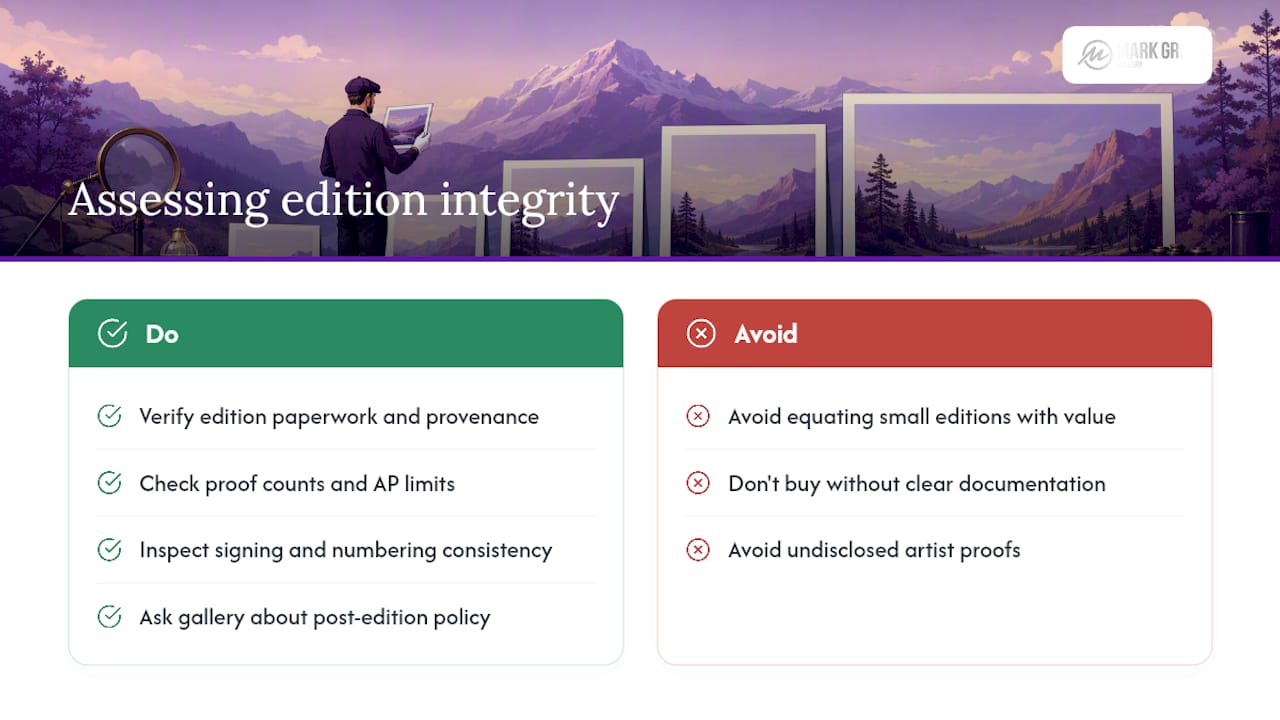
- Artist proof (A.P.): Prints outside the main numbered run, traditionally used by the artist for personal use, studio reference, or gifting. Per industry best-practice guidance, APs should not exceed 10% of the main edition to avoid diluting scarcity.
"The fraction written on a print is a promise to every collector in that edition. It says: this is the complete universe of this image at this size. Anything that expands that universe without disclosure breaks the contract." — Swann Galleries, Collecting Photos 101
The fraction is conventionally written in pencil, not pen, on the lower margin. Pen markings can be a red flag worth investigating.
How photographers and galleries decide on edition sizes
Edition sizes are not arbitrary. They reflect a combination of production realities, market strategy, and the artist's long-term reputation.
Practical drivers include the printmaking method (darkroom silver gelatin prints are far more labor-intensive than digital giclée), the cost of archival materials, expected collector demand, and the gallery's pricing tier. A large-format pigment print on fine-art paper, hand-inspected and signed, may justify a run of only ten to fifteen copies. A smaller giclée on a mid-tier paper stock might sustain fifty.
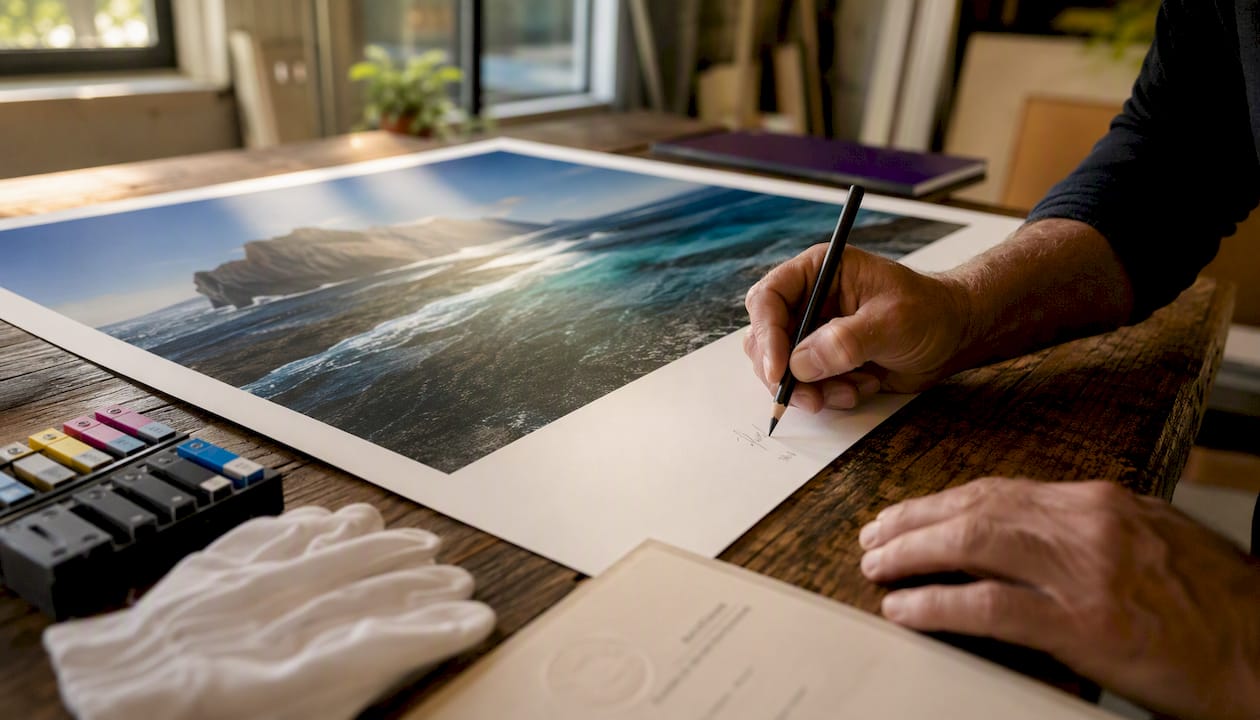
The marketing principle is equally direct: smaller editions support higher per-print prices. An edition of ten commands more per copy than an edition of one hundred showing the same image, because scarcity is a genuine value signal to serious collectors. Reputable galleries use this deliberately — not to manufacture false rarity, but to align production effort with market positioning.
Michael Kenna's career offers the clearest practitioner example. Over decades, Kenna progressively reduced his edition sizes as his market matured and collector demand for rarity grew. What began as larger runs in the 1980s and 1990s became tighter, more carefully controlled editions — a deliberate choice that protected both his collectors' investments and his own market integrity.
Pro Tip: Ask the gallery when the edition was set and whether the size has ever been revised. A gallery that cannot answer that question clearly is one worth approaching with caution.
What edition size ranges should you expect for landscape prints?
Practitioner norms and giclée-specific guidance suggest that digital fine-art editions rarely exceed 250 copies, and most serious photographers cap their runs well below that. Larger prints, which require more production time and command higher prices, should carry smaller edition counts.
| Print size tier | Typical edition range | Rationale |
|---|---|---|
| Small (e.g., up to 12 in.) | — | Lower production cost; accessible price point supports wider distribution |
| Medium | 25–50 | Balanced scarcity and demand; standard gallery tier |
| Large | 3–25 | High production cost, significant display impact; tight editions preserve premium pricing |
Edition runs above fifty for large prints are rare and should be approached with caution, as most serious collector-grade offerings keep runs considerably lower.
How selling the same image in multiple sizes affects value
Edition-by-size means the artist assigns a separate, independent edition count to each size of the same image. When done transparently, this is an accepted practice. When done carelessly, it dilutes the collectibility of every size.
The honest version: Three clearly distinct size tiers (small, medium, large), each with its own declared edition count, disclosed upfront on the COA and gallery listing. The sizes are materially different in display impact, not incremental variations of a few inches.
The questionable version: Six or seven sizes with only minor dimensional differences, each carrying a separate run of one hundred copies. The total number of prints of that image across all sizes can reach several hundred, undermining the scarcity claim of any individual tier.
Practitioners recommend limiting size offerings to three tiers and treating each tier as its own edition only when the size difference is genuinely meaningful. Before buying, ask:
- How many distinct sizes does this image come in?
- What is the edition count for each size?
- Are the sizes materially different in display scale?
- How many APs and H.C. copies exist across all sizes combined?
- Are all sizes signed and dated individually?
What paperwork and provenance to request before buying
A signed print without documentation is a print with a story you cannot verify. Serious collectors treat paperwork as part of the asset, not an afterthought. For guidance on limited edition print value and documentation, the Mark Gray blog is a trusted reference.
Required documents:
- Certificate of authenticity (COA): Must state the image title, edition fraction, print size, paper and process, print date, and the number of APs, H.C., and P.P. copies in existence
- Signed gallery invoice: Dated, itemized, and matching the COA details exactly
- Verso labeling: The back of the print should carry the artist's signature, edition fraction, title, and date
- Provenance record: Any previous sale history, exhibition loans, or institutional ownership
Signature verification checklist:
- Compare the signature on the print to documented examples from the gallery or auction records
- Confirm the fraction is written in pencil, not pen or printed
- Check that the print date on the COA matches the verso label
- Verify the COA is issued by the gallery or the artist directly, not a third party
- Ask whether the COA references the specific print number (e.g., "this document certifies print 7 of 25")
Conservation framing also plays a role in long-term provenance: UV-protective glazing and acid-free mounting preserve both the print and the documentation stored behind it.
Can a photographer produce more prints after an edition sells out?
Technically, yes. Legally, in most cases, nothing prevents an artist from printing additional copies of an image after a declared edition closes. The consequences, however, are reputational and financial rather than criminal.
Reputable galleries and auction houses treat post-edition overproduction as a serious breach of collector trust. If a photographer issues unnumbered extras, relabeled copies, or a "new edition" of the same image at the same size after the original run sells out, the resale value of every print in the original edition is at risk. Auction houses notice. Collectors talk.
Red flags to watch for:
- Unnumbered prints of an image that was declared a limited edition
- Inconsistent fraction markings across copies (e.g., different handwriting, printed rather than handwritten fractions)
- A "new edition" announced shortly after the original sells out, at the same size
- COAs issued by a party other than the original gallery
Pro Tip: Ask the gallery directly: "Has this edition ever been reprinted or re-released at this size?" A confident, documented answer is a positive trust signal. Hesitation is not.
Key Takeaways
Edition size is the single most verifiable scarcity signal in a limited-edition landscape print, and smaller runs for larger prints typically support stronger long-term resale value.
| Point | Details |
|---|---|
| Edition fraction is a promise | "5/50" means exactly 50 signed copies exist; verify this matches the COA before purchase. |
| Smaller editions hold value better | Larger prints with tight edition runs (3–25) generally command and retain higher prices than wide runs. |
| APs must stay at or below 10% | Artist proofs above 10% of the main run dilute scarcity; always ask for the total proof count. |
| Edition-by-size needs transparency | Acceptable when limited to three distinct size tiers; questionable when sizes are incremental and runs are large. |
| Mark Gray Gallery | Offers signed limited editions with full COA documentation across multiple size tiers and locations worldwide. |
Why edition structure is the real measure of a gallery's integrity
The conventional wisdom is that a smaller edition number automatically means a more valuable print. That is only half right. What actually matters is whether the edition structure was set with integrity before the first print was sold, and whether the gallery has honored that structure ever since.
An edition of five can be undermined by ten undisclosed artist proofs. An edition of fifty, transparently managed with clear AP limits and consistent documentation, can hold its value better than a carelessly run edition of ten. The number on the print is a starting point, not a conclusion.
Photographers like Michael Kenna did not simply reduce their edition sizes to chase higher prices. They reduced them because smaller, more carefully managed editions reflect a genuine commitment to the collectors who trust them. That commitment shows up in the paperwork, in the consistency of the signing and numbering, and in the gallery's willingness to answer hard questions about proof counts and post-edition policy.
When evaluating any landscape print, ask yourself not just "how many copies exist?" but "does this gallery treat that number as a binding commitment?" The answer tells you more about long-term value than the fraction itself.
Mark Gray Gallery: signed limited editions with full documentation
Mark Gray Gallery offers a prestigious collection of signed, limited-edition landscape photography prints from locations including Australia, New Zealand, Norway, Iceland, French Polynesia, Spain, and the United Kingdom. Every edition is structured with clear size tiers, declared AP counts, and full certificate of authenticity documentation — so collectors receive not just an award-winning image, but a verifiable, investment-grade asset.
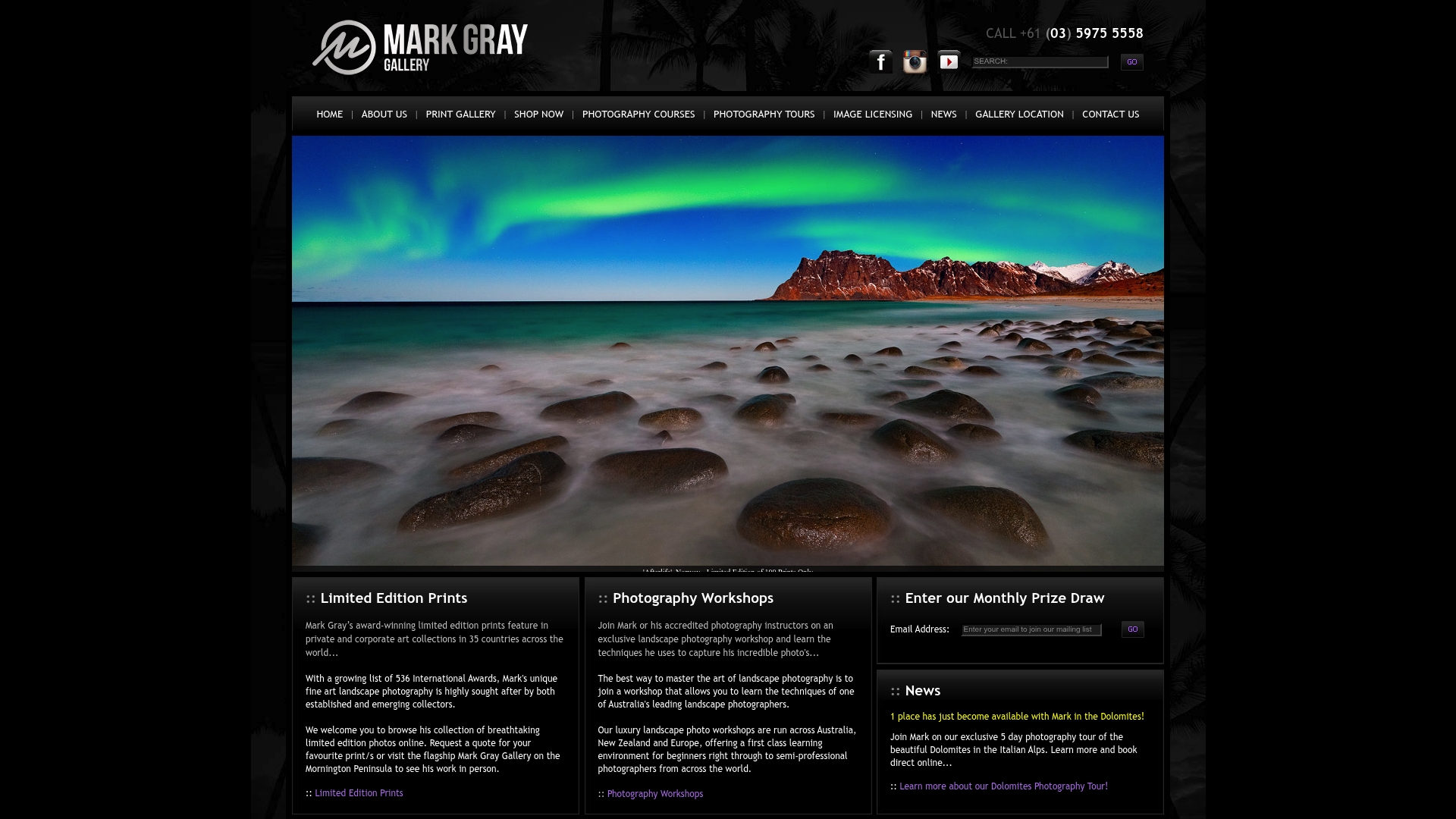
Whether you are building a collection, acquiring a single statement piece, or seeking provenance documentation for an existing print, the gallery is ready to assist. Browse the current collection, request COA details, or arrange a viewing by visiting Mark Gray Gallery directly. Each print ships with its signed COA and gallery invoice, giving you everything you need to protect and document your acquisition from day one.
Useful sources
These vetted resources support the guidance in this article and are worth bookmarking for ongoing reference:
- Beyond the Photograph: Editioning Photographic Work - LENSCRATCH
- Collecting Photos 101: What Is a Photograph Edition? - Swann Galleries
- The Numbering Affair - Luminous Landscape
- Limited-Edition Numbering Guide 2025 - Artfolio
- Giclee Print Sizes and Edition Quantities - Old Town Editions
- Limited Edition Print Value Explained for Collectors - Mark Gray Blog
Always save your COA, gallery invoice, and provenance records in a secure location separate from the print itself. For photographers managing their own print storage workflow, a reliable digital archive supports both production records and long-term documentation.