

New Zealand's top landscape highlights are defined by a concentration of geological extremes found nowhere else in the Southern Hemisphere. Visiting New Zealand landscape highlights means standing at the edge of Milford Sound's sheer fiord walls, watching turquoise glacial melt pool at Lake Pukaki beneath Aoraki / Mount Cook, and feeling the earth breathe through Rotorua's geothermal vents. The country packs alpine terrain, volcanic plateaux, ancient fiords, and accredited dark sky parks into two islands you can drive end to end in under a week. That density of dramatic scenery is precisely what makes New Zealand scenic spots so compelling for photographers and nature travelers alike.
What are the must-see landscapes in New Zealand?
New Zealand's signature scenic locations fall into four distinct categories: fiords, glacial lakes, geothermal regions, and dark sky parks. Each category delivers a different sensory experience, and the best itineraries combine at least two or three of them.
Fiords: Milford Sound vs. Doubtful Sound
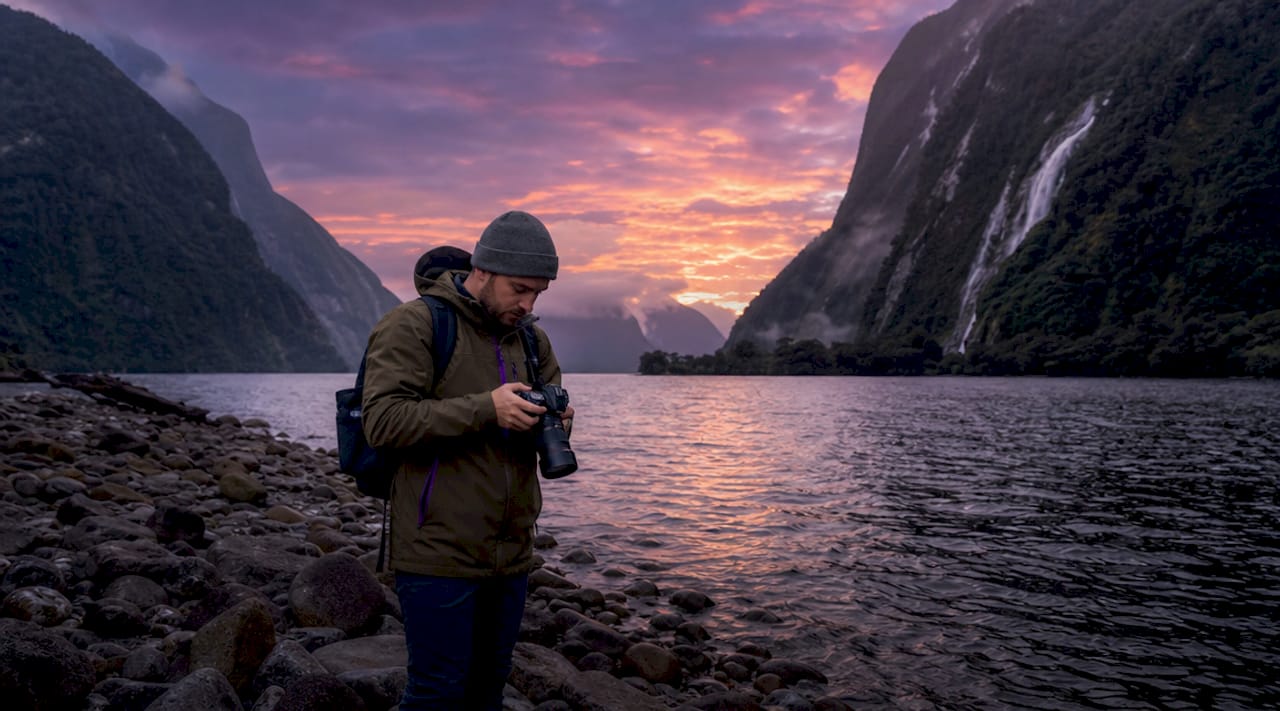
Milford Sound is the most accessible fiord for first-time visitors, reachable by road roughly two hours from Te Anau. Doubtful Sound sits deeper in Fiordland and requires a boat crossing plus a coach transfer, which filters the crowds and rewards you with a quieter, more remote atmosphere. Both fiords feature waterfalls that multiply dramatically after rain. Milford is the right choice if your schedule is tight; Doubtful Sound is worth the extra half day if solitude matters to you.
Glacial lakes and alpine sightlines
Lake Pukaki's dam wall viewpoint delivers a classic turquoise lake with Aoraki / Mount Cook visible 90 km away on clear mornings. The SH80 road running 55 km along the lake's western shore is the only land route to Mt Cook Village, making it both a practical necessity and one of the most photographed scenic drives in the country. The lake's color comes from glacial flour suspended in the meltwater, a fine mineral sediment that scatters light into that unmistakable blue-green.
Geothermal regions
Rotorua and Taupō anchor the North Island's geothermal belt. Rotorua's Wai-O-Tapu Thermal Wonderland hosts the Champagne Pool, a 65-meter-wide hot spring with vivid orange and green mineral deposits around its rim. Taupō sits on the caldera of one of the world's most powerful supervolcanoes, and Huka Falls just north of town is where the Waikato River narrows to 15 meters and surges through a blue gorge at 220,000 liters per second.
Dark sky parks
Kawarau Gibbston Dark Sky Park, accredited in May 2024, covers 25 km² between Cromwell and Queenstown and is shielded by surrounding mountains. On clear nights you can photograph the Milky Way core and, in season, the Aurora Australis. This is one of the few accredited dark sky parks globally that sits within 45 minutes of a major tourist hub.
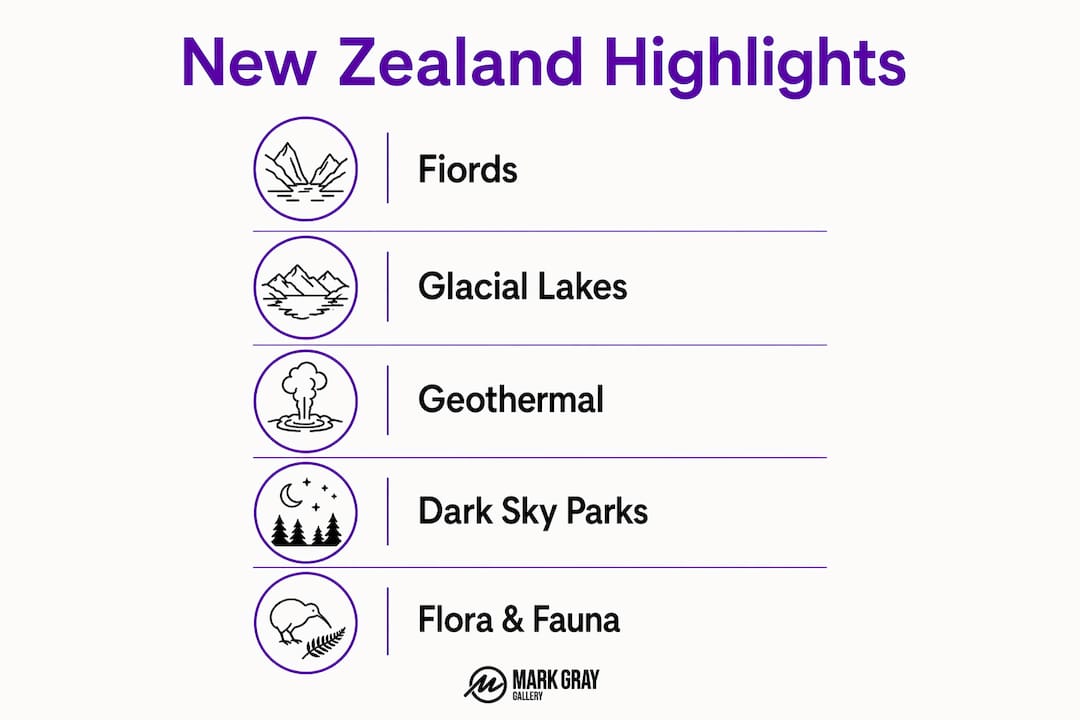
| Location | Category | Standout Feature |
|---|---|---|
| Milford Sound | Fiord | Accessible by road, dramatic waterfalls after rain |
| Lake Pukaki | Glacial lake | Turquoise water, Aoraki / Mt Cook sightline |
| Rotorua / Taupō | Geothermal | Champagne Pool, Huka Falls |
| Kawarau Gibbston | Dark sky park | Milky Way and Aurora Australis viewing |
| Doubtful Sound | Fiord | Remote, quieter alternative to Milford |
Key flora and fauna add another layer to these top landscapes in New Zealand. Silver ferns line the walking tracks near Milford Sound. Kea parrots, the world's only alpine parrot, patrol the Homer Tunnel approach. Fur seals haul out on the rocks at Milford's entrance year-round.
How to plan and access New Zealand's landscape highlights efficiently
Logistics separate a good New Zealand trip from a great one. The distances between major sites are manageable, but several routes require specific preparation.
-
Book Milford Sound cruises early. Summer demand is high, and the best morning departure slots sell out weeks in advance. Fill your fuel tank in Te Anau before you leave because there are no fuel stations on the 120 km road to Milford. The drive from Queenstown takes four to five hours; from Te Anau, plan on two hours.
-
Secure Great Walk bookings the moment they open. More than 4,000 people queue online for Great Walk hut and campsite spots each season. Milford Track bookings for the 2026/27 season open on May 13 at 9:30 a.m. Create your DOC account well in advance and be logged in before the window opens.
-
Drive SH80 to Mt Cook Village in the morning. Early light on Lake Pukaki produces the clearest Aoraki / Mount Cook reflections and the least wind on the water's surface. The 55 km drive from the SH8 turnoff takes under an hour, so an early start from Twizel is straightforward.
-
Plan for Rotorua and Taupō as a two-day North Island loop. The two towns sit 80 km apart on SH1. Combining Wai-O-Tapu, the Huka Falls walk, and a Taupō lake cruise covers the geothermal and freshwater highlights without backtracking.
-
Pack for four seasons in one day. Fiordland receives over 6,000 mm of rain annually. Waterproof layers, insect repellent for sandflies, and merino base layers are non-negotiable for the South Island's west coast.
Pro Tip: Book your Milford Sound cruise for the first departure of the day, typically around 9:00 a.m. Morning light hits the fiord walls at a low angle, and the waterfalls are most dramatic after overnight rain. You also beat the coach tour crowds that arrive mid-morning.
Seasonal timing shapes the experience significantly. Summer (December to February) offers long daylight hours and the best alpine access, but also peak crowds and sandfly season. Autumn (March to May) delivers stable weather, golden beech forest color, and thinner crowds at most sites. Winter closes some alpine roads but opens up snow-capped mountain photography and uncrowded fiord cruises.
What are the best ways to experience and photograph New Zealand's scenic landscapes?
The most rewarding way to engage with New Zealand's natural attractions is to combine at least one short walk, one scenic drive, and one water or aerial experience at each major location.
-
Short walks with high visual payoff. The Huka Falls walk is a 2.1 km trail through native bush ending at one of New Zealand's most visited waterfalls. Visit early morning or late afternoon for better light and fewer people. At Milford Sound, the Foreshore Walk takes 20 minutes and positions you directly beneath Mitre Peak for wide-angle compositions.
-
Scenic drives worth planning around. SH80 along Lake Pukaki is the benchmark for New Zealand road trip photography. The Milford Road through Fiordland passes Mirror Lakes, the Avenue of the Disappearing Mountain, and the Homer Tunnel, each offering a distinct composition. Learning how seasons change landscape photography helps you decide which route to prioritize by month.
-
Helicopter and flightseeing tours. A 20-minute helicopter flight over Milford Sound or the Tasman Glacier near Mt Cook Village reveals scale that ground-level photography cannot replicate. Several operators depart from Queenstown and Te Anau daily.
-
Boat cruises and kayaking. Milford Sound cruises run 1.5 to 2 hours and pass Stirling Falls and Bowen Falls up close. Sea kayaking inside the fiord puts you at water level beneath 1,200-meter cliff faces, a perspective no cruise can match.
-
Night photography at accredited dark sky parks. Kawarau Gibbston's managed light pollution standards make it far more reliable for astrophotography than random rural locations. Bring a wide-aperture lens (f/2.8 or wider), a sturdy tripod, and plan your shoot around the new moon phase for maximum Milky Way visibility.
Pro Tip: For landscape photography across New Zealand's diverse terrain, understanding photography techniques for varied scenery before you leave home will save you hours of trial and error in the field.
| Experience type | Best location | Recommended timing |
|---|---|---|
| Scenic drive | SH80, Lake Pukaki | Early morning, autumn |
| Short walk | Huka Falls, Taupō | Dawn or late afternoon |
| Boat cruise | Milford Sound | First morning departure |
| Astrophotography | Kawarau Gibbston | New moon, clear nights |
| Helicopter tour | Tasman Glacier, Mt Cook | Midday for snow contrast |
How do New Zealand's geological processes shape its landscapes?
New Zealand's dramatic terrain is a direct product of its position on the boundary between the Pacific and Australian tectonic plates. Complex tectonic processes have built fold mountains, volcanic plateaux, and fiords over millions of years. The Southern Alps continue to rise at roughly 10 mm per year, even as glacial erosion carves them back. This ongoing tension between uplift and erosion is what keeps the mountains so sharp and the valleys so deep.
The fiords of Fiordland were carved by glaciers during the last ice age, which ended roughly 10,000 years ago. Glaciers scoured U-shaped valleys to depths well below sea level, and when the ice retreated, the sea flooded in to create the fiords you see today. Milford Sound's floor sits 290 meters below sea level at its deepest point.
Geothermal activity in the central North Island is driven by the subduction of the Pacific Plate beneath the Australian Plate. Rotorua and Taupō sit directly above this heat source, producing the geysers, mud pools, and hot springs that define the region. The Taupō Volcanic Zone is one of the most active geothermal regions on earth.
Conservation work actively preserves these landscapes for future visitors. Project Janszoon has been restoring Abel Tasman National Park's wildlife and natural environment since 2012, working alongside DOC, iwi, and volunteers to protect the coastal and forest ecosystems that make the park one of New Zealand's most visited natural attractions.
Understanding these geological forces changes how you see the scenery. A fiord is not just a dramatic inlet. It is a record of an ice age. A geothermal pool is not just a curiosity. It is a window into the plate boundary 200 km below your feet.
Key takeaways
New Zealand's most rewarding landscape experiences require early booking, seasonal awareness, and a mix of ground-level and aerial perspectives to fully appreciate the country's geological diversity.
| Point | Details |
|---|---|
| Book early for iconic tracks | Milford Track and other Great Walks sell out fast; secure spots on opening day in May. |
| Milford Sound logistics matter | Fill fuel in Te Anau and book morning cruises weeks ahead to avoid missing out. |
| Lake Pukaki rewards early risers | Visit at dawn for the clearest Aoraki / Mt Cook sightline and best photography light. |
| Dark sky parks need planning | Kawarau Gibbston is accredited and reliable; time visits around new moon phases. |
| Geology enriches the experience | Knowing that fiords are glacial valleys and geothermal pools reflect plate tectonics deepens every visit. |
What I've learned from photographing New Zealand's landscapes
New Zealand rewards the prepared traveler more than almost any destination I've worked in. The light changes fast, the weather shifts without warning, and the difference between a memorable image and a forgettable one often comes down to whether you were at the right spot 20 minutes before sunrise or 20 minutes after.
My honest advice: resist the urge to tick every iconic site off a list. Spending two full mornings at Lake Pukaki will produce better results than a single rushed stop on the way to Mt Cook Village. The same applies to Milford Sound. Most visitors arrive on a day tour, spend 90 minutes on a cruise, and leave. Staying overnight in Milford or Te Anau gives you the fiord at dusk and dawn, when the light is extraordinary and the tour coaches are gone.
Guided photography tours offer a genuine advantage in New Zealand because local knowledge about weather windows and access points is hard to replicate from research alone. That said, independent travel along SH80 or the Milford Road gives you the freedom to stop whenever the light demands it. I'd combine both: join a guided experience at one or two key sites, then drive the scenic routes independently.
Pack a weather-aware photography mindset alongside your gear. Rain at Milford Sound is not a problem. It is the feature. Hundreds of ephemeral waterfalls appear on the fiord walls within hours of heavy rain, and the low cloud creates a moody atmosphere that clear days simply cannot match.
— Mark
Bring New Zealand's beauty home with award-winning photography
New Zealand's landscapes deserve more than a phone snapshot. Mark Gray's collection of limited edition landscape prints includes stunning work from New Zealand alongside Australia, Iceland, Norway, and beyond, each printed to museum quality and available in limited editions.
If you want to capture these scenes yourself, Mark offers multi-day landscape photography workshop tours that take you to the most photogenic locations with professional guidance on composition, light, and timing. Whether you're looking for a print to bring the memory home or the skills to create your own, the Mark Gray Gallery has you covered. Explore the full collection and upcoming workshop dates at markgray.com.au.
FAQ
What makes New Zealand landscapes unique compared to other destinations?
New Zealand concentrates fiords, active geothermal regions, glacial lakes, and accredited dark sky parks within a driveable two-island geography. This geological diversity, shaped by active plate tectonics, is unmatched at this scale anywhere in the Southern Hemisphere.
When is the best time to visit New Zealand's scenic spots?
Autumn (March to May) offers stable weather, smaller crowds, and vivid beech forest color across the South Island. Summer provides the longest daylight hours and best alpine access, but peak crowds and sandfly season are significant trade-offs.
How far in advance should I book the Milford Track?
Milford Track bookings for the 2026/27 season open on May 13. More than 4,000 people queue online on opening day, so create your DOC account beforehand and log in before 9:30 a.m.
Is Milford Sound worth visiting even in rainy weather?
Rain at Milford Sound creates hundreds of ephemeral waterfalls on the fiord walls and dramatic low cloud that clear days cannot replicate. Pack waterproof layers and insect repellent and treat wet weather as an advantage rather than a setback.
What gear do I need for night photography at Kawarau Gibbston?
A wide-aperture lens (f/2.8 or wider), a sturdy tripod, and a remote shutter release are the core requirements. Time your visit around the new moon for the darkest skies and the clearest Milky Way views at this accredited dark sky park.