
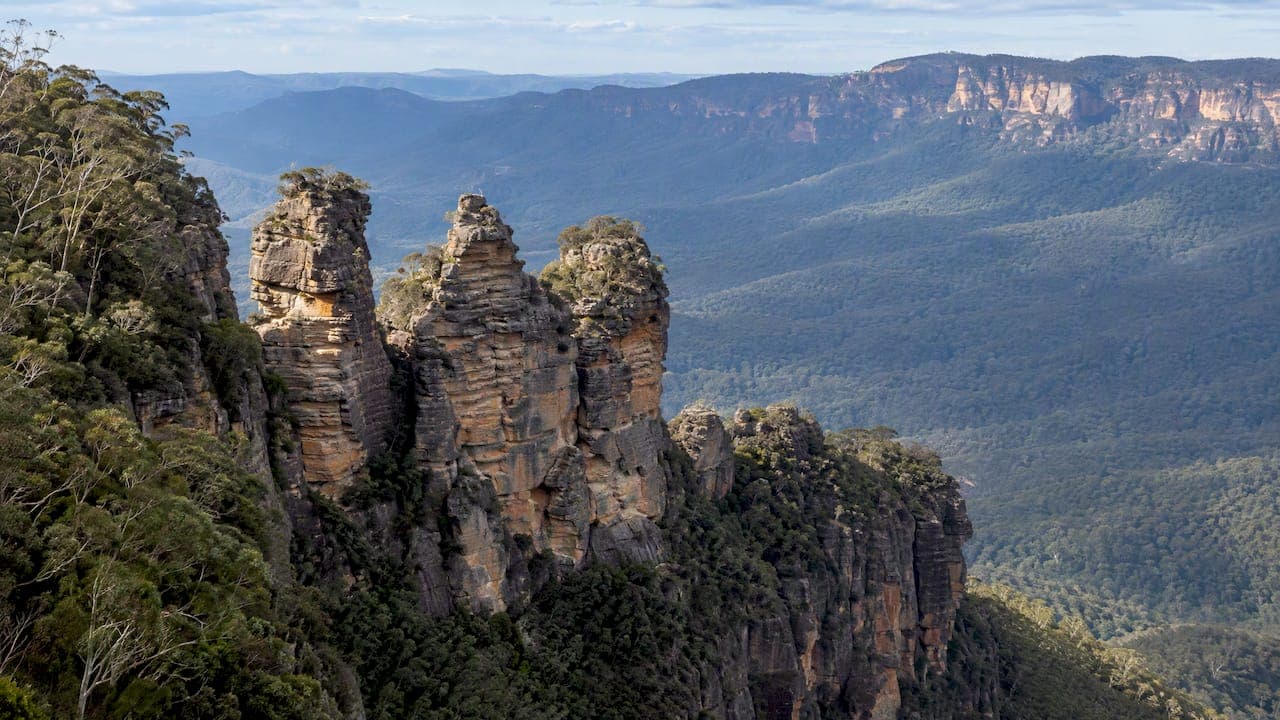
The best Blue Mountains photography comes from choosing one region and one kind of light, then working it properly. Start at Govetts Leap in Blackheath for sunrise, move to Echo Point in Katoomba for the late-afternoon Three Sisters, and add a short waterfall walk such as the South Lawson circuit. This guide covers where to shoot, when, what is closed right now, and how to turn a visit into images worth printing.
TL;DR
- Plan by region, not by postcard. The Greater Blue Mountains Area extends almost 250 kilometres, so the Three Sisters are only one chapter.
- Blackheath suits sunrise over the Grose Valley. Katoomba and Echo Point suit late-afternoon light. Waterfalls reward overcast or misty mornings.
- Check National Parks alerts before you go. Mount Hay Road and the Jenolan Karst Conservation Reserve are closed in late 2026.
- Night work and cliff-edge exposures need far more preparation than a sunset shoot.
- Guided instruction on location teaches faster than settings learned at home.
Table of Contents
- Why the Blue Mountains reward photographers
- Where to shoot: the locations worth your time
- Check what is closed before you drive
- Light, weather and season
- A first day that works
- Our perspective: shoot for the print
- Learn on location
- Bring the mountains home
- FAQ
- Sources
Why the Blue Mountains reward photographers
The region is less than two hours from Sydney, and Tourism Australia lists lookouts, waterfalls, caves, wildlife, small-town street art and misty mountain landscapes among its subjects. That range is the first thing to understand. "Blue Mountains photography" can mean a grand escarpment at dawn, a small cascade in fern light, or a mural in a Katoomba laneway.
The geology explains the appeal. The World Heritage listed area is a deeply incised sandstone tableland covering more than one million hectares, and NSW Environment describes vertical cliffs, waterfalls, canyons and ridgelines as defining values. For a photographer, abrupt contrast between exposed rock, deep forested valleys and distant ridges means one viewpoint yields several compositions as the light and weather change.
The famous blue is not a filter. It comes from a vast eucalypt forest and layered escarpments that stack into receding bands of tone. That layering is what you are really photographing, and it is why a wide, patient frame often beats a tight one here.
Where to shoot: the locations worth your time
The table below pairs the places Tourism Australia and other published guides highlight with the light that suits them. Walk lengths are as published by Tourism Australia.
| Location | Area | Best for | Notes |
|---|---|---|---|
| Echo Point and the Three Sisters | Katoomba | Late-afternoon light, classic escarpment | Busy, so arrive early to claim a spot |
| Govetts Leap | Blackheath | Sunrise, valley cloud | Descent is a 1.8 km return walk |
| South Lawson Waterfall Circuit | Lawson | Waterfall detail | 3 km circuit past Adelina, Federal, Cataract and Junction falls |
| Blue Mountains Botanic Garden | Mount Tomah | Botanical and panoramic work | 28-hectare estate at about 1,000 m |
| Katoomba Street Art Walk | Katoomba | Documentary, urban imagery | Good in flat midday light |
| Sublime Point | Leura | Sunrise or sunset | Wide, open outlook |
Katoomba and the Three Sisters
Echo Point is the obvious start, and obvious is fine. The Three Sisters Walk takes about 30 minutes, and Tourism Australia also points to the Scenic Skyway views toward the Three Sisters, Mount Solitary and Katoomba Falls. A local guide to lookouts recommends Echo Point for late-afternoon light on the Three Sisters and notes it can be crowded, so arrive early.
For a different angle, Cahill Lookout is described in the same guide as giving strong late-afternoon light on the Narrow Neck Plateau. Walk a few minutes from the main platform and the crowd thins quickly.
Blackheath and the Grose Valley
For sunrise, Blackheath is the usual recommendation. The same lookouts guide calls Govetts Leap its favourite sunrise spot, noting the Grose Valley often fills with low cloud in early morning. Evans Lookout and Anvil Rock are listed nearby as alternatives with fewer people.
The cloud is the prize. A valley of cloud with ridgelines rising out of it gives you the layered depth the region is known for. It is also unpredictable, so give yourself at least two mornings.
Lawson and the waterfalls
The South Lawson Waterfall Circuit is 3 km and passes four named falls, which makes it one of the most efficient waterfall walks for a photographer. Work close: a short telephoto for isolating cascades, a tripod for slow water, and a polariser to cut glare on wet rock.
Mount Tomah and the wider region
The Botanic Garden at Mount Tomah gives you a calmer, cooler setting with formal and panoramic compositions. Beyond that, the park is far larger than the Katoomba corridor. The Greater Blue Mountains Area includes eight adjacent conservation reserves, and the NSW government notes it holds 96 eucalypt species, about 13% of all eucalypt species. Exploring Blackheath, the Grose Valley and Mount Tomah as separate trips will give you more variety than three visits to the same lookout.
Check what is closed before you drive
This is the detail that catches visitors out. According to current NSW National Parks alerts, reviewed on 16 October 2026:
- Lower Fern Bower track is closed for repairs until 30 October 2026, with no access from Leura Cascades or Cliff Drive to Leura Forest or the valley tracks via Fern Bower.
- Mount Hay Road is closed to vehicles and pedestrians from 9 June to 17 December 2026 for upgrade works, which affects Lockley's Pylon, Fortress Ridge and the Mount Hay tracks.
- The Jenolan Karst Conservation Reserve, including the Caves Visitor Precinct, is closed until 31 December 2026, and the Six Foot track is closed at its boundary.
That last closure matters because Tourism Australia's guide recommends the Blue Lake near Jenolan. Until the reserve reopens, plan around it. Alerts change, so look again the night before and on the morning.
Light, weather and season
Weather is a creative asset here. Tourism Australia highlights misty mornings and waterfalls, and the guided-tour listing from NSW National Parks teaches sunrise, sunset and long-exposure photography. Rain can improve waterfall flow and deepen colour in the rock, but it also makes tracks slippery. Treat a wet forecast as a reason to adjust your location, not to stay home.
A practical rhythm for a single day:
- Before sunrise: be at a Blackheath lookout while the valley is still dark. Watch for cloud.
- Mid-morning: drop into a waterfall walk where soft, even light flatters wet rock and foliage.
- Midday: use the flat light for Katoomba street art, a garden, or rest and edit.
- Late afternoon: return to Echo Point or Cahill Lookout as the escarpment warms.
Night photography needs a plan
An astro frame is a different job. Australian Photography describes a Milky Way image at Mount Hay made from 12 exposures between 10:30pm and 11:30pm. That takes a tripod, reliable navigation, weather awareness and a return plan at exposed cliff locations. Scout the site in daylight first, tell someone where you are going, and remember Mount Hay Road is closed until 17 December 2026.

A first day that works
If you have one day, do not try to see everything. Combine one accessible lookout with one short walk. Pair Three Sisters or Govetts Leap for layered escarpment views with South Lawson for waterfall detail. The published distances (30 minutes, 1.8 km return and 3 km) make this far more manageable than a multi-day route attempted without preparation.
What to carry:
- A tripod and a cable release or timer
- A wide lens and a short telephoto
- A polariser and, for slow water, a neutral density filter
- Footwear for uneven, sometimes muddy tracks, plus water and weather protection
- A head torch for pre-dawn starts
Guided outings are more demanding than a casual lookout visit. The NSW National Parks listing for a Katoomba-area photography tour grades it Medium, with steep sections, stairs and potentially rocky or muddy terrain, and requires advance booking. Treat any walk with a camera bag the same way.
Our perspective: shoot for the print
We approach landscape photography from the end result. Mark Gray's prints are made with panoramic medium format film, and that discipline changes how you work in a place like the Blue Mountains. Film makes you slow down. You choose the frame before you press anything, you wait for the light to settle on the ridge, and you accept one considered exposure rather than a hundred hopeful ones.

That is the habit we would encourage in anyone, whatever camera they carry. Ask of each scene: would this hold on a wall? Layered escarpments, receding ridgelines and a single bright band of mist do. A crowded platform with a phone in every hand does not. Move ten minutes along the track, wait for the cloud to lift off the valley floor, and compose for depth.
There is also a lesson in restraint. The region offers so many subjects that it is tempting to chase them all. The images that last usually come from returning to one place until the light does what you hoped. Our work has been collected in 32 countries, and none of it came from a single hurried visit.
— Mark
Learn on location
Technique sticks when it is tied to a place. The NSW listing makes the same point: participants learn long exposure and sunrise or sunset work while moving through real lookouts and tracks, not settings in isolation. If you would rather learn from us, our small-group format and luxury arrangements are designed around that idea. Read what you need to know about a Blue Mountains photography workshop, or see why guided photography tours shorten the learning curve.
For a wider view of Australian shooting destinations, our guides to natural landscapes to explore and scenic drives for photography are a good next step.
Bring the mountains home
If you would rather hang the landscape than chase it, explore our limited edition prints and open edition prints. For something smaller, an acrylic block is $295 each, with postage and handling of $24.95 within Australia or $74.95 internationally. Gift certificates start from $50 AUD.
If you want to learn the craft, our 1 day photography courses, private lessons and photography tours are open for booking. Businesses needing imagery can ask about image licensing. You can also start from the Mark Gray home page.
FAQ
What is the best time of day for Blue Mountains photography?
Sunrise at Blackheath lookouts such as Govetts Leap is widely recommended, especially when low cloud fills the Grose Valley. Late afternoon suits Echo Point, where the Three Sisters catch warm light. Overcast or misty mornings are best for waterfalls.
How long do you need to photograph the Blue Mountains?
One day is enough for a lookout and a waterfall walk, such as Three Sisters or Govetts Leap plus the 3 km South Lawson circuit. Two or three days lets you cover Katoomba, Blackheath and Mount Tomah and wait for better conditions.
Is the Blue Mountains worth visiting in the rain?
Yes, with care. Mist and rain can improve waterfalls and add atmosphere to the valleys. Tracks become slippery, so wear suitable footwear and check NSW National Parks alerts for closures.
Do I need a guided tour to photograph the Blue Mountains?
No. The main lookouts are easy to reach and well signed. A guide helps if you want instruction in sunrise, sunset or long-exposure work, or access to less obvious spots. Guided tours in Katoomba-area national park require advance booking.
Are any Blue Mountains locations closed in 2026?
As of 16 October 2026, Mount Hay Road is closed until 17 December 2026 and the Jenolan Karst Conservation Reserve is closed until 31 December 2026. Lower Fern Bower track is closed until 30 October 2026. Check the official alerts before you leave.
Sources
- Greater Blue Mountains Area, NSW Environment and Heritage
- An Instagrammers' guide to the Blue Mountains, Tourism Australia
- Blue Mountains guided photography tours, NSW National Parks
- Current alerts, Wentworth Falls track, NSW National Parks
- Photographing the Blue Mountains (Part two), Australian Photography
- Blue Mountains Lookouts: Best Sunrise & Sunset Spots 2026