
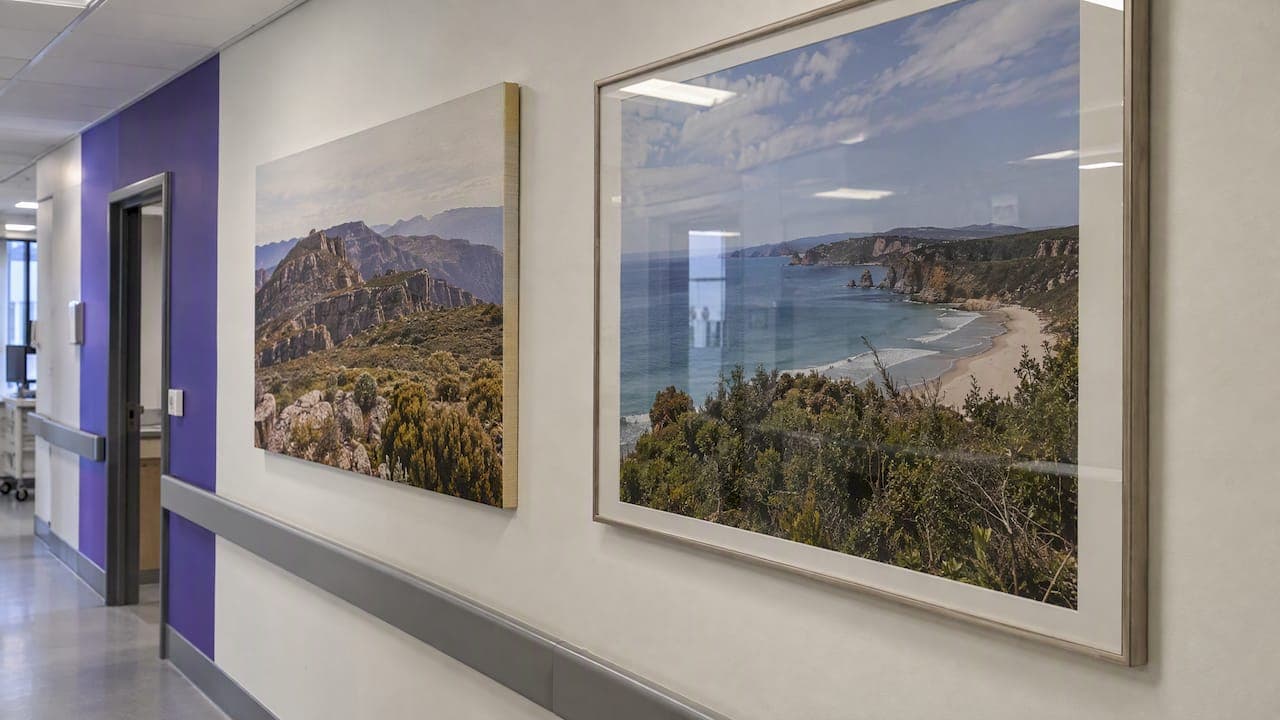
Healthcare wall art must be smooth, non-porous and easy to clean, chosen for calming and inclusive content, mounted with tamper-resistant or anti-ligature hardware where required, and backed by a documented approval and maintenance plan that follows frameworks like the Australasian Health Facility Guidelines and established Arts-in-Health practice.
TL;DR:
- Nature imagery is the safest choice for patients; place it within their direct sightlines, since care perceptions improve while effects on clinical outcomes remain mixed.
- In patient care areas, choose smooth, impervious, cleanable finishes such as vinyl or sealed prints, with acrylic or polycarbonate glazing instead of glass.
- Behavioral health and unsupervised patient areas need flush, tamper resistant anti ligature fixings that release under a defined load, and fire equipment must remain clear.
- Budget for replacement: wall graphics typically last four to six years, murals about a decade, while framed prints vary with glazing, location, and cleaning.
- Require clinical, infection control, facilities, design, and communications teams to approve content and materials, with local community input for culturally relevant commissions.
Table of Contents
- Why art matters in healthcare: the evidence summary
- Design principles: content, themes and audience fit
- Materials, framing and infection-control requirements
- Mounting, anti-ligature and safety standards for installations
- Commissioning, approvals and governance process
- Installation, schedule and maintenance lifecycle
- Lighting and visual display considerations
- A curator's view on selecting and framing clinical artwork
- Accessibility considerations for every patient and visitor
- Psychological impact and the evidence behind artwork choices
- Fitting art into facility branding and interior design standards
- Author perspective: treat artwork as a clinical instrument
- How the Mark Gray Gallery can support compliant photographic art
- FAQ
- Sources
Why art matters in healthcare: the evidence summary
Art in clinical spaces is not decoration, it is a measurable part of the patient experience. A review of empirical aesthetics research found that nature-themed imagery is consistently preferred by patients and can reduce stress and improve perceptions of care in both waiting rooms and patient rooms. That matters because the goal of art shifts depending on where it hangs.
- Waiting areas benefit from positive distraction that eases pre-appointment tension.
- Patient rooms call for calming imagery placed to support rest and recovery.
- Long-stay units need visual variety that holds interest over weeks or months.
One review found that nature-based art and views are linked to reduced anxiety across multiple healthcare settings, reinforcing why image choice should follow function, not just taste.
Design principles: content, themes and audience fit
Nature and biophilic imagery remain the safest, most broadly acceptable choice for clinical environments, though lobbies and staff-only zones can carry curated contemporary work with more personality. The deciding factor is always who sees the piece and under what kind of stress.
- Choose landscapes, botanical studies and water scenes for patient-facing corridors and rooms.
- Reserve bolder or abstract pieces for administrative areas away from patient sightlines.
- Involve local communities and, where relevant, Aboriginal design voices in co-creation so imagery reflects cultural safety and belonging rather than generic decor.
- Avoid explicit, violent or politically charged imagery everywhere, and apply extra sensitivity screening in mental health and pediatric units.
Our curator guidance on choosing healthcare art photography walks through how image mood and composition should match the clinical setting before anything goes to framing.
Materials, framing and infection-control requirements
Surfaces in patient-care zones must be smooth, impervious and easily cleanable, a requirement spelled out directly in Part D of the AusHFG. That rules out raw canvas, unsealed timber and textured fabric in favor of vinyl, high-pressure laminate or sealed printed substrates in high-clean zones.
Framing follows the same logic. Acrylic or polycarbonate glazing is preferred over glass because it resists shattering and holds up against hospital-grade disinfectants, and sealed frame edges stop moisture and dust from collecting where cleaning crews need quick access. Our guide to gallery-grade framing covers the same conservation principles applied here to a clinical context.

Lifespan planning matters for budgeting too. Facility policy examples put wall graphics at roughly five years and murals closer to ten years before replacement, figures worth building into any multi-year art procurement plan.
Mounting, anti-ligature and safety standards for installations
Hanging hardware carries real safety weight in clinical buildings. Anti-ligature systems typically use short cable lengths and fixings engineered to disengage under a defined load, and these should be standard in behavioral health units and anywhere unsupervised patients may be at risk.
Fire exits, alarms and fire-fighting equipment must stay fully unobstructed, with no artwork mounted within their clearance zones under any circumstance.
Public corridors and reception areas suit flexible, secure hang-rail systems that let curators rotate work without repeated wall damage. Behavioral health and high-acuity rooms need flush, tamper-proof fixings with no protruding hardware or cord.
Commissioning, approvals and governance process
A clear sign-off chain keeps art choices clinically sound rather than purely aesthetic. Stakeholders typically include a design lead, facilities management, a clinical lead, infection control, communications or brand, and an art manager or curator, each holding a distinct approval gate before a piece reaches the wall.
- Draft a brief defining purpose, location and budget.
- Run a content suitability review with clinical and cultural input.
- Confirm framing and material specifications against infection-control standards.
- Approve an installation plan that accounts for clinical disruption.
- Set a maintenance schedule and, for donated works, a licensing agreement or letter of understanding.
Licensing terms differ by format: a digital file licensed for print offers more flexibility for future resizing or replacement than a commissioned mural or printed wallpaper, which locks in dimensions and location for its full lifespan.
Installation, schedule and maintenance lifecycle
Installation should be scheduled around clinical activity, not the other way around. Coordinating with facilities and infection control teams ahead of time avoids disrupting patient care, and a brief continuity-of-service note keeps ward staff informed of any temporary access changes.
Cleaning regimens need to match whatever disinfectant protocol the unit already runs, which is exactly why sealed, non-porous surfaces matter so much at the material stage. Rotation and storage plans extend the useful life of framed pieces between placements.
For budgeting, wall graphics generally need replacing every four to six years, murals closer to a decade, and framed prints vary widely depending on glazing quality and location.
Lighting and visual display considerations
Good lighting protects both the art and the patient experience around it. UV-filtering glazing and conservation-quality materials limit fading, while a high color rendering index keeps skin tones and landscape colors looking natural under clinical lighting, a detail that matters more in healthcare than almost any other setting.
Dedicated lighting rails and directional fixtures, recommended in Arts-in-Health framework guidance, give facilities flexibility to rehang and relight work without new wiring. Glare control deserves particular attention along patient sightlines from the bed, since a reflective surface at the wrong angle defeats the calming purpose entirely.
Our piece on wall art lighting covers CRI and placement angles that translate directly to clinical corridors and patient rooms.
A curator's view on selecting and framing clinical artwork
Selecting photography for a healthcare commission starts with sightlines: what a patient sees from the bed, and what a visitor sees from the corridor. Sizing and glazing decisions follow from there, usually sealed acrylic over a conservation print, licensed for the specific wall it will occupy.
Facilities can act on this immediately:
- Map every patient sightline before choosing a single image.
- Standardize framing and glazing across a unit to simplify future maintenance.
Our wall art size guide and reception wall art ideas offer practical sizing references for both rooms and lobbies.
Accessibility considerations for every patient and visitor
Wall art only does its job if every patient and visitor can actually see it. Height placement needs to account for wheelchair users and seated patients, which generally means hanging centerlines lower than a standard gallery eye level designed for standing adults.
Corridors and reception areas benefit from artwork placed at a height range that works for someone seated as well as someone standing, rather than optimizing only for one group. In pediatric units, a second, lower band of art gives children their own sightline independent of the adult-height pieces above.
Tactile elements extend the experience to visitors with low vision or blindness. Raised-texture panels, sculptural reliefs or printed materials with a textured finish let touch convey what sight cannot, though any tactile surface in a patient-care zone still needs to meet the same cleanable, non-porous standard applied to everything else on the wall.
Signage and wayfinding art should pair strong color contrast with clear typography, since many patients experience some degree of visual impairment, whether temporary from medication or illness, or long-term. None of this is a separate checklist bolted onto the design process. It belongs in the same brief, reviewed by the same stakeholders, at the same approval gate as material and content decisions.

Psychological impact and the evidence behind artwork choices
The case for art as a clinical tool rests on more than intuition. Review evidence on empirical aesthetics in healthcare settings points to consistent benefits for patient wellbeing tied specifically to nature imagery and views, benefits that show up in both self-reported stress and, in some settings, reduced reliance on medication.
Controlled evaluation work adds a useful nuance: patients report better perceptions of care when artwork sits within their direct sightline, even though effects on harder clinical outcomes are more mixed and harder to isolate from other variables. Patient choice and engagement with the artwork, rather than passive exposure alone, appears to matter for the qualitative benefit.
This is why the strongest healthcare art programs treat image selection as a clinical decision with a feedback loop, not a one-time purchase. A piece chosen for its calming reputation but hung outside every patient sightline delivers none of the benefit the evidence describes. The placement decision and the content decision are inseparable, which is exactly why both sit inside the same approval workflow rather than being handled by separate teams working from separate briefs.
Fitting art into facility branding and interior design standards
Art programs work best when they reinforce the same visual language as the rest of the facility rather than competing with it. A consistent palette, framing style and placement rhythm across units builds a sense of calm continuity, which matters as much to first-time visitors forming an impression of care quality as it does to returning patients.
Standardizing framing specifications across a facility is a genuinely low-cost way to achieve this consistency, and it simplifies future maintenance because every replacement piece fits the same mounting hardware and glazing spec. Brand guidelines around color and typography can extend naturally into wayfinding-adjacent art without turning the collection into signage.
Communications or brand teams should hold a seat at the same approval gate as clinical and infection-control reviewers, since a mismatch between a facility's public identity and its art collection is just as visible to visitors as a mismatch in signage or uniforms.
Author perspective: treat artwork as a clinical instrument
Most facilities still buy art the way they buy furniture: once, by committee, with no measurement afterward. We think that is backward. Pilot one area, survey patients and staff before and after, and document a maintenance schedule from day one. Audit sightlines first; everything else follows from that.
— Mark
How the Mark Gray Gallery can support compliant photographic art
Sourcing imagery that meets both clinical standards and a facility's visual identity is easier when the photography is licensed correctly from the start. Image licensing is available for commercial and healthcare use, along with limited-edition and open-edition prints, acrylic blocks and gallery-grade framing built around conservation-quality materials, the same qualities this guide recommends for patient-facing walls.
The collection spans landscapes captured on panoramic medium format film, the kind of calming, nature-led imagery that reviews consistently favor for healthcare settings.
- License an image for a specific wall, room or wing through our image licensing service.
- Source gallery-grade, framed photography through our limited edition prints collection for a curated, donor-ready installation.
If a facility is weighing imagery for a new wing or a donor-funded wall, our image licensing page is the fastest place to start a conversation about rights and formats.
FAQ
What surfaces are required for healthcare wall art?
Surfaces in patient-care areas should be smooth, impervious and easily cleanable, following guidance set out in Part D of the AusHFG. Porous textiles, unsealed timber and heavily textured finishes should be avoided in favor of sealed vinyl, HPL or acrylic-glazed prints.
Is nature imagery really better for patients than abstract art?
Review evidence on empirical aesthetics in healthcare consistently favors nature-themed imagery for reducing stress and improving patient perceptions, particularly in waiting rooms and patient rooms. Abstract or bold contemporary work is generally better reserved for staff areas and lobbies away from direct patient sightlines.
When is anti-ligature mounting required?
Anti-ligature hardware is required in behavioral health units and other areas where patients may be unsupervised, using fixings engineered to disengage under a defined load. Public corridors and reception areas can generally use standard secure hang-rail systems instead.
How long does healthcare wall art typically last before replacement?
Hospital policy examples place wall graphics at roughly five years and murals closer to ten years before replacement is needed. Framed prints vary more widely depending on glazing quality, location and cleaning frequency.
Who should approve new artwork in a healthcare facility?
A typical approval chain includes a design lead, facilities management, a clinical lead, infection control, communications or brand, and an art manager or curator, each reviewing the piece against a different standard. Co-creation with local communities is also recommended for culturally relevant commissions, reinforcing belonging and cultural safety in the finished space.
Sources
- Australasian Health Facility Guidelines (Part D — Infection Prevention and Control)
- Benefits of Nature Imagery and Visual Art in Healthcare Contexts: A View from Empirical Aesthetics
- Sydney Children’s Hospitals Network — Wall graphics and mural policy