
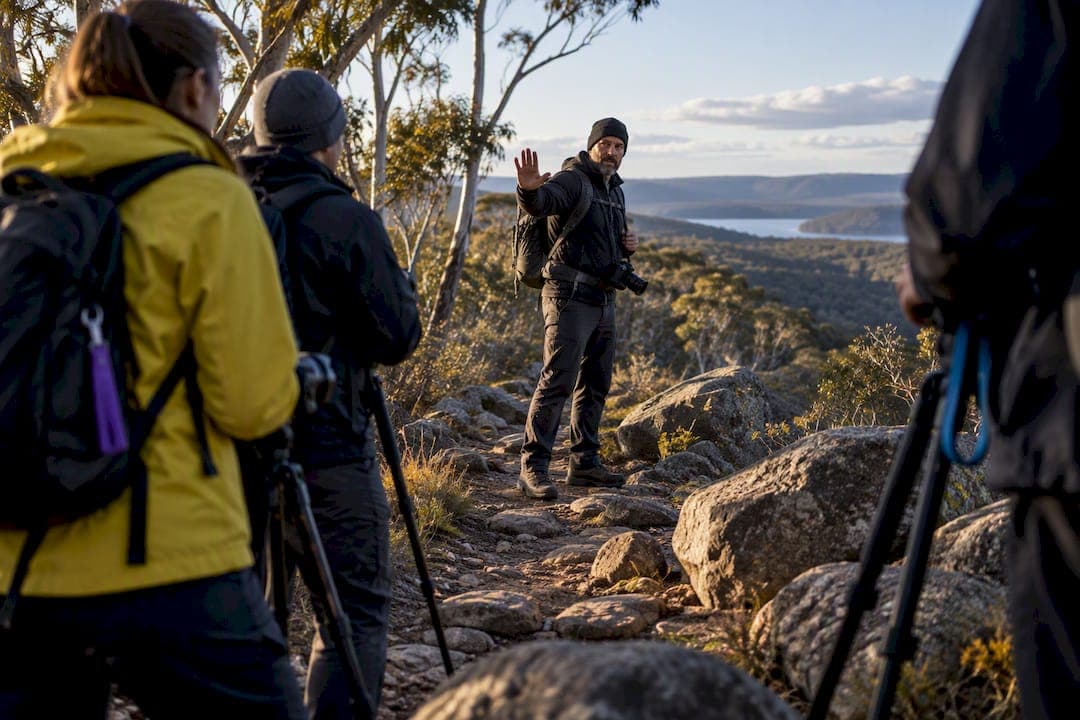
Respect others, follow the instructor's lead, and protect the people, property, and wildlife around you: those three commitments cover nearly every rule of photography workshop etiquette. They govern manners, safety, legality, and ethics all at once, and they apply whether you're in a studio, on a coastal trail, or waiting quietly for a bird to land.
TL;DR:
- Arrive fully prepared with the necessary gear, confirmed logistics, and a coachable attitude focused on following the instructor’s plan.
- Limit your attempts at prime positions, respect queueing, and always ask permission before crossing sightlines or using shared equipment during shoots.
- Follow safety and ethical guidelines for wildlife and habitat protection by maintaining distance, avoiding baiting, and staying on designated trails.
- Obtain proper releases and permissions for photographing people or private property, and respect cultural protocols when working on sensitive land.
- Thank instructors with private feedback, credit the workshop appropriately, and respect usage restrictions or sensitivities when sharing images afterward.
Table of Contents
- Before the workshop: how to prepare practically and mentally
- On-set and field etiquette: fair access, safety, and respectful behavior during shoots
- Critique and feedback etiquette: how to give and take criticism productively
- Wildlife, conservation, and legal constraints for photographers
- Permissions, privacy, and intellectual property
- After the workshop: best practices for follow-up, sharing, and networking
- What experienced workshop leaders expect from attendees
- How our courses put this etiquette into practice
- Authority links: conservation guidance, professional codes, and facilitator resources
- Sources
- FAQ
Before the workshop: how to prepare practically and mentally
A well-prepared attendee makes the whole day run better for everyone, not just themselves. Before you arrive, read whatever pre-course material the organizer sends and confirm your equipment against their list. A tour that requires a telephoto lens or sturdy tripod will say so, and turning up without it puts you and the group behind schedule.

Pack the essentials: charged batteries, formatted memory cards, a tripod if required, and a lens cloth for dust or sea spray. Seasoned attendees often bring a small kit of spares, an extra battery, a spare card, a multitool because someone in the group usually needs one.
Mindset matters as much as gear. Facilitator advice for attending workshops consistently points to coachability: arrive ready to follow the tutor's plan rather than treat the session as a chance to demonstrate what you already know. Photographers who dominate a critique or a Q&A session at the expense of others undermine the value everyone else paid for. If the workshop includes a critique segment, select and prepare your images ahead of time rather than scrambling on the day.
Practical logistics round out your preparation:
- Confirm meeting times, transport arrangements, and parking well before the day starts.
- Check for site-specific safety needs: tide times for coastal shoots, permit requirements for national parks, or weather gear for exposed locations.
- Arrive with time to spare rather than right on the deadline, since late arrivals disrupt briefings and safety talks.
- Charge every device the night before, including phone and GPS units, not just the camera.
Pro Tip: Lay out your kit the night before and photograph it on your phone. It takes thirty seconds and catches the missing battery or forgotten card before you leave the house.
On-set and field etiquette: fair access, safety, and respectful behavior during shoots
Shared shoots put several photographers in the same small space chasing the same light, and etiquette here is what keeps that workable. The rules below apply whether you're in a studio with a model or on a cliff edge at dawn.
- Limit your attempts at a prime position. Take a reasonable number of frames, then move on so others get a turn.
- Queue properly for retakes. If you want another go at a popular spot, join the back of the line rather than pushing in.
- Watch your sightlines. Never step into another photographer's frame, and ask before crossing in front of someone's composition.
- Leave model direction to the instructor. Repositioning or redirecting a model without express permission from the person running the shoot is one of the fastest ways to derail a session.
- Check before using flash, continuous lighting, or drones. Site rules and airspace regulations vary, and the instructor is the one who knows what's permitted at that specific location.
- Treat shared or demo gear with care. Ask before picking up sponsored equipment, and return anything borrowed promptly and in the condition you received it.
A practical guide to workshop etiquette describes this pattern of behavior as avoiding "shot hogging," monopolizing a good angle while others wait. The fix is simple: once you've got your frame, step back and let the next person in. If you need several attempts at a difficult composition, move to the back of the line and use the waiting time to fine-tune your exposure and framing, so you're ready to work quickly when your turn comes around again. That single habit reduces disruption and keeps the whole group moving.
Field shoots add safety to the etiquette equation. Uneven terrain, tide lines, and low light multiply the risk of an accident, and an instructor calling for the group to move or wait deserves an immediate response, not a debate. If you're shooting near cliffs, water, or wildlife, treat the instructor's positioning calls as non-negotiable rather than a suggestion.
Pro Tip: If you're unsure whether a shot, angle, or piece of gear is fair game, ask the instructor before you act. A five-second question beats an awkward correction in front of the group.
Critique and feedback etiquette: how to give and take criticism productively
Critique sessions are where workshops earn their value, and they only work when everyone follows a few shared habits. When you're on the receiving end, listen fully, take notes, and resist the urge to argue your case mid-session. Save clarifying questions for a break or the end of the session, when you can ask them one-on-one without holding up the group.
When you're the one giving feedback, be specific rather than vague. Naming the actual element, exposure, composition, focus point, gives the photographer something concrete to work with, and pairing the critique with a clear suggestion turns criticism into coaching. "The horizon's tilted" is a diagnosis; "try dropping the horizon a third from the bottom next time" is useful advice.
Most workshops set a limit on how many images each person brings to critique, along with a preferred file format or resolution. Respect both. Bringing twelve images when the brief asked for three eats into everyone else's time.
- Bring only the number of images requested, formatted the way the organizer asked.
- Take notes during your own critique instead of relying on memory afterward.
- Frame feedback around specific elements, not general impressions.
- If a critique stings, wait until you've had a moment to process before responding, and take strong reactions to a private conversation rather than the group session.
Critique is skill-building, not a verdict on your worth as a photographer, and the best attendees treat it that way.
Wildlife, conservation, and legal constraints for photographers
Wildlife and landscape workshops carry a layer of responsibility that studio sessions don't: the subject can't consent, and the habitat doesn't reset after you leave. The starting principle is welfare first. Never bait, feed, handle, or otherwise disturb an animal to get a better shot, and keep enough distance that your presence doesn't change its behavior. Guidance on ethical wildlife photography recommends avoiding nests entirely, skipping call playback during breeding season, and using flash sparingly around sensitive species.
Habitat protection matters just as much as animal welfare. Stay on marked trails, avoid trampling vegetation for a better angle, and follow any biosecurity instructions at the site, including boot-cleaning or wash stations designed to stop the spread of disease between locations. The BirdLife Photography Code of Ethics applies this same precautionary approach specifically to bird photography, restricting drone use near birds and asking photographers to withhold the precise locations of rare or threatened species so they aren't targeted by crowds or, worse, collectors.

Feeding or disturbing native fauna can breach state biodiversity legislation, and conservation guidance notes that penalties can apply to photographers who ignore these protections. That's not a suggestion buried in fine print, it's an enforceable rule in the places many landscape and wildlife workshops operate.
A few practical habits keep you on the right side of both ethics and law:
- Never feed, bait, or handle wildlife to improve a photo opportunity.
- Stay on formed trails and follow any biosecurity signage, wash stations included.
- Confirm you have landowner or Traditional Owner permission before entering restricted or culturally significant land.
- Avoid posting exact GPS coordinates for rare or threatened species, and report sensitive sightings through proper conservation channels rather than social media.
Our own nature photography coverage touches on several locations where these protections apply directly, and it's worth reading before you plan a shoot in a similarly sensitive habitat.
Permissions, privacy, and intellectual property
Shooting other people, private property, or someone else's creative setup all carry obligations that are easy to overlook in the moment. If a workshop includes a model, confirm whether a release has already been arranged by the organizer, and never assume you can use images commercially without one. The same applies to property: a striking building or farm doesn't grant automatic permission to photograph it for anything beyond personal use.
Privacy deserves particular care in candid or street segments. Avoid photographing people in private moments without consent, and where a workshop takes place on culturally significant land, follow whatever protocols the organizer or Traditional Owners have set out. The ASMP code of conduct offers a useful professional template here, covering privacy, moral rights, and safe working practices on collaborative shoots.
Credit matters too. Don't present another photographer's lighting setup, composition idea, or edited image as your own work, and follow whatever usage rules the workshop sets for images made during the session.
- Confirm model releases and property permissions before assuming commercial use is allowed.
- Respect cultural protocols on Indigenous or culturally significant land.
- Credit collaborators and instructors rather than claiming shared setups as solo work.
- Strip or edit EXIF and GPS data before posting sensitive wildlife images, particularly for threatened species.
Readers building a portfolio around licensed or commercial images will find more detail in our guide to social media image licensing.
After the workshop: best practices for follow-up, sharing, and networking
What you do once the workshop ends says as much about your etiquette as anything during the day. A short thank-you to the instructor, ideally through the organizer's feedback survey rather than a public comment, closes the loop constructively and gives the organizer something to act on.
- Credit the workshop and instructor when you post images from the session, and respect any usage restrictions the organizer set for shared locations or techniques.
- Exchange contact details respectfully. Ask before adding fellow participants to a mailing list, group chat, or social media group.
- Request further coaching through proper channels. If one critique wasn't enough, ask about a private lesson or a scheduled follow-up review rather than emailing the instructor repeatedly for free feedback.
- Give feedback on the experience itself. Constructive notes on pacing, group size, or logistics help organizers improve the next session.
A guide to choosing the right workshop covers what to look for before you book, which pairs well with these follow-up habits once the course is done.
What experienced workshop leaders expect from attendees
Leaders running small-group sessions want attendees who've read the pre-briefing, turn up on time, and treat site rules as fixed rather than optional. Disruptive behavior, whether that's shot-hogging, ignoring safety calls, or talking over a critique, gets managed quietly and directly, because it affects everyone else's experience, not just the individual involved. Small-group formats exist precisely to make that management easier: fewer people means more personal attention and less room for a single attendee's habits to derail the day.
— Mark
How our courses put this etiquette into practice
Every course we run, from a single-day session to a longer landscape Photography Tours tour, is built around small groups and clear expectations from the first briefing. That structure means less time competing for space and more time actually shooting, with safety and site rules explained before anyone picks up a camera.
Our 1 Day Photography Courses suit photographers who want a focused, guided introduction without a multi-day commitment, while the tours give more time in the field for landscape and travel work. If you'd rather work through feedback one-on-one, Private Lessons offer that without the group critique setting. Whichever format fits, attendees typically work alongside a small number of other photographers rather than competing for attention in a crowd, with sessions following standards of preparation and respect. Check current dates and book directly through the course pages linked here.
Authority links: conservation guidance, professional codes, and facilitator resources
For readers who want the original policy language rather than a summary, a few sources are worth bookmarking. The Eddie Adams Workshop code of conduct shows what a signed, enforceable code looks like in practice, including reporting procedures for harassment. For pre-shoot planning discipline, this production checklist from the video and event world translates well to photography workshop logistics. And for photographers building a professional online presence after a course, this photographer-focused SEO resource covers presentation and follow-up practices worth knowing.
Sources
- Ethical wildlife photography guidance (WA DBCA)
- Eddie Adams Workshop — Code of conduct
- PetaPixel — A guide for photographers attending workshops
FAQ
What is the "20/60/20 rule" in photography?
Definitions vary across sources, and there's no single authoritative version of a "rule" tied to photography workshops or technique. If you've seen it referenced for a specific workshop or publication, check that source directly rather than relying on a general definition.
What is the 80/20 rule in photography?
Like some other informal rules, the "80/20 rule" isn't a fixed, universally recognized standard in photography. Different instructors and writers use the phrase to mean different things, so it's best treated as informal shorthand rather than an official guideline.
What are the 7 rules of photography?
There's no single official list of "seven rules" recognized across the industry. Etiquette-focused advice from workshop guides tends to emphasize preparation, punctuality, coachability, and respect for instructors, other attendees, and subjects instead of a fixed numbered list.
What are the five basic rules of photography?
As with the seven-rule version, no single authoritative source defines exactly five basic rules. Workshop etiquette guidance consistently comes back to the same core habits: arrive prepared, follow the instructor, respect other participants' space and time, protect wildlife and property, and give feedback constructively.
Do I need permission to photograph wildlife on protected land?
Yes, in many protected areas you need to follow specific access and conduct rules, and feeding or disturbing native fauna can breach state biodiversity legislation. Check the relevant conservation authority's guidance for the specific location before you shoot, since rules differ by park and species.