
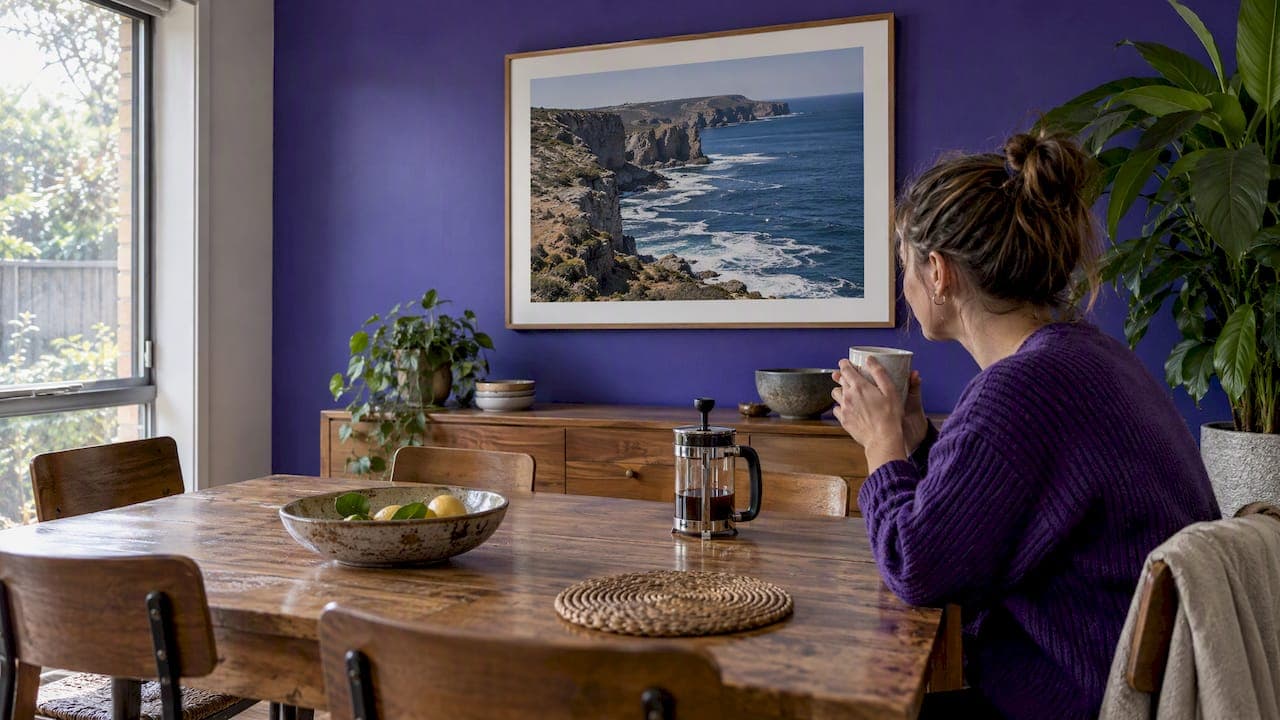
The best dining room wall art is one confident piece, or a tight group, that suits the scale of your table and wall, hangs with its centre around 150 cm from the floor, and sets a warm mood for conversation. Subject matters less than proportion, light and how the work relates to the room. A landscape photograph can do all of this well, because it gives a room that holds meals, long evenings and guests a calm focal point.
This guide covers what to hang, how to size it, where to put it, how to link it to your furniture, and how to keep a photographic print looking its best in a room that often has a chandelier overhead and a window opposite.
TL;DR
- Choose art that is warm, inviting and worth talking about. The dining room is where guests sit still and look, so one strong image beats several timid ones.
- Over a sideboard or buffet, aim for art that fills roughly half to two thirds of the furniture's width.
- A gallery standard is 150 cm from the floor to the centre of the artwork. Adjust for your furniture, ceiling height and the people who sit beneath it.
- Link the art to the room through one or two colors or materials. Do not match everything.
- Photographs are light sensitive. Keep them out of direct sun and use UV-protective glazing.
Table of Contents
- What kind of art suits a dining room
- How to choose the right size
- Where and how high to hang it
- Tying the art to the room
- Protecting a photograph in a dining room
- Our perspective: why landscape photography belongs at the table
- Choosing a print from our collection
- A simple process to follow
- FAQ
- Sources
What kind of art suits a dining room
A dining room is a social room. People sit in it for an hour or three, facing the walls, with nothing to do but talk and look up. That makes it one of the better places in a home for a statement piece.
A useful reminder comes from Australia's most formal address. When The Lodge in Canberra was refreshed, a mural by Emily Kngwarreye was hung opposite a bright Dale Frank abstract in the dining room as conversation pieces. Formal does not have to mean quiet. Bold work can sit very comfortably where people eat.
In practice, the subjects that work in dining rooms fall into a few families:
- Landscape and seascape photography. Open horizons, mist, coastline and mountain light give the eye somewhere to rest. They suit both modern and traditional interiors.
- Abstract and contemporary painting. Strong color and gesture create talking points.
- Still life, botanicals and food-related imagery. Obvious, and charming when done with restraint, but they can feel predictable in a room that already says "dining".
- Textile and handmade work. A framed stitched piece adds texture and personality. If you stitch, these ready to hang cross stitch decor projects come with sizing tips that translate neatly to a dining wall.
We lean toward landscape photography for good reason. It is atmospheric without demanding to be decoded, it brings a sense of place, and it suits a room where you want people relaxed.
Subject and mood
Think about the mood you want at the table. A misty forest or a quiet shoreline at dawn slows a dinner down. A dramatic mountain at sunset adds energy and warmth. Avoid images that are harsh or visually busy opposite the head of the table, because that is the view your guests will have for the whole evening.
Color: guide, not rulebook
Art can echo something already in the room: the rug, chair fabric, wall color, timber tone, metal finish, curtains or even the chandelier finish. One echo is usually enough. A print with warm ochres and a table in oak, or cool blue-greys and brushed nickel, will feel intentional.
You also do not need to match precisely. Wentworth Galleries' Peter Aitken has argued that hanging rules are guides rather than gospel, and that mixing rather than over-coordinating can give a more organic result. Decus founder Alexandra Donohoe Church, speaking to Domain, describes choosing art as an intuitive process, adjusted until the work feels comfortable with the furnishings. Trust your eye. If the piece looks right to you after a week of living with it, it is right.
How to choose the right size
Size is where most dining rooms go wrong. Art that is too small looks lost, and a postage-stamp print on a large wall is the classic mistake.
Start with what the art relates to:
- Above a sideboard, buffet or console: a widely used rule of thumb is that the art, or a grouped arrangement acting as one piece, should fill at least half to two thirds of the furniture's width. A 160 cm sideboard suits art, or a grouping, roughly 80 to 105 cm wide.
- On a feature wall with no furniture: go larger than feels comfortable. A wall that reads as empty needs a piece that takes up a good share of it.
- Opposite or beside the table: consider the viewing distance. Seated guests are a couple of metres away, so detail matters less than impact, and a larger image reads better.
That "two thirds" figure is the answer to the question many people search, the so-called 2/3 rule. It is a proportion, not a law, and it applies to the width of the furniture beneath the art. Treat it as a starting point, then test it.
Test before you drill
Cut paper or cardboard to the size you are considering and tape it to the wall. Leave it there for a day or two and look at it from the head of the table, from the doorway and from a seated position. This costs nothing and prevents most sizing regrets. Our wall art size guide goes through the measurements in more detail for homes and offices.

Single piece, pair or group
There are three sensible layouts:
- One large statement piece. Calm, modern and the simplest to get right. Works over a sideboard or alone on a wall.
- A pair or triptych. Matching sizes, evenly spaced, work well over a long table wall. Panoramic landscapes lend themselves to this.
- A curated group. Interior designer Gillian Gillies suggests mixing "starring roles" and "understudies", so one piece is the main attraction while others provide balance and fill. It is a helpful way to avoid a group where everything competes.
If you want to build a group of photographs, see our guide to curating a landscape photography wall gallery.
Where and how high to hang it
The Canberra Times reported that Peter Aitken, director of Wentworth Galleries, considers 150 cm from the floor to the centre of the artwork a useful gallery standard. He also says furniture, room dimensions and the people who live there should modify it. That is the right way to read the number: as the default.
A few dining-specific adjustments:
- Above a sideboard: the art shouldn't float. A gap of about 4 to 8 inches, or 10 to 20 cm, above the furniture keeps the two visually connected. If that places the center well above 150 cm, favor the connection with the furniture.
- Behind seated guests: hang art a little lower than usual if people will sit with their backs to it and rarely look at it. If it is opposite the seating, the 150 cm standard works well.
- Tall ceilings: do not hang to the ceiling. Go larger or stack two pieces, and keep the center within comfortable viewing range.
- Mixed household heights: stand and sit in the room. A dining room is viewed mostly from a chair, so slightly lower is often right.
For the technical side, including hardware, spacing and levelling, our guide on how to hang landscape photography prints correctly covers the steps.
Tying the art to the room
Good dining room art feels like part of the room, not an add-on. Three simple moves help.
Pick one echo
Identify one color or material in the room, such as the timber of the table, the upholstery on the chairs or the metal on the light fitting. Choose art with a trace of it. Many landscape images carry warm sandstone, deep teal water or soft grey cloud that pairs naturally with these tones.
Respect the wall color
On a pale wall, an image with deep tones and a generous white or neutral mount gives a gallery effect. On a dark wall, a luminous image with light skies or reflective water glows. Neither rule is absolute, which is rather the point of the earlier advice about not over-coordinating.
Think about the frame
The frame is part of the room's furniture language. Timber frames suit a timber table, black frames sharpen a modern room, and a deep white mount calms a busy space. Keep one frame style across the room's art so that different images still read as a family.
Protecting a photograph in a dining room
This is the part that most decorating guides skip, and it matters if you are investing in a quality print. Photographs, textiles and works on paper are sensitive to light and need to be kept in areas with low lighting, according to the National Gallery of Victoria. The same document identifies light sensitivity and handling as core care considerations for artworks.
In a dining room, that translates into practical choices:
- Avoid walls that take direct afternoon sun through a window or glass door.
- Do not hang a print directly beneath a hot downlight or spotlight with no diffusion.
- Choose framing with UV-protective glazing. Our guide to UV protection for prints explains what to look for.
- Light the wall with care. See our notes on wall art lighting for angles and color rendering that flatter a print.
- Reduce reflections. A window opposite a framed photograph can bounce glare across the image, and there are ways to cut glare without losing detail.
Candles, steam and cooking are further reasons to keep a dining room print away from an open kitchen wall if the two spaces are one.
Our perspective: why landscape photography belongs at the table
We have printed and framed landscapes for homes across Australia and overseas, and the dining room is one of the rooms where they earn their place. Guests linger, conversation drifts, and a image of a real place gives them something to talk about: where it was taken, what the light was doing, how long someone waited for the moment.

That is why detail matters to us. Mark's prints are made from panoramic medium format film, which holds the fine detail you notice when you are sitting a few metres from a wall for an entire evening. They have won awards and are collected in 32 countries, and a great deal of that comes from the care taken at capture rather than anything added later.
Our advice is simple. Buy for the wall you have. Choose one image you will not tire of, make it large enough to hold the room, hang it at a height that suits the people who actually sit there, and protect it from the sun. A single well-chosen print will do more for a dining room than a crowded wall of compromises.
— Mark
Choosing a print from our collection
If a landscape suits your dining room, we offer two routes. Limited edition prints are numbered, premium works for collectors, with subjects drawn from Australia, New Zealand, Norway, Iceland, French Polynesia, Spain and the United Kingdom. Open edition prints offer a more accessible way to bring an Australian landscape home. Prices for both are published on the product pages.
For a smaller accent on a sideboard or shelf, our acrylic blocks are $295 each, plus $24.95 postage and handling within Australia or $74.95 internationally. If you are buying for someone else, gift certificates start from $50 and let them choose the image and size for their own wall.
Browse the full gallery at markgray.com.au.
A simple process to follow
- Measure the wall and the furniture beneath it.
- Decide the size using the half to two thirds proportion above a sideboard, or a generous share of a free wall.
- Tape paper templates to the wall and live with them for a day or two.
- Choose the mood and one color or material to echo.
- Check the light. Avoid direct sun and add UV-protective glazing.
- Hang with the center near 150 cm, adjusting to the furniture and the household.
- Step back after a week and adjust only if something feels off.
FAQ
What kind of art should hang in the dining room?
Choose art that is warm, inviting and worth talking about, such as a landscape photograph, a bold abstract or a curated group. Guests sit in the room for a long time, so a confident statement piece works better than small, forgettable decor. Avoid harsh or very busy images opposite the head of the table.
What is the 2/3 rule for hanging pictures?
It is a proportion for hanging art over furniture: the art, or a group arranged as one piece, should fill roughly half to two thirds of the furniture's width. Above a 150 cm sideboard, that means art about 75 to 100 cm wide. It is a guide rather than a strict rule, so tape a template to the wall first.
How high should I hang art in a dining room?
A common gallery standard is 150 cm from the floor to the center of the artwork. Over a sideboard, keep the bottom edge a modest distance above the furniture so the two read together. Adjust for ceiling height and for how people will sit and look.
Is landscape photography suitable for a dining room?
Yes. It brings calm and a sense of place, and it suits both modern and traditional rooms. Hang it away from direct sunlight and hot lights, and use UV-protective glazing, because photographs are light sensitive.
Sources
- The Lodge renovations complete, Lucy Turnbull enlivens Lodge with contemporary Australian art, ABC News
- Dining Room Wall Decor: Scale Rules for Art Over a Buffet or Sideboard, Keck Furniture
- Peter Aitken: Gallery standard art hanging height revealed, The Canberra Times
- Yellowtrace: Contemporary classicism with an attitude, Domain
- Exhibiting Artworks at the NGV, National Gallery of Victoria
- How to coordinate wall art in a room for a curated display, Livingetc
- How High To Hang Pictures, The DIY Playbook