
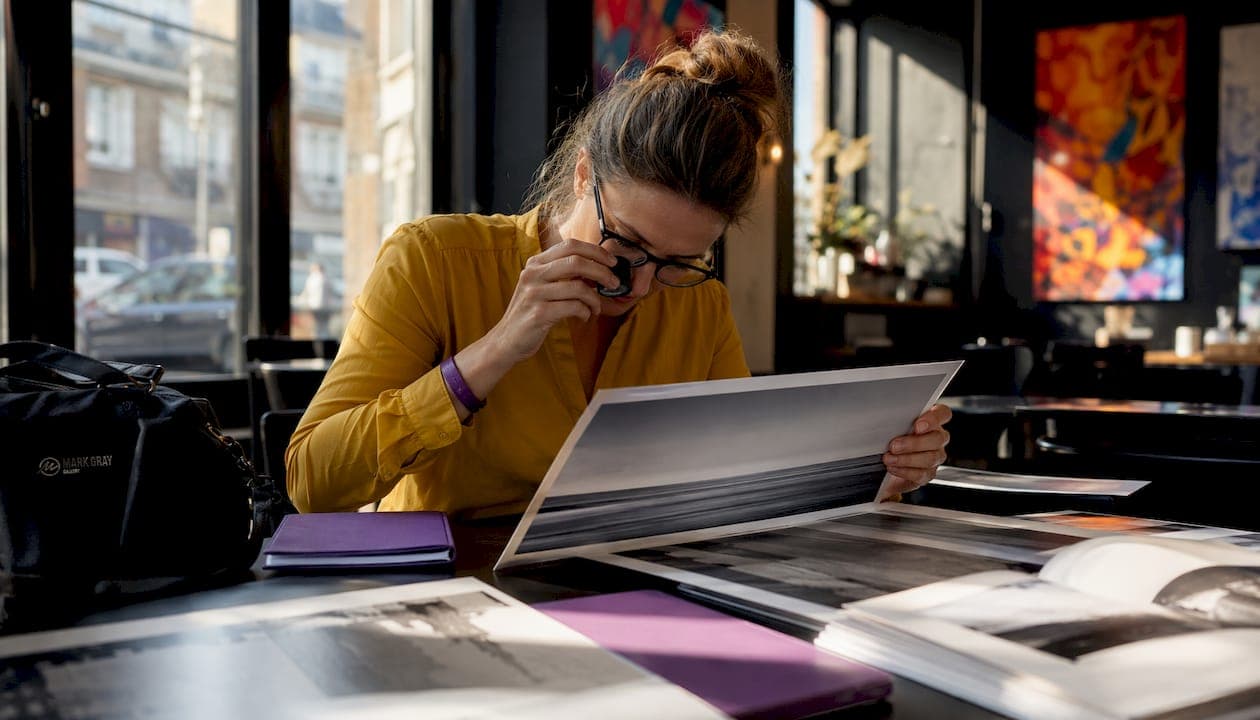
For gallery-quality pics of horizontal lines in landscape photography, Mark Gray Gallery is the standout source — look for prints where the horizon or leading line terminates at a clear focal destination rather than drifting off-frame. Three quick selection cues before you go further:
- Horizon placement: A horizon set on the upper or lower third reads more dynamically than a centered split, though a centered horizon can work beautifully for minimalist, mirror-like compositions.
- Termination point: The strongest horizontal line images guide your eye to a subject — a rock formation, a distant headland, a band of light. If your eye exits the frame, the composition loses its hold.
- Print quality: Look for museum-grade giclée on archival paper meeting ISO 9706 standards. That rating signals the inks and substrate resist fading for generations, not just years.
Browse Mark Gray Gallery's limited-edition prints by motif, request a close-up crop, or ask for a print mockup at your intended size before committing.
Table of Contents
- What makes a horizontal line image genuinely powerful?
- What landscape subjects produce the strongest horizontal lines?
- How do you choose the right print for your space?
- How should you display and care for large landscape prints?
- Where to find and order horizontal-line landscape prints
- Key Takeaways
- Why horizontal lines have always drawn me back
- Bring gallery-quality horizontal-line prints into your space
What makes a horizontal line image genuinely powerful?
Horizontal lines communicate stability and rest in a way no other orientation does. The brain functions as a prediction engine: when it detects a line, it follows that line, seeking a destination. Photographers who understand this choreograph the viewer's journey deliberately, placing the payoff exactly where they want attention to land.
Line orientation carries distinct meaning: horizontals signal calm and permanence, verticals suggest height and aspiration, diagonals inject energy and tension. Choosing horizontal framing is a deliberate creative statement about mood.
Pro Tip: When evaluating any horizontal line photo, trace the line with your finger. If your finger exits the frame without landing on a subject or intentional negative space, the composition has a "leaking eye" problem — the viewer's attention bleeds out rather than settling.
The leaking eye effect is one of the most common pitfalls in horizontal compositions. A strong image either terminates the line on a clear subject or crops it so the line's end reinforces negative space within the frame. Neither outcome is accidental.
Lens choice matters enormously here. Wide-angle lenses exaggerate perspective, pulling foreground elements closer and pushing backgrounds away — a technique that amplifies the perceived scale of a horizontal foreground and adds genuine depth. Pair that with a low camera position and the effect becomes dramatic.
A few practical framing principles worth knowing:
- Rule of thirds vs. centered horizon: Thirds placement adds dynamism; a centered horizon suits still water or salt flat minimalism where symmetry is the point.
- Camera orientation: Landscape framing stretches horizontal lines and emphasizes calm. Portrait framing truncates them, which can heighten tension — useful to know when sizing a print for a tall wall.
- Straight horizon: Many cameras offer gridlines; some photographers carry a hot-shoe bubble level. A tilted horizon undermines the stability that makes horizontal compositions work.
- Intentional division: Horizontal lines can divide the frame into layers, creating minimalist or richly stacked compositions depending on placement and repetition.
What landscape subjects produce the strongest horizontal lines?
Certain motifs reliably generate the clean, layered horizontal line images that collectors prize. Knowing what to look for in a thumbnail makes shortlisting prints much faster.
- Seascapes and ocean horizons: The classic source. A flat horizon over open water delivers an unbroken line with natural termination at the sky. Mood shifts dramatically with light — golden hour warms the palette; overcast conditions flatten contrast for a meditative feel.
- Salt flats and tidal pools: High-key minimalism at its best. The reflective surface doubles the horizontal, creating mirror symmetry that reads as serene and graphic simultaneously.
- Sand dunes and ridgelines: Layered tonal depth. Each ridge adds another horizontal band, building rhythm across the frame. Color palettes tend toward warm ochres and cool shadows.
- Shorelines and rock ledges: Curved or straight, these lines carry the eye laterally and often terminate at a rock formation or headland. Shorelines and coastal edges are among the most versatile leading lines in landscape work.
- Layered mountain ridges: Multiple overlapping horizontals create atmospheric depth, especially in early morning haze. Each ridge recedes in tone, reinforcing the sense of distance.
- Cloud bands and strata: Often overlooked, but a strong cloud band above a clean horizon doubles the compositional weight of the horizontal element.
When scanning thumbnails, check three things: foreground contrast (does the line read clearly at small size?), visible termination (where does the eye land?), and whether the line repeats to create rhythm or stands alone for graphic simplicity. Seasonal color shifts also affect mood significantly — the same ridgeline reads differently in autumn gold versus winter blue.
How do you choose the right print for your space?
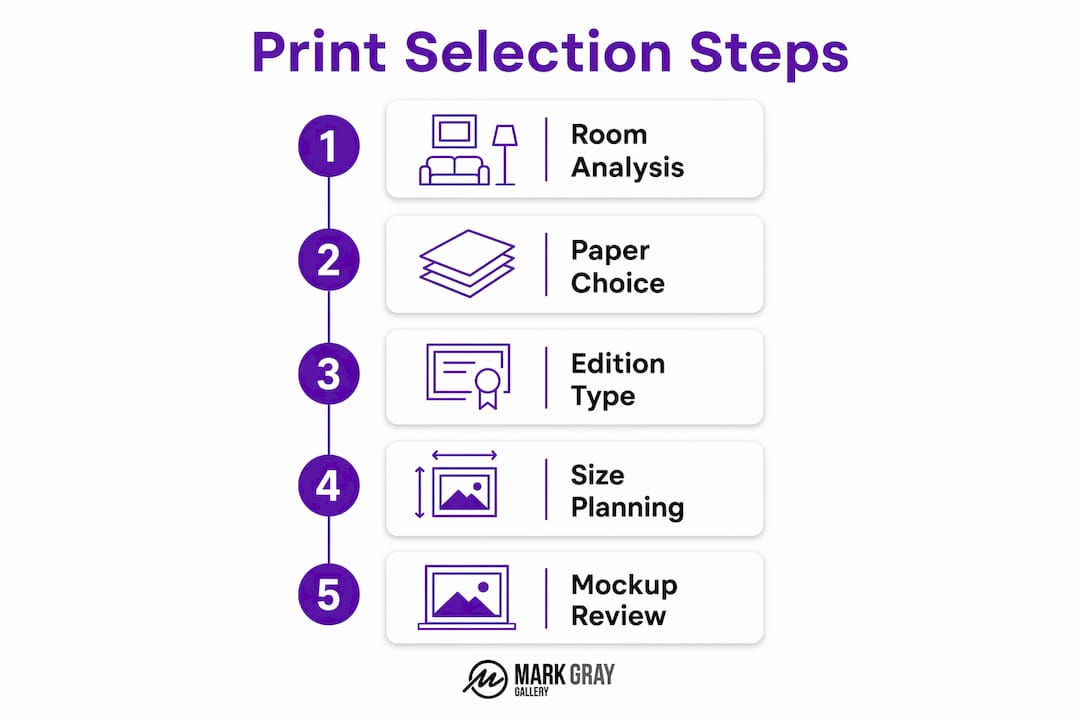
Start with the room, not the image. Viewing distance, wall scale, and intended mood should drive every decision that follows — paper type, edition, and framing are secondary refinements.
Paper and ink options:
| Paper Type | Surface Quality | Best For |
|---|---|---|
| Cotton rag giclée | Matte, fine texture | Tonal depth, monochrome, soft color |
| Baryta | Semi-gloss, film-like | High contrast, rich blacks |
| Metallic | High sheen, luminous | Vibrant color, backlit displays |
All archival-grade options should meet ISO 9706 standards for longevity. That standard matters because inferior papers yellow and fade within a decade under normal indoor light.
Edition types: Limited editions carry a numbered certificate of authenticity and a defined print run — once sold out, they are gone. That scarcity supports long-term value. Open editions offer more flexibility for buyers who want a specific image without the provenance premium. For collectors building a serious collection, limited editions are the stronger investment.
Size and viewing distance: A good sizing rule is that the print's longest dimension in inches should be approximately ten times the viewing distance in feet. For example, with an eight-foot viewing distance, a 40-inch-wide print works well. Horizontal compositions particularly benefit from generous width — a narrow print compresses the very element that makes the image work.
Pro Tip: Always request a scaled mockup of the print on your actual wall before ordering. Most gallery-quality printers can provide a digital room visualization. It takes five minutes and prevents expensive regret.
Cost and production timeline: Gallery-quality giclée prints vary in price based on paper type, edition status, size, and whether custom framing is included. Production for archival prints typically runs one to two weeks; add shipping time for larger framed pieces. Custom commissions require additional lead time for the shoot and editing process.
Before finalizing any order, request: a crop mockup at intended print size, a material sample if available, a framing mockup, and a certificate of authenticity for any limited edition. These are standard requests at any reputable gallery. Gallery-quality print examples can help you calibrate expectations before you buy.
How should you display and care for large landscape prints?
Position prints at eye level for the primary viewing distance — for most living spaces, that means the center of the print sits at a typical museum hang height from the floor.
Display best practices:
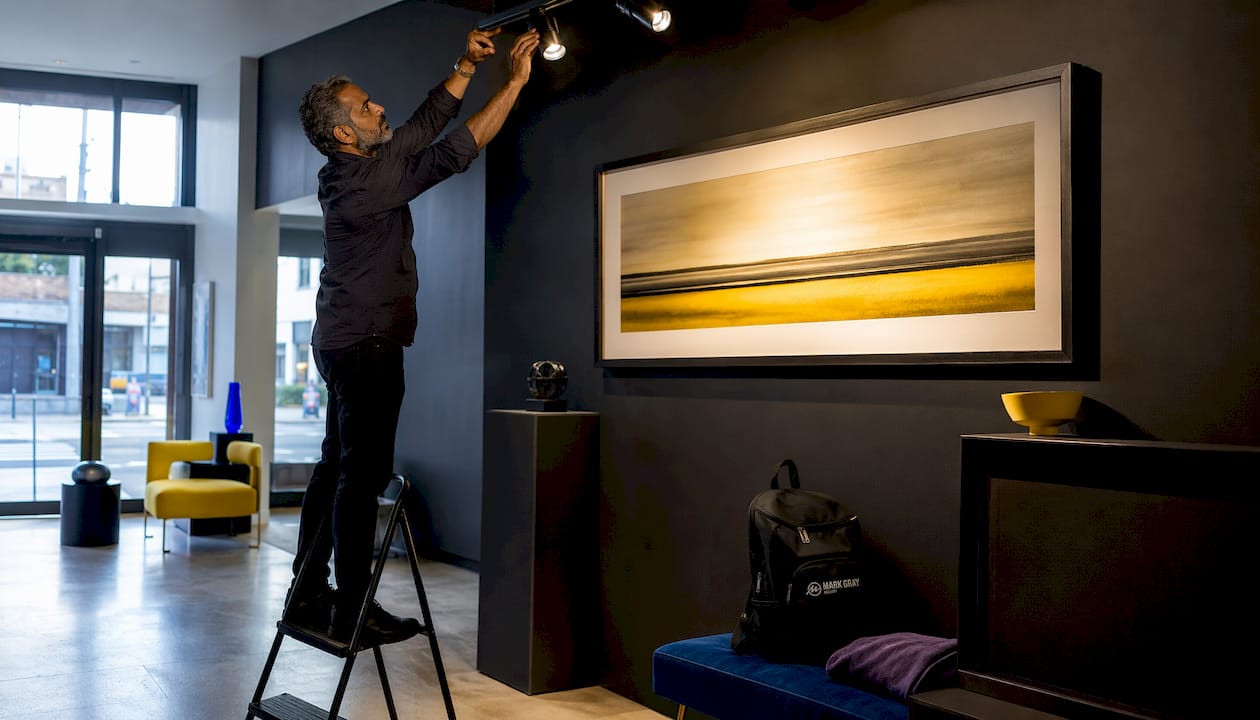
- Lighting: Use LED fixtures with UV-filtering lenses. UV exposure is the primary cause of color shift in archival prints. Avoid placing prints directly opposite windows with strong afternoon sun.
- Spacing and negative space: Horizontal compositions need breathing room. Allow at least four to six inches of wall space above and below the print so the horizontal framing reads without visual interference from adjacent objects.
- Multi-panel groupings: When hanging a series of horizontal-line prints together, align them on a shared horizontal axis rather than staggering heights. This reinforces the compositional theme and creates a gallery-wall effect that feels intentional.
Cleaning and maintenance: Dust framed prints with a dry microfiber cloth. Never apply liquid directly to the print surface unless the printer has specifically approved a cleaning product. For unframed prints, handle only by the edges.
Environmental controls: Ideal conditions for archival prints are 65–70°F and 30–50% relative humidity. Acid-free matting prevents chemical migration from the mat board to the print surface over time. If a print is displayed in a high-traffic area with strong ambient light, consider rotating it periodically to limit cumulative exposure.
Pro Tip: Avoid hanging prints on exterior walls in climates with significant temperature swings — condensation can form behind the frame and damage the paper over time.
Where to find and order horizontal-line landscape prints
Mark Gray Gallery carries a curated collection of gallery-quality horizontal-line landscape prints spanning seascapes, ridgelines, salt flats, and coastal scenes from Australia, New Zealand, Norway, Iceland, French Polynesia, Spain, and the United Kingdom.
How to browse and order:
- Search the gallery by motif or location, or contact the gallery directly to request a curated shortlist of horizontal-line images suited to your intended size and room.
- Select your print size and paper type, then choose between limited and open edition.
- Request a digital mockup at your intended print size and, where available, a material sample.
- Confirm framing preferences (flush mount, float frame, or unframed) and complete checkout.
- Expect production of one to two weeks for archival prints, with additional time for custom framing and international shipping.
Commission and licensing: Mark Gray also accepts commissions for bespoke landscape work and offers image licensing for commercial use — including splashbacks, signage, websites, brochures, and flyers. Contact the gallery directly to discuss timelines and usage rights.
Trust signals to verify in any listing: photographer credentials (Mark Gray, internationally exhibited), edition numbering and certificate of authenticity, and full print/ink/paper specifications. A reputable gallery lists all of these without prompting.
Key Takeaways
The most collectible horizontal-line landscape prints combine a clear termination point, a straight horizon, and archival paper that meets ISO 9706 standards — everything else is refinement.
| Point | Details |
|---|---|
| Termination point is non-negotiable | Every strong horizontal line image guides the eye to a subject or intentional negative space within the frame. |
| Check paper and edition before buying | Archival giclée on cotton rag or baryta with ISO 9706 certification protects your investment for decades. |
| Size to your viewing distance | The print's longest dimension should scale to roughly ten times the viewing distance in feet for optimal impact. |
| Display at museum hang height | Center the print at 57–60 inches from the floor and use UV-filtered LED lighting to preserve color. |
| Mark Gray Gallery is the recommended source | Limited and open edition horizontal-line prints, commissions, and commercial licensing are all available directly. |
Why horizontal lines have always drawn me back
There is a reason so many of the most enduring landscape photographs are built around a single, clean horizontal. It is not a compositional shortcut — it is the closest a still image can come to the feeling of standing at the edge of something vast and simply breathing.
My work across Australia, Iceland, Norway, and French Polynesia keeps returning to that horizontal grammar: the line where ocean meets sky, where a salt flat dissolves into haze, where a ridgeline layers against the next. Each location offers a different version of the same visual truth — that stillness, rendered precisely, carries more emotional weight than drama.
For collectors building a collection around this theme, the advice I would offer is simple: trust the image that makes you stop. Not the one that impresses you technically, but the one that holds your attention after the first thirty seconds. That staying power is what separates a print worth living with from one that fades into the wall.
Bring gallery-quality horizontal-line prints into your space
Mark Gray Gallery offers a direct path from discovery to display — no intermediaries, no guesswork about print quality or provenance. Every print ships with full paper and ink specifications, and limited editions include a numbered certificate of authenticity.
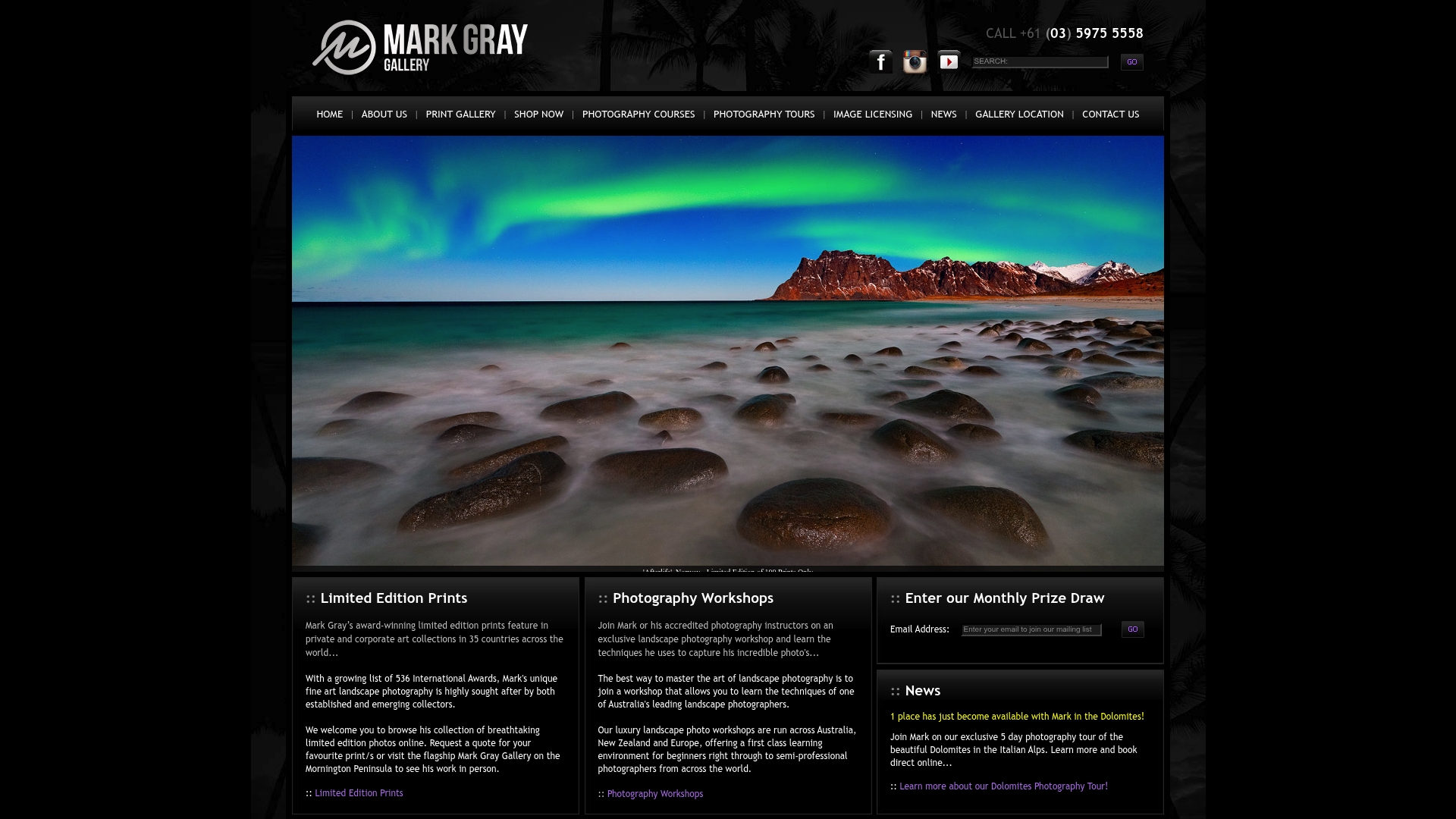
Whether you are looking for a single statement piece for a living room wall, building a curated collection of seascape and ridgeline prints, or need licensed imagery for a commercial project, the gallery covers all three. Photography workshops and multi-day landscape tours are also available for enthusiasts who want to learn the composition skills behind these images firsthand. Visit Mark Gray Gallery to browse the full collection, request a print mockup, or inquire about a commission.