
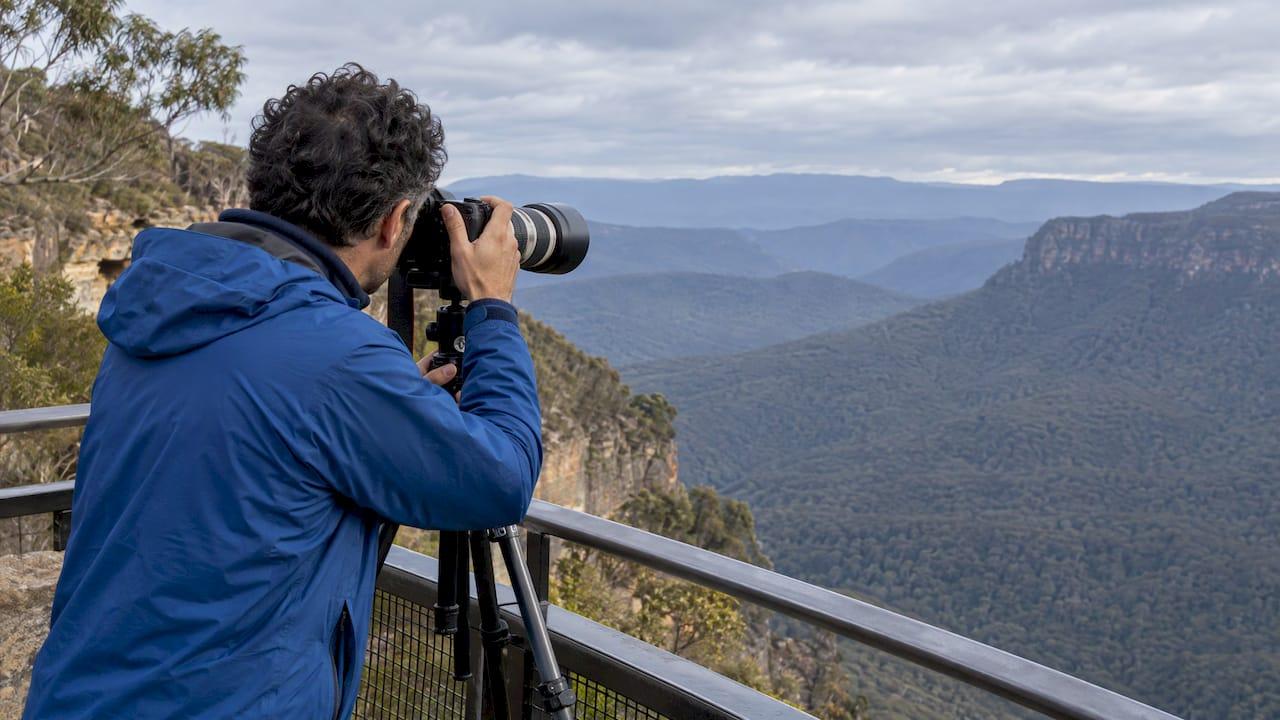
A long lens turns a sprawling landscape into a considered image. It lets you pick out one ridgeline, one lone tree or one band of light, and stack distant layers so they feel close. The craft lies in choosing your position, your focal length and your light, then keeping the result sharp. At Mark Gray Gallery and Photography Tours, our photography tours and courses are built around exactly this kind of decision making in the field.
TL;DR
- A telephoto lens isolates a section of the landscape and makes distant layers look stacked together. That is why it suits mountains, rolling hills, forests and mist.
- For most landscape work, a 70-200mm range on a full-frame camera is the sweet spot. Go to 300mm or beyond only when the scene demands it.
- Compression comes from your distance to the subject, not from the lens alone. Choose where you stand first, then the focal length that fills the frame.
- Long lenses magnify camera shake, focus error and haze. Use a sturdy tripod, magnified manual focus, f/8 to f/11 and clear, cool air.
- Shoot when there is real light on the land. Flat light makes telephoto frames look dull.
Table of Contents
- What a telephoto lens does for a landscape
- Compression explained: distance, not magic
- Which focal length for which scene
- Composition techniques that work with a long lens
- Light and atmosphere: the long lens exaggerates both
- Keeping long-lens landscapes sharp
- A field routine you can repeat
- Where wide and long work together
- Our perspective
- Learn it in the field, or see it on the wall
- FAQ
- Sources
What a telephoto lens does for a landscape
Most people reach for a wide-angle lens in the field because they want to fit everything in. A telephoto does the opposite, and that is its value. It narrows the field of view and compresses the apparent distance between layers, so distant mountains feel larger and closer to the foreground. This helps when a main feature looks too small at a wide angle.
Three practical gains follow:
- Isolation. You choose one part of the scene and leave out the clutter. One photographer quoted by Canon Europe puts it well: trying to get it all in never works, while isolating one tree against an immense mountain does.
- Simplification. Telephotos excel at simplifying scenes. Look for a strong, solitary element such as a lone tree and fill the frame with it, or pull out patterns, textures and abstract details.
- A different story. Australian Photography's Doug Gimesy argues that the real advantage is composing the background differently, not simply getting closer. A smaller field of view and added compression change what the image says.
A telephoto is not a backup lens for bad conditions. Photography Life's Alex Mody treats it as a tool as useful as a wide-angle, best used in ideal light.
Compression explained: distance, not magic
Compression is the look where far-apart elements seem to sit close together. Many photographers credit the lens itself, but the cause is more precise. Lee Morris explains at Fstoppers that distance from camera to subject creates compression, not the lens. Backing up with a telephoto makes subject and background appear closer together.
Australian Photography describes what happens when you step back and zoom in to keep the subject the same size. The field of view shrinks, hidden background elements are revealed, and the background appears closer than it is.
The practical rule is simple:
- Decide the relationship you want between foreground and background layers.
- Walk to the position that gives you that relationship.
- Pick the focal length that fills the frame from there.
If a scene feels flat at 70mm, a longer lens from the same spot only crops it. Move back, then zoom in.
Which focal length for which scene
There is no single answer, but there are useful ranges. Photo Review, an Australian publication, splits landscape telephotos into three groups, all expressed in full-frame terms:
| Type | Approximate range | Typical landscape use |
|---|---|---|
| Medium telephoto | 80-100mm | Gentle isolation, tighter framing of a vista |
| Telephoto | 100-300mm | Ridgelines, layered hills, single trees, light on distant features |
| Super-telephoto | 300mm and longer | Dense forest, undulating hills, far-off details |
For kit planning, B&H suggests a 70-200mm telephoto zoom for full-frame, 50-150mm for APS-C and 35-100mm for Micro Four Thirds, alongside a wide-angle zoom. Those crop-sensor figures give a similar field of view to 70-200mm on full-frame.
Nikon's Nicolas Jægergaard names 200-300mm as his favorite range. It gives strong separation between subject and background while keeping more of the scene than 600mm would. At 200mm, he finds, fog or light across layers of hills works especially well.
Match the lens to the land
Not every landscape suits a long lens. Amateur Photographer's Amy Davies notes that flat landscapes and coastal scenes with strong foreground interest are better served by wide angles. Rolling hills with overlapping forms and interlocking shapes look their best with telephotos.
Canon Australia's comparison makes the same point: telephotos are best when mountains, ridgelines or repeated layers need greater visual presence, while wide angles emphasize a nearby foreground.
In Australia, that points to familiar subjects: the folds of the Blue Mountains, ridgelines in the Flinders Ranges, vineyard rows in the Barossa, eucalyptus forest in morning mist, and sea stacks and lighthouses along the coast. For coastal work, Australian tour guidance says 70-200mm or longer is essential for isolating distant subjects such as offshore rock stacks.

Composition techniques that work with a long lens
Pre-visualize and scout
Jægergaard advises pre-visualizing compositions and scouting for subjects worth isolating. Long lenses reward patience. Scan the scene with the lens already on, rather than walking up with a wide angle and hoping.
Get up high or level with the subject
Elevation helps layers line up. With a 400mm lens, even small movements change the composition a lot, so being up high or level with the subject makes alignment easier. Shifting a few steps sideways can separate or merge two ridgelines.
Look for overlap and repetition
At 300mm, compression makes scenes more graphic and abstract, so overlapping elements are what bring depth back. Repeating forms, mountain layers and a peak glowing in light are all good candidates. Our guide to landscape photography composition gives a checklist you can run through before pressing the shutter.
Treat the lens like a brush
Photographer Toma Bonciu describes the lens above 105mm as behaving like a painter's brush, isolating a ridge, a patch of trees or a slice of sunlight. His 70-200mm f/4 also compresses distant landscapes to show scale, such as a tiny mountain hut dwarfed by cliffs.
Keep scale and layers deliberate
Canon Australia suggests building frames in layers: foreground interest, leading lines, and a person or recognizable object for scale. With a telephoto, a tiny figure on a distant dune or a hut on a hillside does the same job a foreground rock does at 16mm.
Use the frame edges
Nature TTL recommends keeping breathing space around the subject on an intersecting third for rural scenes. Tight crops tempt you to center everything, so check where your subject sits.
Light and atmosphere: the long lens exaggerates both
A telephoto magnifies the air between you and the subject. Amateur Photographer warns that atmospheric haze is exaggerated by telephoto magnification. Shooting on cool days and in the early morning helps reduce the heat haze, dust and pollution that rob contrast and clarity.
That makes timing part of the technique:
- Dawn and dusk. Low, directional light picks out ridge edges and separates layers. Our sunrise photography settings guide covers exposure for those first minutes.
- Light on the land. Photography Life reminds us that flat light makes telephoto images dull. Look for scenes with actual light falling on part of the landscape.
- Fog and cloud. Mist and dramatic distant cloud simplify messy scenes, and fog or light across layers of hills gives a telephoto exactly what it likes.
- Lens hood. Canon Europe notes that telephoto hoods are longer and block sun flare better, increasing micro-contrast. Keep it on.
Keeping long-lens landscapes sharp
The People Also Ask question is a fair one: why are my photos not sharp when I zoom in? Because every flaw is magnified along with the scene. PetaPixel identifies camera motion as the main cause of unsharp telephoto images.
Support and shutter speed
Use a sturdy tripod. PetaPixel advises handholding only at shutter speeds faster than 1/F, where F is the focal length in millimeters, so 1/300s at 300mm. Jægergaard's suggested minimums when working carefully are 1/200s at 180mm, 1/300s at 300mm and 1/600s at 600mm. Photo Review adds that longer lenses magnify camera shake, so judge blur risk by focal length and lens speed, especially in dim light where a wide maximum aperture helps.

Wind
In extreme wind, Photography Life suggests composing through the viewfinder, then standing with your body between the wind and the equipment. It also warns never to leave a tripod standing upright with gear mounted on a windy day. Nature TTL says that in blustery weather you can raise ISO for faster shutter speeds.
Focus
Long lenses expose every focusing error. Nature TTL recommends a tripod with Live View magnified focusing. PetaPixel calls manual focusing at 100% magnification the most reliable way to get sharp telephoto landscapes. Jægergaard uses Wide-area AF (S) when he wants precise control.
Aperture and depth of field
Avoid extremes. Jægergaard recommends f/6.3 to f/11, and Amateur Photographer suggests stopping down further for front-to-back sharpness, with a mid-range aperture such as f/8 for very distant scenes where depth of field is not an issue. PetaPixel points out that at 340mm on a Sony a7R IV, even at f/22 the depth of field including infinity starts half a mile away. That is why it recommends focus stacking at f/11 rather than f/22, which brings diffraction. Our guides to when to use focus stacking and hyperfocal distance explain how to decide when a scene needs either.
A field routine you can repeat
- Read the light. Arrive early, check where the sun will fall on the land and wait for it to reach your chosen layer.
- Walk first, zoom second. Pick your position for the layer relationship, then choose the focal length.
- Frame with intent. Place the subject on a third, leave breathing room and check for overlaps.
- Lock down. Tripod, hood on, stabilization off if your manual advises it for tripod use.
- Focus manually. Magnify the live view to 100% on the key detail.
- Set f/8 to f/11. Stack if the layers span a lot of depth.
- Check the histogram and zoom in on the playback. Look for haze, shake and a soft focal plane before you leave the spot.
Afterwards, a little contrast and clarity work can recover the punch that atmosphere takes away. See our overview of post processing in landscape photography for a sensible approach.
Where wide and long work together
The best portfolios use both. A wide angle gives context and a sense of place, and a telephoto gives intimacy. Radomir, quoted by Canon Europe, explains it neatly: with a wide-angle the background seems little and unimportant, whereas with a telephoto the elements are perceptibly pushed together. When you reach a great location, shoot the wide frame, then spend the rest of your time looking for the three or four tight frames hiding within it. Vladimir Medvedev goes further in the same feature: no amount of processing compensates for the lack of a long-focus lens.
Our overview of types of landscape photography techniques shows how these approaches fit alongside long exposure, panoramic and others.
Our perspective
We think the long lens is where landscape photographers learn to see. A wide angle forgives a lot, because the scene is so big that something will usually work. A telephoto asks you to decide what the picture is about, then remove everything else.
That discipline is behind the way we approach our own work. Our prints are made with panoramic medium format film and digital cameras for exceptional detail, and detail is exactly what a long-lens frame depends on. Sharp focus, clean light and a considered position matter far more than the number on the lens barrel.
It is also why we teach in small groups. Our workshops are led by Mark Gray and our team of professional photography instructors, with luxury arrangements, so you can spend your energy on light, layers and position. Standing beside someone as the light moves across a ridge, and working out together which focal length it wants, teaches more than a page of advice.
Try the routine above on a single scene this month. Shoot it wide, then shoot it at 200mm, and compare what each frame says.
Mark
Learn it in the field, or see it on the wall
If you would like to practice these techniques with expert guidance, our 1 Day Photography Courses run across Australia, and our multi-day photography tours take small groups to landscapes in Australia and around the world. They are led by Mark Gray and his team of professional instructors. For a closer look at what you will practice, read about the skills learned in landscape photography courses.
If you would rather see what refined landscape work looks like, explore our limited edition prints, collected in 35 countries. For lessons tailored to your own camera and kit, there are also private lessons.
FAQ
What are telephoto lenses used for in landscape photography?
They isolate parts of a scene, simplify busy views and compress distant layers so mountains, ridgelines and hills feel closer together. They also pull out patterns, textures and small areas of light that a wide angle would lose. They suit rolling hills, mountain ranges, forests and distant coastal features best.
Which focal length is best for landscapes with a telephoto?
A 70-200mm zoom on a full-frame camera is the most versatile starting point, according to B&H. Many photographers also favor 200-300mm for strong subject separation. Go longer than 300mm when you need to close in on dense forest or far-off details.
Does a telephoto lens really compress perspective?
Yes, in effect, though the cause is your distance from the subject rather than the lens alone. Stepping back and zooming in to keep the subject the same size makes the background look closer and larger. So choose your position first, then the focal length that frames the scene from there.
Why are my long-lens landscape photos not sharp?
The usual cause is camera shake, which longer focal lengths magnify. Use a sturdy tripod, a shutter speed at least as fast as 1/focal length if handholding, and magnified manual focus. Shoot around f/8 to f/11 and choose cool, clear air, because haze also softens distant detail.
Can I use a telephoto lens for every landscape?
Not for every one. Flat scenes and coastal views with strong foreground interest usually suit a wide angle better. Carry both and let the scene decide.
Sources
- Telephoto landscape photography: a fresh perspective (Amateur Photographer)
- How to Show Scale and Depth in Landscape Photography (Canon Australia)
- Landscape photography with telephoto lenses (Canon Europe)
- Opinion: Why a telephoto lens does more than just get you closer (Australian Photography)
- Using Telephoto Lenses for Landscape Photography (Photography Life)
- Lens Compression and Perspective Distortion Explained (Fstoppers)
- Best Lens Focal Lengths for Landscape Photography (B&H)
- Telephoto lenses for landscape photography (Photo Review)
- Using telephotos for landscapes (Nikon)
- Focal Length Secrets for Landscape Photography (Fstoppers)
- Why You Should Use a Telephoto Lens for Landscape Photos (Nature TTL)
- 13 Tips for Shooting Sharp Landscape Photos with a Telephoto Lens (PetaPixel)