
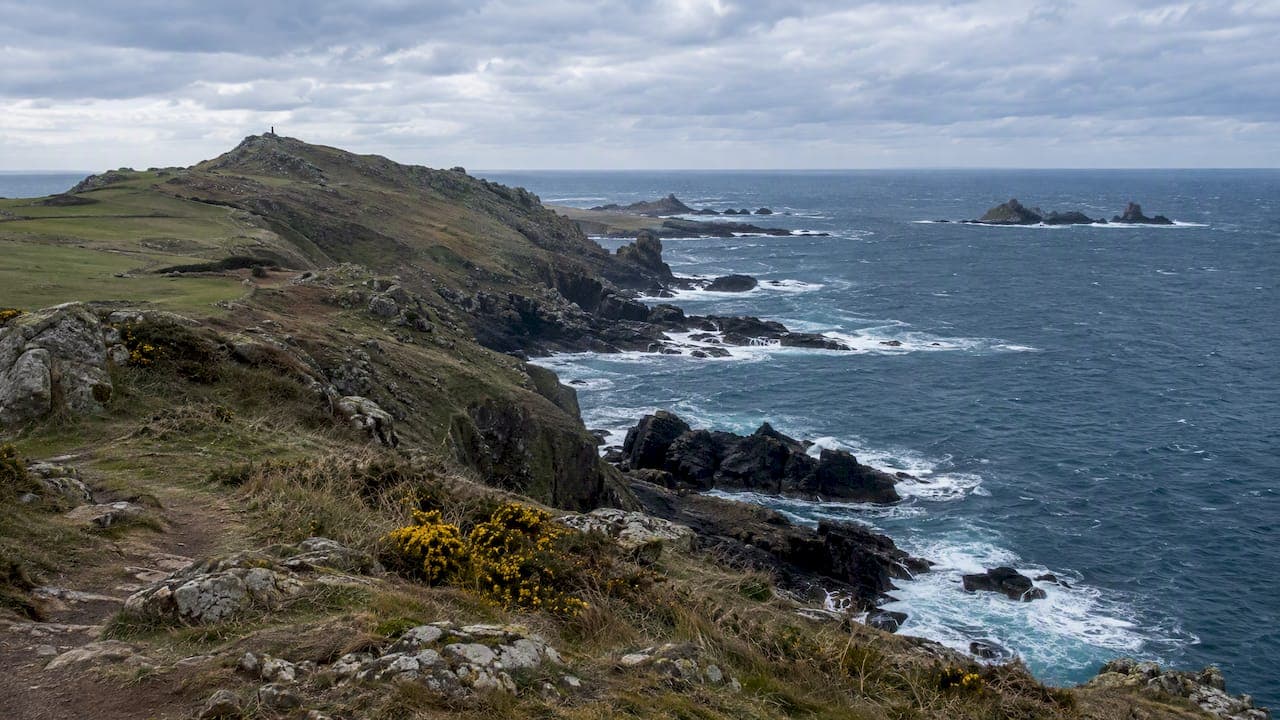
The best Cornish seascapes come from three things done well: choosing the right tide, being in position before the light, and never taking your eyes off the Atlantic. Pick a few locations rather than a dozen, scout them in daylight, and let the tide table decide your itinerary. This guide shows you how, from our Australian gallery's point of view as a team that lives by the same rules on the coast.
TL;DR
- Build each day around the tide and the light, not the location. Check tide times daily, because the sea can cut off beaches and caves quickly.
- Start with proven locations: Porthcurno, Cape Cornwall, St Michael's Mount, Kynance Cove and Wheal Coates at St Agnes.
- Arrive early. Visit Cornwall notes that the reward for a dark start is often an iconic spot to yourself for an hour or more.
- Never turn your back on the sea. On the north coast, unexpected waves can arrive even on a falling tide.
- In an emergency on the coast, dial 999 and ask for the Coastguard.
Table of Contents
- Why Cornwall rewards the patient photographer
- Safety first: tides, swell and signage
- Planning your tides
- Reading the light
- Where to shoot: five locations and what each does best
- Long exposures and storm light
- A sample two-day plan for west Cornwall
- Our perspective: what a coast teaches you
- Take the next step with Mark Gray
- FAQ
- Sources
Why Cornwall rewards the patient photographer
Cornwall offers cliffs, stacks, coves, lighthouses and tidal islands within a short drive of each other. The Royal Photographic Society's guide, Western Cornwall: a coastal photography guide, covers the stretch between Godrevy and the Lizard via Land's End, "from lighthouse to lighthouse". It is a useful reminder of how much variety fits into one compact piece of coast.
The difficulty is that the coast is demanding. Swell, tide and weather all change quickly. Professionals describe the shift from tourist to serious photographer as a matter of respect for the ocean's power. In that view, photographing this coast is less about a single frame than about understanding the rhythm of tides, swells and weather.
That is also how we think about seascapes in Australia. If you want the full technique side, our ocean seascape photography technique guide covers settings and approach in depth. This article focuses on what is specific to Cornwall.
Safety first: tides, swell and signage
For a seascape photographer, safety planning is part of the craft. Cornwall Council's beach safety guidance says visitors should check local tide times daily, because rapid changes can cut off access to beaches and caves. It also gives the emergency protocol: dial 999 and ask for the Coastguard. Lifeguard flags matter too. If there are no flags, there is no lifeguard service on that beach.
Do not rely on high and low times alone
A common mistake is to read only the high and low tide times and assume everything in between is equally safe. The Rule of Twelfths gives a better picture. Over a six-hour tide, the water moves roughly one twelfth of the range in the first hour, two in the second, three in the third and fourth, then two and one. A professional long-exposure guide notes that the third and fourth hours are when water moves fastest and the risk of being cut off is highest. The first and sixth hours are the safest windows for tricky spots such as sea caves or tidal islands.
In practice, this means:
- Work out when you need to leave a cove, not when you can arrive.
- Plan to be back on higher ground well before the fast middle hours of the incoming tide.
- Note an escape route in daylight and confirm it again before you set up in the dark.
Never turn your back on the sea
The Cornish coast is exposed to large Atlantic swells, and a beach is not safe just because it is sandy or reachable at low tide. The Royal Photographic Society guide stresses constant awareness: keep a clear, safe route back to higher ground. Visit Cornwall adds that on the north coast unexpected waves can crash even on a falling tide, so watch the wave behavior from a safe distance before you approach the water's edge.
If your plan depends on a big wave crashing over rocks, shoot it from higher ground with a longer lens. No frame is worth a soaking at best and a rescue at worst.
Respect closures and signs
Some popular spots are managed because of demand and fragile ground. The National Trust says the Kynance Cove car park often fills in summer and in September, and that if it is full you may need to park elsewhere and walk 30 to 40 minutes. The same page warns that the path to Pedn Vounder beach is closed because of erosion and instability. Do not use it, whatever you have seen on social media. For Porthcurno, read the National Trust's safety notes before you visit.
Planning your tides
For same-week planning, a free tide checker is enough. A site such as Cornwall Tide Times lists high and low water for beaches on both the north and south coasts, from Bude to Looe, with Penzance and Marazion handy for St Michael's Mount.
For trips booked months ahead, free web tools are limiting. The Royal Photographic Society guide notes that standard free checkers often give only about a week of data, so photographers planning longer ahead use paid services or annual paper tide tables. Our research also flagged apps such as Nautide (subscription) and Ayetide (one-off purchase) for specialist tidal planning.
If you want to understand how tide shapes a coastline photograph in general, our practical guide to tides and coastal photography walks through the ideas using Australian examples. The logic carries over to the English coast.
Reading the light
Visit Cornwall points out that the golden hour is an informal photographers' term, not an official one like dawn or dusk. It simply refers to the soft, colored light around sunrise and sunset. Many photographers fixate on the sunrise or sunset time itself, but the magic often happens either side of it.
Three habits make a difference:
- Look opposite the sun. The best light is frequently found opposite the sunrise or sunset, not only where the sun is. Turn around and check the sky and the rocks behind you.
- Scout in daylight. Foreground silhouettes, such as rocks, stacks and old engine houses, define your composition. Find them before the light arrives.
- Start early. Dark mornings are a commitment, but iconic and usually crowded locations can be completely yours for an hour or more.
The Met Office publishes daily sunrise and sunset times, and they swing a long way across the year. Summer sunrises come very early, so check the date before you set an alarm. For how weather turns a good coastline into a great picture, see our piece on how weather shapes landscape photography and the wider seasonal effects on landscape work.
Where to shoot: five locations and what each does best
Google's top results agree on a core list: Porthcurno, Cape Cornwall and St Michael's Mount are the names that come up first, with sunrise or sunset recommended for softer light. Here is how we would use them, with two more to round out the coast.
| Location | Coast | Best for | Main caution |
|---|---|---|---|
| Porthcurno | South-west | Turquoise water, cliffs, soft evening light | Follow National Trust beach safety guidance |
| Cape Cornwall | West | Headland views, sunset over the Atlantic | Exposed to wind and swell |
| St Michael's Mount | South | Tidal island, causeway, sunrise and sunset compositions | Causeway timing depends on the tide |
| Kynance Cove | The Lizard | Serpentine stacks, islands, caves, clear water | Car park fills up; keep clear of cut-off areas |
| Wheal Coates, St Agnes | North | Sunset silhouettes against the Atlantic | Cliff edges and wind |
Kynance Cove
The National Trust describes it as one of the world's most spectacular beaches, famous for serpentine stacks, islands, caves and turquoise sea. It rewards a low-tide visit with a wide-angle lens, but it is also where the Rule of Twelfths matters most. Arrive early, partly because of parking and partly because the light is gentler.

Wheal Coates and the north coast
Visit Cornwall singles out the north coast, and Wheal Coates at St Agnes in particular, for exceptional silhouettes at sunset against the Atlantic. The old mine building gives you a strong foreground, which is exactly the kind of element you should find in daylight before you shoot at dusk.

St Michael's Mount, Porthcurno and Cape Cornwall
These are the postcard locations, so the challenge is to make your image different. Work the tide: a low-tide causeway and a high-tide island are two different photographs. Move your viewpoint, wait for weather, and shoot with and against the light. For more composition prompts that suit any coastline, use our landscape photography composition checklist.
Long exposures and storm light
The most powerful long-exposure seascapes in Cornwall are not captured on calm summer days, according to that guide. Movement, cloud and drama make the picture. The safe way to work with that is to separate the dangerous part (the water) from your position (stable, high, with an exit).
A workable kit and routine:
- Sturdy tripod. Wind and wash will test a light one. Keep it low and braced, and wipe salt spray off after each session.
- Neutral density and polarizing filters. They let you slow the water to silk in softer light and cut glare on wet rock.
- Lens cloths. Spray reaches your front element sooner than you expect. Carry several dry cloths.
- Test exposures. Start with a few seconds for textured surge, then try longer for a misty look. Review the histogram, not only the screen.
- Bracket for contrast. Bright sky and dark rock can overwhelm a single frame, so shoot a bracketed series when the dynamic range is high.
Back at the computer, restraint pays off. Our overview of the role of post-processing in landscape photography explains how to finish an image without losing the character of the place.
A sample two-day plan for west Cornwall
Treat this as a template to adjust to your tide table, not a fixed timetable.
Day one: south-west. Scout Porthcurno and Cape Cornwall in daylight. Pick your sunset position at Cape Cornwall and check the tide for the beach below before you decide where to stand. Return for the evening light, then pack up in time to walk back safely.
Day two: the Lizard. Aim for a low-tide window at Kynance Cove and arrive early to secure parking. If the car park is full, accept the walk rather than parking where you should not. Shoot the stacks and caves in the first and last hours of the tide's movement, not the middle.
Spare evening: north coast. If the sky looks promising, head to Wheal Coates for a sunset silhouette. Stay behind the cliff edge and keep your tripod legs short in the wind.

Whatever you plan, the weather will sometimes overrule you. Leave a day free, and treat a gray, stormy morning as an opportunity rather than a loss.
Our perspective: what a coast teaches you
We work with landscapes that are as unforgiving as Cornwall's, and the lessons carry across. The photographs that last are rarely the ones taken in a rush at the famous viewpoint. They come from returning, from understanding how a place changes with the tide and season, and from being ready when the light turns.
That patience is the reason we shoot panoramic medium format film, where every frame is deliberate and the detail it holds is exceptional. It is also why our workshops run as small groups, so there is time to scout, wait and talk through a composition rather than chase a crowd. If you are heading to Cornwall, spend a full tide cycle at one location before moving on. You will learn more from one beach watched carefully than from five visited briefly.
— Mark
Take the next step with Mark Gray
Cornwall is a long way from Australia, but you can build the same skills closer to home. Our 1 day photography courses cover the fundamentals across Australia, and our photography tours take small groups to landscapes in Australia and around the world. If you prefer one-to-one guidance before an overseas trip, ask about private lessons.
If you would rather bring a coastline home, browse our limited edition prints, with landscapes from Australia, New Zealand, Norway, Iceland, French Polynesia, Spain and the United Kingdom. A gift certificate, from 50 AUD, is a simple way to share it with a fellow photographer.
For a closer look at another dramatic British landscape, read our Scotland Highlands photo locations guide, and for a home-grown coastal route, our Great Ocean Road photography guide.
FAQ
What is the best time of day to photograph Cornish seascapes?
Sunrise and sunset, plus the soft golden hour around them, give the most atmospheric light. Visit Cornwall notes that an early start can also mean having a normally busy location to yourself. Check the Met Office for daily sunrise and sunset times, because they vary widely through the year.
Which tide is best for seascape photography in Cornwall?
There is no single best tide, because it depends on the location and the picture you want. At St Michael's Mount, for example, a low tide shows the causeway and a high tide creates an island. For safety, the first and sixth hours of the tidal cycle are the calmest windows for tidal islands and sea caves, while the third and fourth hours move fastest.
Is it safe to photograph on Cornish beaches and cliffs?
It can be, with preparation. Check tide times every day, respect signs and closures such as the closed path to Pedn Vounder, and never turn your back on the sea. If someone is in trouble on the coast, dial 999 and ask for the Coastguard.
Do I need to book anything for Kynance Cove?
The National Trust says the car park often reaches capacity in summer and in September. If it is full, you may need to use alternative parking and walk 30 to 40 minutes, so allow extra time, especially for sunrise.
What gear should I take for seascapes in Cornwall?
Take a sturdy tripod, neutral density and polarizing filters, several lens cloths and weatherproof clothing. Add a reliable source of tide data, either a free tide checker for short-term planning or a paid tool or annual tide tables for longer trips.
Sources
- Beach safety, Cornwall Council
- Visiting Kynance Cove, National Trust
- Staying safe at Porthcurno beach, National Trust
- The Golden Hours, Visit Cornwall
- Western Cornwall: a coastal photography guide, Royal Photographic Society
- Mastering Long Exposure Seascapes on Cornwall's Treacherous Coast
- Cornwall Tide Times for Beaches