
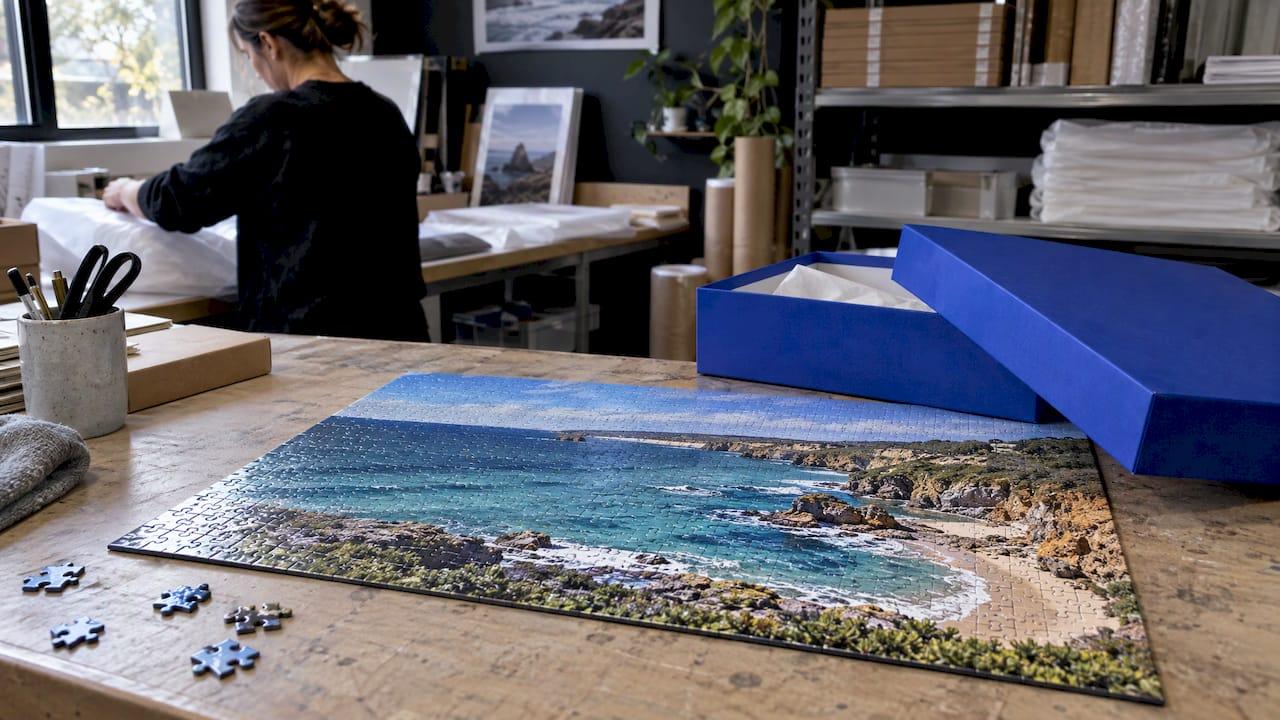
A photo puzzle makes a corporate gift that people keep, finish and often frame, which is more than most branded merchandise manages. The strongest version starts with a premium landscape photograph. It carries a place, a mood and a story that a logo alone cannot. Mark Gray Gallery includes jigsaw puzzles in its gift range, made from the work of award-winning Australian landscape photographer Mark Gray, and this guide sets out how to choose, plan and give them well.
TL;DR
- Pick a landscape image with strong structure and a clear point of interest. It rewards the hours spent assembling it and looks good on a wall afterward.
- Match the piece count to the recipient: a smaller count for broad client lists, a larger one for people you want to impress.
- Image quality decides the result. Work from a high-resolution original and keep key detail away from the edges.
- Plan quantities and delivery well before the gifting date, and keep a record of who received what and why.
- Gift certificates and framed prints sit naturally beside a puzzle when a gift needs to scale up for a key account.
Table of Contents
- Why a puzzle works as a business gift
- Choosing the right photograph
- Choosing a piece count
- Print quality and image resolution
- Image rights: use photography you are licensed to use
- Branding without spoiling the picture
- Planning quantities, budget and timing
- When a puzzle is not enough
- Our perspective
- Gifts from Mark Gray Gallery
- FAQ
- Sources
Why a puzzle works as a business gift
Most corporate gifts are consumed or forgotten within a week. A puzzle asks for an evening or a weekend, which is a long time to spend with your name on the box. It is also a gift that suits an unusually wide range of recipients: a senior client, a retiring colleague, a team that has just closed a big project, a supplier you want to thank at year's end.
Two things make the difference between a puzzle people enjoy and one that sits in a cupboard.
- The image. A puzzle is a long look at one photograph. A weak or generic image becomes dull by the second hour. A strong one reveals new detail the whole way through.
- The finish. Print sharpness, color and the quality of the box all signal how much you value the recipient.
A landscape suits both. Australian coastlines, deserts, ranges and light give recipients something they recognize, whether they live in Sydney, Perth or Hobart, and they say something about the place your business operates in without a word of copy.
Choosing the right photograph
Not every beautiful photo makes a good puzzle. Pretty skies and soft gradients are lovely on a wall, but a solid expanse of blue is miserable to assemble. When choosing, look for:
- Varied texture and color across the frame. Rock, foliage, water, cloud and shadow give pieces their identity.
- A clear focal point with supporting detail. The recipient needs somewhere to start and somewhere to keep returning to.
- Balanced areas of calm. Some quiet sky or water is welcome and gives the picture room to breathe, but too much frustrates.
- Meaning for the recipient. A coastal image for a client based on the coast, an outback scene for a mining or agriculture partner, a rainforest for an environmental organization.
If you want to understand what makes a landscape puzzle easier or harder, our guide to four factors that shape landscape puzzle difficulty explains how color range, contrast and pattern affect the experience. For inspiration on subjects, Australian natural landscapes to explore covers destinations whose scenery photographs well.
Matching the picture to the occasion
| Occasion | What the image should say | Example subject |
|---|---|---|
| Year-end client thank-you | Warmth, reflection, a sense of place | Coastline at sunrise |
| Welcoming a new key account | Confidence, a strong first impression | Dramatic range or gorge |
| Staff milestone or team win | Achievement, a summit or a clear horizon | Mountain light |
| International partner | Distinctly Australian | Iconic coastal or desert landscape |
Choosing a piece count
Piece count is a gifting decision as much as a practical one. A smaller puzzle can be finished in an evening and suits a broad list where you do not know the recipient's habits. A larger one is a serious commitment and suits people who already enjoy puzzles or whom you want to give something substantial.
Two points help when deciding:
- Know your recipient. If you are unsure whether someone enjoys puzzles at all, go smaller. A puzzle that is finished feels like a success. One that stalls half-built feels like homework.
- Think about display. A finished puzzle that is framed becomes a permanent piece of art on an office or home wall. Our guide to 1000 versus 2000 piece puzzles walks through the trade-offs in size, difficulty and finished dimensions, and how to frame a jigsaw puzzle and store it safely helps recipients keep the result.
It is worth saying in a note inside the gift that the puzzle can be framed. People often do not think of it, and the gift lasts for years when they do.
Print quality and image resolution
A puzzle magnifies flaws. A photograph that looks fine on screen can look soft when printed across a large finished surface and then cut into pieces. The test is the pixel count against the finished size.
When preparing any image for a large print, resolution is measured in DPI (dots per inch, the number of pixels used for each inch of printed output). Printers commonly work toward a higher target for close-viewing items and accept a lower one for items seen from a distance. A puzzle is handled up close, piece by piece, so it sits at the demanding end.
Some practical habits protect the result:
- Start from the original file, never a screenshot, a social media download or a website thumbnail.
- Calculate before you commit. Multiply the finished print size in inches by your target DPI to find the pixels required.
- Leave a margin. Keep the important content away from the edges, because trimming and the box edge take a little of the picture.
- Zoom in at 100 percent and look for softness, noise or compression artifacts.
Our photographer's checklist for photo puzzles covers the zoom test, cropping and DPI in more detail, and what DPI you need for large prints and banners explains the arithmetic behind it. If you want a wider sense of what separates a fine print from an average one, how to assess photography print quality is a useful standard to hold any supplier to.
The simplest route to good quality is to begin with imagery created for large-format reproduction. Mark Gray's prints are made with panoramic medium format film and digital cameras for exceptional detail, which is exactly the kind of source material a puzzle benefits from.
Image rights: use photography you are licensed to use
A corporate gift is a commercial use. That matters when the image is not yours. Photographs are protected by copyright from the moment they are made, so you cannot simply take a picture you found online and have it printed onto a puzzle for clients, even if it is only a handful of units.
There are two clean ways through:
- Buy a finished product made from a photographer's own work, where the rights are already sorted.
- License an image for a defined commercial use. Mark Gray's landscape photos can be licensed for stock use in splashbacks, signage, websites, brochures, flyers and more through our image licensing service. If your gift project involves your own branded material that features a landscape, that is the starting point.
If your own staff or a commissioned photographer shot the image, check what your agreement says about who owns the copyright and what you may do with it before you print.
Branding without spoiling the picture
The best corporate puzzles let the photograph do the work. A logo splashed across the image works against everything that makes the gift special. Consider quieter options:
- A personal note or card tucked inside the box, signed by the person who has the relationship.
- Branding on the outside only, such as a sleeve, a ribbon or a card, so the puzzle image stays pure.
- A short caption naming the place, which gives the recipient a story to tell.
- A framing tip printed on the card, so the puzzle has a second life.
This restraint is why a photograph-led gift feels like a mark of respect rather than advertising. Recipients keep and display things that look like art.
Planning quantities, budget and timing
Bulk gifting goes smoothly when it is planned backward from the date you want people to open the gift.
- Build the list early. Separate key clients, regular clients, staff and suppliers, since each tier may merit a different gift.
- Set tiers by value. A common approach is one gift for the top accounts and a simpler one for everyone else. A puzzle can anchor either tier depending on the size and presentation.
- Allow time for delivery. End-of-year gifting is when couriers are busiest. Order well ahead, and check postage costs for the destinations on your list.
- Order a few spares. A replacement for a late addition or a damaged box is easier to find from the same batch.
Postage is a real line in the budget. For the acrylic blocks in our gift range, postage and handling is published at $24.95 within Australia and $74.95 internationally, which is a useful reminder to price interstate and overseas recipients separately from the start. For puzzles and other items, confirm the figure with us when you order.
Keep the paperwork straight
Tax treatment depends on who receives the gift and what it is. As a general guide published by an Australian accounting practice, a gift to an employee is generally exempt from fringe benefits tax as a minor benefit if it is under $300 and it would be unreasonable to treat it as a fringe benefit, and the same source recommends recording who received each client gift and why. Your own accountant can confirm how this applies to your business and gifting program, so ask them before you finalize a large order.

When a puzzle is not enough
A puzzle can sit inside a larger gifting plan. Some businesses pair it with a framed print for a major client or a retiring leader. Others offer a gift certificate when they do not know a recipient's taste. Our gift certificates start from 50 AUD and let the recipient choose. Our acrylic blocks are $295 each and make a refined desk piece for a senior contact.

For a more substantial gesture, limited edition prints and open edition prints are available from Australia, New Zealand, Norway, Iceland, French Polynesia, Spain and the United Kingdom. Displaying such a piece well is its own subject, covered in displaying large format photography prints.
And for an experience rather than an object, our photography tours and one day photography courses suit teams and clients who enjoy photography and travel.
Our perspective
We have spent our careers standing in cold dawn light waiting for a landscape to reveal itself. A gift made from that work carries something a catalog item cannot: a real place, photographed with care.
That is why we believe a photo puzzle can be a thoughtful business gift. It asks the recipient to slow down and look closely, and every piece they place is a piece of the photograph. Our prints are collected in 35 countries and made with panoramic medium format film and digital cameras for exceptional detail, and we want a gift made from that work to hold up under that kind of close attention.
If you are choosing for clients, we would start with the story you want the image to tell, then work toward piece count and presentation. Get those right and the gift speaks for you long after the card is thrown away.
Mark
Gifts from Mark Gray Gallery
If you are planning a corporate gift, our gift range includes jigsaw puzzles, acrylic blocks and gift certificates, all drawn from Mark Gray's award-winning landscape photography. Browse the range and the gallery at Mark Gray Gallery and get in touch about the quantities and timing you need.
For a gift with the widest choice built in, a gift certificate lets the recipient pick for themselves.
FAQ
What piece count is best for a corporate puzzle gift?
Choose by recipient. A smaller count suits a broad client list because it can be finished in an evening or two. A larger count suits keen puzzlers and key accounts. Our comparison of 1000 and 2000 piece puzzles sets out the differences.
Can I put my company logo on the puzzle image?
You can, but most businesses get a better result by keeping the photograph clean and putting branding on a card, sleeve or note that accompanies the gift. Recipients tend to display a landscape and set aside a logo. Ask us about what is possible for your order.
Do I need permission to use a photograph on a puzzle?
Yes, if you did not take it or own the copyright. A photograph is protected from the moment it is made, so a commercial use needs the owner's permission. You can license Mark Gray's landscapes through our image licensing page.
How early should I order for the end of the year?
As early as you can. Courier networks are at their busiest in the weeks before Christmas, and interstate or international recipients need extra time. Build your recipient list first, then confirm quantities and delivery with us.
Are corporate gifts tax deductible?
It depends on the recipient and your circumstances. Gifts to employees may fall under the minor benefit exemption when they are under $300, and records of who received each client gift and why are good practice. Speak with your accountant before you place a large order.