
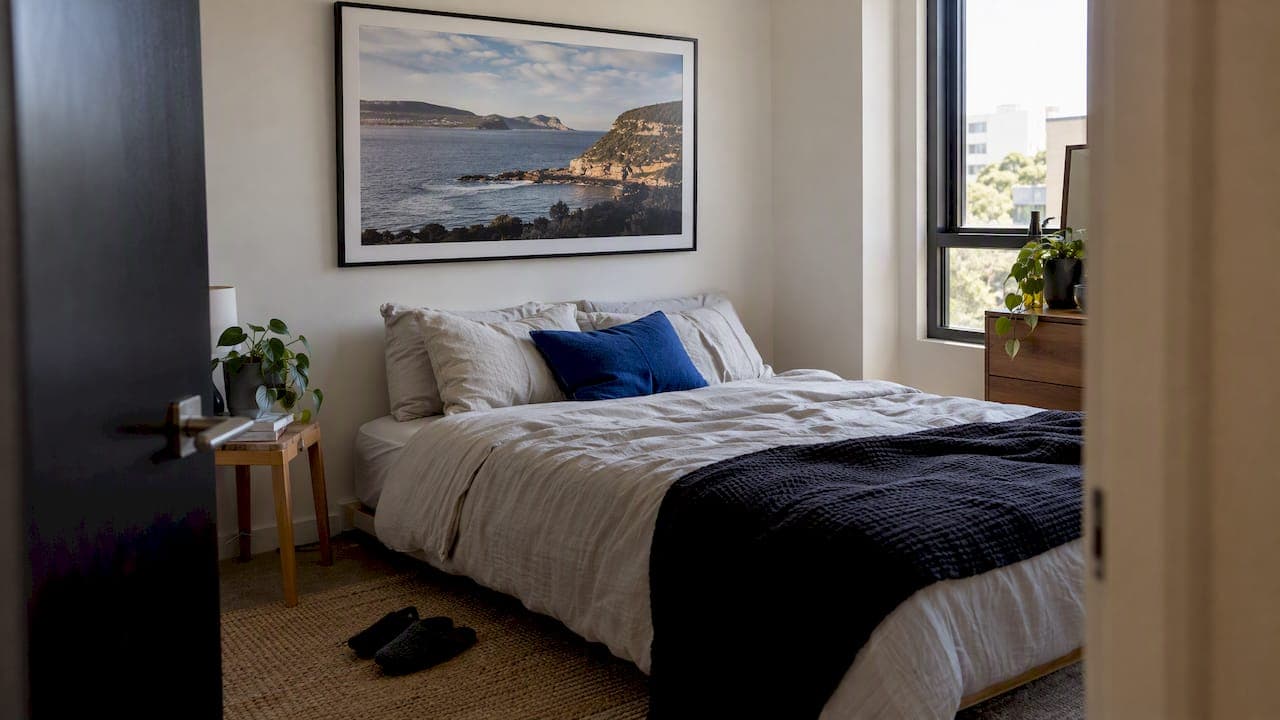
The best art for a small space is a few well-scaled pieces, hung at eye level, with generous empty wall around them. A compact room does not need tiny pictures. It needs art sized to the wall it hangs on, a clear focal point and calm surroundings, so the eye travels instead of stopping at clutter. Below you will find how to measure, what to choose, how to arrange it and where landscape photography fits, from a studio apartment to a narrow hallway.
TL;DR
- Size the art to the wall, not to the room's reputation for being small. Mark the dimensions on the wall with tape or paper first.
- One strong piece, or a tight group aligned on a shared line, usually looks calmer than many scattered frames.
- Hang at eye level, and over a sideboard keep the piece to about three-quarters of the furniture's width.
- Landscape photography with a long horizon or a deep view gives a compact room a sense of distance.
- Photograph the taped layout before you drill. It shows problems your eye misses.
Table of Contents
- Why small rooms need a different approach to art
- Measure first: the tape-and-photo method
- Choosing the right kind of art for a small wall
- Colour, mood and the feature wall
- Arranging several pieces: gallery walls that stay calm
- Where to hang: eye level, furniture and unexpected places
- Why landscape photography suits compact rooms
- Light, frames and finishing touches
- Art that is not on the wall
- Our perspective: fewer, better pieces
- Bring a landscape into your room
- Common mistakes to avoid
- FAQ
- Sources
Why small rooms need a different approach to art
In a large room, a poorly judged picture disappears. In a small one, it dominates. Walls are short, furniture sits close and every object competes for the same few square metres of sight line. That is why the same print can look generous in one home and cramped in another.
Scale is the first thing to get right. Designer Julia Green, speaking to Australian magazine Home Beautiful, says that scale is vital and artwork can look terrible if it is not aligned with the dimensions of the space. The practical lesson is to take your cues from the room itself before deciding how big the piece should be, rather than choosing a picture and hoping it fits.
Many Australian homes make this a daily question. Apartments, units, terraces and older cottages often have a single uninterrupted wall, perhaps above a sofa or a bed, and several doors, windows and built-ins that break up the rest. Your art plan starts by identifying which walls are truly available.
Measure first: the tape-and-photo method
Before you buy, measure the wall you have in mind, then measure the furniture beneath it. Next, cut paper or lay painter's tape to the exact dimensions of the artwork you are considering, including the frame and any mat.
The method Home Beautiful describes is simple: mark the desired artwork dimensions on the wall with tape or paper, then photograph the space and surrounding decor to judge the fit. The photo matters more than it sounds. A camera flattens the scene the way a viewer's eye does from the doorway, and it shows at once whether the shape is crowding a light switch, a curtain or a door frame.

Live with the tape for a day or two. Check it in morning and evening light, and from the places you actually sit. If the outline feels too heavy, reduce the size by a few centimetres and try again. If it feels timid, go up.
Our own wall art size guide goes deeper on proportions for homes and offices, including how to work out sizes for different walls.
A quick sizing checklist
- Measure the free wall width and height, not the whole wall.
- Note the furniture width under the artwork.
- Tape the outline, including the frame.
- Photograph it from the doorway and from the main seat.
- Adjust before you order or drill.
Choosing the right kind of art for a small wall
There are three broad routes, and each works when it is done with intent.
One statement piece
A single, well-sized picture gives a small room a focal point and a sense of order. It suits a living area where the sofa, side table and lamp already create visual activity. A simple composition reads better here than a busy one: a quiet horizon, a repeated shape, a single point of interest.
A small, tight group
Two, three or four smaller pieces can fill a wall that a single large print would overwhelm, or a narrow space such as a hallway or the wall beside a staircase. The group should behave like one object: similar frame weight, consistent spacing and a clear outer edge.
Miniatures and shelf displays
In tiny rooms, small framed pieces can rest on a shelf, a mantel or the back of a desk, leaning slightly against the wall. They add depth without using wall space and are easy to change with the seasons. A leaning piece works particularly well when the wall itself is already busy with a window or a door.
Colour, mood and the feature wall
Colour changes how a compact room feels. Pale, soft tones recede and reflect light. Deeper tones can make a room feel enclosed, but they can also give it richness when the art is chosen to match.
Home Beautiful notes that bold hues can pop more against a wall colour with depth, and a rich feature wall can complement a large-scale, dynamic abstract artwork. If you are considering a darker wall, take a look at these ideas for decorating with brown to see how deeper shades sit with furniture and accents.
For landscape photography the principle is the same. A coastline in cool blues and silvers sits calmly against pale walls and suits a bedroom. A glowing desert at dusk, with rich oranges and reds, can hold its own against a warmer or darker wall. In either case, choose a print whose dominant colour echoes something already in the room: a cushion, a rug, the timber of a table.
Keep the palette tight
In a small room, three or four main colours across walls, furniture and art feel settled. When a print introduces a fifth, it should do so deliberately, as the accent.
Arranging several pieces: gallery walls that stay calm
Gallery walls are popular in small homes because they put many pieces onto one wall. They also fail more often than any other layout, because the eye finds every inconsistency.
The approach Home Beautiful recommends is to plan the arrangement on the floor first and align the tops of the pieces along a shared horizon line, which creates a considered result. Lay out your frames on the floor, or cut paper templates and stick them to the wall with tape. Move them until the gaps look even.
Designer Harrison, quoted by The Spruce, points out that spacing, alignment and wall margins are often overlooked yet decide whether an arrangement feels balanced or "off". For small walls, that means:
- Keep the gap between frames consistent, and narrow enough that the group reads as one shape.
- Leave clear margin between the group and the ceiling, the corner and the furniture below.
- Combine different sizes only when one anchor piece leads and the others support it.
If you want to build a group with a coherent subject, our guide to curating a landscape photography wall gallery shows how to select and sequence prints so they read as a collection rather than a collage.
Where to hang: eye level, furniture and unexpected places
Height is the most common slip in small rooms. Interior stylist Kia Weatherspoon told The Spruce that art hung above eye level can disconnect people from the space, while pieces kept at eye level ground the room. In a small room, where you are always close to the wall, this matters even more. Standing a metre or two from a picture, you should not have to look up to read it.
Over furniture, use the furniture as your guide. Homes to Love advises that when you hang art above a sideboard or console, the picture should not be larger than the furniture, with about three-quarters of its width a good guide. This is the practical version of the so-called two-thirds rule, and it keeps the arrangement looking anchored rather than top-heavy.
A few places small-room owners overlook:
- Narrow walls beside doors. A slim vertical print draws the eye up and makes the ceiling feel higher.
- The wall behind a desk. If you work from a compact home office, art here sits in the video-call frame as well. For ideas on what to put behind a workspace, see these notes on panels behind a desk.
- Above the bed or sofa. A wide, low picture works best, kept a little narrower than the furniture.
- Shelf ledges and picture rails. Leaning lets you rotate pieces without making new holes, which suits renters.
For the mechanics, our walk-through on how to hang landscape photography prints correctly covers fixings, levelling and height.
Why landscape photography suits compact rooms
Landscape photography has an unusual advantage in a small space: it contains distance. A photograph of a long beach, a valley fading into mist or a mountain ridge gives the eye somewhere to go, and the wall appears to extend beyond its physical edge. That effect is strongest with prints that show a clear foreground, a middle ground and a horizon.
Some practical pointers when choosing a landscape print for a small room:
- Favour a clear horizon. Keep the horizon level and let the print's horizontal line echo the room's furniture lines.
- Pick a quiet focus. One strong subject, such as a tree, a jetty or a rock, is easier to live with at close range than a busy scene.
- Consider panoramic formats. A wide, shallow shape suits a space above a sofa or a bed, and avoids taking up the vertical height that small rooms lack.
- Think about the light in the image. Soft dawn or dusk tones tend to feel settled in bedrooms and living areas.
- Favour detail. At close viewing distances, fine detail is rewarded. Mark Gray's prints are made with panoramic medium format film and digital cameras to capture exceptional detail, which is what you want when the viewer is only a few steps from the wall.
If you are drawn to long, level compositions, our guide to pictures of horizontal lines explains how to buy and display them.
Light, frames and finishing touches
Light can make or unmake a small room's art. Natural light changes through the day, and one picture can look flat at noon and glowing at dusk. Avoid hanging prints where direct sun will hit them for hours. Our article on wall art lighting sets out how to angle and colour-match lights so the print reads accurately without glare.
Frames also do work in a small room. Slim, simple frames keep the focus on the image and do not eat into the wall. Heavy, ornate frames can feel bulky. Whatever you choose, use the same frame finish across a group. For prints you intend to keep, the gallery grade framing essentials explain the materials that protect an image over the years.
Mirrors and plants as partners
A mirror placed beside, not opposite, a landscape print bounces light around the room without doubling visual noise. A plant or a lamp near the artwork adds depth. Keep the surfaces below the art uncluttered so the picture has room to breathe.
Art that is not on the wall
Sometimes a wall is not available at all. A rental may forbid nails, or the room may be all windows and doors. In that case, art can still do its work in other forms.
Our acrylic blocks, for example, stand freely on a shelf, desk or console and bring a photograph into a room without any hanging. An acrylic block is $295 each. Postage and handling is $24.95 within Australia or $74.95 internationally. Our range also includes jigsaw puzzles, and gift certificates from A$50 if you are buying for someone else and want them to choose.

Our perspective: fewer, better pieces
We have seen what happens when someone falls in love with a photograph and then discovers it does not suit the wall. In small rooms, the lesson is the same every time: the room tells you what it can hold. Measure before you buy. Then choose an image you will not tire of, because in a compact space you will see it every day, from close range, for years.
We make our limited edition prints to be lived with. The detail that comes from panoramic medium format film and digital capture is not there to impress from across a gallery. It is there so that a person standing beside a hallway wall, or sitting at a kitchen table, still finds something new in the picture a year later. Our advice is to begin with one piece you love, give it the space it deserves, and let the room grow around it.
— Mark
Bring a landscape into your room
If you are ready to choose, browse our limited edition prints for collectable, award-winning landscape photography, collected in 35 countries. Prefer a more flexible way in? Our open edition prints cover Australian scenes, and our acrylic blocks suit shelves and desks where hanging is not an option.
Not sure which image or size is right? A gift certificate lets someone else choose the piece that fits their own wall, and you can start from our home page to see the full collection.
Common mistakes to avoid
- Buying before measuring. Always tape the outline first.
- Hanging too high. Keep pieces at eye level so they connect with the room.
- Oversizing above furniture. Stay near three-quarters of the furniture width.
- Mixing too many frame styles. In a small room, consistency reads as calm.
- Scattering pieces. Group them tightly, aligned to a common line.
- Ignoring light. Check how the wall looks at different times of day.
The same logic applies in commercial settings, where space is often limited too. If you are dressing a compact reception, our notes on reception wall art ideas show how to apply it at work.
FAQ
What size art works best in a small room?
It depends on the wall, not the room. Measure the free wall and the furniture beneath it, then tape the outline of the piece and photograph it. Over a sideboard or console, about three-quarters of the furniture's width is a good guide, according to Homes to Love.
How do I decorate a small wall space?
Choose either one well-sized focal piece or a tight group aligned on a shared line, and leave margin around it. Hang it at eye level and keep the area underneath tidy. Plan any arrangement on the floor first.
Can large art work in a small room?
Yes, when it is chosen deliberately. One large piece on a clear focal wall can feel more composed than many small frames, provided the surrounding decor stays simple. Tape the outline first to check the proportions.
Should small rooms have light or dark art?
Both can work. Light, soft images reflect brightness and feel open, while a rich image set against a deeper wall colour can add warmth and depth. Choose according to the mood you want and the colours already in the room.
Sources
- Gallery wall or solo hang? How to decorate with wall art, Home Beautiful
- The One Wall Art Mistake That Makes Your Home Feel Tiny, The Spruce
- How To Hang Artwork In 3 Simple Steps, Homes to Love