
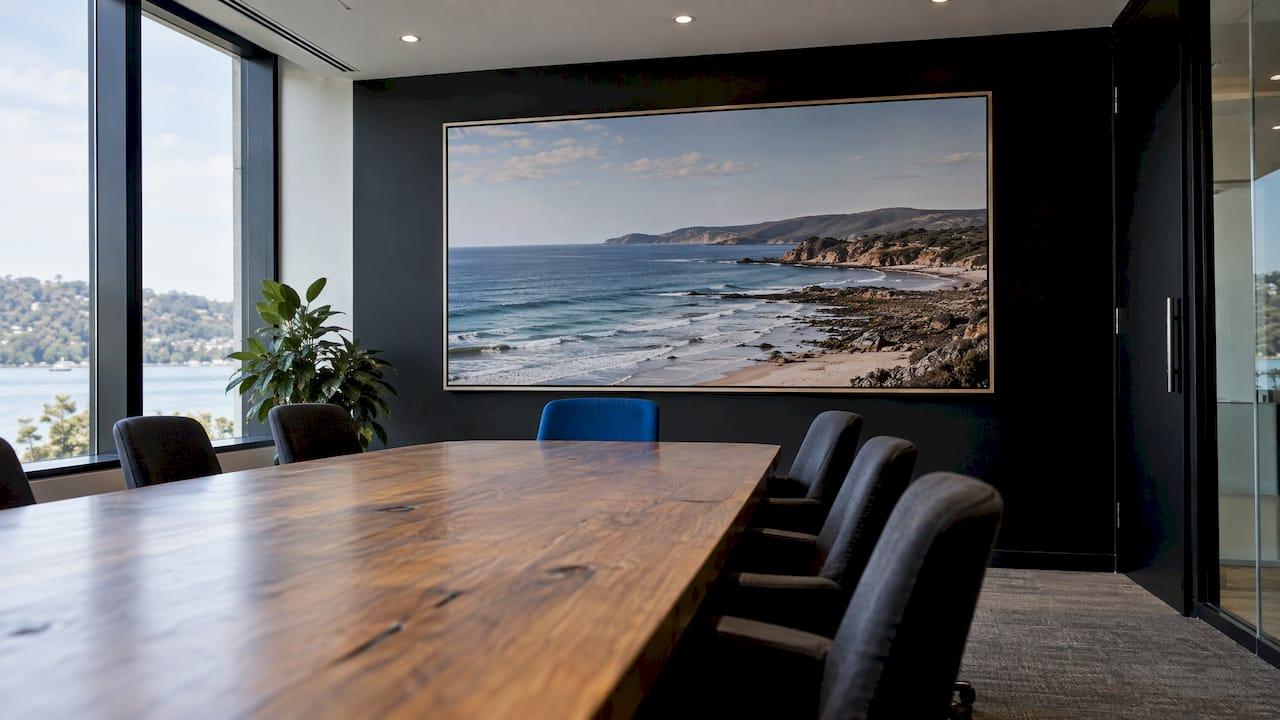
The best boardroom wall art is one large, calm landscape photograph on the wall everyone faces, sized to the room and printed at a quality that holds up when people look at it for an hour. A single confident image beats a crowded arrangement of small pieces, and it says more about your company than any motivational poster could. Here is how to choose the subject, the scale, the placement and the finish, with examples that suit Australian offices.
TL;DR
- Choose one dominant landscape or a tightly matched pair or triptych for the main wall, rather than many small frames.
- Hang it where every seat has a view: the wall opposite the entrance or behind the head of the table.
- Keep the palette restrained and let the image echo your brand colors, rather than matching the carpet.
- Specify anti-reflective glazing and UV protection, because boardrooms have glass walls, projectors and sun.
- Limited edition photographic prints give a boardroom a signature piece with a story, and the edition number adds provenance.
Table of Contents
- What a boardroom wall has to do
- Start with the feeling, then choose the picture
- Types of boardroom wall art that work
- Choosing by subject, color and style
- Size, number and placement
- Light, glare and protection
- Why a limited edition print suits a boardroom
- A boardroom suite, not just a boardroom
- Perspective
- Bring a Mark Gray photograph into your boardroom
- A simple checklist before you buy
- FAQ
- Sources
What a boardroom wall has to do
A boardroom is a working room with an audience. Clients, investors, candidates and your own directors sit there for long stretches, often with nothing to look at when a conversation pauses. The wall art does three jobs at once: it signals the standing of the company, it calms the room, and it gives people somewhere restful for their eyes.

One Australian framing business argues that art can breathe life into a sterile conference room and act as a natural icebreaker, prompting questions before a meeting begins and helping people settle. That fits what most of us have felt walking into a room with a striking image: the conversation starts a little more easily.
That is why the usual office wall art advice, built around cheerful posters and quote prints for home desks, does not transfer. A boardroom needs fewer, larger and quieter decisions.
Start with the feeling, then choose the picture
Melbourne interior designer Fiona Lynch is profiled as starting with atmosphere rather than products: deciding whether a space should feel calm, energizing, intimate or theatrical before choosing any pieces. It is a useful order of work for a boardroom too.
Ask three questions before you browse:
- What decisions are made here? A room for quarterly strategy and a room for client presentations want different moods. Strategy rooms benefit from calm and space. Client rooms can carry more drama.
- Who sits facing the wall? Whoever sits at the head of the table usually has their back to the best wall. Visitors and presenters face it. Choose for them.
- What do you want a visitor to remember? Stability, ambition, a connection to place, a long view. The subject should say it without words.
Types of boardroom wall art that work
Landscape photography
Landscape photography suits a boardroom because it is calm without being empty, it carries depth, and it has no fashion date stamped on it. A wide horizon gives the eye somewhere to travel. Mountains suggest endurance, coastlines suggest openness, and desert or salt-lake scenes suggest scale and clarity. Australian landscapes also tie a company to the country where it trades, which matters for firms that value local roots.
We cover the choices in more detail in our guide to office landscape wall art, including how to match subject to the work your business does.
Abstract and minimal art
Abstract work is safe for color matching, and a good piece can look sophisticated. The risk is that it can feel anonymous, a piece that could hang in any hotel corridor. If your company wants to show a point of view, an abstract rarely does it as directly as a place does.
Architectural and city images
Skylines and structural details suit finance, property, engineering and legal firms. Keep them uncluttered. A busy night skyline can look restless across a long table, and a clean dawn view tends to feel steadier.
Commissioned or bespoke pieces
A company with a strong tie to a region can commission imagery that belongs to it alone. Our article on commissioning landscape photography for corporate offices explains how that process works from the buyer's side.
Sculpture and objects
A considered sculpture can sit beside a wall piece, especially near reception or at the end of a corridor leading to the boardroom. If that idea appeals, this guide to choosing a calming sculpture for an entry area shows the principles of scale and mood that carry over to the approach to your meeting room.
What to avoid
Skip quote prints, cartoons, anything that dates quickly, and anything that could start an argument. Also avoid very busy images with many small points of interest: in a long meeting they become a distraction rather than a pleasure.
Choosing by subject, color and style
Subject
Match the subject to the message:
| Company character | Subject that suits | Why it works |
|---|---|---|
| Finance, law, advisory | Still water, dawn light, wide horizons | Reads as steady, clear-sighted and unhurried |
| Mining, resources, energy | Desert, rock formations, big skies | Scale and endurance, a link to the land |
| Property, construction | Coastlines, ridgelines, strong structure in nature | Foundations, growth, a view of what is possible |
| Tourism, hospitality | Beaches, reefs, mountain light | Direct reflection of the experience you sell |
| Health, education, community | Soft forest, gentle coastal light | Warmth, calm and care |
Color
Designer advice quoted in the same profile favors using fewer materials more deliberately, since a controlled palette creates greater coherence than a long list of finishes. In a boardroom that means picking one or two colors from the image to echo in the room: the blue of a coastline against a navy chair, or the warm ochre of a desert against timber. You do not need to match everything. You need the image to feel as if it belongs.
Cool images (blues, greens, grays) lower the temperature of a room and suit long, analytical meetings. Warm images (golds, reds, sunset tones) feel hospitable and suit client-facing rooms. A neutral, tonal image works in both.
Style
Photographic prints in a clean, thin frame suit modern offices. Classic timber frames suit traditional firms. The same framing source suggests sleek metallic or floating frames for modern offices and classic wood for traditional spaces. Keep the frame style the same across the whole floor so the boardroom feels part of one considered building.
Size, number and placement
One large piece or a set
In a boardroom, scale is where most mistakes happen. A small picture on a large wall looks timid. As a starting point, the artwork or group should fill roughly two thirds of the wall width available, centered on the space or on the furniture beneath it. Our wall art size guide gives the working in more detail.
For a long wall, consider:
- A single panoramic print. A wide format suits a long, low room and reads as a window to somewhere else.
- A triptych. Three matching panels with even gaps create rhythm and let you fill a wide wall without one oversized frame.
- A pair. Two equal prints on either side of a screen or door balance a wall that has to hold equipment.
Panoramic formats are well suited to boardroom walls because their proportions follow the shape of the room. Mark Gray's prints are made with panoramic medium format film and digital cameras, for exceptional detail that holds up when people are sitting a few meters away and have time to study the image.
Where to hang
Place the art where all participants can see it. Practical advice from one Australian source is to use the wall opposite the entrance or behind the head of the table, going bold in larger rooms and restrained in smaller ones.
If the room has a screen wall, put the art on the wall opposite it, so people have something beautiful to rest their eyes on when the slides change. If you use a video conferencing camera, check what sits in the camera frame: the wall behind the presenter is what remote participants see, and a calm landscape there looks far better than a blank wall.
Hanging height
The familiar gallery rule puts the center of a work around 145 cm from the floor, a guideline for comfortable standing eye level. A commercial hanging specialist in Sydney notes that the common 155 to 156 cm eye-level line is often too low in spaces with high ceilings. In a boardroom, people are mostly seated, so lean toward a slightly lower center than you would in a lobby, and above a credenza keep the bottom of the frame close enough that the two read as one group. Step back to seated eye level in the room and check before drilling.
In a small room, the rules change. Our guide to art for small spaces covers scale and light when the table nearly touches the wall.
Light, glare and protection
Boardrooms are often glass-fronted, west-facing or lit by downlights. All three cause trouble. Reflections across a framed print make it unreadable from half the seats, and sun fades inks and papers.
The same Sydney specialist recommends anti-reflective glazing with UV protection in high-traffic areas where sun damage and knocks are risks. Use it. Then position the piece so windows are beside it rather than opposite it, and aim downlights from an angle that does not bounce into the seated eye line. We explain what to look for in our articles on cutting glare in framed photographs and UV protection for prints.
Why a limited edition print suits a boardroom
A boardroom piece is also an asset. A limited edition print is made in a fixed number, so each one carries an edition number and its own record of ownership, which is why collectors and investors value them. For a company, that gives the wall a story you can tell a visitor: where the photograph was taken, who made it, and why you chose it.
Mark Gray's prints are award-winning and collected in 35 countries. The collection spans Australia, New Zealand, Norway, Iceland, French Polynesia, Spain and the United Kingdom, so a firm with international clients can choose a scene that reflects where it works. Where a budget is tighter, open edition prints from the Australian collection offer the same photography in a more flexible form.

A boardroom suite, not just a boardroom
The room is only part of the visitor's experience. Ideas that connect the whole route:
- Reception: use a related image so guests see a visual thread from the front door. See our ideas for reception wall art.
- Open-plan areas: keep a ratio so the art supports the space rather than competes with it. The 70/30 rule for open-plan office art is a good starting point.
- The table: an acrylic block makes a refined small piece for a side table, credenza or executive desk. Acrylic blocks are $295 each, with Australia-wide postage and handling of $24.95.
- Presentations and print: if you want the same imagery on signage, websites, brochures or flyers, Mark's photographs can be licensed for commercial use, so the boardroom image can match your brand material.
Perspective
When a company asks us what belongs on a boardroom wall, we begin with the people who will sit in front of it. A long meeting is a long time to look at one wall, and landscape photography rewards that attention in a way few subjects do. The detail is in the print: the light on a ridge, the texture of water, the way the horizon sits.
That is why we make our prints with panoramic medium format film and digital cameras, and why we offer them as limited editions. A boardroom image should be something you are proud to explain to a visitor, and a numbered, award-winning photograph from a place you can name is exactly that.
Choose one strong image, give it room, light it well and let it do its work.
Mark
Bring a Mark Gray photograph into your boardroom
If you have a wall in mind, our limited edition prints are the place to begin, with open edition prints of Australian scenes alongside them. You can also see the full collection and the story behind it on the Mark Gray Gallery site.
For a gift to a retiring director or a valued client, gift certificates let the recipient choose their own piece. If your team would enjoy making landscape images themselves, our photography tours and 1 day photography courses are led by Mark and his team of professional instructors, in small groups.
A simple checklist before you buy
- Measure the wall and the seated viewing distance, then pick a size that fills about two thirds of the available width.
- Choose a subject that matches the mood you want, not just the carpet.
- Decide on one or two colors to echo in the room.
- Choose a frame style consistent with the rest of the floor.
- Specify anti-reflective, UV-protective glazing.
- Check reflections from the window and downlights at seated height.
- Plan the thread through reception and open-plan areas.
FAQ
What is the best art for a boardroom?
A large landscape photograph is a strong choice. It is calm, timeless and gives the eye somewhere to rest during long meetings. Choose one dominant piece or a matched set rather than many small frames, and pick a subject that reflects your company's character.
How big should boardroom artwork be?
Aim for a piece or group that fills roughly two thirds of the wall width you are decorating. In larger rooms go bold, and in smaller rooms keep the piece restrained so it does not overwhelm. Check the proportion at seated height before you commit.
Where should art go in a conference room?
Place it where every participant can see it, typically on the wall opposite the entrance or behind the head of the table. If the room has a screen, hang the art on the opposite wall so it is in view between presentations.
Should boardroom art be framed with glass?
Yes, in most offices. Choose anti-reflective glazing with UV protection, particularly in rooms with strong sun or glass walls. It cuts glare for people at the table and protects the print from fading and knocks.
Sources
- Transform Your Conference Rooms with Engaging Framed Art
- Fiona Lynch: Interior Designer, Style and Projects
- Commercial Art and Picture Hanging Sydney
- How High to Hang Art: The 57-Inch Museum Rule Explained
- How to Choose a Calming Sculpture for Your Reception Area