
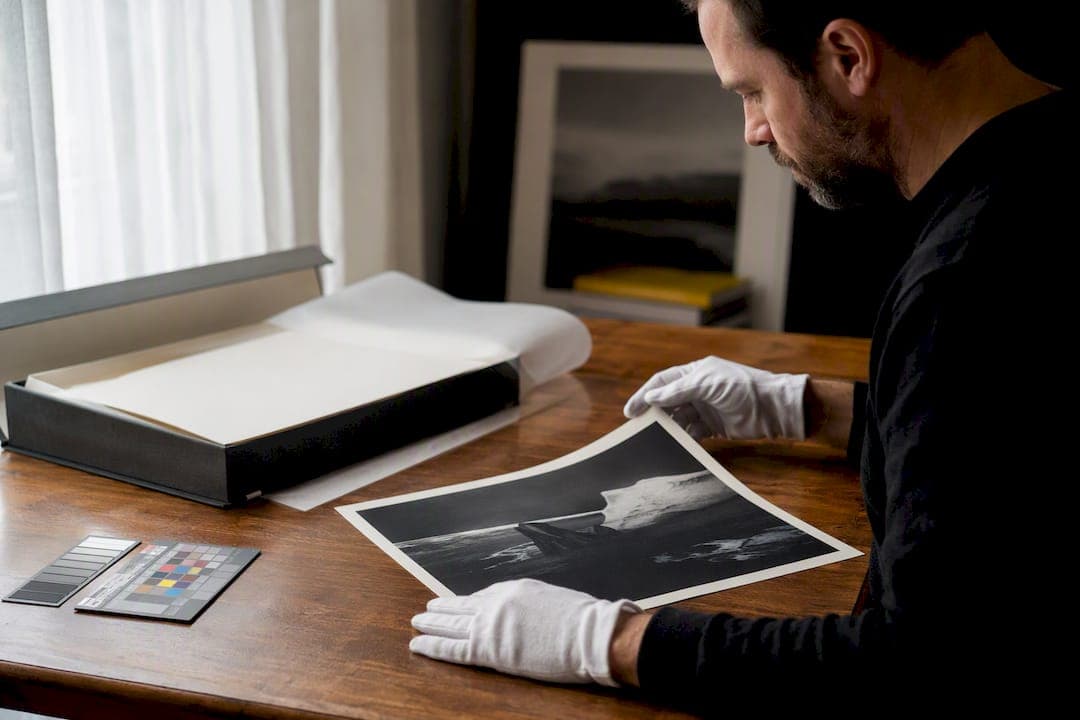
For collectors, large format photo printing means archival giclée prints produced on museum-grade substrates with verified provenance. Before you pay for anything, insist on pigment inks, a signed Certificate of Authenticity, and a pre-print proof. Anything less isn't gallery-grade, no matter how sharp the image looks on screen.
TL;DR:
- Verify that large format prints use pigment inks on archival substrates and include a signed Certificate of Authenticity before purchasing.
- Ensure resolution, viewing distance, and pixel count support the desired size without relying on software upscaling or interpolation.
- Inspect print details such as ink type, paper weight, ICC profiles, and proof quality to confirm museum-grade permanence and color accuracy.
- Limit editions to small runs or artist proofs with proper documentation and provenance to maintain long-term value.
- Choose framing, mounting, or finishing options based on display environment and substrate, considering UV protection and reversibility for longevity.
Table of Contents
- What Are the Common Formats for Large Format Photo Printing?
- How Big Can I Print a Photo Without Losing Quality?
- What Should You Inspect Before Approving a Large Print?
- How Do Editions and Certificates Protect a Print's Value?
- How Should You Frame and Care for a Large Photographic Print?
- What's the Checklist for Buying or Licensing a Gallery Print?
- What Finishing Options Exist Beyond Framing?
- An Editorial Take on What Collectors Get Wrong
- Why Collectors Choose Mark Gray Gallery for Large Format Photo Printing
- Sources
What Are the Common Formats for Large Format Photo Printing?
Giclée is the standard collectors should demand, and the word itself carries weight worth understanding. It refers to fine-art inkjet printing using pigment-based inks on archival substrates, a process built for permanence rather than speed. The term has been used loosely by some print shops in recent years, so verify the actual materials rather than trusting the label alone.
Substrate choice shapes both the look and the longevity of a piece. Fine-art rag paper gives a soft, matte texture favored for moody landscape work. Baryta paper adds a subtle sheen reminiscent of traditional darkroom prints, prized by collectors who want depth without gloss. Coated canvas suits large statement pieces where texture matters more than fine detail. Acrylic and Di-Bond mounts deliver a modern, frameless presentation with striking clarity and saturation.
Finish decisions interact directly with gallery lighting. A glossy or acrylic-faced print can throw reflections under spotlights, while matte fine-art paper handles ambient light more gracefully. Consider these starting points:
- Fine-art rag: best for intimate, textured landscape work under soft lighting
- Baryta: strong choice for high-contrast black-and-white or fine detail
- Canvas: forgiving under variable lighting, ideal for large statement walls
- Acrylic/Di-Bond: maximizes vibrancy and depth for feature pieces, but reflects harsher light
Acrylic mounting or museum glazing earns its cost on oversized pieces meant to anchor a room. Learn more about the difference between photographic and fine art paper before committing to a substrate.
How Big Can I Print a Photo Without Losing Quality?
Print size depends on resolution and viewing distance working together, not resolution alone. A print viewed inches from your face needs roughly 300 DPI to look crisp. A large piece hanging on a wall, viewed from six feet or more, can look flawless at 150 to 200 DPI, since the eye simply can't resolve that level of detail from a distance.
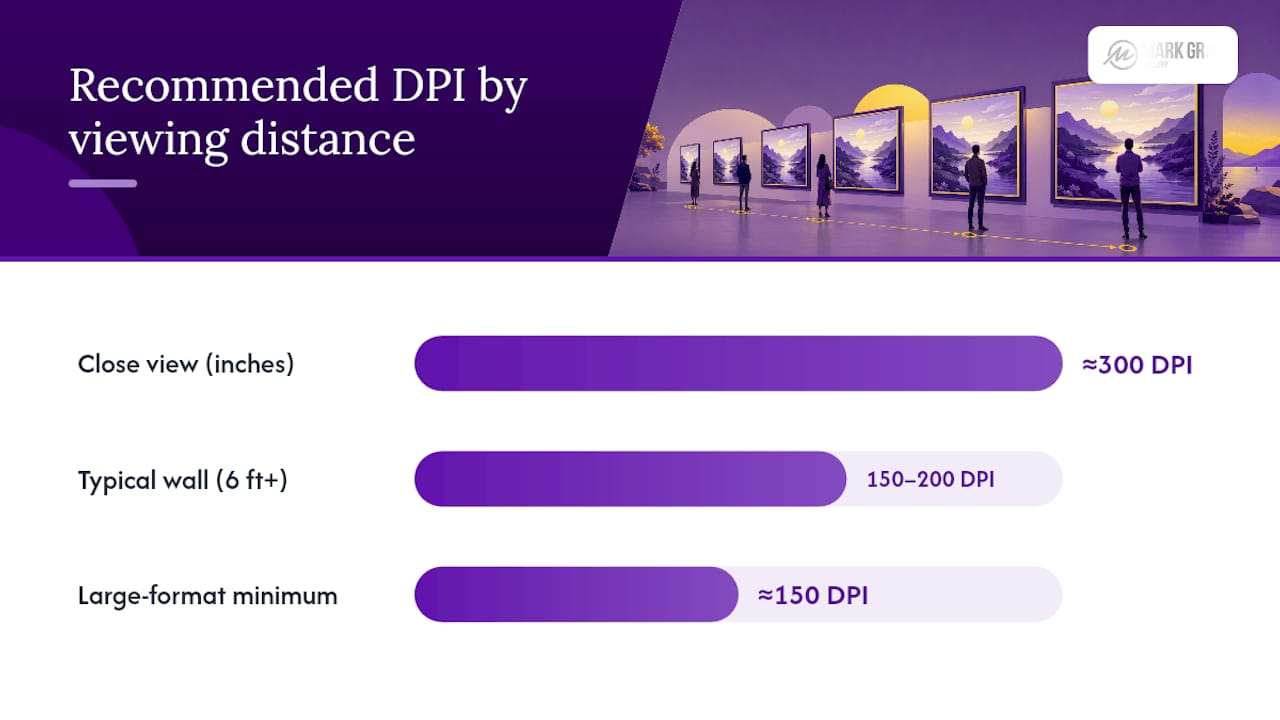
That distinction changes what's actually achievable from a given file. A 24-megapixel file, common in modern mirrorless and DSLR cameras, comfortably supports prints up to roughly 24x36 inches at 300 DPI, and considerably larger when viewed from typical wall distance. A 45 to 61-megapixel medium-format or high-resolution full-frame file opens the door to mural-scale prints without visible softness.
Stat check: the practical DPI range for large-format work runs from 150 to 300 DPI depending on viewing distance, which means megapixel count alone doesn't tell you the whole story.
A few practical rules before you commit to a size:
- Never rely on software upscaling as a substitute for a genuinely high-resolution source file
- Ask your printer whether denoising or interpolation was applied, and how
- Request a small hard-proof section before committing to a full mural-scale print
- For anything over 40 inches on the long edge, ask for an in-room mockup or scaled printout
If a lab hesitates to provide a proof on a large or expensive order, treat that as a warning sign.
What Should You Inspect Before Approving a Large Print?
The gap between consumer output and museum-grade production comes down to a handful of technical choices, and most of them are invisible until something fades or shifts color. Pigment inks resist UV degradation far better than dye-based inks, which is why archival giclée prints can last 100 to 200 years under proper display conditions, while dye prints can visibly shift within a decade.
Paper weight matters more than most buyers realize. Professional fine-art papers typically run 230 to 310 GSM, heavy enough to resist cockling under dense pigment loads, and usually acid-free or cotton-based to resist yellowing over time. Ask specifically about:
- Ink type: pigment-based, not dye-based
- Paper composition: acid-free, cotton rag, or alpha-cellulose base
- GSM weight: 230 or higher for large-format stability
- ICC profile availability for the specific paper and printer combination
Color accuracy depends on a properly color-managed workflow: calibrated monitors, custom ICC profiles for each paper stock, and a soft or hard proof before final output. Professional labs typically run wide-gamut printers with extra ink channels beyond standard CMYK to extend color range and consistency across an edition. Equipment like the Epson SureColor T5460 illustrates the kind of multi-channel, wide-format hardware serious labs rely on.
Pro Tip: Ask for a framing-ready proof and inspect it under the same lighting conditions where the piece will hang. Gallery spotlights and living-room lamps render color very differently, and a proof that looks perfect under one can look flat under the other.
How Do Editions and Certificates Protect a Print's Value?
A limited edition caps the total number of prints ever made, and that scarcity is what protects long-term value. Artist proofs, marked AP, sit outside the numbered edition and are typically reserved for the artist. Open editions have no cap, which keeps prices lower but removes any collectability premium tied to scarcity.
A properly documented Certificate of Authenticity should include the artist's signature, the edition number and total run size, the paper or substrate used, the print date, and the printer or lab responsible for production. Missing any of these should raise questions.
Provenance is what the National Gallery of Australia calls close to the currency of the art world, and it's a non-negotiable requirement for any purchase you'd consider an investment. That means invoices, exhibition history, and an unbroken chain of ownership from artist to you.
Watch for these red flags:
- No CoA, or a CoA missing the edition number and total run size
- Vague or unverifiable claims about "limited" availability
- No documented provenance trail on secondary-market pieces
- Reluctance to disclose the printer, paper, or ink type used
Understanding how edition sizes affect value before you buy prevents costly surprises later.
How Should You Frame and Care for a Large Photographic Print?
Framing and environment decide whether a large print holds its color and structure for decades or fades within a few years. The right choices depend on scale, substrate, and where the piece will live.
- Choose your frame style based on substrate: float frames suit paper prints with visible borders, tray frames complement canvas, and gallery wrap eliminates the need for a frame entirely on canvas pieces.
- Pick glazing carefully. Museum glass offers superior UV protection and near-invisible clarity but adds weight and cost; acrylic glazing is lighter and safer for oversized pieces but can scratch more easily.
- Keep prints away from direct sunlight and limit exposure to intense artificial lighting, since UV and heat both accelerate fading even with archival inks.
- Maintain stable humidity (around 40 to 55%) and temperature to prevent substrate warping or emulsion damage.
- Clean glazing only with a soft, lint-free cloth and manufacturer-approved solutions; inspect large pieces annually for shifts in mounting or frame integrity.
Pro Tip: For large acrylic-mounted pieces, confirm the mounting hardware is rated for the panel's weight. Acrylic adds significant heft, and undersized hanging systems are a common cause of damage during moves.
See the full collector's guide to caring for fine art prints for room-by-room placement advice.
What's the Checklist for Buying or Licensing a Gallery Print?
Buying with confidence comes down to asking the right questions in the right order, before money changes hands.
- Request full substrate and ink specifications in writing, including GSM and pigment ink confirmation
- Ask for a proof or sample section before approving a large or custom-size order
- Confirm the Certificate of Authenticity will include signature, edition number, paper, date, and printer
- Clarify packing, shipping method, and insurance coverage for transit
- Discuss framing options and whether the gallery coordinates installation
Production timelines for gallery-quality large prints typically run several weeks once a proof is approved, longer for custom sizes, heavy glazing, or complex framing. Costs rise with scale, acrylic mounting, museum glass, and any custom crating for shipping. Galleries often coordinate framing and installation directly rather than leaving buyers to source separate vendors.
Commercial licensing adds another layer entirely. Clarify the scope of use (web, print, signage), duration, territory, and whether resizing or reproduction is permitted under the fee. Mark Gray Gallery supports both paths: limited-edition collector prints with full documentation, and licensed image use for commercial applications, with bespoke framing support available on request. Reach out directly through Markgray for enquiries on either.
What Finishing Options Exist Beyond Framing?
Framing isn't the only way to finish a large photographic print, and some collectors prefer alternatives that change the surface character entirely. Lamination adds a protective layer that guards against scratches and moisture, though it can slightly alter color depth and is more common on commercial display pieces than fine-art editions. Varnishing, typically applied to canvas prints, adds a protective sheen or matte layer while enhancing color saturation, and it's often the final step before a canvas leaves the studio.
Mounting to rigid substrates like Di-Bond or gator board gives a print structural rigidity without a traditional frame, a popular choice for modern minimalist display. Face-mounting to acrylic, distinct from framing behind acrylic glazing, bonds the print directly to the acrylic surface for exceptional depth and vibrancy, a technique favored for feature pieces meant to be the focal point of a room.
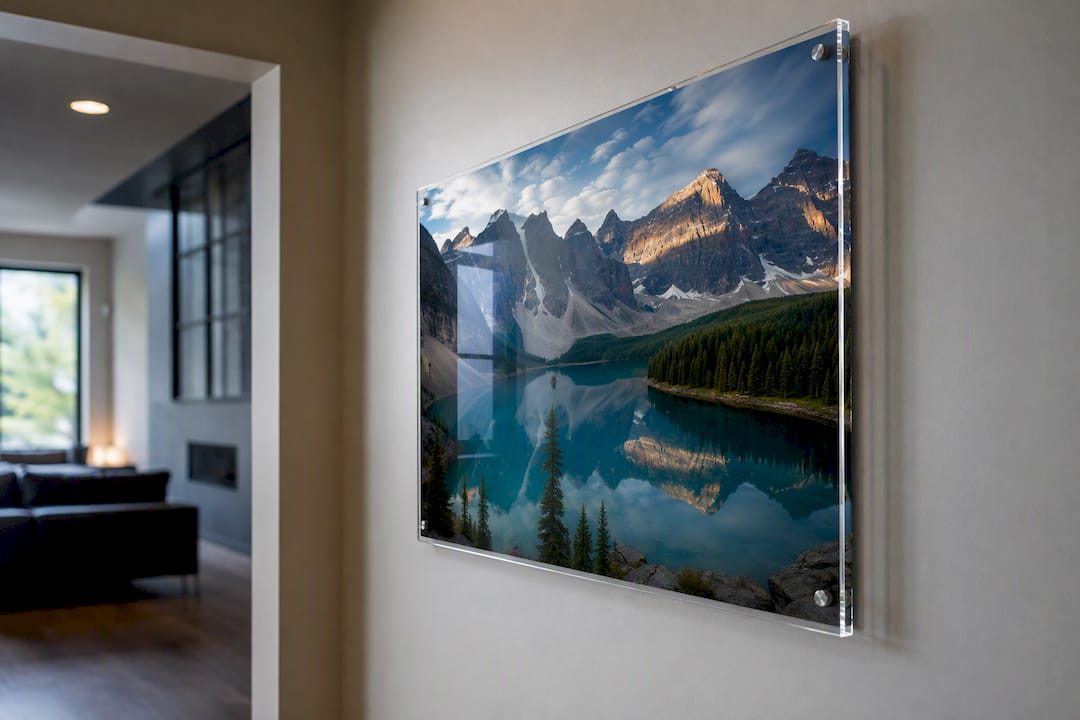
Each of these finishing choices carries trade-offs in cost, weight, and reversibility. Varnish and lamination are generally permanent once applied, while a properly framed print can be reframed or reglazed later without touching the print itself. For pieces intended as long-term collector holdings rather than short-term display, that reversibility often matters more than the initial visual upgrade. Explore panoramic framing options if you're weighing finishing choices for wide-format landscape work specifically.
An Editorial Take on What Collectors Get Wrong
Most buyers focus entirely on the image and treat the print process as an afterthought. That's backward. A stunning photograph on cheap dye-based paper will look worse in five years than a modest composition printed correctly on archival stock. The print IS the artwork, not a delivery mechanism for it.
The bigger blind spot is provenance. Collectors will interrogate paper weight and ink type for twenty minutes, then accept a print with no documented chain of ownership. That's a mistake serious buyers in any other asset class wouldn't make, and fine-art photography deserves the same scrutiny as any other collectible.
Passion for a piece shouldn't override due diligence. Ask for the proof. Read the Certificate of Authenticity line by line. Confirm the edition size before you fall in love with the image. If you're considering a custom size, unusual substrate, or a licensing arrangement, reach out directly. We're happy to walk through bespoke framing or commercial usage terms before you commit.
— Mark
Why Collectors Choose Mark Gray Gallery for Large Format Photo Printing
Mark Gray Gallery exists for exactly the reader who just finished this article: someone who wants archival-grade production without chasing down proofs, ICC profiles, and provenance paperwork from three separate vendors. Every limited-edition print comes with a signed Certificate of Authenticity, verified pigment inks on museum-grade substrates, and full production transparency, so the due diligence this guide describes is already built into the purchase.
Photography enthusiasts and commercial licensees get the same standard. Whether you're adding a landscape piece to a growing collection, sourcing a mural-scale print for a commercial space, or licensing an image for signage or brochure use, the gallery's catalogue of gallery-quality landscape prints shows exactly what finished large-format work looks like before you order. Browse available editions and framing options, or reach out about custom sizing and licensing terms, at Markgray.