
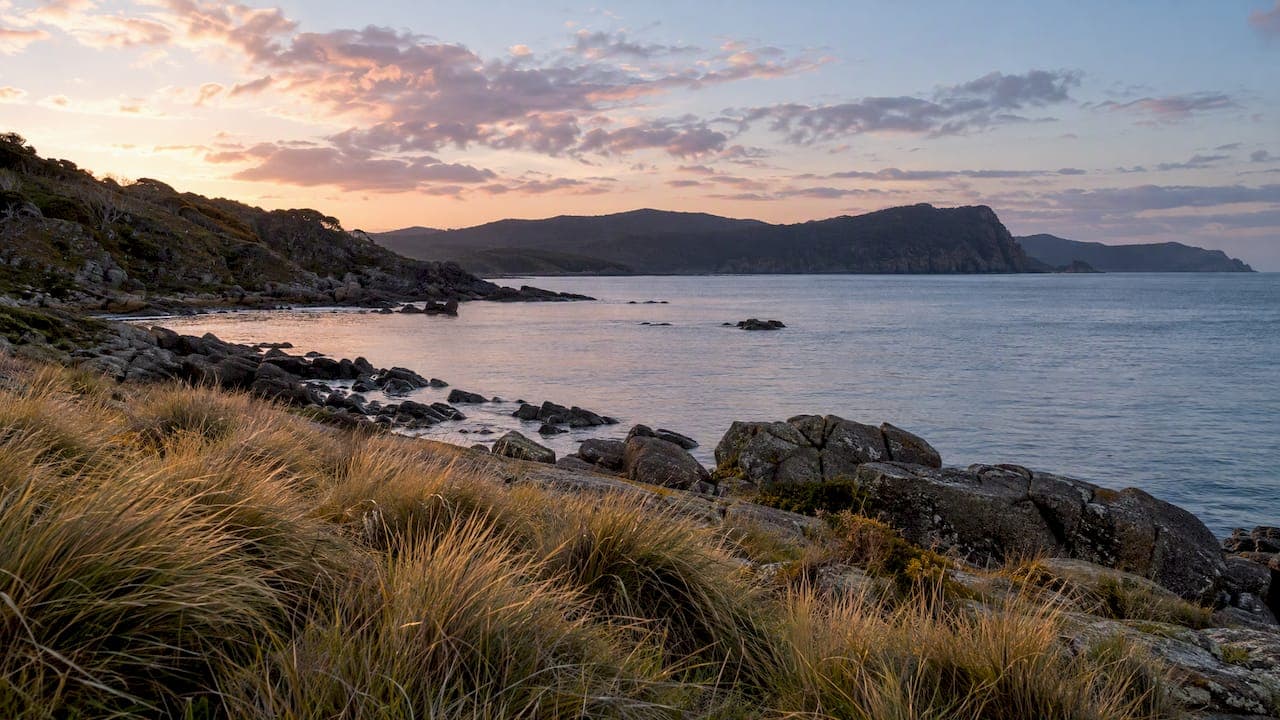
Neither is better in every case. Sunrise usually gives you cleaner air, calm water, mist and empty viewpoints. Sunset usually gives you warmer, redder color and an easier evening, because you can scout in daylight. The right choice depends on where the sun rises and sets relative to your subject, the season, and the weather. This guide shows you how to decide, and how to shoot each one well in Australian conditions.
TL;DR
- Sunrise tends to bring clearer air, calm conditions, mist and dew, and far fewer people at the lookout.
- Sunset tends to bring redder, hazier light and a gentler start: you arrive in daylight and watch the color build.
- Direction decides. Pick the session where the low sun lights your subject from the side or front, and remember that this changes with the season.
- Arrive early either way. Be on location at least half an hour before sunrise and stay at least half an hour after sunset.
- Plan for safety. Dawn and dusk are when wildlife is most active on Australian roads, and remote parks demand communication gear.
Table of Contents
- The real difference: what the light does
- Sunrise versus sunset at a glance
- Weather, mist and what the sky tells you
- Direction: the question most guides skip
- Crowds, effort and practicalities
- How to shoot each one
- Staying safe at dawn and dusk
- Our perspective
- Learn it in the field
- FAQ
- Sources
The real difference: what the light does
Both sessions give you low-angle sunlight, which is soft, warm and throws long shadows. That is why landscape photographers chase these hours: the shadows add dimension and interest to a composition, as Digital Camera World explains. What separates the two is what has happened to the air in between.
Morning air is usually cleaner. Photo Review notes that sunrise light is typically clearer, while daytime heating can stir up dust and moisture haze by evening. That haze is why sunset light is often redder. It scatters the blue end of the spectrum and leaves warm tones, which can look dramatic over a coastline or a desert range.
Evening air is more loaded. A day of heat, wind and human activity puts particles into the atmosphere. Those particles can give a sunset a glowing, saturated look. They can also soften distant detail. If your picture depends on crisp layers of ridgelines or a sharp horizon, the clean air of dawn is often your friend.
The useful window is short. According to Photo Review, the productive landscape period runs from roughly 15 to 30 minutes before sunrise until about an hour after it, and from 15 to 30 minutes before sunset until about 30 minutes after it. The morning window is the more generous of the two on paper. In practice, the best minutes can be few, so being ready matters more than the clock.

Color: warm pinks versus deep reds
Sunrise often delivers the first pink and red light of the day. Tasmanian landscape photographer Nick Monk, speaking to ABC News, points to that early color as the reason to get up. Sunset tends to run warmer and deeper because of the haze described above.
The period after the sun drops matters too. Western Australian photographer Pamela Jennings told ABC News that the blue-hour stretch after sunset can intensify red and blue sky colors, and that in tropical northern Australia it can be much shorter than the traditional blue hour. If you stay after the sun is gone, our blue hour photography guide covers how to make the most of that fading light.
Quality over a rule
Nick Monk's wider point is worth keeping in mind: the decisive factor is the quality of the light, not a rigid golden hour rule. Outside the golden hours, weather can still make good light. A storm clearing at midday can beat a flat, cloudless sunrise. For a deeper look at this idea, see our guide to light quality in landscape images.
Sunrise versus sunset at a glance
| Factor | Sunrise | Sunset |
|---|---|---|
| Air | Usually clearer, with less dust and haze | Often hazier, which can deepen red tones |
| Color | First pink and red light | Warm, often redder light, plus afterglow |
| Conditions | Often calm, with mist and dew on low ground and water | Light builds steadily, with more movement in the air |
| Crowds | Usually fewer people at popular spots | Busier, especially at famous lookouts |
| Planning | Navigate and set up in the dark | Arrive and scout in daylight |
| Weather signal | Red sky can hint at changing weather | Red sky can hint at settled weather |
| Effort | Early alarm, often cold | Easier day, but you may drive home in the dark |
Weather, mist and what the sky tells you
Sunrise has a unique advantage on water and in valleys. Calm air overnight can leave low mist and dew, which gives lakes, rivers and wet grass a quiet, layered look that evening rarely matches. Sunrise is also when you can catch dramatic fog events. ABC News reported on "cloud waterfalls" at Bluff Knoll in Western Australia, where fog flowed over cliff edges. They need a specific mix: clear nights, cool temperatures and little wind. The lesson is that you must be in the right place at the right time, and that is easier to arrange when you have checked the forecast.

Clouds decide most of the drama at either end of the day. The Bureau of Meteorology's Anna Forrest told ABC News that cloud or other particles that scatter light, such as high, thin ice cloud or an approaching cold front, help produce colorful sunrises and sunsets. A completely clear sky is often the least interesting option, and a heavy grey overcast blocks the color entirely. Broken cloud with gaps near the horizon is what you want.
Sunset has its own show. ABC News explained that crepuscular rays, the beams that appear to fan across the sky, are an optical effect caused by cloud partly blocking the sun, and they are frequently seen at sunset as light passes through more atmosphere.
Can the sky predict the weather?
The old proverb about red skies has some science behind it. According to ABC News, a red sunset often points to a high-pressure system approaching from the west, while a red sunrise can signal that clear weather is moving on and a low-pressure system is arriving. For a photographer, a vivid red dawn is a prompt to pack a rain cover. Our guide to how weather shapes your landscape photography goes further, and our lighting conditions guide helps you read the sky before you commit.
Direction: the question most guides skip
Here is the point that should decide your choice more often than any mood or color rule: which way is your subject facing?
The sun rises and sets in different places through the year. Nick Monk notes that a location with poor light in summer can be perfectly aligned in winter, and that smartphone apps can help you plan where the sun will appear. So before you ask whether sunrise or sunset is better, ask three things:
- Where does the sun come up and go down at this spot, on the day I am going? A planning app will show you the exact angle.
- Which side of my subject does that light hit? A cliff face that glows at dawn may be in shade at dusk.
- Do I want to shoot toward the sun or away from it? Photo-friendly light is not only found by pointing at the sun. As one forum photographer put it, light opposite the sun can be great when it lights the clouds, and side light shows more form.
A headland facing east is a sunrise subject. A west-facing beach is a sunset subject. A valley running north to south may work for either, depending on the season. Our piece on how seasons change landscape photography shows how much the same location can shift across the year.
In Australia the effect is easy to see on a calendar. The Bureau of Meteorology's guide to the equation of time shows that solar noon is not fixed: in Melbourne it falls around 12:04 AEST in early November and 12:34 in mid-February. Sun timing drifts through the year, so check the times for the exact date and place instead of relying on last season's habit.
Crowds, effort and practicalities
Sunrise is cold, early, and quiet. At the big lookouts, a dawn session is often far less busy than the evening one, and that gives you space to set up a tripod, try different compositions and take your time. Sunset is the social shift. It is easier on the body and easier to prepare for, but you may be sharing the view with a crowd.
Sunset also suits beginners. You arrive in daylight, see the terrain, choose your spot, and watch the light build. At sunrise, you walk in the dark and hope you picked the right place. If you are scouting somewhere new, visit at sunset first, then return the next morning with your composition already worked out.
Arrive earlier than you think
Photo Review's advice on photographing sunrise and sunset is simple: arrive at least half an hour before sunrise and stay at least half an hour after sunset, because the best conditions are unpredictable. Many of the most striking skies come after the sun has gone, and most people have packed up by then.
How to shoot each one
The technique is similar, but a few habits differ.
Exposure. The sky is far brighter than the land. Pamela Jennings recommends checking the histogram to balance the bright sky and darker ground, and she suggests a neutral-density filter, as reported by ABC News. Shoot RAW so you have latitude to recover highlights and shadows later.
Aperture and ISO. For landscapes, a mid-range aperture such as f/8 to f/11 gives good depth of field, and a low ISO keeps files clean. Use a tripod once the light fades, and let the shutter speed do the adjusting.
White balance. Auto white balance can neutralize the warm tones you came for. A daylight or shade setting keeps the oranges and yellows. If you shoot RAW, you can adjust it later, but a warm preset on the back of the camera gives you a more honest preview.
Composition. Look for water, clouds and landmarks to anchor the frame. Reflections in a calm bay at sunrise or in wet sand at sunset double the color. Keep the horizon level using your grid lines.
Keep shooting. Cloud and color are unpredictable. Jennings treats sunset as preparation plus persistence: scout the position, allow for tides and reflections, watch your exposure, and keep going. The best frame is often the one after you thought it was over.
Our golden hour landscapes guide and gear essentials list cover the kit and the settings in more depth, and our overview of landscape photography techniques helps you match approach to subject.
Staying safe at dawn and dusk
The best light often comes at the most hazardous times, so plan for it.
- Wildlife on the road. Animals are generally more active at dusk and dawn, so drive cautiously, as Queensland Parks advises. Allow extra time for the drive home after a sunset session.
- Communication. Mobile reception is often unreliable in remote country. The Kakadu visitor guide advises carrying communication equipment such as a personal locator beacon or satellite phone. Tell someone where you are going.
- Cliff edges. Stay well back, particularly in low light, and especially if you are walking out in the dark for a sunrise.
- Gorges and rain. In places like Karijini, flash floods can follow rain. Avoid gorges in wet conditions and leave immediately if it starts to rain.
- Opening hours. Some lookouts restrict access seasonally. The Kakadu guide lists summer opening for the Ubirr lookout as 2:00 pm until sunset from December to March, so check the park's current page before you plan a dawn visit.
If you are heading to the mountains west of Sydney, our Blue Mountains photography guide covers locations, light and planning. For road-based trips, see our scenic drives guide.
Our perspective
We have spent years photographing landscapes across Australia, New Zealand, Norway, Iceland, French Polynesia, Spain and the United Kingdom, and we do not pick a side in this debate. We pick a place, then let the light tell us when to be there.
What we do insist on is preparation. We work out the direction of the sun before we leave, we arrive early, and we stay late. The pictures people remember are rarely the ones taken at the predicted peak; they come from the extra twenty minutes when the cloud lit up behind us or the mist lifted off the water.
If you are new to this, start with sunset to learn a location, then return at dawn for the cleaner air and the quiet. If you already know your spot, trust the sun's position over any rule of thumb. And accept that some mornings and evenings will give you nothing. That is part of the craft, and it is why a great image feels earned.
— Mark
Learn it in the field
Reading about light is useful. Standing on a headland at 5 am with someone who can explain what is happening in the sky is faster. Our small-group landscape photography workshops and tours are led by Mark Gray and his team of professional photography instructors, with luxury arrangements, across Australia and worldwide.
If you would like a taste first, our 1 day photography courses run across Australia, and our multi-day photography tours take you to the locations at the right time of year. Prefer one-to-one? Ask about private lessons. And if you want to see what dawn and dusk light looks like on the wall, browse our limited edition prints. Check each page for current dates and pricing.
FAQ
Is sunrise or sunset better for landscape photography?
Neither wins every time. Sunrise often offers clearer air, mist and fewer people, while sunset often offers redder light and easier preparation. Choose based on which direction the light falls on your subject and what the weather is doing.
What time should I arrive for a sunrise or sunset shoot?
Arrive at least half an hour before sunrise and stay at least half an hour after sunset. Photo Review recommends this because the best conditions are unpredictable. Use a planning app or the Bureau of Meteorology's data to get the exact times for your date and place.
Why are sunsets often redder than sunrises?
Daytime heat can lift dust and moisture into the air, and that haze scatters light so that warm tones dominate in the evening. Morning air is usually cleaner, so sunrise light is often clearer and less intensely red.
Does a red sky really predict the weather?
To an extent. ABC News reports that red sunsets often point to high pressure approaching from the west, while red sunrises can signal that clear weather is giving way to a low-pressure system. Treat it as a hint and check the forecast.
How do I know where the sun will rise or set?
The position changes through the year, so use a photography planning app on your phone to see the exact direction for your date. A spot that is poorly lit in summer may be ideal in winter.
Sources
- Reading the light for nature photos, Photo Review
- Photographing Sunrise and Sunset, Photo Review
- Why do we have better light earlier and later in the day, Digital Camera World
- Tasmanian landscape photographer Nick Monk on capturing light, ABC News
- How to take the perfect sunset photo, ABC News
- Cloud waterfalls at Bluff Knoll, ABC News
- Crepuscular rays and sunsets, ABC News
- The science behind red skies, ABC News
- The Equation of Time, Bureau of Meteorology
- Visiting safely, White Mountains National Park, Queensland Parks
- Kakadu National Park Visitor Guide
- Karijini National Park, Parks and Wildlife WA