
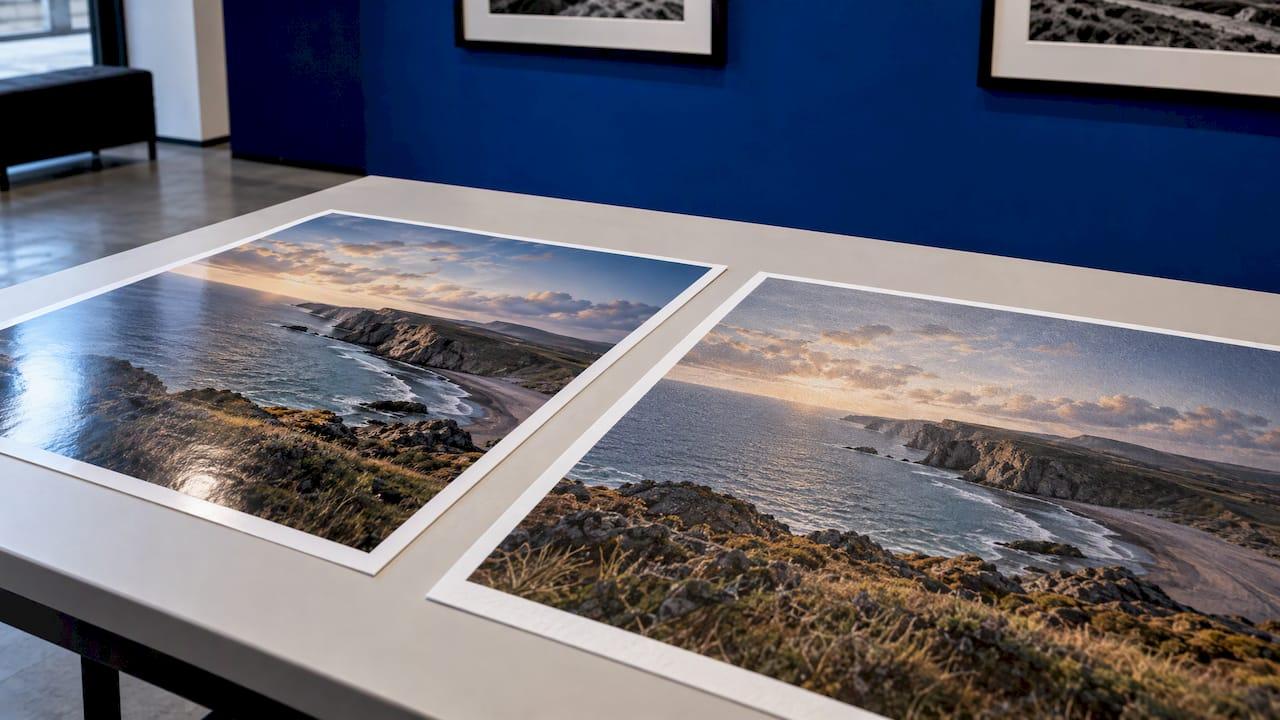
A giclée print is made by a wide-format inkjet printer that sprays pigment inks onto fine art paper. A traditional photographic print, often called a C-type, is made by exposing light-sensitive paper and developing it chemically. The two are different processes, but the labels overlap, and the word "giclée" on its own tells you very little about quality. What matters is the ink, the paper and how the print is made and displayed.
This guide explains both processes in plain terms, shows where they overlap, and gives you a checklist for reading any print description, whether you are buying a landscape for your living room or building a collection.
TL;DR
- Giclée is a fine art inkjet process. It sprays ink in tiny dots onto paper. A photographic (C-type) print is exposed to light and chemically developed.
- "Giclée" has no legal or technical standard, so the word alone does not guarantee pigment inks or archival paper.
- "Archival pigment print" describes the materials and longevity, and is the more informative phrase. A giclée print can be archival, but only if the paper and framing are too.
- Giclée offers a wide choice of papers and finishes. C-type has its own distinctive, continuous-tone look.
- Giclée describes the printing method. It says nothing about edition size, which is a separate question.
Table of Contents
- What a giclée print actually is
- What a photographic print is
- Giclée vs photographic print side by side
- Can a photographic print also be giclée?
- Archival pigment print and archival giclée
- Color, detail and paper: what shapes the look
- How long each type lasts
- How to read a print listing
- Perspective
- Framing and display
- Bring a landscape home
- FAQ
- Sources
What a giclée print actually is
Giclée (pronounced zhee-CLAY) describes digital prints intended as fine art and produced on inkjet printers. According to the reference entry on the term, it comes from the French word gicleur, meaning a nozzle, and was coined in 1991 for fine art prints made on a modified Iris printer. Today it is widely used for high-quality inkjet fine art printing generally. That answers the common question about the meaning of the word: it is simply a more elegant name for a fine art inkjet print.
In practice, a good giclée print usually involves four things:
- A high-resolution file, prepared from a sharp original capture.
- A wide-format printer with many ink channels, not an office machine.
- Pigment-based inks, which sit on or in the paper as fine particles of color.
- A quality paper, often acid-free cotton rag or a museum-grade photographic base.
The operative word is "usually". Nobody regulates the term. A seller can describe almost any inkjet output as giclée, which is why the details behind the label matter more than the label itself.
What a photographic print is
A photographic print, in the darkroom sense, is made by exposing light-sensitive paper. The paper carries layers of silver halide crystals. Light hits it, usually from an enlarger or a digital exposure unit, and the paper is then developed and fixed in chemistry. This is why it is called a wet process. Digital C-type printing is the modern version: a digital file is exposed onto the paper by lasers or LEDs, and the paper still goes through chemical development.

The result has a continuous tone, meaning there are no individual dots of ink. Many photographers love the way a lustre or glossy C-type handles deep shadows and subtle gradients in skies. The paper choices are narrower than with inkjet, mostly gloss, lustre and matte surfaces, but those surfaces are consistent and familiar.
People also use "photographic print" loosely for anything printed on glossy photo paper, including the cheap prints from a retail kiosk. That is one reason the term can mean very different things at different price points.
Giclée vs photographic print side by side
| Feature | Giclée (fine art inkjet) | Photographic (C-type) |
|---|---|---|
| How the image forms | Ink sprayed onto paper in microscopic dots | Light-sensitive paper exposed and chemically developed |
| Process type | Dry | Wet |
| Typical inks or chemistry | Pigment inks (when done to fine art standard) | Silver halide layers and dyes in the paper |
| Paper range | Very wide: lustre, textured fine art papers, cotton rag, silk, mulberry, even metal | Mainly gloss, lustre and matte photographic papers |
| Look | Rich color, wide choice of surface texture | Continuous tone, familiar photographic finish |
| Standard behind the name | None. The term is not regulated | Established, though quality still varies by lab |
| Best for | Fine art presentation, tactile papers, large-format work | A classic photographic look |
Neither column is automatically the winner. Each is a legitimate way to produce a beautiful print, and a skilled printer working in either process will beat a careless one working in the other.
Can a photographic print also be giclée?
This is where the confusion starts. If you take a photograph and print it on a fine art inkjet printer, you have a photographic image on a giclée print. Many photographers describe the result as a fine art photographic print, and they are not wrong: it is a photograph, printed with inkjet technology. "Photographic print" can mean either the process (silver halide) or the subject (a photograph), and sellers use it both ways.
So the useful question is never "giclée or photographic?" but "how exactly was it printed?". A listing that says only "photographic print" does not tell you whether the paper is exposed and developed or sprayed with ink. A listing that says only "giclée" does not tell you which ink or paper. The more precise the description, the more confident you can be in what you are buying.
Archival pigment print and archival giclée
People searching for these phrases are usually asking the same thing: is this the same as giclée? Almost, but they describe different things.
- Giclée names a printing method and an intended quality level.
- Archival names longevity: a print made with stable materials that resist fading and deterioration.
- Pigment names the ink type, which is the main reason a digital print can be archival.
A Middlebury College study resource notes that the terms archival pigment print, giclée print, digital ink print and inkjet print are sometimes used interchangeably, yet the stability of the inks involved differs in important ways. In other words, two prints sold under similar names can age very differently.
A print can be made by a giclée method and still fail to be archival if the paper is unstable or the framing materials are poor. Conversely, "archival pigment print" is the more descriptive phrase for collectors because it points straight at the materials. When you see "archival giclée print", read it as a promise that should be backed up by named paper and pigment inks.
For a deeper look at the ink question, our own guide to pigment vs dye inks and which lasts longer explains why pigment is the standard for collectible photography.
Color, detail and paper: what shapes the look
The name of the process is only one input. The look of a print depends on a chain of decisions.
The capture and the file
A print can only show the detail that the original image holds. Sharp lenses, good light and a high-resolution capture, whether on film or a digital sensor, set the ceiling. Everything after that either preserves the detail or loses it.
The ink and the printer
Fine art inkjet printers use many ink channels, including light tones and extra colors, which lets them render subtle gradients such as dawn skies and water. Inkjet can also reach highly saturated colors that are difficult in traditional photographic printing. A C-type, on the other hand, renders tones as smooth, continuous transitions, which many people find very natural for landscapes.
The paper
Paper changes the mood of an image as much as the process does. A smooth lustre surface gives punchy contrast and deep blacks. A textured cotton rag paper gives a softer, more painterly feel. Even something as simple as an A3 art poster shows how much a paper and finish can change the way an image reads on a wall. If you want to explore this further, our article on photographic paper vs fine art paper walks through the surfaces and when each suits a landscape.
The person doing the printing
Color management, soft proofing and calibration decide whether the print on your wall matches the photographer's intent. A fine art print is the product of a careful, colour-managed workflow, not just a machine. Two printers with identical equipment can produce very different results.
How long each type lasts
Longevity is where the pigment-or-dye question matters most. Pigment inks on archival paper are generally rated for many decades of display behind glass in normal indoor light, and they hold up far better than dye-based inks. Dye-based prints, including some cheap photo prints and some prints casually labelled giclée, can fade noticeably much sooner, especially in strong light.
Australia adds its own pressure. Strong UV, humidity and large temperature swings all stress prints. The same print will last far longer in a shaded hallway than on a wall that gets afternoon sun. Our guide to UV protection for prints covers how glazing and placement work together.
Figures you see quoted for lifespan, such as 75 or 100 years, come from manufacturer or lab testing under controlled conditions. Treat them as a guide to relative stability, not as a guarantee for your particular wall.

How to read a print listing
Because giclée has no standard, a few questions turn a vague label into real information.
- Which ink? Look for "pigment inks" rather than only "giclée" or "inkjet".
- Which paper? A named paper stock, described as acid-free or archival, is far more informative than "fine art paper".
- Which process? Is it an inkjet print or a C-type photographic print? Both can be excellent, but you should know which you are getting.
- What is the edition? Giclée describes reproduction quality, not scarcity. An open edition giclée is still an open edition, and a limited edition has a fixed, numbered run. Our guide to the types of limited edition photography prints explains how editions work.
- How is it mounted and framed? Acidic mounts and backing boards can damage even a well-made print over time.
A useful shorthand many printers recommend is a phrase such as "pigment ink print on archival paper". It is plain, accurate and hard to misuse.
If you are thinking about prints as a long-term purchase, our print investment basics cover what holds value and why provenance and edition details matter as much as the print process.
Perspective
Collectors often ask us whether they should be buying a giclée or a photographic print. We think the better question is what the print is made from and how well it is made.
Our work begins long before printing. Mark Gray's landscapes are captured with panoramic medium format film and digital cameras, because detail at the source is what makes a large print hold up from across the room and from a few inches away. That is the foundation of every print in the gallery, from Australia to Iceland, Norway, New Zealand and beyond.
A name is only a starting point. Pigment inks, archival paper, careful color management and sensible framing are what carry a photograph through decades on a wall. When you look at any print, including ours, read past the label to the materials, and consider the edition too. Our limited edition prints are collected in 35 countries, and we are proud that the work has earned awards along the way.
If you love a landscape, choose it for the light, the place and the way it makes you feel. Then make sure it is presented to last.
Mark
Framing and display
A fine print can be undermined by the wrong frame. Acidic mat boards and backing can discolor an image over time, and ready-made frames are not necessarily made to conservation standards. Choose acid-free materials and UV-filtering glazing, and have a professional framer handle the work for anything you intend to keep.
Mounting is a separate consideration. The Australian Institute for the Conservation of Cultural Materials notes that paper, printing process and display environment all influence which face-mounting approach suits a photograph, and that adhesives age over time, a process which poor handling or the wrong materials can speed up. That is why acrylic face-mounting and similar finishes are best chosen with the specific print in mind.
For practical next steps, see our articles on gallery grade framing essentials, framing limited edition prints professionally, and how to reduce glare on framed photos. Our guide to caring for fine art photography prints covers hanging, cleaning and handling once the print is home.
Bring a landscape home
If you are ready to choose a print, our gallery presents Mark Gray's award-winning landscape photography from Australia, New Zealand, Norway, Iceland, French Polynesia, Spain and the United Kingdom. Browse the limited edition prints if you are collecting, or the open edition prints if you want a landscape for your home.
Giving a print to someone else? Our gift certificates start from $50 and let them choose the landscape that speaks to them. You can also explore the rest of the gallery at markgray.com.au.
FAQ
Is a giclée print better than a photographic print?
Not automatically. A giclée print offers a wide choice of papers and strong color, while a C-type offers a classic continuous-tone photographic look. Quality depends on the ink, paper, color management and the person printing, so judge each print on its materials rather than its label.
Is giclée the same as an archival pigment print?
They overlap but are not identical. Giclée describes a fine art inkjet method, while archival pigment print describes pigment inks made to resist fading. Many giclée prints are archival pigment prints, but only when the paper and framing are stable too.
Do you put glass over a giclée print?
Yes, in most cases. Glass or acrylic protects the surface from dust, handling and humidity, and UV-filtering glazing reduces fading. Pair it with acid-free mounts and have a professional framer do the work for prints you plan to keep.
What is the difference between a giclée and a C-type print?
A giclée is made by spraying pigment ink onto paper in tiny dots, which is a dry process. A C-type is made by exposing light-sensitive paper and developing it in chemistry, which is a wet process. The two look and feel different, and each has fans among photographers.
Does giclée mean the print is a limited edition?
No. Giclée describes how the print is made, not how many exist. A giclée print can be part of a numbered limited edition or an open edition, so check the edition details separately.
Sources
- Giclée (reference entry on the term's origin and use)
- Archival Pigment Print, Digital Ink Print, Inkjet Print (Land and Lens, Middlebury)
- Face-mounting techniques for contemporary photographs (AICCM)